Scope Creep: How to Say No to 'Just One Quick Change' Without Losing the Client
July 1, 2026
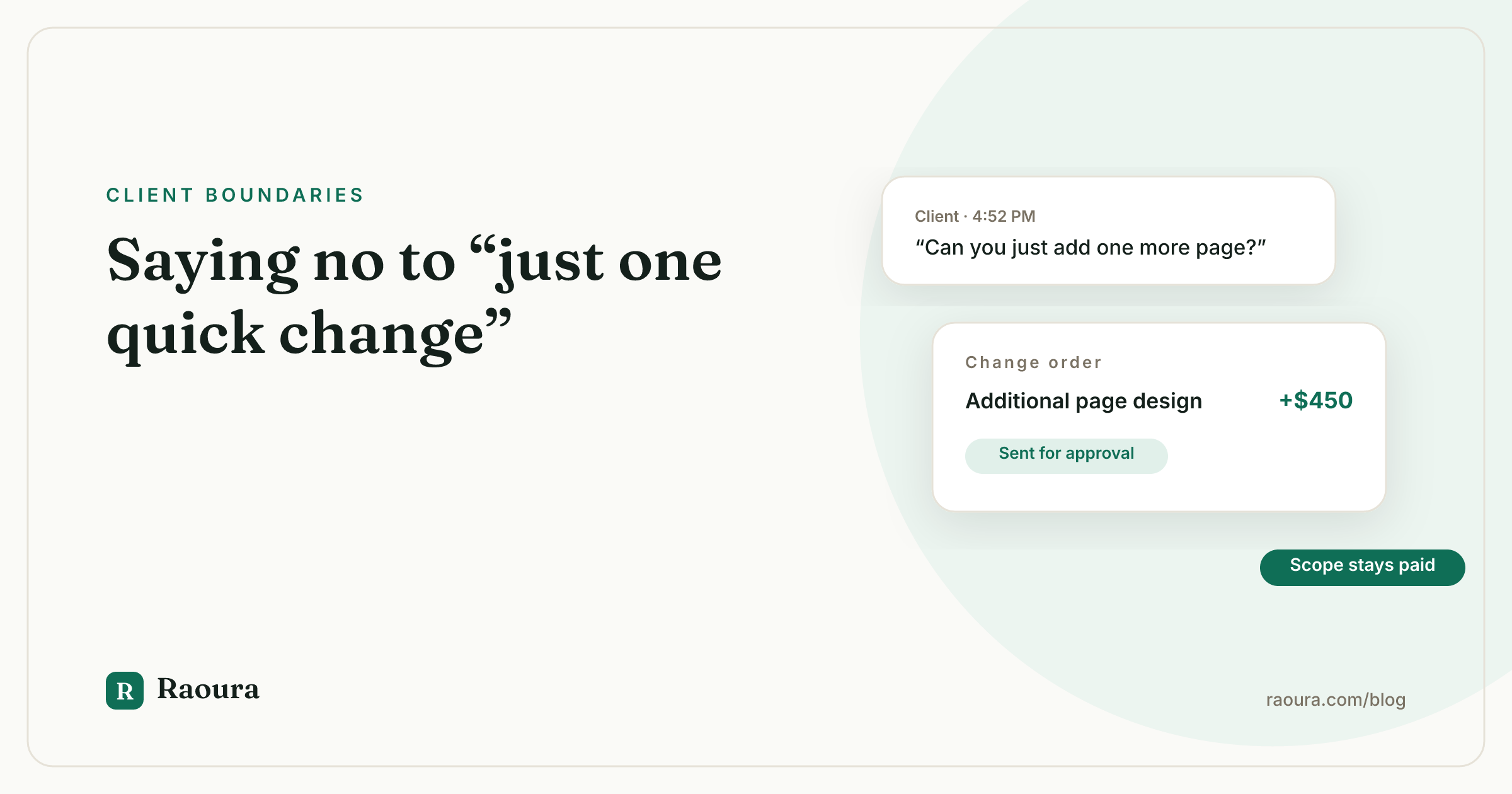
"Hey! This looks great. Can you just add one more page? Should be quick."
Every freelancer knows the temperature drop that message causes. It's Friday afternoon, the project was supposed to wrap Wednesday, and here comes request number nine, each one small, each one reasonable-sounding, none of them in the agreement you both signed.
This is scope creep, and it is not an edge case. Roughly 72% of freelance projects experience some form of scope creep, and the typical freelancer loses somewhere around $2,000 to $5,000 a year to unbilled extra work. That's a vacation, a new laptop, or a month of rent, handed out one "quick change" at a time. If you've ever caught yourself working every Friday for free, this is where those Fridays went.
The fix is not becoming the freelancer who says no to everything. It's building a process where extra work is welcome, and billed.
Why scope creep happens (hint: it's usually not the client)#
Clients are rarely trying to rob you. Scope creep happens because three gaps exist, and requests flow through them like water.
Vague proposals#
"Design and build a website" is not a scope. Is that five pages or fifteen? One round of revisions or unlimited? Does "build" include writing the copy? Migrating the blog? If your proposal doesn't answer these, the client will, and their answer is always the bigger one. Not out of malice: they genuinely believe it was included, because nothing said otherwise.
No change process#
When there's no defined way to request extra work, every request arrives as a favor. And favors are awkward to bill. A change process converts "can you just" from an imposition into a transaction: here's the request, here's the price, here's the timeline impact, approve and we go.
Fear of conflict#
This is the big one. You know the request is out of scope. But the client is nice, the invoice for the current milestone isn't paid yet, and you'd rather lose an hour than have a money conversation. Do that twelve times and you've lost a week.
The scripts below exist so the money conversation is thirty seconds long and doesn't feel like conflict at all.
Prevention: make scope a wall, not a fog#
Put a real scope section in every proposal#
List deliverables specifically and countably. Not "social media graphics" but "10 Instagram post templates in 2 sizes." Not "revisions included" but "2 rounds of revisions per deliverable; a round is one consolidated list of changes."
Add a "What's not included" list#
This is the single highest-leverage paragraph you can add to a proposal. Example for a web project:
Not included in this scope: copywriting, logo or brand design, blog content migration, ongoing maintenance, additional pages beyond the 6 listed above, and third-party integration setup other than the contact form. Any of these can be added via a change order at $95/hour or a fixed quote.
Now "can you just add a page" has a pre-written answer, and you wrote it back when everyone was calm and happy.
Define what a revision is#
"Two rounds of revisions" means nothing until you define a round. One consolidated list of changes, submitted within X days of delivery, is a round. Seventeen Slack messages over three weeks is seventeen rounds pretending to be one.
Price the change process into the contract#
One line: "Requests outside the scope above are quoted separately as change orders before work begins." That sentence is the legal and social foundation for every script below.
The scripts: what to actually say#
The formula behind all of these: acknowledge, classify, offer a path. Yes is always available, it just has a price. Copy, adapt, send.
1. The classic "can you just..."#
Happy to add that! It's outside our current scope, so I'll write it up as a quick change order. It'd be $350 and adds 2 days to the timeline. Want me to send that over so we can keep moving?
Enthusiastic, specific, zero guilt. Most clients say yes to the change order or drop the request. Both outcomes are wins.
2. Mid-project additions (the growing to-do list)#
Good news: all of this is doable. Since these items weren't in the original scope, we have two options.
1. I add them as a change order ($600, timeline moves by 4 days), or
2. we park them for a phase 2 right after launch, so the current timeline and budget hold.
Either works for me. Which do you prefer?
Giving two paths keeps you out of the "no" position entirely. You're not the obstacle, you're the person offering choices.
3. Post-delivery tweaks ("one last thing" after the project closed)#
Glad it's live and you're happy with it! The project scope wrapped with final delivery on the 12th, so I'd handle this as a small standalone job: $150 flat, done by Thursday. Want me to go ahead?
The key move is naming the project as closed. Otherwise "done" projects trail warranty work forever.
4. The "while you're in there" client (steady expansion, every conversation)#
This one needs a pattern reset, not a per-request reply:
Before we go further, I want to flag something so the budget doesn't surprise you later. We've added about 6 hours of work beyond the original scope over the last two weeks. I covered the early bits, but from here I need to quote anything new before doing it. I'll send a change order for the two open requests today. Sound fair?
Notice: you flag the pattern, you set the rule going forward, and you don't retroactively bill the hours you already ate. Eat them once, never again.
5. "This will only take you five minutes"#
It's quick to do, but small changes still carry setup, deployment, and testing, which is why I bill a minimum unit. I can fold this into a monthly support arrangement if these keep coming up, which is usually cheaper for you. Want me to send options?
This turns the annoying dribble of tiny asks into a retainer conversation, which is the correct destination for that client.
6. When the scope was genuinely vague and it's partly on you#
It happens. Own it and split the difference:
You're right that the proposal didn't spell this out, and that's on me. Here's what I suggest: I'll include the first item at no charge, and the remaining two go on a change order at $400. Going forward I'll make the scope lists more explicit so we're never guessing. Fair?
You lose a little now, protect the relationship, and fix the process. Then actually fix the process.
The change-order template#
A change order can be five lines. The point is that it's written, priced, and approved before you work. Copy this:
```text CHANGE ORDER #2 - [Project name] Date: [date] Requested by: [client name]
Description of additional work: Add a "Team" page (design + build), matching existing site style, including up to 8 staff bios supplied by client.
Price: $350 (fixed) Timeline impact: +2 business days (new delivery date: July 18) Payment: added to the next invoice / due on completion Everything else in the original agreement stays unchanged.
Approved by client: ____________ Date: ________ ```
An email reply that says "approved" is enough for the signature line if you're keeping it light. What matters: description, price, timeline impact, in writing, before you start.
When the requests keep coming: reprice the relationship#
Sometimes scope creep isn't a project problem, it's a pricing problem. If a client constantly needs "one more thing", they don't need a stricter freelancer. They need a bigger engagement:
- Retainer: X hours per month at a set rate, requests welcome, no per-item negotiation. Their creep becomes your recurring revenue.
- Phase 2: batch every parked request into a new proposal. "Here's everything we've collected, here's the price, want to book it for August?"
- Rate correction at renewal: if a client's real usage of you is consistently 130% of what they pay for, the next contract should say so.
The clients who create the most scope creep are often your best clients. They have needs and budget. The problem was never the requests, it was that the requests were free.
Where Raoura fits#
Every fix in this article is a document: a specific scope, a not-included list, a change order, a phase 2 proposal. Raoura is client and project management for solo freelancers, and it's built around exactly that paper trail.
You write the scope into a proposal, the client accepts it, and the accepted proposal becomes the e-signed contract, so "what did we agree to?" always has one answer that both of you can see.
When "just one quick change" shows up, extra work becomes a new line item on the next invoice or a fresh mini-proposal in a couple of minutes, and your client approves it in their portal (they log in with a magic link, no password). Projects, milestones, contracts, and invoices all live in that one place, and it's $17/month flat with a 14-day free trial, no credit card needed.

Extra work as a line item: the add-on gets its own price, the total updates in front of the client, and they approve it the same way they approved the original scope.
The mindset shift#
Scope creep survives on ambiguity and awkwardness. Kill the ambiguity with specific proposals and a not-included list. Kill the awkwardness with scripts you've already written and a change-order template that takes two minutes to send. You'll say yes more often than before, because now yes pays.
Frequently asked questions
What exactly counts as scope creep?
Any work beyond what the signed proposal or contract describes, added without a corresponding change in price or timeline. Extra pages, extra revision rounds, new features, "small" post-delivery tweaks: if it wasn't in the agreement and isn't billed, it's creep.
How do I say no to scope creep without sounding difficult?
Don't say no. Say "yes, and here's the change order." Acknowledge the request, note it's outside the current scope, and offer a price and timeline. Clients respect a clear process far more than a reluctant freebie followed by quiet resentment.
Should I ever do out-of-scope work for free?
Occasionally, deliberately, and say so when you do: "I'll include this one at no charge." A named freebie builds goodwill. A silent freebie builds expectation. If the scope gap was your fault, comping the first item while quoting the rest is a fair split.
What should a change order include?
Description of the added work, fixed price or hourly estimate, timeline impact, how it will be billed, and a line stating the original agreement otherwise stands. Get written approval (an email reply saying "approved" works) before starting.
How do I handle a client who keeps asking for changes after the project is done?
Formally close projects at final delivery and say so in your handoff note. After that, tweaks are small standalone jobs or a monthly support retainer. If post-launch requests are frequent, the retainer conversation is the real answer.
Run your client work in one place
Send a proposal, get it signed, invoice, and get paid, with a branded portal your clients will actually use. One flat plan at $17/month, and we never take a cut of your payments.
Try Raoura free for 14 daysNo credit card required. Set up in minutes.
Keep reading
Is Upwork Worth It in 2026? A Break-Even Test for Your Situation
Upwork is worth it when its fee costs less than finding the client yourself, and that is true far more often for a first project than for a repeat client. Here is the break-even math with 2026 numbers: the 0 to 15% fee, Connects, the shrinking client base, and when to wait out the 24-month rule instead of paying to leave.
The Virtual Assistant Contract: 24 Clauses, Scored Against Every Template Ranking for This Search
We scored the four pages that publish actual virtual assistant contract text against 24 clauses a VA agreement needs. Twenty-four of 96 possible slots were filled. The best single template managed 7 out of 24. Twelve clauses appear in none of them, including every clause about the thing that makes VA work different from other freelance work: you are holding your client's passwords and running their inbox. One popular template also tells you a contract fixes your independent contractor status, then mandates client-set 9 to 5 weekday hours in the same document. Here is the clause-by-clause version, with the classification test the DOL is actually applying in 2026, the data protection terms nobody drafts, and the retainer mechanics that decide whether unused hours roll over.
Stripe vs PayPal for Freelancers: Every Fee Verified (2026)
Every page ranking for this comparison either prints in-person retail rates, contradicts itself, or skips the numbers freelancers actually pay. We read the current Stripe and PayPal pricing pages line by line, ran a $3,000 invoice through every rail, and found a $1,764 per year gap between the cheapest setup and the default one.