How to Get Clients to Pay Invoices on Time: Scripts, Deposits, and a System That Works
July 6, 2026
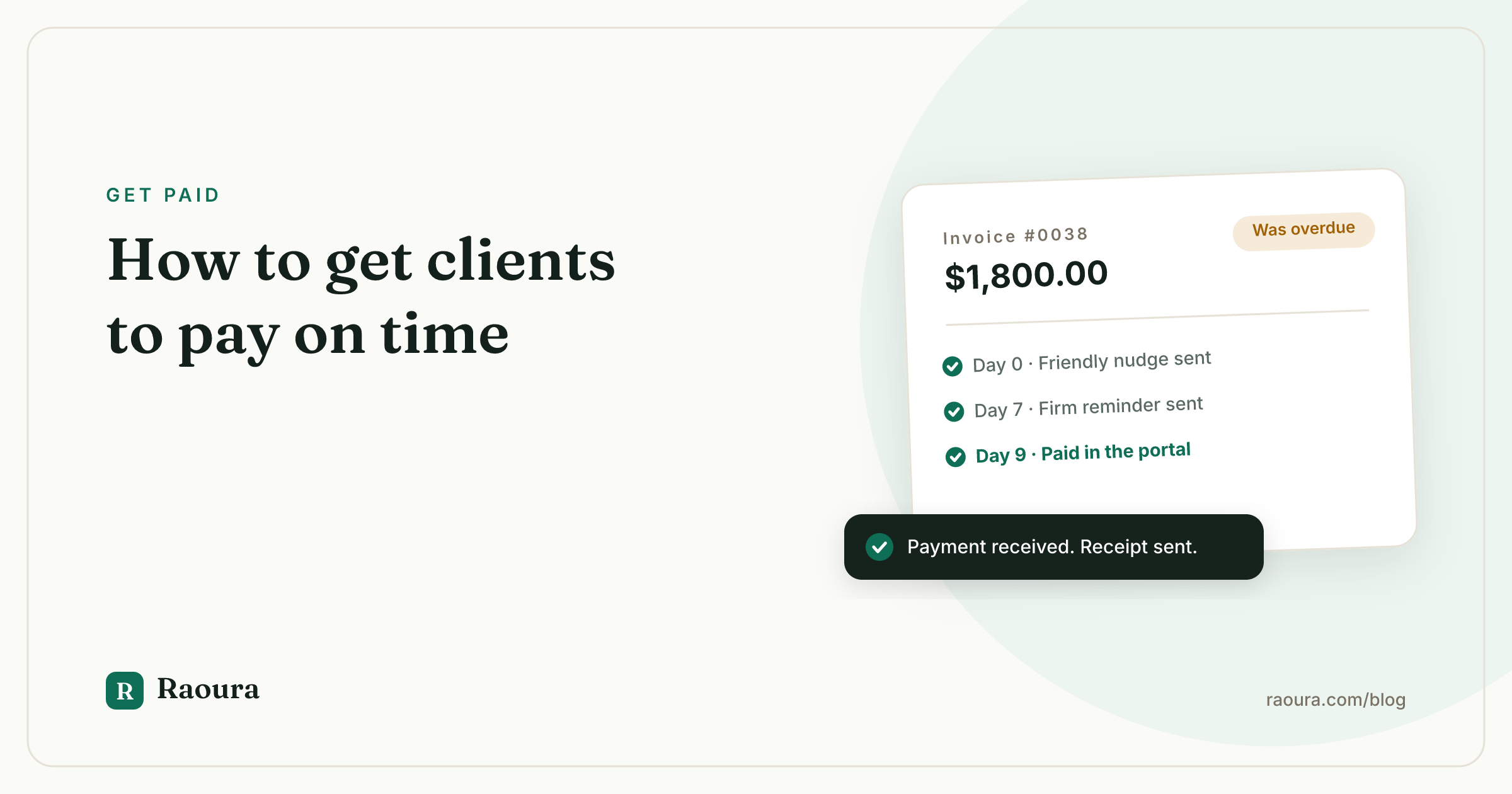
You did the work. You sent the invoice. Now you're refreshing your bank app like it owes you an apology.
If that's familiar, you're in the majority. Roughly 85% of freelancers get paid late at least sometimes, and roughly 65% report waiting 30 days or more past the due date for at least some invoices. On top of the waiting, freelancers spend around 3.2 hours a month just chasing payments. That's almost a full working week per year spent writing "just following up on this" emails instead of doing billable work.
Here's the uncomfortable truth: late payment is rarely about the client being evil. It's usually about your process being optional. Clients pay the invoices that are easy to pay, contractually risky to ignore, and impossible to forget. This article gives you that system, plus the exact emails to send when someone drifts past the due date anyway.
Prevention: the system that makes late payment rare#
Chasing invoices is the failure mode. The real work happens before the project starts.
1. Take a deposit. Always.#
A deposit (25% to 50% up front, or 50/50 for smaller projects) does three things:
- It filters out clients who were never going to pay well.
- It funds your first weeks so you're not working on hope.
- It sets the norm that money moves when you say it moves.
If a client balks at any deposit at all, that's not a red flag, it's a flare. Established businesses pay deposits to vendors constantly. You are a vendor.
2. Put payment terms in writing before work starts#
Your proposal and contract should state, in plain language:
- Due date: "Net 7" or "Net 14." Net 30 is a corporate default, not a law of nature. Solo freelancers can and should use shorter terms.
- Accepted payment methods: card, bank transfer, whatever you actually take. The fewer steps between "client opens invoice" and "money sent", the faster you get paid.
- Late fee: see below.
- Work stoppage clause: "Work pauses on any invoice more than 14 days overdue." This is your single most powerful lever mid-project.
3. Add a late fee clause to every contract#
A sample clause you can adapt:
Invoices are due within 14 days of the invoice date. Overdue balances accrue a late fee of 1.5% per month (or the maximum permitted by law, whichever is lower), beginning 14 days after the due date. Work may be paused while any invoice is more than 14 days overdue.
Two notes:
- Check your local rules. Some jurisdictions cap interest on overdue commercial invoices, so "1.5% per month" is a common, generally safe starting point, but verify for where you operate.
- The point of the fee is not revenue. It's leverage. You will waive it constantly for good clients who slip once. Its job is to make ignoring you cost something.
4. Invoice fast, and invoice clearly#
Invoice the same day a milestone completes, not "sometime this week." Every day you delay sending is a day added to the wait. And make the invoice stupidly easy to pay: a link the client clicks, a card or bank option, done. If your payment process involves a PDF, a wire form, and a prayer, you built the delay yourself.
The escalation sequence: copy-paste emails that get invoices paid#
Send these on a schedule, not when your frustration peaks. Calm and predictable beats angry and sporadic every time. Adjust names and numbers, keep the tone.
Day 0 (due date): the friendly nudge#
Subject: Invoice #142 due today
Hi Dana,
Quick note that invoice #142 ($2,400 for the website redesign, milestone 2) is due today. Here's the payment link: [link]
If it's already on its way, ignore me and thanks! Any questions on the invoice, just reply here.
Best,
Sam
No apology, no "sorry to bother you." You are not bothering anyone. You are a business sending a receivables notice.
Day 7: the check-in#
Subject: Invoice #142, one week overdue
Hi Dana,
Following up on invoice #142 ($2,400), which was due on June 12 and is now a week overdue. Payment link is here: [link]
If something's holding this up on your end (approval process, billing contact, questions about the invoice), let me know and I'll help sort it out.
Could you confirm when I can expect payment?
Thanks,
Sam
The magic phrase is "confirm when I can expect payment." It converts silence into a commitment you can hold them to.
Day 14: firm, with consequences#
Subject: Invoice #142, two weeks overdue, action needed
Hi Dana,
Invoice #142 ($2,400) is now 14 days past due, and I haven't heard back on my last note.
Two things per our agreement:
1. As of today, work on the project is paused until the balance is settled.
2. If the invoice remains unpaid on July 12, a late fee of 1.5% per month begins to accrue, as outlined in our contract.
I'd much rather skip both. Here's the payment link: [link]. If there's a problem with the invoice itself, tell me today and we'll fix it.
Sam
Notice: still polite, zero drama, and every consequence is something they already agreed to. You're not threatening. You're quoting.
Day 30: final notice#
Subject: Final notice: invoice #142, 30 days overdue
Dana,
Invoice #142 is now 30 days past due. The balance including the contractual late fee is $2,436.
If payment is not received by July 26, I'll need to escalate: a formal demand letter, and if necessary, small claims court or a collections agency. I would genuinely prefer not to do any of that, and one payment makes it all go away: [link]
Please pay or reply by July 26.
Sam
After day 30: the demand letter#
If the final notice gets silence, send a formal demand letter (email plus a printed copy by tracked mail if you can). State the amount, the work performed, the contract date, the payment history of your attempts, and a hard deadline (10 to 14 days) before you file in small claims court. Templates are easy to find; the tracked-mail paper trail is what matters.
A surprising number of "ghost" clients pay within days of receiving a physical demand letter, because now it looks like what it is: a legal problem.
When to charge late fees, and how much#
- When: After a stated grace period (7 to 14 days past due is common), and only if the fee is in your signed contract. A fee that appears out of nowhere on an invoice is unenforceable and just annoys people.
- How much: 1% to 2% per month is typical for freelancers. Some use a flat fee (for example, $50 after 14 days) which is simpler on small invoices.
- When to waive: First offense from a good client, or any time the client communicates proactively and gives you a real date. Waiving a fee you were entitled to charge builds goodwill. Never being entitled to charge one builds nothing.
What to do when you're truly ghosted#
Sometimes a client won't pay the invoice and won't answer anything. In order:
- Try a different channel once. A short phone call or a message to a second contact at the company often shakes loose an invoice lost in someone's inbox.
- Send the demand letter (above). This resolves a large share of ghostings on its own.
- Small claims court. Cheap to file (usually under $100), no lawyer needed, and limits are high enough for most freelance invoices ($5,000 to $12,500 depending on your state). Often just filing, and the client receiving the summons, produces payment.
- Know your local protections. If you or your client are in New York City, the Freelance Isn't Free Act requires written contracts for work over $800 and payment within 30 days, with double damages for violations. New York State expanded similar protections statewide, and other states have followed with their own versions. If a law like this covers you, say so in your demand letter. It changes the client's math instantly.
- Collections, as a last resort. Agencies take 25% to 50%, so this only makes sense on larger balances where you've exhausted everything else.
And then: fire the client. No project is worth running this playbook twice for the same person.
Let software do the chasing#
Everything above works, but the day 7 and day 14 emails are exactly the kind of task humans skip when they're busy. You feel awkward, you delay a day, the day becomes a week, and now you're part of the 65% waiting past 30 days.
This is the strongest case for automating your invoicing:
- One-click payment. Clients pay the moment the invoice is in front of them instead of forwarding a PDF to "someone in billing."
- Automatic reminders. The nudge goes out on schedule whether you're busy, on vacation, or dreading the conversation. Clients also don't take an automated reminder personally, which keeps the relationship clean.
- Status you can see. Sent, viewed, paid, overdue. No more wondering whether they even opened it.
How Raoura handles this#
Raoura is client and project management built for solo freelancers, and payments are the core of it. Your client gets a portal (they log in with a magic link, no password to forget) where every invoice lives next to the project it belongs to. They pay right there by card or bank.
You can require deposits and take partial payments, invoice in multiple currencies, and reminders go out automatically on your schedule. Raoura adds no markup on transaction fees, and the whole thing is $17/month flat.
There's a 14-day free trial, no credit card required, which feels appropriate given the topic.

Everything the client needs to pay you lives behind one magic link, so "I couldn't find the invoice" stops being a reason.
The short version#
Deposits up front. Short payment terms and a late fee clause in every contract. Invoice the day work ships. Escalate on a calendar, not on a mood. And automate the reminders so the system runs even when you don't want to send that email. Do this for six months and "chasing invoices" stops being part of your job description.
Frequently asked questions
What payment terms should a freelancer use?
Net 7 or Net 14 for most solo work. Net 30 exists because large companies have slow accounts payable departments, not because you owe anyone a free 30-day loan. Larger corporate clients may insist on Net 30; if so, price the wait into your rate.
Is it legal to charge a late fee on an invoice?
Generally yes, if the fee was agreed to in your contract before the work started and it stays within any interest caps in your jurisdiction. 1% to 2% per month is a common range. You cannot invent a fee after the fact and expect it to hold up.
How long should I wait before escalating an unpaid invoice?
Follow a fixed schedule: nudge on the due date, follow up at day 7, firm notice with work pause at day 14, final notice at day 30, then a formal demand letter with a 10 to 14 day deadline. Waiting longer rarely helps; the older an invoice gets, the less likely it is to be paid at all.
Can I take a client to small claims court over an unpaid invoice?
Yes, and for most freelance-sized invoices it's the most practical option. Filing costs are low, you don't need a lawyer, and limits range from roughly $5,000 to $12,500 depending on the state. Bring your contract, the invoice, your delivery records, and your email trail.
Should I keep working while an invoice is overdue?
No. Put a work stoppage clause in your contract (work pauses when any invoice is 14+ days overdue) and enforce it. Continuing to deliver while unpaid teaches the client that paying you is optional.
Run your client work in one place
Send a proposal, get it signed, invoice, and get paid, with a branded portal your clients will actually use. One flat plan at $17/month, and we never take a cut of your payments.
Try Raoura free for 14 daysNo credit card required. Set up in minutes.
Keep reading
Is Upwork Worth It in 2026? A Break-Even Test for Your Situation
Upwork is worth it when its fee costs less than finding the client yourself, and that is true far more often for a first project than for a repeat client. Here is the break-even math with 2026 numbers: the 0 to 15% fee, Connects, the shrinking client base, and when to wait out the 24-month rule instead of paying to leave.
The Virtual Assistant Contract: 24 Clauses, Scored Against Every Template Ranking for This Search
We scored the four pages that publish actual virtual assistant contract text against 24 clauses a VA agreement needs. Twenty-four of 96 possible slots were filled. The best single template managed 7 out of 24. Twelve clauses appear in none of them, including every clause about the thing that makes VA work different from other freelance work: you are holding your client's passwords and running their inbox. One popular template also tells you a contract fixes your independent contractor status, then mandates client-set 9 to 5 weekday hours in the same document. Here is the clause-by-clause version, with the classification test the DOL is actually applying in 2026, the data protection terms nobody drafts, and the retainer mechanics that decide whether unused hours roll over.
Stripe vs PayPal for Freelancers: Every Fee Verified (2026)
Every page ranking for this comparison either prints in-person retail rates, contradicts itself, or skips the numbers freelancers actually pay. We read the current Stripe and PayPal pricing pages line by line, ran a $3,000 invoice through every rail, and found a $1,764 per year gap between the cheapest setup and the default one.