The Unpaid Invoice Escalation Ladder: What to Do When a Client Won't Pay
July 6, 2026
The advice you find when a client stops paying is mostly written for someone else. It is either accounts-receivable content for companies with a finance department, or prevention advice ("get a deposit next time") that does nothing for the invoice sitting unpaid right now.
And here is the part that surprised us: we read every page ranking on the first page for this query in July 2026, and not one of them mentions the New York, Illinois, or California freelance payment laws that took effect in 2024 and 2025. The single most leverage-changing development for unpaid freelancers is missing from the entire search result.
You are in common company. Bonsai's analysis of invoices from 100,000+ freelancers found 29% are paid at least a day late, and a Freelancers Union survey found 71% of freelancers struggle to collect payment at least once in their career, losing an average of nearly $6,000 a year to nonpayment (that survey is from 2015, and nothing since suggests it improved).
Intuit QuickBooks' January 2025 survey of 2,487 small businesses found 56% are owed money on unpaid invoices, averaging $17,500 each.
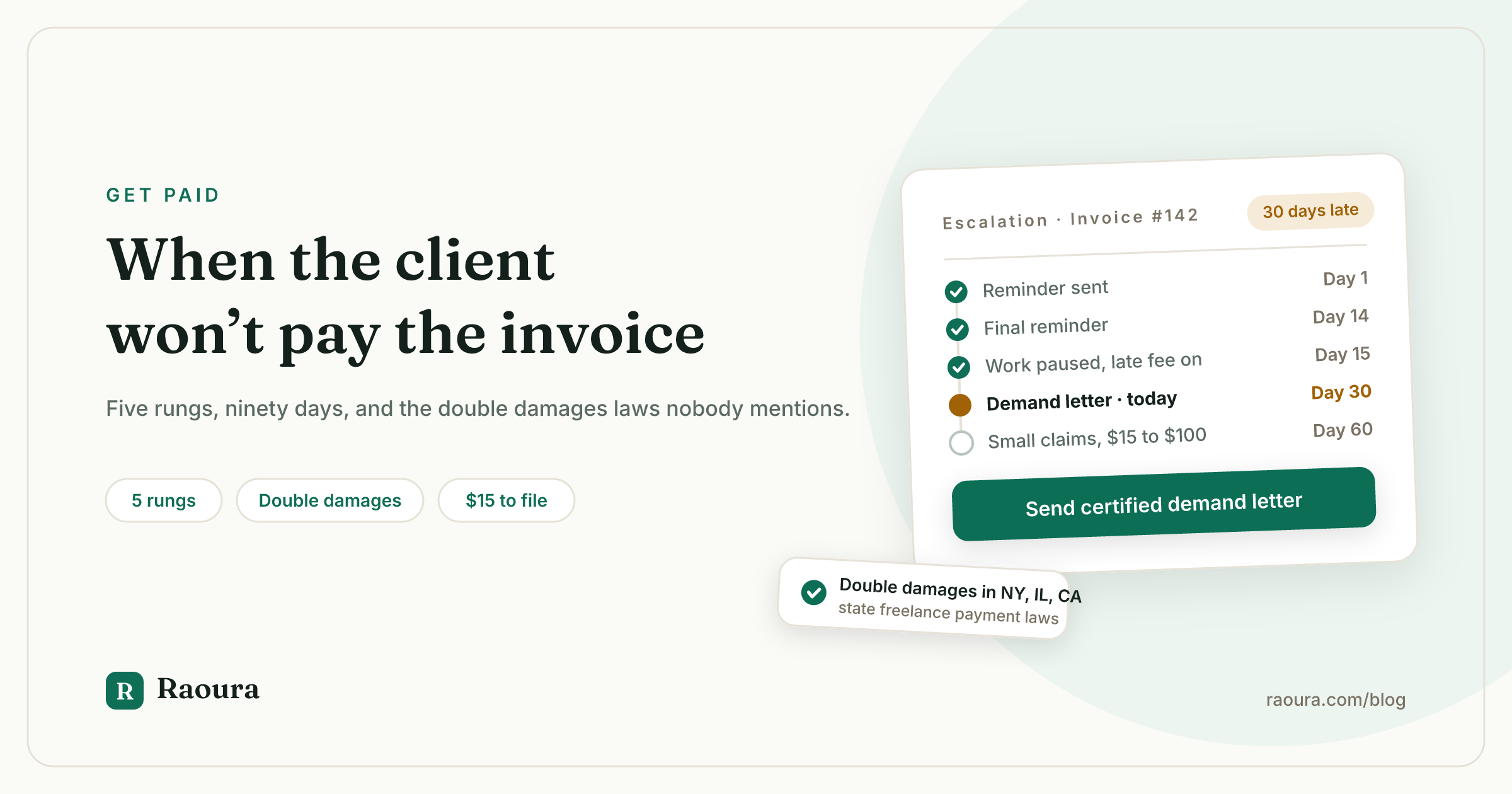
This guide is the escalation ladder: five rungs, each with its timing, its cost, what it actually recovers, and what it does to the client relationship. Climb one rung at a time. Most invoices get paid on the bottom two.
The ladder at a glance#
Escalating an unpaid invoice runs through five rungs over roughly 90 days: reminders (free), a stop-work notice (free), a formal demand letter (free to about $500 with a lawyer), a statutory claim or small claims filing ($15 to $100 in court fees), and finally collections or a civil suit (20% to 50% of the debt). Each rung is cheap compared to the one above it, which is exactly why you climb in order.
| Rung | When | Out-of-pocket cost | What it typically achieves | Relationship after |
|---|---|---|---|---|
| 1. Reminders | Day 1 to 14 overdue | $0 | Resolves most late invoices | Intact |
| 2. Stop work + late fee | Day 15 to 30 | $0 | Creates a real deadline | Strained but professional |
| 3. Final demand letter | Day 30 to 60 | $0 alone, roughly $200 to $500 via a lawyer | Signals court is next, prompts settlement | Effectively over |
| 4. Statutory claim or small claims | Day 60 to 90 | $15 to $100 filing fee | A judgment, doubled in some states | Over |
| 5. Collections or civil suit | Day 90+ | 20% to 50% of what is recovered | Partial recovery on debts too big to drop | Over |
The timings are conventions, not laws. Compress them for a client who has gone completely silent (silence after delivery is its own problem, and we treat it separately in the topic map), and stretch them for a good client in a genuine cash crunch who is communicating.
Rung 1: Days 1 to 14, reminders#
More than 75% of late invoices are paid within 14 days of the due date, so your first two weeks are polite persistence, not threats. That figure comes from Bonsai's dataset of three years of freelance invoices, which also found about 90% of late invoices are paid within a month. At this rung the most likely explanation is boring: the email was missed, the approver is on vacation, the card on file expired.
Send a reminder the day after the due date, again around day 7, and again around day 14. Keep each one short, factual, and attached to the invoice: amount, invoice number, original due date, payment link.
Escalate tone across the three from friendly nudge to direct request. The exact scripts, and the system for sending them without feeling like a debt collector, are in our guide to getting clients to pay invoices on time.
Two details raise the odds this rung works.
- Make paying trivially easy. An invoice with an online payment link beats "please mail a check" every time.
- Mention your late fee's start date, if you have one. Put it in the day-14 reminder, not as a threat but as a calendar fact. In FreshBooks' analysis of over one million invoices, invoices whose terms mention interest were paid 92.15% of the time versus 78.62% for invoices overall. The word alone does measurable work.
Rung 2: Day 15 to 30, stop the work and start the meter#
By day 15 overdue, stop all in-progress work for that client and say so in one professional sentence. Continuing to deliver while an invoice ages tells the client that paying you is optional. Stopping is your single strongest piece of leverage while the relationship still exists, and it costs you nothing you were being paid for anyway.
The note should be neutral and reversible: "I have paused work on [project] until invoice #142 is settled. Everything resumes as soon as payment lands." No apology, no anger. If your contract has a pause clause this is simply the contract operating. If it does not, add one to your next contract (our freelance contract guide covers the clause).
This is also the rung where your late fee, if you agreed one in writing before the work started, begins to apply. Reissue the invoice with the fee as its own line item rather than sending a threat. The legality, the standard 1.5% per month rate, and the exact reissue workflow are in our late fees guide. One warning that ranking pages skip: you cannot invent a late fee now if it was never agreed. The fee is a clause that pays out, not a punishment you improvise.
Somewhere in this window, call. An actual phone call converts an ignorable email thread into a human commitment, and it is the fastest way to learn which situation you are in: a cash-flow problem (negotiate a payment plan with dates in writing), a dispute about the work (a different problem, solve it on the merits), or avoidance (climb the ladder).
Rung 3: Day 30 to 60, the final demand letter#
At 30 days overdue, send one final demand letter giving the client 10 business days to pay before you pursue legal remedies. This is the last communication before the tone changes from collection to enforcement, so make it count: send it by email and by certified mail with return receipt, so you have proof of delivery for any court that comes next.
A demand letter that works contains five things and nothing else:
- The facts (contract date, work delivered, invoice number and amount)
- The total now owed, including any accrued late fee
- The deadline
- The specific consequence ("I will file a claim in [county] small claims court" or "I will file a complaint under the Freelance Isn't Free Act")
- A payment link that makes surrender easy
One page. No emotion, no history of the relationship, no bolded threats.
Should a lawyer send it instead? Nolo's practical view is that an attorney letter carries more weight, and a substantial share of clients simply do not contest claims for unpaid fees. A single attorney demand letter typically runs a few hundred dollars, which pencils out on a $5,000 invoice and does not on a $500 one.
There is no honest published statistic on what percentage of demand letters get paid (we looked, and any page quoting one is guessing), but the adjacent fact is telling: the overwhelming majority of civil disputes settle before trial. Most clients fold when court stops being hypothetical.
If your client is in New York, Illinois, or California, your demand letter gets a paragraph that does more work than everything else in it combined. Read the next section before you send.
The statutory shortcut: three states now double your money#
If your contract is worth $800+ in New York, $500+ in Illinois, or $250+ in California, state freelance payment laws entitle you to up to double the unpaid amount plus attorney fees. These laws are the biggest development in freelance collections in a decade, and, as noted above, no page ranking for this query in July 2026 mentions any of them.
| State | Law | Covers contracts of | Payment deadline | If you win |
|---|---|---|---|---|
| New York | [Freelance Isn't Free Act](https://dol.ny.gov/freelance-isnt-free-act), statewide since Aug 28, 2024 | $800+ (alone or aggregated over 120 days) | Contract date, or 30 days after work is completed | [Double damages plus attorney fees](https://www.nysenate.gov/legislation/bills/2023/S5026); free complaint route via the state Attorney General |
| Illinois | [Freelance Worker Protection Act](https://labor.illinois.gov/laws-rules/legal/freelance-worker-protection-act.html), contracts after Jul 1, 2024 | $500+ (within a 120-day period) | Contract date, or 30 days after completion | [Double the underpayment plus attorney fees](https://www.ilga.gov/Legislation/ILCS/Articles?ActID=4441&ChapterID=68); complaint route via the Illinois Department of Labor, 2-year window |
| California | [SB 988, Freelance Worker Protection Act](https://leginfo.legislature.ca.gov/faces/billNavClient.xhtml?bill_id=202320240SB988), effective Jan 1, 2025 | $250+ (alone or aggregated over 120 days) | Contract date, or 30 days after completion | Up to twice the unpaid amount plus attorney fees, via civil action (no agency complaint route) |
Three accuracy notes the summaries usually botch:
- New York and Illinois give you a free administrative complaint route, so you may never need to hire anyone or file a suit yourself.
- California's law covers "professional services" as defined in Labor Code 2778 (writing, design, marketing, photography, and similar), so not every trade qualifies, and its damages are "up to" double rather than automatic.
- New York City has its own older Freelance Isn't Free law with its own complaint office, which the state law did not replace. The city version is proof the mechanism works: the sponsor memo for the state bill reports NYC recovered over $1.3 million in restitution and penalties from 1,191 freelancer cases in 2018 to 2019.
The practical move: one sentence in your demand letter. "This invoice is covered by [law]; if I am forced to pursue it, the statute provides double damages and attorney fees."
Double damages transforms the client's math. Stalling you is now an investment with a negative 100% return. A full state-by-state reference for these laws is on our roadmap and will be linked here.
Rung 4: Day 60 to 90, small claims court#
Small claims court handles disputes up to between $2,500 and $25,000 depending on the state, costs $15 to $100 to file, and you do not need a lawyer. It is designed for exactly this case: a documented debt, a paper trail, and an amount too small for a civil suit to make sense.
| State | Small claims limit | Filing fee | Source |
|---|---|---|---|
| California | $12,500 for individuals ($6,250 if you sue as a corporation or LLC) | $30 to $100 | [California Courts self-help](https://selfhelp.courts.ca.gov/small-claims-california) |
| New York (NYC) | $10,000 ($5,000 or $3,000 in many courts outside NYC) | $15 up to $1,000 claimed, $20 above that | [NY Courts](https://www.nycourts.gov/new-york-city-small-claims-court/starting-case-nyc-small-claims-court) |
| Texas | $20,000 | Varies by county | [Nolo 50-state chart](https://www.nolo.com/legal-encyclopedia/small-claims-suits-how-much-30031.html) |
| Illinois | $10,000 | Varies by county | [Nolo 50-state chart](https://www.nolo.com/legal-encyclopedia/small-claims-suits-how-much-30031.html) |
| Florida | $8,000 | Varies by county | [Nolo 50-state chart](https://www.nolo.com/legal-encyclopedia/small-claims-suits-how-much-30031.html) |
| Washington | $10,000 for individuals | Varies by county | [Nolo 50-state chart](https://www.nolo.com/legal-encyclopedia/small-claims-suits-how-much-30031.html) |
(A caution from our own checking: several widely cited state tables, including Nolo's, still list California at $10,000. The California courts' own site says $12,500 for individuals, so verify your state's figure on the court website before filing.)
Useful mechanics most guides skip:
- In California, lawyers are not allowed at the hearing and a losing plaintiff cannot appeal, so the filing is genuinely the whole fight.
- In New York City, corporations cannot file in small claims (they use the commercial claims part instead), which matters if you invoice through an LLC or S corp.
- Your evidence is the boring stack you already have: contract, emails approving the work, delivered files, invoices, reminders, the certified-mail demand letter.
- You have far longer than you think to file. The statute of limitations on a written contract runs 3 to 10 years depending on the state (California 4, New York 6, Texas 4, Illinois 10).
One honest caveat before you file: winning gets you a judgment, not a check. If the client still refuses, collecting means wage garnishment, bank levies, or property liens, a process with its own steps that deserves its own guide (it is on our topic map).
Most business clients pay a judgment rather than let a levy hit their bank account, but "most" is not "all".
Rung 5: Day 90+, collections, a lawyer, or a deliberate write-off#
A collection agency typically keeps 20% to 50% of whatever it recovers, so it is the rung for debts too large to abandon and too awkward to chase yourself. Nolo puts typical commercial contingency fees at 10% to 50% of the amount collected, with higher rates on smaller and older debts, and the US Chamber of Commerce's 2026 guidance says most agencies take 20% to 50%.
Run the arithmetic before signing: on a $3,000 invoice, an agency that recovers everything at a 35% fee returns you $1,950, and agencies recover only a fraction of what they chase. Above your state's small claims limit, a civil suit with a lawyer enters the picture; below it, small claims almost always beats collections on math.
The other legitimate move at this rung is choosing to stop. Value your hours: if you bill $75 an hour, twenty more hours of chasing a $900 invoice costs you $1,500 of billable capacity to recover $900.
Two facts make walking away easier to do cleanly.
- The tax consolation most freelancers expect does not exist. If you are a cash-basis service business (almost every freelancer), the IRS does not let you deduct an unpaid invoice as bad debt, because you never reported the income in the first place.
- A deliberate write-off is a business decision you make once, in writing, with a final one-line note to the client. It is not the same as being ignored into silence, and it frees the attention the chase was consuming.
Whatever you do at this rung, do not vent publicly. A factual review is legal; an angry thread naming the client invites a defamation claim you would have to defend even if you won. The ladder works because every rung stays professional.
Making the next invoice un-ignorable#
Freelancers who work under a written contract earn 13.7% more, and every rung of this ladder is easier to climb when the paperwork existed before the problem. That income figure comes from a Cornell ILR Review study of freelance earnings, and the pattern in this article explains part of it: the contract is what turns "client won't pay" from a plea into a claim.
The prevention stack, each covered in depth in its own guide:
- A deposit, so you are never owed 100% of anything (how much deposit to charge).
- Payment terms short enough to surface problems early (payment terms that get you paid in days).
- A late fee clause agreed upfront (the late fees guide).
- A collection-costs clause making the client liable for reasonable collection expenses and attorney fees if it ever comes to that.
For work on physical property, a mechanic's lien is an additional state-law remedy; for digital work it is not available, which makes the contract clauses matter more.
The reason this ladder fails in practice is rarely knowledge. It is that every rung requires noticing, on the right day, that an invoice crossed a threshold, then doing an unpleasant task instead of billable work.
That is a systems problem. Raoura tracks every invoice due date, sends the reminder sequence automatically on your schedule, applies your agreed late fee after the grace period, and shows every overdue invoice in one view so day 30 never arrives unnoticed. You climb the ladder; it tells you when you are standing on the next rung. Disclosure: Raoura is our product, and the advice above works the same if you run it from a spreadsheet.

Overdue turns red the day it happens, so day 30 never sneaks up on you while you are heads down in billable work.
For context on how late is normal, how much freelancers are typically owed, and how often invoices are never paid at all, see the freelance late payment statistics hub.
Frequently asked questions
What if there was no written contract?
You can still collect. Emails, texts, invoices, and delivered work establish an agreement in every state, and small claims courts accept exactly that evidence daily. The statutory double-damages laws are harder to use without a written contract (New York and Illinois actually penalize the client for refusing to provide one you requested), and everything takes longer, but no contract does not mean no debt.
Can I charge interest on the unpaid amount while I wait?
Only if a late fee or interest rate was agreed in writing before the work started, with one exception: Texas law provides a 6% per year fallback starting 30 days after the due date. The full rules are in our late fees guide.
How long do I have before it is too late to sue?
Longer than you think. The statute of limitations on written contract debt runs 3 to 10 years depending on the state. Urgency is about evidence and the client's solvency, not the legal deadline.
The client is in another state. Where do I sue?
Generally where the client is located, which can mean filing in their state's small claims court, and that changes the math of rung 4. Jurisdiction for out-of-state clients is its own topic and is on our roadmap.
The client's company went out of business. Is the money gone?
Often, but not always: it depends on the entity type, whether a bankruptcy was filed, and whether anyone guaranteed the debt personally. That scenario has its own escalation path, which we cover separately on the topic map.
Should I accept a partial payment or a payment plan?
Usually yes, with two conditions: the plan is in writing with specific dates and amounts, and something (a late fee, the remaining balance accelerating, or a statutory claim) happens automatically if a date is missed. A partial payment also restarts goodwill, and in many states it can reset the statute of limitations clock in your favor.
Will using a collection agency ruin the relationship?
The relationship is already over by rung 5; the honest question is whether the debt is worth 20% to 50% of itself to recover. For clients you might work with again, stop at rung 3 and decide deliberately between small claims and walking away.
---
Every statute, court limit, fee range, and statistic in this article was verified against primary sources in July 2026: the New York State DOL and Senate bill text for the Freelance Isn't Free Act, the Illinois Department of Labor and 820 ILCS 193 for the FWPA, the California Legislature's text of SB 988, the California and New York court self-help pages for small claims limits and fees, Nolo's 50-state charts, and invoice datasets from Bonsai, FreshBooks, and Intuit QuickBooks.
Run your client work in one place
Send a proposal, get it signed, invoice, and get paid, with a branded portal your clients will actually use. One flat plan at $17/month, and we never take a cut of your payments.
Try Raoura free for 14 daysNo credit card required. Set up in minutes.
Keep reading
Is Upwork Worth It in 2026? A Break-Even Test for Your Situation
Upwork is worth it when its fee costs less than finding the client yourself, and that is true far more often for a first project than for a repeat client. Here is the break-even math with 2026 numbers: the 0 to 15% fee, Connects, the shrinking client base, and when to wait out the 24-month rule instead of paying to leave.
The Virtual Assistant Contract: 24 Clauses, Scored Against Every Template Ranking for This Search
We scored the four pages that publish actual virtual assistant contract text against 24 clauses a VA agreement needs. Twenty-four of 96 possible slots were filled. The best single template managed 7 out of 24. Twelve clauses appear in none of them, including every clause about the thing that makes VA work different from other freelance work: you are holding your client's passwords and running their inbox. One popular template also tells you a contract fixes your independent contractor status, then mandates client-set 9 to 5 weekday hours in the same document. Here is the clause-by-clause version, with the classification test the DOL is actually applying in 2026, the data protection terms nobody drafts, and the retainer mechanics that decide whether unused hours roll over.
Stripe vs PayPal for Freelancers: Every Fee Verified (2026)
Every page ranking for this comparison either prints in-person retail rates, contradicts itself, or skips the numbers freelancers actually pay. We read the current Stripe and PayPal pricing pages line by line, ran a $3,000 invoice through every rail, and found a $1,764 per year gap between the cheapest setup and the default one.