Freelance Payment Terms That Get You Paid in Days, Not Months
July 6, 2026
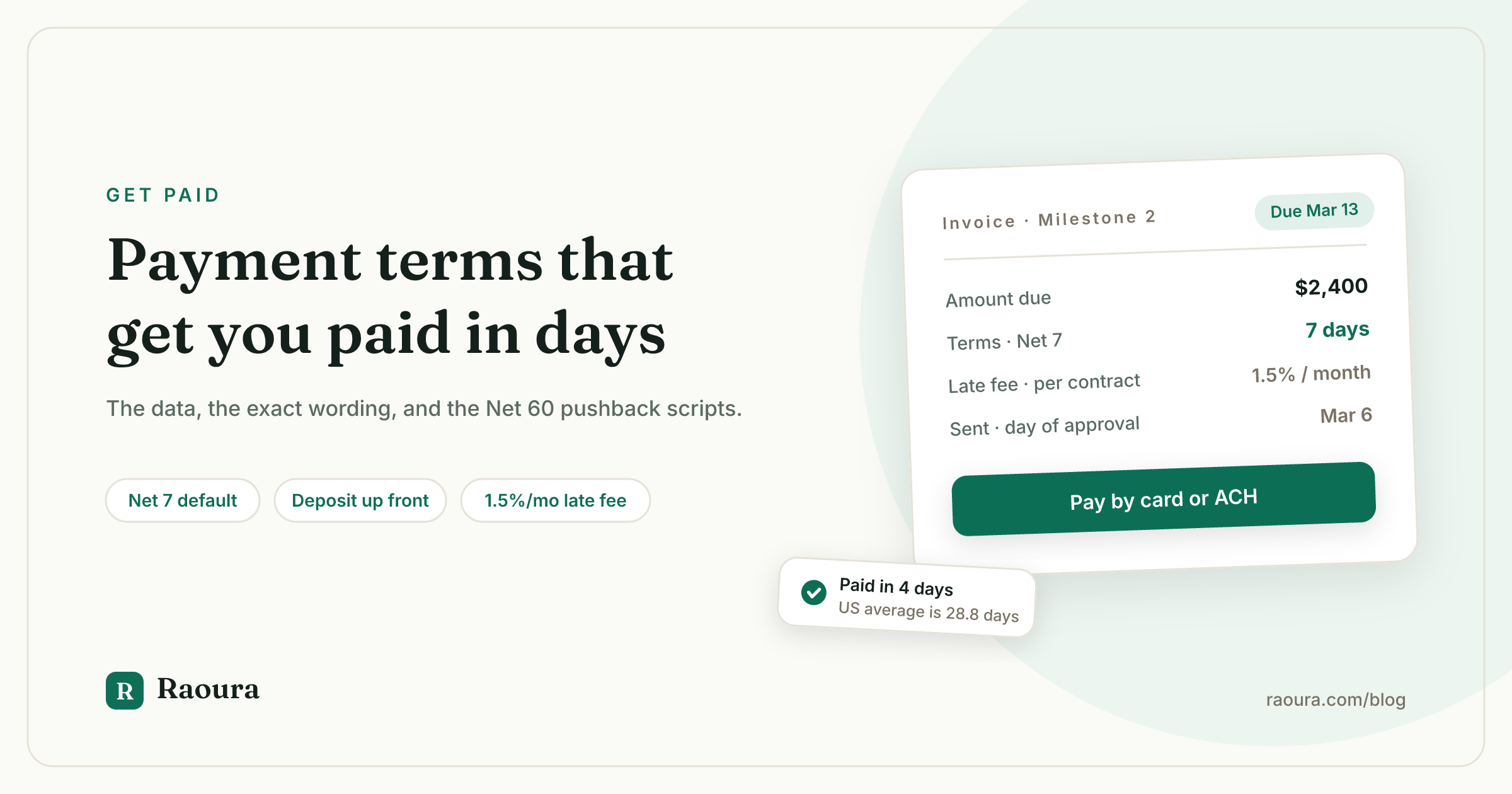
Somewhere along the way, freelancers inherited Net 30 the way you inherit a weird family recipe: nobody remembers choosing it, everyone assumes it is mandatory. It is not. Net 30 exists because large companies buy from other large companies on credit, and their accounts payable departments batch payments monthly. You are not a supplier of industrial fasteners. You are one person whose rent is due whether or not a client's payment run happens this cycle.
The numbers on what this default costs are not small. US small businesses currently wait an average of 28.8 days to get paid, and invoices are paid an average of 9 days late, per Xero's Small Business Insights for the March 2026 quarter.
Intuit QuickBooks' January 2025 survey of 2,487 small businesses found 56% are owed money on unpaid invoices, averaging $17,500 each. And Bonsai's analysis of invoices from 100,000+ freelancers found 29% are paid at least a day late.
Your payment terms are the single cheapest lever you have against all of that. They cost nothing to change, they are entirely within your control, and there is real data on which ones work. This guide covers what the terms mean, what the invoice data says, the exact wording to use, what to say when a client insists on Net 60, and the state laws that now back you up. Everything here was checked in July 2026.
What payment terms actually are (and the six you will run into)#
Payment terms are the when, how, and what-if-late of getting paid, and for freelancers they boil down to six standard options. They live in two places: your contract, which makes them enforceable, and your invoice, which makes them visible at the moment of payment. If the two disagree, you have a problem, so set them once in the contract and repeat them verbatim on every invoice.
| Term | What it means | When it fits a freelancer |
|---|---|---|
| Due on receipt | Payment expected as soon as the client gets the invoice | Small projects, deposits, tiny one-off tasks |
| Net 7 | Full payment within 7 calendar days of the invoice date | The sweet spot default for most solo work |
| Net 14 / Net 15 | Full payment within 14 or 15 calendar days | New clients you expect to invoice repeatedly |
| Net 30 | Full payment within 30 calendar days | Only when a client's AP process genuinely requires it |
| 2/10 Net 30 | 2% discount if paid within 10 days, otherwise full amount in 30 | Rarely; you are paying for speed you can usually get free |
| EOM / Net 30 EOM | Due at (or 30 days after) the end of the invoice month | Almost never; it silently stretches your wait |
Two details worth knowing. "Net" days are calendar days, not business days, so Net 7 sent on a Friday is due the following Friday.
And "due on receipt" sounds fast but gives the client no concrete date to act on, which matters more than you would think, as the data below shows. If you want receipt-speed payment, write an actual date that is one or two days out instead.
For the full definitions of these and related terms, we keep a plain-English reference in our freelance late payment statistics hub.
What the data says: shorter terms get paid faster, and the gap is large#
Invoices with 7-day terms get paid within a week 58% of the time, versus 40% for invoices with 30-day terms, an 18 percentage point gap. That is from FreshBooks' analysis of more than one million invoices sent through its platform over a year, and it is the closest thing this topic has to a controlled experiment.
| Term on the invoice | Paid within 7 days | Took 30+ days to be paid |
|---|---|---|
| 7 Days | 58.05% | 16.51% |
| 14 Days | 52.84% | not reported |
| 30 Days | 40.22% | 27.56% |
Run that gap through a normal freelance year and it stops being abstract: a freelancer sending 40 invoices a year on 7-day instead of 30-day terms would, at these rates, have about 7 more of them paid in the first week. That is our own arithmetic on the FreshBooks figures, not theirs, but it is simple multiplication.
The same dataset holds two more useful findings:
- Mentioning interest raises the odds of being paid at all. Invoices whose terms mentioned interest for late payment were eventually paid 92.15% of the time, against a 78.62% baseline across all invoices. You do not even have to enforce the late fee for the sentence to work.
- Politeness is not fluff. Invoices saying "thank you" in the terms were paid 89.61% of the time, roughly 11 points above baseline. "Please" performed similarly at 88.07%. A sentence like "Thank you for your business, please pay within 7 days" costs nothing.
The macro data points the same direction. QuickBooks found that 60% of businesses offering longer payment terms report cash flow problems, versus 40% of those on immediate terms. Longer terms do not just delay money, they correlate with the exact problem freelancers cite most.
One honest caveat: clients pay late relative to whatever term you set, so shortening the term does not shorten the lateness, it moves the whole timeline earlier. Xero's data shows invoices paid an average of 9 days late; on Net 7 that means money around day 16 instead of day 39 on Net 30. Earlier is the win. Expecting perfection is not the point.
Here is the float math nobody shows you. If you bill $96,000 a year, every day of average payment delay leaves about $263 of your completed work sitting in client bank accounts instead of yours. At the current US average of 28.8 days from invoice to payment, that is roughly $7,600 of finished work you are permanently floating, interest free, as a one-person business. Shorter terms are how you take most of that float back.
The terms stack: five settings that work together#
Effective freelance payment terms are a system of five settings: a deposit, milestone billing, a short net term with a real date, a late fee sentence, and an easy payment method. Any one of them helps. Together they change what kind of invoice you send: one that is easy to pay, contractually risky to ignore, and never a surprise.
- Deposit before work starts. Nothing protects you more per word of contract language. The standard is 25 to 50% upfront, and we cover the exact percentage by client type and project size in how much deposit a freelancer should charge.
- Milestones on anything over about six weeks. Bonsai's data found invoices over $20,000 were three times more likely to be paid late than invoices under $100. Big invoices stall. Split the project so you are never owed more than one phase.
- Net 7 with an explicit date. Write both the term and the date it produces: "Payment due within 7 days, by Friday, March 13." The term sets the policy, the date removes the excuse.
- A late fee sentence. Commonly 1 to 1.5% per month, agreed in writing, subject to your state's interest limits. Remember the FreshBooks finding: the presence of the sentence is most of the effect.
- A payment method that takes seconds. A pay button beats a PDF with wire instructions every time. Card or ACH, on the invoice itself, no login required for the client.
If you already have terms and clients still drift past them, the fix is usually the follow-up system rather than the terms themselves; the reminder cadence and escalation emails are in our guide to getting clients to pay invoices on time.
The exact wording to copy#
Your payment terms need two pieces of text: one clause in the contract and two sentences on the invoice. None of the pages currently ranking for this topic give you actual language, so here is a version you can adapt.
In the contract:
Payment. Client will pay a deposit of [X]% of the project fee upon signing, before work begins. Remaining fees are invoiced [on completion of each milestone listed in the Scope of Work / on delivery]. Invoices are due within 7 days of the invoice date. Overdue balances accrue a late fee of 1.5% per month (or the maximum permitted by law, whichever is lower). Work may be paused on any account more than 14 days overdue, and paused time extends the project schedule accordingly.
On every invoice:
Payment due within 7 days, by [date]. Overdue balances accrue 1.5% monthly interest as agreed in our contract. Thank you for your business.
Notes on why each piece is there: the deposit gates the start, the pause clause gives your late fee teeth without requiring you to ever sue anyone, "as agreed in our contract" reminds the client the late fee is not improvised, and the thank-you is the 11-point politeness effect earning its keep.
What belongs in the rest of the agreement is covered clause by clause in what should be in a freelance contract.
This is general information rather than legal advice, and late fee ceilings vary by state, so if you invoice large amounts it is worth an hour of a lawyer's time to set your percentage.
When the client says "we pay Net 60"#
Most Net 60 and Net 90 demands from small and mid-size clients are negotiable, because they are policy preferences, not system constraints. Genuine enterprise AP systems do exist, and with those you negotiate around the term instead of against it. Three scripts:
For a small or mid-size client quoting Net 60 out of habit:
"My standard terms are 7 days, and I hold them because I run a one-person business without a credit line. Happy to build the invoice schedule around your monthly payment run if that helps, but I can't extend 60 days of credit."
For a genuine enterprise with immovable Net 60:
"Understood, I know AP terms are set above your desk. In that case let's structure it so the timeline works for both of us: 30% deposit on the PO, milestones invoiced as delivered, and I'll get each invoice into your system the day the milestone is approved so the clock starts immediately."
The enterprise version works because Net 60 measures from invoice receipt, so your real lever is invoicing instantly and slicing the project so something is always in their pipeline. A deposit on the purchase order is normal in professional services; ask for it plainly.
For the client who agreed to your terms and then ignores them, that is no longer a negotiation problem. It is an escalation problem, and the escalation ladder handles it.
The legal floor: three states now enforce your due date#
If your client is in New York, Illinois, or California, a law now requires them to pay you by the contract date or within 30 days of finishing the work. This is the newest development in freelance payment terms and the one the ranking articles uniformly miss.
| State | Law | Covers contracts worth | Payment deadline | Teeth |
|---|---|---|---|---|
| New York | [Freelance Isn't Free Act](https://dol.ny.gov/freelance-isnt-free-act) (statewide Aug 2024) | $800+ (alone or aggregated over 120 days) | Contract date, or 30 days after completion if none | Double damages, attorney fees |
| Illinois | [Freelance Worker Protection Act](https://labor.illinois.gov/laws-rules/legal/freelance-worker-protection-act.html) (Jul 2024) | $500+ in a 120-day period | Contract due date, or 30 days after completion | Double damages, attorney fees |
| California | [SB 988, Freelance Worker Protection Act](https://leginfo.legislature.ca.gov/faces/billNavClient.xhtml?bill_id=202320240SB988) (Jan 2025) | $250+ (alone or aggregated over 120 days) | Contract date, or 30 days after completion | Damages, attorney fees |
Three practical consequences.
- The 30-day fallback only applies when your contract is silent, so a contract that says 7 days keeps its 7 days; the law then punishes ignoring it.
- These laws require written contracts at low thresholds, which means "we don't do contracts for small projects" is now legally wrong for clients in three large states.
- Another reason to put a due date in writing: it is the number these statutes enforce.
Make the terms run themselves#
All of the above is words on documents, and words need mechanics behind them: the invoice has to go out the day the milestone finishes, carry the due date, take payment in one click, and remind the client without you drafting anything. That mechanical layer is the part most freelancers skip, and it is where a tool earns its keep. (Disclosure: Raoura is our product. Raoura puts your payment terms on every proposal, contract, and invoice automatically, collects the deposit at the moment the client accepts, invoices per milestone, and takes card or ACH payments straight into your own Stripe account. It costs $17 per month flat and takes no cut of your payments.)

From "the milestone is done" to money moving is one button, and the payment goes straight into your own Stripe account.
Whatever tool you use, the test is the same: from the client saying yes to money moving should take minutes of their time, not days of yours.
Frequently asked questions
What are the best payment terms for freelancers?
Net 7 with an explicit due date, on top of a 25 to 50% deposit, with milestone billing on long projects and a 1 to 1.5% monthly late fee stated in the contract. In FreshBooks' million-invoice dataset, 7-day terms were paid within a week 58% of the time versus 40% for 30-day terms.
Is Net 30 bad for freelancers?
It is not immoral, it is just expensive. Net 30 plus the average 9 days of lateness means money around day 39. Reserve it for clients whose AP systems genuinely cannot do better, and offset it with a deposit and instant invoicing.
Can I legally charge a late fee?
Yes, if it is agreed in writing before the work starts and stays within your state's interest limits. 1 to 1.5% per month is the common range. State usury caps vary, so check yours before setting a higher rate.
Should I use "due on receipt"?
Only for deposits and small one-off invoices. For project invoices, a concrete short deadline ("due within 7 days, by March 13") gives the client a date to act on, which vague immediacy does not.
What is 2/10 Net 30 and should I offer it?
A 2% discount for paying within 10 days, otherwise full payment in 30. For most freelancers it is a worse deal than simply setting Net 7: you give up 2% to get speed that shorter terms produce for free, and there is no solid published data showing the discount reliably changes client behavior.
Do payment terms need to be in the contract or on the invoice?
Both. The contract makes them enforceable, the invoice makes them visible. Use identical wording in each so there is never a discrepancy to argue about.
What if the client just ignores my terms?
Send reminders on a fixed cadence, pause work at 14 days overdue if your contract allows it, and escalate in writing. If the client is in New York, Illinois, or California, cite the applicable freelance payment law; double damages concentrate minds.
---
Every statistic, price, and legal reference in this article was verified in July 2026. Sources are linked inline; the payment-speed data comes from FreshBooks' analysis of one million invoices, Xero Small Business Insights (March 2026 quarter), Intuit QuickBooks' 2025 Late Payments Report, and Bonsai's freelance invoice dataset.
Run your client work in one place
Send a proposal, get it signed, invoice, and get paid, with a branded portal your clients will actually use. One flat plan at $17/month, and we never take a cut of your payments.
Try Raoura free for 14 daysNo credit card required. Set up in minutes.
Keep reading
Is Upwork Worth It in 2026? A Break-Even Test for Your Situation
Upwork is worth it when its fee costs less than finding the client yourself, and that is true far more often for a first project than for a repeat client. Here is the break-even math with 2026 numbers: the 0 to 15% fee, Connects, the shrinking client base, and when to wait out the 24-month rule instead of paying to leave.
The Virtual Assistant Contract: 24 Clauses, Scored Against Every Template Ranking for This Search
We scored the four pages that publish actual virtual assistant contract text against 24 clauses a VA agreement needs. Twenty-four of 96 possible slots were filled. The best single template managed 7 out of 24. Twelve clauses appear in none of them, including every clause about the thing that makes VA work different from other freelance work: you are holding your client's passwords and running their inbox. One popular template also tells you a contract fixes your independent contractor status, then mandates client-set 9 to 5 weekday hours in the same document. Here is the clause-by-clause version, with the classification test the DOL is actually applying in 2026, the data protection terms nobody drafts, and the retainer mechanics that decide whether unused hours roll over.
Stripe vs PayPal for Freelancers: Every Fee Verified (2026)
Every page ranking for this comparison either prints in-person retail rates, contradicts itself, or skips the numbers freelancers actually pay. We read the current Stripe and PayPal pricing pages line by line, ran a $3,000 invoice through every rail, and found a $1,764 per year gap between the cheapest setup and the default one.