The Virtual Assistant Contract: 24 Clauses, Scored Against Every Template Ranking for This Search
August 30, 2026
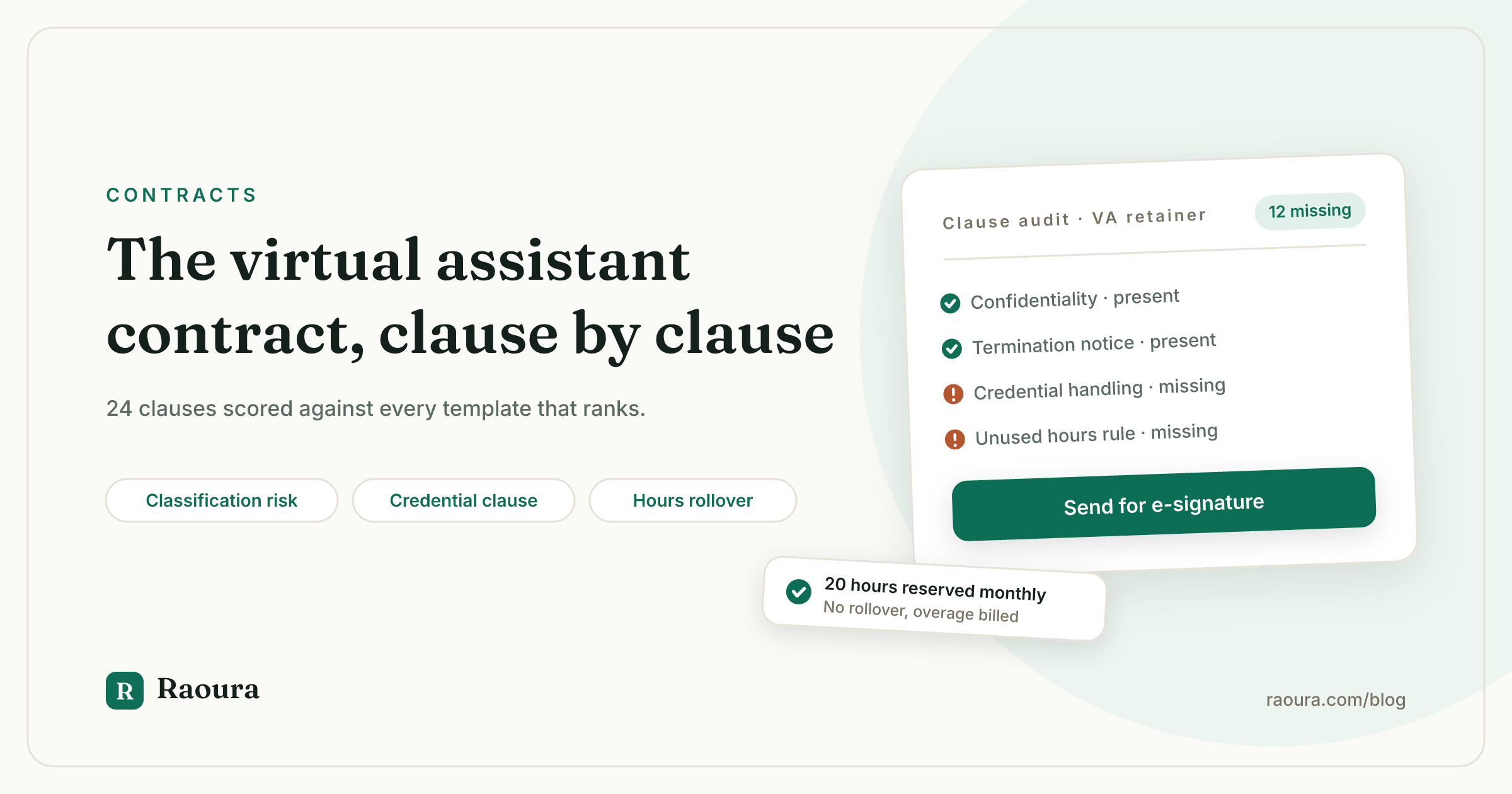
Before writing this we fetched every page ranking for "virtual assistant contract" and its close variants in July 2026, and read the operative contract text on each one that actually publishes any.
Four of them do. The rest are articles about what a contract "should" contain, wrapped around a signup form.
Of those four, one contains no independent contractor clause at all and uses the phrase "payment in lieu of notice," which is an employment law construct. Another says "in the event that employment is terminated early due to inadequate performance as determined solely by the Client, a partial payment for completed services may be withheld." A third, sold by a freelancer software company, ships a generic VA template that still says the contractor "shall render Services as required for the successful operation of the Amazon store," and sets its governing law to "the laws of the United States of America," which is not a body of contract law that exists.
All of them rank on page one.
This guide goes clause by clause. It gives you the language on this page, ungated, names the law behind each clause, and covers the four things every ranking template omits completely: what happens to your client's passwords, what happens to your client's customers' personal data, what happens to the hours in a retainer that nobody used, and what actually determines whether you are a contractor or a misclassified employee.
Nothing here is legal advice. It is a map of the decisions, with primary sources cited so you can check the work.
What the ranking templates actually contain#
We scored the four pages that publish operative virtual assistant contract text against 24 clauses, and across all four only 24 of 96 possible slots were filled.
We counted a clause as present only if it appears in the contract itself, not in the marketing article above it. That distinction turns out to carry most of the weight. One vendor's prose recommends password managers, multi-factor authentication, breach notification timelines, cross-border transfer terms, late fees, deposits, minimum monthly hours, and "a related data processing addendum as needed." Its actual contract, printed directly below that prose, contains none of those things.
Here is the scoring.
| Clause | Present in the 4 templates |
|---|---|
| Independent contractor status stated | 1 of 4 |
| Operative IP assignment of your work product | 2 of 4 |
| Assignment conditioned on payment in full | 0 of 4 |
| Portfolio license back to the VA | 0 of 4 |
| Moral rights waiver | 1 of 4 |
| Data processing terms (GDPR or CCPA) | 0 of 4 |
| Credential storage and access procedure | 0 of 4 |
| No authority to initiate payments | 0 of 4 |
| Scope of services defined | 4 of 4 |
| Written change-order mechanism | 0 of 4 |
| Hours included per period | 1 of 4 |
| Unused-hours rollover or expiry | 0 of 4 |
| Response-time expectation | 1 of 4 |
| Time off and coverage | 1 of 4 |
| Rate increase notice | 0 of 4 |
| Deposit or prepayment | 0 of 4 |
| Invoicing cadence | 2 of 4 |
| Late fee or interest | 2 of 4 |
| Right to suspend on nonpayment | 0 of 4 |
| Liability cap | 0 of 4 |
| Indemnity | 1 of 4 |
| Confidentiality | 4 of 4 |
| Governing law naming a jurisdiction | 0 of 4 |
| Termination notice period | 4 of 4 |
Two numbers are worth sitting with.
The best single template filled 7 of 24. And 12 of the 24 clauses appear in none of the four contracts.
The twelve that are missing everywhere are not obscure. They are payment-conditioned IP transfer, portfolio rights, data processing, credential handling, financial authority, change orders, rollover, rate increases, deposits, suspension rights, liability caps, and a governing law that names a real jurisdiction.
Notice what four of those have in common. Credentials, data processing, financial authority, and rollover are the four clauses that exist because the work is virtual assistance rather than generic freelancing. The SERP has produced a set of generic contractor templates with the word "virtual assistant" pasted at the top.
The classification problem, which is not solved by the contract#
Your independent contractor status is decided by how the relationship actually works, not by what the agreement calls it, and the fixed-hours single-client arrangement most VA templates describe is the highest-risk fact pattern there is.
This is the single most consequential error in the category, and it is repeated on almost every ranking page.
One gated template promises its document "helps with proper tax and legal classification as an independent contractor." Its own sample scope clause then reads: "The Virtual Assistant will handle email management and calendar scheduling between 9 a.m. and 5 p.m. on weekdays only." That is client-set working hours. The page is selling you the thing that creates the risk while telling you it removes it.
California's Labor Commissioner says it plainly. In their words, "an employer cannot change a person's status from that of an employee to one of an independent contractor by requiring a written agreement to that effect or by giving them an IRS Form 1099 instead of a W-2." (DIR independent contractor FAQ)
There are three tests you can be measured against, and they are not the same.
1. The IRS common law test#
The IRS groups its analysis into behavioral control, financial control, and the type of relationship. Behavioral control asks whether the company "control[s] or ha[s] the right to control what the worker does and how the worker does his or her job." Financial control looks at how you are paid, whether expenses are reimbursed, and who provides tools and supplies. Type of relationship looks at written contracts, benefits, permanence, and whether your work is a key aspect of the business. (IRS worker classification)
The IRS also states, on the same page, that "there is no 'magic' or set number of factors that 'makes' the worker an employee or an independent contractor and no one factor stands alone."
And then this, which every VA should read twice:
An individual working remotely, for example, performing services for you from a location other than an office operated by you, is your employee under the common-law rules, if you can control what will be done and how it will be done. This is so even if the worker can choose to work remotely.
Working from your own home does not make you a contractor. It never did.
2. The federal wage and hour test, which changed in 2025#
This one is genuinely confusing right now, and no ranking page mentions it.
The Department of Labor published an independent contractor rule effective 11 March 2024 (89 FR 1638). Then, on 1 May 2025, the Wage and Hour Division issued Field Assistance Bulletin 2025-1 telling its own investigators to stop using it: "WHD will no longer apply the 2024 Rule's analysis when determining employee versus independent contractor status in FLSA investigations."
Investigators now apply the seven-factor economic reality test from Fact Sheet #13 instead. The same bulletin adds the part people miss: "the 2024 Rule remains in effect for purposes of private litigation."
So there are two live standards. A federal investigation applies one. A lawsuit brought by a worker applies the other.
The seven Fact Sheet #13 factors are whether the services are an integral part of the business, the permanency of the relationship, the worker's investment in facilities and equipment, the degree of control, opportunity for profit and loss, the initiative and judgment required, and the degree of independent business organization. Fact Sheet #13 also notes directly that "people who perform work at their own home are often improperly considered as independent contractors."
DOL proposed a replacement rule on 27 February 2026 (91 FR 9932), narrowing the analysis to two core factors: control, and opportunity for profit or loss. The comment period closed 28 April 2026. As of July 2026 it has not been finalized. (DOL 2026 rulemaking page)
3. The California ABC test, where prong B decides it#
If either you or your client is in California, the presumption flips. You are an employee unless the hiring entity proves all three prongs, and the second one is the one that matters:
The worker performs work that is outside the usual course of the hiring entity's business.
California's guidance elaborates: "contracted workers who provide services in a role comparable to that of an existing employee will likely be viewed as working in the usual course of the hiring entity's business." And on prong C: "if an individual's work relies on a single employer, Part C is not met." (California employment status FAQ)
We read the full AB 5 professional services exemption list under Labor Code 2775 and following. It includes marketing, human resources administration, graphic design, grant writing, and freelance writing and editing. It does not include virtual assistant, administrative support, executive assistant, or general admin work.
That is a real and specific finding. A VA doing general admin for a California client is on the ABC test with no exemption to reach for. A VA whose engagement is genuinely scoped to marketing or HR administration may be able to reach the older, more forgiving Borello test, if the additional statutory conditions are met.
What this costs when it goes wrong#
The penalties run against your client, not you, which is exactly why the clause is worth having: it gives them a reason to respect the boundaries.
| Exposure | Amount | Source |
|---|---|---|
| California willful misclassification | $5,000 to $15,000 per violation | [Labor Code 226.8(b)](https://law.justia.com/codes/california/code-lab/division-2/part-1/chapter-1/article-1/section-226-8/) |
| California, pattern or practice | $10,000 to $25,000 per violation | Labor Code 226.8(c) |
| California EDD additional assessment | 15 percent of the deficiency | Unemployment Insurance Code 1127(a) |
| IRS back withholding, 1099s filed | 1.5 percent of wages paid | [IRS Pub 4341](https://www.irs.gov/pub/irs-pdf/p4341.pdf), IRC 3509 |
| IRS employee FICA share, 1099s filed | 20 percent of the full rate | IRS Pub 4341 |
| IRS back withholding, no 1099s filed | 3 percent of wages paid | IRS Pub 4341 |
| IRS employee FICA share, no 1099s | 40 percent of the full rate | IRS Pub 4341 |
In every case the client owes 100 percent of the employer's share of Social Security and Medicare on top. California also requires a violator to post a notice on its own website for a full year stating that it "has committed a serious violation of the law by engaging in the willful misclassification of employees," signed by an officer.
If you genuinely cannot tell which side of the line you are on, either party can file IRS Form SS-8 and ask for an official determination. The IRS warns it "may take at least six months."
What to actually put in the contract#
The clause is worth having. It just does different work than people think: it does not decide your status, it documents the arrangement you are actually going to run, and it stops the client from casually assuming otherwise.
Contractor is an independent contractor and not an employee, partner, or joint venturer of Client. Contractor determines the method, details, and means of performing the Services, sets Contractor's own working hours, and supplies Contractor's own equipment, software, and workspace. Contractor is free to provide similar services to other clients. Contractor is responsible for all taxes on amounts paid under this Agreement, and Client will not withhold taxes or provide employee benefits, insurance, paid leave, or unemployment coverage.
Then honor it. Set deadlines instead of shifts. Bill against outcomes or against a monthly hour allocation, not against a schedule the client controls. Keep more than one client if you possibly can, and note that a client who wants you exclusive should be paying an exclusivity premium and understanding what they are buying.
If your client insists on fixed daily hours, exclusivity, their laptop, and their email address, they are describing a part-time job. That may be a good deal. It is just not a contracting deal, and pricing it as one costs you the employer half of payroll tax with none of the protections.
Scope, and the sentence that prevents most disputes#
Define the scope by naming what is excluded, not only what is included, because a VA scope written as a task list has no edge and everything adjacent becomes free.
Every ranking page tells you to define the scope. One puts it well: it is "just as important to state what you won't be doing."
That advice is correct and universally ignored in the actual templates, which give you five blank rows to list services and nothing else.
A workable scope clause has four parts.
- Included services, named specifically. Not "administrative support." Instead: inbox triage and first-response drafting for one inbox, calendar management for one calendar, weekly invoicing in the client's accounting tool, and scheduling of up to twelve social posts per month.
- Explicit exclusions. The list that saves you: bookkeeping and reconciliation, copywriting beyond routine replies, design work, ad account management, phone coverage, travel booking, personal or family errands, and anything for a second business entity.
- Working pattern. "Contractor performs the Services during Contractor's own business hours and responds to messages within one business day. Contractor is not on call and does not guarantee same-day or out-of-hours response."
- The change mechanism, which is the part nobody drafts.
Here it is, because none of the four templates has one:
Any work outside the Included Services requires a written change order describing the additional work and its fee, agreed by both parties by email before the work begins. Work performed without an agreed change order is billed at Contractor's standard hourly rate of $____.
That last sentence matters more than the first. Without it, a refused change order just means the work still happened and nobody paid for it.
For the language to use when a client pushes on this in real time, see our scope creep scripts for freelancers and the change order template.
Retainer hours, and the rollover question the whole SERP ignores#
Not one page ranking for this keyword addresses what happens to unused retainer hours, which is the most common recurring dispute in VA work.
The setup is always the same. You sell 20 hours a month. In March the client uses 11. In April they want the missing 9 back, and they want them on top of April's 20, and they would like that to keep working indefinitely.
If your contract is silent, you are negotiating from nothing, every month, forever.
There are three defensible answers. Pick one and write it down.
| Model | Clause effect | Best for | Risk |
|---|---|---|---|
| Expiry | Unused hours expire at the end of each billing period | Retainers sold as reserved capacity | Client perceives waste in a light month |
| Limited rollover | Up to N hours roll into the next period only, then expire | Clients with genuinely uneven months | Bookkeeping overhead, and stacking if N is high |
| Bank of hours | Prepaid block, drawn down until exhausted, expires at 6 or 12 months | Project-shaped or occasional work | No revenue predictability, and cash you owe work against |
The clause language for the most common choice:
The monthly fee reserves ____ hours of Contractor's availability in each billing period. Unused hours do not roll over and are not refundable, as the fee purchases reserved capacity rather than a quantity of output. Hours used beyond the monthly allocation are billed at $____ per hour in the following invoice. Client may request additional hours in advance, subject to availability.
The "reserved capacity" phrasing is doing real work there. It explains why the hours do not roll over: the client bought your calendar, not a bucket of labor. That framing survives a conversation. "It says so in the contract" does not.
If you allow rollover, cap it hard, and put an expiry on the rolled hours too:
Up to ____ unused hours may be carried into the immediately following billing period. Carried hours expire at the end of that period and do not accumulate further.
One more clause worth adding, because a retainer is the one arrangement where you can end up working for free without noticing:
If Client does not assign work sufficient to use the allocated hours, the monthly fee remains payable in full.
Our guide to retainer invoicing covers the billing side, and freelance retainer agreement template has the general-purpose version of this document.
Payment terms, and three laws that now put a duty on your client#
In Illinois, New York, and California, your client has a legal obligation to give you a written contract above a dollar threshold, and to pay within 30 days if the contract does not say otherwise.
These three statutes are the strongest lever a VA has, and the entire SERP is silent on them.
| Law | Effective | Written contract threshold | Payment deadline | Damages |
|---|---|---|---|---|
| [Illinois Freelance Worker Protection Act](https://labor.illinois.gov/faqs/freelance-worker-protection-act.html) (820 ILCS 193) | 1 July 2024 | $500, single contract or aggregated over 120 days | 30 days, and a contract cannot specify longer | Double the underpayment, plus costs and all reasonable attorney's fees |
| [New York Freelance Isn't Free Act](https://dol.ny.gov/freelance-isnt-free-act) (GBL Art. 44-A) | 28 August 2024 | $800, single contract or aggregated over 120 days | 30 days after completion if unspecified | Double damages, $250 statutory for no written contract, attorney's fees |
| [California Freelance Worker Protection Act](https://leginfo.legislature.ca.gov/faces/billTextClient.xhtml?bill_id=202320240SB988) (SB 988) | Contracts entered or renewed from 1 January 2025 | $250, single contract or aggregated over 120 days | 30 days after completion if unspecified | Up to twice the unpaid amount, $1,000 if a written contract was refused, attorney's fees |
Read the aggregation rule carefully, because it is what pulls VA work in. A $300 monthly retainer is under every threshold on its own. Over 120 days it is $1,200, which clears all three.
Illinois goes furthest: the act caps any contractually specified payment date at 30 days, so a client cannot write net 60 into your agreement and rely on it.
New York's anti-retaliation provision carries statutory damages equal to the value of the contract, per violation. California's act prohibits adverse action for asserting your rights and requires the hiring party to retain the contract for four years.
Several cities have their own versions with lower thresholds: Los Angeles at $600 in a calendar year, Seattle at $600 with a disclosure regime rather than a contract mandate, Columbus at $250, and New York City's original 2017 ordinance.
We have longer pieces on the Illinois act and the California act, plus a state-by-state map of freelance payment laws.
What the payment clause should say#
Four elements, in this order.
- When you invoice. Monthly in advance for retainers. This is the single highest-leverage choice in VA contracting and almost nobody defaults to it.
- When payment is due. Net 14 for a retainer billed in advance. Net 30 is a project convention that makes no sense for recurring work.
- The late fee. State a rate and cap it at whatever the governing state permits. A flat "5 percent" with no jurisdiction named, which is what two ranking templates give you, is not necessarily enforceable.
- The right to stop. This is the clause with teeth.
Invoices are payable within 14 days. Overdue amounts accrue interest at 1.5 percent per month or the maximum rate permitted by applicable law, whichever is lower. If an invoice remains unpaid 10 days after the due date, Contractor may suspend all Services, including access to Contractor-held accounts and scheduled work, on written notice, until payment is received in full. Suspension under this clause is not a breach by Contractor and does not extend any deadline.
Exactly one page in this SERP includes a suspension right, and only in a prose example rather than a template. It is the clause that changes behavior, because it is the only one that costs the client something before a lawyer is involved.
For how to actually use it, see stop work on an unpaid invoice and the unpaid invoice escalation ladder.
How common is this? The strongest available data comes from New York City's enforcement of its own freelance act. In the department's five-year report, among freelancers who filed complaints, 49 percent reported they were not paid anything at all, and 51 percent of the contracts involved were worth $5,000 or less. That is complaint data rather than population incidence, but it tells you the shape of the problem: small contracts, total nonpayment.
Rate increases, which every template forgets#
None of the four templates contains a mechanism for raising your rate, which is how VAs end up billing 2023 prices in 2026.
Retainers are sticky by design. That is the point of them, and it is also the trap. Without a written path, every rate conversation is a renegotiation of the whole relationship.
Contractor may adjust the fees under this Agreement no more than once in any 12-month period by providing Client at least 30 days' written notice before the start of the billing period in which the new rate applies. If Client does not agree to the adjusted fees, either party may terminate this Agreement effective at the end of that notice period without penalty.
Two things make that clause work. The 12-month limit reassures the client that you will not do this quarterly. The termination right makes it fair, which is what makes it signable.
Then use it. Our rate increase email scripts and how to raise your freelance rates cover the conversation itself.
For context on what the underlying work is worth: the most recent Bureau of Labor Statistics occupational data (May 2024) puts the median hourly wage for secretaries and administrative assistants at $22.26, and for executive secretaries and executive administrative assistants at $35.70 (BLS OEWS). Treat those as a floor rather than a benchmark. They measure W-2 employees, and OEWS explicitly excludes the self-employed, so they carry none of your self-employment tax, your unbilled hours, your software, or your lack of paid leave.
Who owns the work, and why "work for hire" is the wrong phrase#
Copyright in what you create starts with you, and a "work made for hire" clause on its own does not move it, because virtual assistant deliverables do not fit the nine statutory categories.
Two of the four ranking templates use work-for-hire language. Only one of them includes the fallback that saves it.
The law is not ambiguous here. Under 17 U.S.C. 201(a), "copyright in a work protected under this title vests initially in the author or authors of the work." That is you, the moment you write the thing.
Work made for hire is the exception. For a commissioned work from an independent contractor, the Copyright Office's Circular 30 sets out four criteria that must all be met, and the first is that the work falls into one of nine enumerated categories:
- A contribution to a collective work
- A part of a motion picture or other audiovisual work
- A translation
- A supplementary work
- A compilation
- An instructional text
- A test
- Answer material for a test
- An atlas
The Circular is blunt about the consequence: "if a work fails to satisfy any of these requirements, it is not a work made for hire."
Look at what a VA actually produces. Email replies. Calendar entries. Spreadsheets. Standard operating procedures. Social captions. Slide decks. Meeting notes. Client research. Almost none of that lands in the nine.
Some of it arguably could. A curated resource list might be a compilation. A section of a course workbook might be a contribution to a collective work. But "arguably could" is not a basis on which to transfer ownership of three years of work product.
The fix is the same one competent lawyers use everywhere: keep the recital, add the assignment.
To the extent permitted by law, the Deliverables are works made for hire. To the extent any Deliverable does not qualify as a work made for hire, Contractor hereby irrevocably assigns to Client all right, title, and interest in and to that Deliverable, effective upon Client's payment in full of all amounts due under this Agreement. Contractor waives any moral rights in the Deliverables to the extent waivable, and agrees to execute any documents reasonably necessary to perfect this assignment.
The words "hereby irrevocably assigns" are load-bearing. 17 U.S.C. 204(a) requires a transfer to be "in writing and signed by the owner of the rights conveyed." A promise to assign later is not an assignment. Present tense, in the signed document.
The words "effective upon Client's payment in full" are the other half, and no template in this SERP has them. Without that condition, the client owns everything the moment it exists, including on the projects they never paid for.
Two carve-outs to add.
Your own materials. You have process documents, checklists, templates, and canned responses that predate this client and will outlive them.
Contractor retains all right, title, and interest in Contractor's pre-existing materials, templates, systems, and know-how, and grants Client a non-exclusive licence to use them to the extent incorporated in the Deliverables.
Your portfolio. One ranking template goes the other way and bars portfolio use without written consent. If you sign that alongside an NDA, you have produced work you can never mention.
Contractor may describe the nature of the Services performed and identify Client as a client in Contractor's portfolio and marketing materials, excluding any Confidential Information and any specific client content.
For the broader picture, see freelance IP rights.
The credential clause nobody writes#
A virtual assistant typically holds more sensitive access to a client's business than any other contractor they hire, and not one template ranking for this keyword contains a single sentence about how that access is stored, limited, or revoked.
Think about what you actually hold. The client's email. Their calendar. Their CRM. Their Meta Business Manager and ad accounts. Their scheduling tools. Their payment processor dashboard. Sometimes their bank login.
The best any ranking page manages is to name the risk. One template lists "login information, credit card information, business and banking account information" as confidential and then imposes only a non-disclosure duty. One article recommends a specific password manager in a one-line affiliate plug. That is the entire state of the art.
Meanwhile Verizon's 2026 Data Breach Investigations Report found that breaches involving a third party "increased by 60% from last year's dataset, reaching 48% of total breaches," and that "only 23% of third-party organizations fully remediated missing or improperly secured multifactor authentication (MFA) on their cloud accounts."
You are the third party.
This clause protects you at least as much as it protects the client, because it converts an open-ended trust relationship into a bounded, documented one.
Access to Client systems. Client will provide access to Client's systems through a shared password manager vault or delegated access (such as account-level user permissions), and not by sending credentials by email or message. Contractor will not store Client credentials in personal notes, browsers, spreadsheets, or unencrypted files, will enable multi-factor authentication where available, and will not share credentials with any third party or subcontractor without Client's prior written consent.
Scope of authority. Contractor is authorised to access only those systems necessary to perform the Services. Contractor has no authority to initiate, approve, or authorise any payment, transfer, purchase, or financial transaction on Client's behalf unless separately agreed in writing.
Revocation. Client is responsible for revoking Contractor's access to all systems within 5 business days of termination. Contractor will delete or return any Client credentials in Contractor's possession within the same period and confirm in writing when done.
Incidents. Contractor will notify Client without undue delay, and in any event within 48 hours, on becoming aware of any actual or suspected unauthorised access to Client systems or data occurring within Contractor's control. Contractor is not responsible for security incidents originating in Client's own systems, Client's other personnel, or third-party services chosen by Client.
That final sentence is the one to fight for. Without it, you are a plausible defendant every time the client's account gets compromised, regardless of cause.
The "no authority to initiate payments" clause matters for a reason that is not obvious: it is what protects you when a fraudster impersonates the client by email and asks you to move money. Business email compromise targets exactly this relationship. A written limit on your authority is both a control and a defense.
When you handle the client's customers' data#
If you run a client's inbox, CRM, or customer list and the client is established in the EU or UK, you are a processor and Article 28 requires a written contract with eight specific terms, none of which appear in any template in this SERP.
This is the largest single gap in the category, and it is not hypothetical. Inbox management, CRM administration, email list management, appointment booking, and customer support are all processing personal data on someone else's behalf. That is the definition.
One useful correction first, since the secondary internet gets this wrong constantly. A US-based VA is not usually caught by GDPR Article 3(2) just because the client is European. Article 3(2) catches you directly only if your own processing relates to offering goods or services to, or monitoring the behaviour of, people in the EU.
What happens instead is contractual. The European Data Protection Board puts it precisely in its territorial scope guidelines: "the processor located outside the Union will therefore become indirectly subject to some obligations imposed by controllers subject to the GDPR by virtue of contractual arrangements under Article 28."
Your client is legally required to impose these terms on you. GDPR-level duties arrive through the paperwork.
Article 28(3) requires a written contract setting out the subject matter, duration, nature and purpose of the processing, the types of personal data and categories of data subject, and then binding you to eight things:
- Process only on the client's documented instructions
- Ensure anyone handling the data is under a confidentiality obligation
- Apply the Article 32 security measures
- Not engage a sub-processor without written authorisation
- Help the client respond to data subject requests
- Help the client with security, breach notification, and impact assessments
- Delete or return all the personal data at the end, and delete copies
- Provide information to demonstrate compliance, and allow audits
Article 28(9) requires all of that to be in writing. Article 28(4) adds the point that matters if you subcontract: if your sub-processor fails, "the initial processor shall remain fully liable to the controller."
For California, the parallel is CCPA/CPRA "service provider" status. Under Civil Code 1798.140(ag), a written contract must prohibit you from selling or sharing the personal information, retaining or using it for any purpose beyond the business purposes named in the contract, using it outside the direct business relationship, and combining it with personal information received from anyone else. The implementing regulation, CCR Title 11 section 7051, adds ten required terms, including that the business purposes "shall not be described in generic terms."
You do not have to draft any of this. Most clients with a compliance function have a data processing addendum ready. Ask for it and attach it. If they do not, the UK ICO publishes a plain list of the required terms, and a short DPA is a normal thing for a solo contractor to sign.
Add one thing the standard DPA usually will not: a liability boundary. A solo VA should not carry unlimited liability for an incident that started in the client's own systems.
Termination, and the notice asymmetry to watch for#
One popular VA template lets the client terminate immediately while binding the VA to 30 days' notice, which is a red flag you should redline rather than sign.
The exact language, from a template marketed to freelancers: "Contractor may terminate ... upon thirty (30) days' prior written notice. Hiring Party may terminate ... immediately upon written notice."
Symmetry is the whole test. Whatever notice you owe, they owe.
Either party may terminate this Agreement for convenience on 30 days' written notice. Either party may terminate immediately if the other materially breaches this Agreement and fails to cure within 10 business days of written notice. On termination, Client will pay for all Services performed through the effective date, plus the full fee for the billing period in progress. Fees already paid for the current billing period are non-refundable.
Thirty days is the right number for a retainer, not because there is a standard, but because that is roughly how long it takes to replace the income. It is the closest thing a freelancer has to a notice period.
The last sentence pairs with the reserved-capacity framing from the retainer section. If the fee bought your calendar, a mid-month exit does not get a refund of the calendar.
Watch for the other trap too. One template says the contractor "agrees to forgo payment" if they do not invoice within a stated number of months. Strike it. Late invoicing is a bookkeeping problem, not a forfeiture event.
For what to do when a client vanishes rather than terminates, see client ghosted after delivery.
Non-competes and non-solicits, and what to refuse#
A template sold to freelancers in this SERP hands the client a 24-month non-compete with no geographic limit, no consideration, and no carve-out, and you should not sign it.
The clause bars offering services "utilizing information and processes that are unique to Hiring Party" plus any contact with the client's customers, for two years after the engagement ends.
For a VA, that is close to a bar on continuing to be a VA. Your entire skill set is information and processes learned at clients.
Two years post-termination is at the outer edge of enforceable everywhere and void or heavily limited in California, Oklahoma, North Dakota, and Minnesota. Enforceability varies enough by state that "it probably would not hold up" is not a plan.
Take this position instead.
Refuse the non-compete outright. You are a contractor. Working for multiple clients is the definition of the arrangement, and a client who wants exclusivity should be paying for it as a term of the deal, not extracting it as a restriction after the fact. Refusing also strengthens your contractor status, since freedom to serve other clients is a factor in all three classification tests.
Accept a narrow non-solicit. This one is reasonable, because it protects something real.
For 12 months after termination, Contractor will not solicit for employment or contract any employee or contractor of Client with whom Contractor worked directly under this Agreement. This clause does not restrict Contractor from providing services to any other party, including parties in Client's industry, and does not restrict responses to general public job postings.
Note the second sentence. It is what stops a "non-solicit" from being redrafted into a non-compete.
Also watch the warranty clauses. One template asks the VA to warrant they are "the sole author" of all materials and that "no third parties contributed." A VA scheduling posts from client-supplied copy breaches that on day one, and the same contract has an uncapped one-way indemnity attached to it. Qualify author warranties with "to Contractor's knowledge," or delete them.
Our freelance contract red flags piece covers the rest of what to strike when a client sends you their paper.
Liability, the clause with a zero in the table#
No operative template in this SERP contains a liability cap, and one contains an uncapped indemnity running from the VA to the client including attorneys' fees "whether or not litigation is commenced."
You are a one-person business with access to the client's entire operational surface. Unlimited liability is not a risk you can price, insure against cheaply, or survive.
Neither party is liable for indirect, incidental, special, consequential, or punitive damages, or for lost profits, revenue, or data. Each party's total aggregate liability under this Agreement is limited to the total fees paid by Client to Contractor in the 6 months preceding the event giving rise to the claim. These limits do not apply to a party's breach of confidentiality, infringement of the other's intellectual property, or fraud or wilful misconduct.
Six months of fees is a defensible number for a recurring engagement. Twelve is common for larger contracts. The excluded categories at the end are what make it acceptable to a client's lawyer.
Make indemnity mutual or delete it. A one-way indemnity in a template marketed to freelancers tells you who the template was really drafted for.
The 18-clause virtual assistant contract#
If you take nothing else from this page, these are the clauses that carry actual financial consequence, in this order.
- Parties and term, with a stated start date and whether it auto-renews monthly.
- Scope, with named inclusions, explicit exclusions, and the working pattern.
- Change orders, with a written approval requirement and a stated hourly rate for unapproved extra work.
- Hours and rollover, with the reserved-capacity framing and an overage rate.
- Fees and invoicing, billed monthly in advance for retainers.
- Payment terms, net 14, with a stated late fee capped at the legal maximum.
- Suspension right after a stated number of days overdue.
- Rate increases, once per 12 months on 30 days' notice, with a termination right.
- Independent contractor status, describing the arrangement you will actually run.
- IP, with a work-for-hire recital, present-tense assignment effective on payment in full, and a moral rights waiver.
- Your pre-existing materials, carved out and licensed rather than assigned.
- Portfolio rights, excluding confidential information.
- Confidentiality, with a stated survival period and return or destruction on termination.
- Credentials and access, covering vault storage, MFA, no financial authority, revocation, and incident notice.
- Data protection, with a DPA attached if you touch the client's customers' personal data.
- Liability, capped, with mutual indemnity and the standard carve-outs.
- Restrictions, meaning no non-compete and a narrow 12-month non-solicit.
- Termination and boilerplate, symmetric notice, governing law naming a real state, entire agreement, written amendments, e-signature.
Eighteen clauses. A good VA agreement is five to seven pages, not thirty.
For the general-purpose version of this checklist, see what should be in a freelance contract. For the sequence that surrounds it, see client management for virtual assistants and freelance client onboarding.
Where Raoura fits#
Disclosure: Raoura is our product. It is a $17 a month client and project tool for solo freelancers, and it is not a law firm. What it does is make the clauses above happen on every client instead of only the ones where you were paying attention.
The failure mode for VAs is specific and predictable. You draft a careful agreement for your third client. Client seven signs a shortened version because they were in a hurry. Client nine starts on a Slack message and a rate, and nine months later they are the one holding your calendar hostage over rolled-over hours you never agreed to.
A template library fixes that by making the careful version the default version rather than the one you meant to reuse.

The credential clause, the rollover rule, and the payment-conditioned assignment in this article only protect you if they are in the template you actually send.
The second half is the signed record. All three state statutes put a written-contract duty on your client, and California specifically requires the hiring party to retain the contract for four years. A signed document with a timestamped audit record is what makes a rate-increase clause, a suspension right, or an assignment date provable rather than remembered.
!A signed contract in Raoura showing the signature and audit record

The signature and audit trail are what turn a 30-day notice clause or a payment-conditioned IP assignment into a date you can point at.
One thing worth stating plainly given how much of this article is about access and money: Raoura never holds your money. Client payments run through your own Stripe account, directly to you, with no commission taken. We wrote about why that matters in why your client tool should never touch your money.
Frequently asked questions
Do I need a contract as a virtual assistant?
Yes, and in three states your client has a legal duty to give you one. Illinois requires a written contract at $500, New York State at $800, and California at $250, each measured on a single engagement or aggregated across the preceding 120 days. A monthly VA retainer clears all three thresholds within four months. Outside those states a written contract is still what makes your scope boundary, your payment date, and your copyright transfer provable.
Does a contract make me an independent contractor rather than an employee?
No. Classification is decided by how the relationship actually works. The IRS applies a common law test covering behavioral control, financial control, and the type of relationship, and states directly that someone working remotely is an employee under those rules "if you can control what will be done and how it will be done." California applies the ABC test, where the hiring entity must prove your work is outside the usual course of its business. California's own guidance says an employer "cannot change a person's status ... by requiring a written agreement to that effect." The contract documents the arrangement. It does not create it.
Can a virtual assistant contract say the work is "work made for hire"?
It can, but that phrase alone does not transfer ownership. Under 17 U.S.C. 101 a commissioned work only qualifies as work made for hire if it falls into one of nine categories, which are contributions to collective works, parts of audiovisual works, translations, supplementary works, compilations, instructional texts, tests, answer material for tests, and atlases. Routine VA deliverables like inbox replies, spreadsheets, SOPs, and social captions generally fit none of them. Pair the recital with a present-tense assignment effective on payment in full, and let the assignment do the work.
What happens to unused hours in a VA retainer?
Whatever your contract says, and if it says nothing you will renegotiate it every month. The three defensible models are expiry at the end of each period, limited rollover into the immediately following period only, or a prepaid bank of hours with a 6 to 12 month expiry. Expiry is easiest to defend when the fee is framed as purchasing reserved capacity rather than a quantity of output. Not one page currently ranking for "virtual assistant contract" addresses this at all.
Do I need a data processing agreement as a virtual assistant?
If you manage a client's inbox, CRM, mailing list, or customer support and the client is established in the EU or UK, then yes, and your client is legally obliged to put one in place. GDPR Article 28(3) sets out eight mandatory processor commitments and Article 28(9) requires them in writing. In California, CCPA service provider status requires a written contract with four specific prohibitions plus the ten terms in CCR section 7051. Ask the client for their DPA rather than drafting one, and negotiate a liability boundary so you are not carrying unlimited exposure for incidents in their systems.
How should a VA contract handle passwords and account access?
Through a shared password manager vault or delegated account-level permissions, never credentials emailed or messaged to you. Write in a prohibition on storing credentials in personal notes or browsers, an MFA requirement, a bar on sharing with subcontractors without consent, revocation within a stated number of days of termination, an incident notification window, and an explicit statement that you have no authority to initiate or approve any payment or transfer. That last item is what protects you when someone impersonates your client and asks you to move money.
Should I sign a non-compete for a virtual assistant client?
Decline it. One template ranking for this keyword hands clients a 24-month non-compete with no geographic limit that would effectively bar you from continuing to work as a VA, and two-year restrictions are void or heavily limited in California, Oklahoma, North Dakota, and Minnesota. Refusing also supports your contractor status, since freedom to serve other clients is a factor in the IRS, DOL, and ABC tests. Offer a narrow 12-month non-solicit covering the client's own personnel instead, with an express statement that it does not restrict you from serving other clients in their industry.
Can I stop working if a client has not paid?
Only if your contract says so, which is why the suspension clause matters more than the late fee. Write in a right to suspend all services, including access to accounts you manage, on written notice once an invoice is a stated number of days overdue, and state that suspension is not a breach by you and does not extend any deadline. It is the only clause in the payment section that costs the client something before lawyers get involved.
How do I raise my rate on a long-standing retainer client?
Put the mechanism in the contract at the start: one adjustment per 12 months, at least 30 days' written notice before the affected billing period, and a right for either party to terminate at the end of that period without penalty if the client does not accept. The termination right is what makes the clause fair enough to sign. None of the four templates in this SERP contains any rate adjustment mechanism, which is how VAs end up billing three-year-old prices.
---
Sources verified July 2026: IRS worker classification guidance and Form SS-8 (irs.gov, page reviewed 19 May 2026); IRS Publication 4341 on IRC section 3509 rates; DOL Wage and Hour Division Field Assistance Bulletin 2025-1 (1 May 2025) and the 2026 rulemaking page for the NPRM at 91 FR 9932; California DIR independent contractor FAQ (March 2025), labor.ca.gov employment status FAQ, and Labor Code 226.8; 820 ILCS 193 and Illinois Department of Labor FAQ; New York General Business Law Article 44-A and NY DOL guidance; California SB 988 via leginfo.legislature.ca.gov; 17 U.S.C. 101, 201, and 204(a) and U.S. Copyright Office Circular 30 (revised 08/2024); GDPR Articles 3, 28 and EDPB Guidelines 3/2018 on territorial scope; Cal. Civ. Code 1798.140(ag) and CCR Title 11 section 7051; Verizon 2026 Data Breach Investigations Report executive summary (19 May 2026); BLS OEWS national occupational wage table (May 2024 estimates); NYC DCWP Freelance Isn't Free Act Five-Year Report (November 2023). The 24-clause audit reflects the four pages publishing operative virtual assistant contract text among the results for "virtual assistant contract" and its close variants, as read in July 2026. This article is information, not legal advice.
Run your client work in one place
Send a proposal, get it signed, invoice, and get paid, with a branded portal your clients will actually use. One flat plan at $17/month, and we never take a cut of your payments.
Try Raoura free for 14 daysNo credit card required. Set up in minutes.
Keep reading
Is Upwork Worth It in 2026? A Break-Even Test for Your Situation
Upwork is worth it when its fee costs less than finding the client yourself, and that is true far more often for a first project than for a repeat client. Here is the break-even math with 2026 numbers: the 0 to 15% fee, Connects, the shrinking client base, and when to wait out the 24-month rule instead of paying to leave.
Stripe vs PayPal for Freelancers: Every Fee Verified (2026)
Every page ranking for this comparison either prints in-person retail rates, contradicts itself, or skips the numbers freelancers actually pay. We read the current Stripe and PayPal pricing pages line by line, ran a $3,000 invoice through every rail, and found a $1,764 per year gap between the cheapest setup and the default one.
The Pause Clause: How to Stop Work When an Invoice Goes Overdue
Stopping work is the strongest move a freelancer has against a late-paying client, and the least understood. Here is the legal doctrine that lets you pause even without a clause, the exact clause to add so you never have to rely on doctrine again, the day-by-day timing, and the two emails that keep the pause professional. Verified against primary sources in July 2026.