The Pause Clause: How to Stop Work When an Invoice Goes Overdue
August 30, 2026
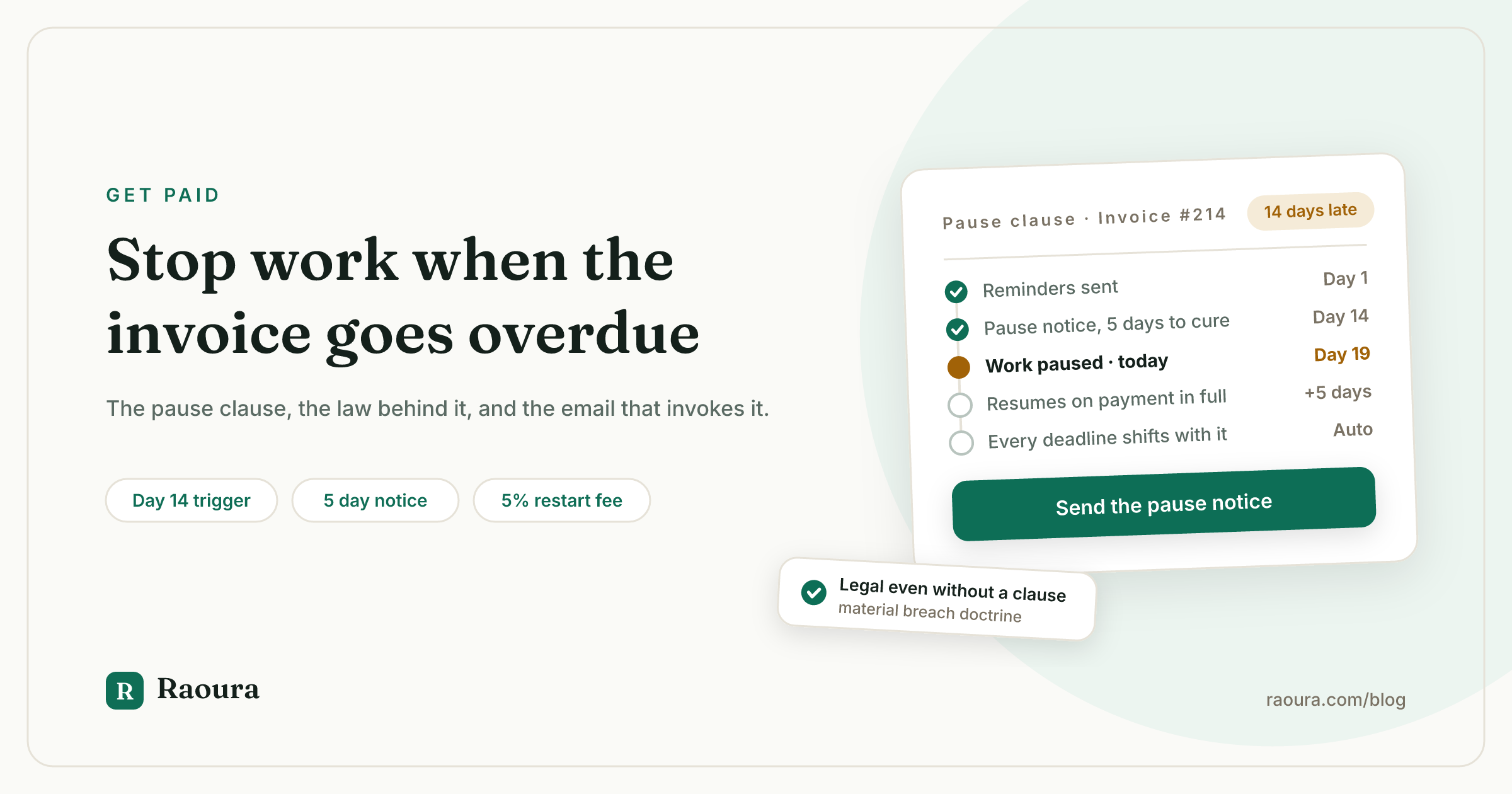
There is a moment in every overdue invoice where you are still working. The client is two weeks late on the last milestone, you are polishing the next deliverable anyway, and some part of you knows you are now extending an interest-free loan to someone who has already shown you how they repay loans.
Stopping work is the strongest lever you have before lawyers get involved. It costs you nothing, it creates a real consequence on a real date, and unlike a late fee it cannot be shrugged off, because the project the client wanted is now not moving.
Yet the advice on it is scattered. We fetched the top five pages ranking for this query in July 2026 and found a strange split: a law firm page has good clause language but writes for agencies, a legal publisher covers the collection process but gives stopping work one buried paragraph, and a payments vendor has a timeline but no contract language and no legal authority at all.
Not one page combines the clause, the law behind it, and the email that invokes it. None mention the state freelance payment laws passed in 2024 and 2025 that change the math. This article is all of it in one place.
The scale of the problem is not small.
Bonsai's analysis of three years of invoices from 100,000+ freelancers found 29% are paid at least a day late, and Intuit QuickBooks' 2025 survey found 56% of small businesses are owed money on unpaid invoices, averaging $17,500 each.
If you freelance long enough, you will face this decision. Better to face it with a clause, a date, and a script.
Can you legally stop work when a client has not paid?#
Yes: under the material breach doctrine followed by US courts, you can suspend your own performance once the client's failure to pay is material and uncured, even if your contract says nothing about pausing. This is the piece missing from nearly every page on the subject.
The Restatement (Second) of Contracts, the standard summary of American contract law, puts it in sections 237 and 241: each party's remaining duties are conditioned on there being no uncured material failure by the other side.
A client who has materially failed to pay cannot insist you keep performing while they do not.
The important word is material. Courts weigh factors like how much of the benefit you are being deprived of, how likely the client is to cure, and whether the failure looks like bad faith. In practice, for a solo freelancer, that maps to a few conditions you should be able to check off before pausing without a clause:
- The payment is genuinely overdue under the contract or invoice terms, not just slow by your preference.
- The amount is significant relative to the project, not a $40 rounding dispute on a $8,000 engagement.
- You have notified the client in writing and given them a real chance to cure.
- You are otherwise holding up your own end, because a freelancer who is behind on deliverables makes a poor injured party.
Pause wrongly, over a trivial amount, without notice, or while you are the one in breach, and you risk flipping the script: your work stoppage becomes the breach the client points to.
That risk is exactly why you put a pause clause in the contract, so the right to stop is spelled out and nobody has to argue Restatement sections at each other.
One more piece of perspective from abroad: the United Kingdom liked this remedy so much it wrote it into statute.
Section 112 of the Housing Grants, Construction and Regeneration Act 1996 gives unpaid parties on construction contracts a statutory right to suspend performance after seven days' written notice, makes the client pay the reasonable costs of the suspension, and extends the deadline by the paused time.
It only covers UK construction contracts, but it is a useful blueprint: notice first, costs recovered, deadline shifted. Your clause should do the same three things.
The pause clause: what to put in your contract#
A working pause clause needs five parts: a trigger, a written notice with a cure window of 5 to 7 business days, a deadline shift, a restart condition, and an optional restart fee of about 5% to 10%.
Established templates gesture at this without finishing the job. The AIGA Standard Form of Agreement for Design Services, the most widely copied designer contract in the US, reserves "the right to withhold Deliverables if accounts are not current" and tells you to put projects "on credit hold" for missed payments, but never spells out the notice, restart, or deadline mechanics.
Spell them out. Here is each component and why it exists:
| Component | What it does | Suggested version |
|---|---|---|
| Trigger | Defines exactly when the right activates, so there is no argument about "a few days late" | Any invoice 14+ days past due |
| Notice + cure window | Protects you from the wrongful-pause risk above and gives a cooperative client an exit | Written notice, 5 business days to pay before work stops |
| Deadline shift | Stops the client from holding you to the original timeline they caused you to miss | All deadlines extend by at least the length of the pause |
| Restart condition | Makes clear the pause ends on full payment, not on promises | Work resumes within 5 business days of payment clearing |
| Restart fee (optional) | Compensates you for the cost of context-switching back in, and makes pausing expensive for the client instead of only for you | 5% to 10% of the remaining project fee |
Assembled into plain language you can adapt (this is a starting point, not legal advice, and a lawyer licensed in your state should review anything you rely on):
Suspension of work. If any invoice remains unpaid 14 days after its due date, Contractor may suspend all work under this agreement after giving Client written notice and 5 business days to bring the account current. During any suspension, Contractor has no obligation to perform, and all project deadlines are extended by at least the length of the suspension. Work resumes within 5 business days after all outstanding amounts are received in full. If a suspension lasts longer than 14 days, resuming work is additionally subject to a restart fee of 5% of the remaining fees under this agreement. Client remains responsible for payment for all work completed before and during any suspension notice period. Suspension is in addition to, not instead of, any other remedy available to Contractor.
The restart fee deserves a word, because it is the part freelancers skip and agencies do not. A pause costs you money: you lose momentum, you re-read everything when you come back, and you may have turned down work to hold the slot.
A modest concrete example: on a $6,000 remaining balance, a 5% restart fee is $300, which is less than most clients' late fee exposure and far less than what re-mobilizing actually costs you in hours. It also changes the client's incentive during the cure window, because paying on day 4 of 5 is now visibly cheaper than paying after the pause lands.
Note what this clause is not:
- Not termination. Pausing preserves the contract and the relationship while removing your unpaid labor from the table.
- Not withholding of already-delivered work, which is a separate (and more aggressive) lever usually handled by making IP transfer conditional on full payment, the way the AIGA agreement does.
- Not a late fee, which you should also have; the two stack.
What belongs in the rest of the agreement is covered in what should be in a freelance contract, and the fee rules by state are in the late fee guide.
When to actually pull the trigger#
Day 14 past due is the right moment to send the pause notice for most project work, which stops work at day 21 if the cure window runs out. Earlier than that and you are escalating against ordinary sloppiness: Bonsai's invoice data shows 75% of late invoices are paid within 14 days of the due date, so the first two weeks belong to polite reminders, not ultimatums.
Much later than day 30 and you have donated weeks of free work to someone who is now 3x less responsive.
The full day-by-day cadence of reminders before this point is its own system, laid out in the payment reminder schedule with copy-paste wording in the reminder template library.
The pause slots in as rung two of the unpaid invoice escalation ladder: after reminders, before the demand letter.
If the pause notice and the stopped work do not produce payment within another two weeks, you are no longer in a late-payment situation, you are in a nonpayment situation, and the next moves are a formal demand letter and, if needed, small claims court.
Three situations shift the timing:
Retainers: pause at the start of the unpaid period, not day 14. A retainer is payment for availability. If the month is not paid, the month's availability does not start. Working a second unpaid cycle on a retainer is the single most common way freelancers convert one bad month into a $10,000 problem.
Milestone projects: the pause is built in if you let it be. When payment is tied to approval of each phase, not starting the next phase until the last one is paid is not even an escalation, it is just the deal. More on making that automatic below.
Clients in New York, Illinois, or California: the law is already on your side, so pause with confidence.
New York's Freelance Isn't Free Act (statewide since August 2024, contracts of $800+ over 120 days), Illinois' Freelance Worker Protection Act (July 2024, $500+), and California's SB 988 (January 2025, $250+) all require payment by the contract date or within 30 days of completing the work, with double damages available for violations in New York and Illinois and enhanced damages in California.
A client who is 14+ days past due in these states is drifting toward statutory liability that dwarfs your invoice. Which state's law applies, and what the complaint process looks like, is mapped in freelance payment laws by state.
How to tell the client: the two emails#
The pause notice is three sentences of fact and one of consequence, sent 5 business days before work stops.
No apology, no anger, no essay.
The notice is doing legal work (it is your cure-window notice under the clause) and relationship work (it gives a disorganized-but-decent client a clean exit) at the same time.
The notice, day 14:
Subject: [Project name]: work pausing Friday unless invoice #214 is paid
Hi [Name], invoice #214 for $2,400 was due on [date] and is now 14 days past due. Per our agreement, I am giving notice that I will pause all work on [project] at end of day [date, 5 business days out] unless payment is received before then. All project deadlines will extend by the length of any pause. The payment link is here: [link]. If something is stuck on your end, tell me today and we will sort it out.
The restart, whenever payment clears:
Subject: Payment received: [project] resuming
Thanks, [Name], payment for invoice #214 cleared today. I am picking the work back up and the revised delivery date is [date], reflecting the [X] days paused per our agreement. Updated timeline attached.
Two details worth copying exactly.
The notice names a specific date and a specific amount, because vague warnings ("I may have to pause work soon") read as bluffs and get treated like bluffs.
And the restart email restates the shifted deadline in writing on the day work resumes, because six weeks later the client will remember the original date and not the pause, and you want the correction time-stamped, not argued from memory.
What you should not do while paused: keep quietly working "so the project doesn't fall behind." The entire mechanism depends on the pause being real.
A freelancer who announces a pause and keeps shipping has taught the client that deadlines from either side mean nothing.
If the silence stretches on and the client disappears entirely, that is a different playbook: the ghosted-after-delivery guide covers finding out whether anyone is still there to pay you.
Make the pause automatic instead of dramatic#
The least confrontational version of stopping work is milestone billing, where each phase starts only after the last one is paid, so a pause needs no announcement at all.
The showdown quality of a stop-work notice comes from payment and work running on separate tracks: work ran ahead, payment fell behind, and now you have to yank the tracks back together in one uncomfortable email.
Structuring the project as pay-per-phase from the start means the tracks were never separate. Milestone billing and a real deposit quietly replace most of this article for new projects.
The practical obstacle is visibility. To pause on day 14, you have to notice day 14, and a freelancer juggling five projects in spreadsheets usually notices somewhere around day 23.
This is the part we built tooling for. In Raoura, client and project management for solo freelancers at one flat $17/mo, every invoice carries a live status, so the moment one tips from sent to overdue it is red on the list and on your dashboard, and automatic reminders have already been escalating in your voice before you ever have to type a pause notice. (Disclosure: Raoura is our product.)

The pause decision starts with noticing: an overdue invoice turns red the day it tips, not the week you happen to reconcile.
Milestones work the same way. Each phase of a project carries its own price and its own paid-or-not status, so "we do not start visual design until wireframes is paid" is not a threat you deliver, it is a status the client can see in their own portal.

When every phase shows its own payment status, the next phase not starting is information, not confrontation.
Frequently asked questions
Can the client fire me for pausing work?
They can end the contract per its termination terms, but if your pause followed a valid clause or a genuine material breach, the nonpayment was the breach, not your pause, and they still owe you for work completed. What you are owed on a cancelled project, including kill fees, is its own topic on our roadmap.
Does pausing work mean I stop responding to the client?
No. You stop producing deliverables; you stay reachable and professional. Going dark undermines the message that this is a process, not a tantrum, and in a dispute your continued communication is evidence of good faith.
Can I pause work if there is no written contract?
Often yes, under the same material breach doctrine, since courts recognize agreements formed by emails, invoices, and conduct. But the materiality and notice requirements matter even more, because nothing is spelled out. Send the same 5-business-day notice email regardless; it creates the paper trail the doctrine expects.
Should I also withhold work I have already delivered?
That is a separate, sharper lever. If your contract transfers IP rights only on full payment (as the AIGA agreement does), unpaid work is still legally yours, and using it anyway puts the client in new trouble. Reclaiming or disabling delivered work, like taking down a live site, has real legal risk and deserves its own analysis before you try it.
Is a restart fee actually enforceable?
A modest fee tied to the real cost of remobilizing, agreed in writing before the project, is generally treated like any other contract term. A punitive one (25% of the whole project for a two-day pause) risks being read as a penalty. Keep it small, justified, and in the signed agreement.
Do project deadlines really shift automatically when I pause?
Only if your contract says so, which is exactly why the deadline-shift sentence is in the clause. Without it, expect the client to claim you are late. With it, restate the new date in writing the day you resume, per the restart email above.
What if the client pays the overdue invoice but disputes the next one too?
A client who is late twice is telling you about invoice three. Tighten terms on the spot: shorter due dates, a deposit on remaining phases, or milestone billing. The payment terms guide covers what to change and how to announce it without drama.
Is stopping work worth it for a small invoice?
Below a few hundred dollars, the pause mechanics outweigh the leverage, and the doctrine may not even support you, since a small shortfall is hard to call material. Send reminders, add the late fee if you have one, finish the engagement, and do not book the client again.
---
Every legal provision, clause practice, and statistic in this article was verified against primary sources in July 2026: the Restatement (Second) of Contracts sections 237 and 241 for the suspension doctrine, the AIGA Standard Form of Agreement 2022 text, section 112 of the UK Housing Grants, Construction and Regeneration Act 1996, the New York State DOL, Illinois DOL, and California Legislature pages for the 2024 to 2025 freelance payment laws, and invoice datasets from Bonsai and Intuit QuickBooks' 2025 Late Payments Report.
Run your client work in one place
Send a proposal, get it signed, invoice, and get paid, with a branded portal your clients will actually use. One flat plan at $17/month, and we never take a cut of your payments.
Try Raoura free for 14 daysNo credit card required. Set up in minutes.
Keep reading
The Virtual Assistant Contract: 24 Clauses, Scored Against Every Template Ranking for This Search
We scored the four pages that publish actual virtual assistant contract text against 24 clauses a VA agreement needs. Twenty-four of 96 possible slots were filled. The best single template managed 7 out of 24. Twelve clauses appear in none of them, including every clause about the thing that makes VA work different from other freelance work: you are holding your client's passwords and running their inbox. One popular template also tells you a contract fixes your independent contractor status, then mandates client-set 9 to 5 weekday hours in the same document. Here is the clause-by-clause version, with the classification test the DOL is actually applying in 2026, the data protection terms nobody drafts, and the retainer mechanics that decide whether unused hours roll over.
Stripe vs PayPal for Freelancers: Every Fee Verified (2026)
Every page ranking for this comparison either prints in-person retail rates, contradicts itself, or skips the numbers freelancers actually pay. We read the current Stripe and PayPal pricing pages line by line, ran a $3,000 invoice through every rail, and found a $1,764 per year gap between the cheapest setup and the default one.
Quarterly Estimated Taxes for Freelancers (And the Uneven Quarters Trap)
The IRS calls them quarterly taxes, but the four payment periods are 3, 2, 3, and 4 months long, and that mismatch is where freelancers get hurt. We fetched the top-ranking pages in July 2026: one maps the deadlines to normal calendar quarters (wrong), another lists June 16 as a 2026 due date (that was 2025's date), and a third publishes 2025 deadlines under an April 2026 update stamp. Here is the version with every date and rule checked against the 2026 Form 1040-ES: who has to pay, the safe harbor that ends the guessing, what a missed payment actually costs at the current 7% rate, and the Schedule AI method that saves you money when your income is lumpy.