Small Claims Court for a Freelance Invoice: Worth It?
July 19, 2026
Small claims court is the rung of the unpaid invoice escalation ladder that everyone mentions and almost nobody explains. The advice you will find ranges from stale to salesy: one page ranking on the first page of Google for this query in July 2026 still quotes California limits that stopped being true in January 2024, and the pages with the most confident statistics ("70 to 85% win rates," "60 to 70% of judgments collected") are published by companies selling $299 filing services, citing no study we could locate.
So this article does the thing those pages avoid: it prices the whole process from filing to collection using court fee schedules and statutes you can click, and it gives you a break-even rule for deciding whether your invoice is worth it. Spoiler: the deciding factor is usually not the filing fee. It is your time, and whether the client has anything to collect.
One more thing the vendor pages skip. Small claims is designed for exactly you. It exists so a person with a $3,000 dispute can get a ruling without a lawyer; in California, Michigan, and Nebraska, lawyers are not even allowed to argue small claims hearings (California, Michigan MCL 600.8408, Nebraska). You do not need to be intimidated by it. You need to know whether it pays.
The 60-second answer#
Small claims court is usually worth it when the unpaid invoice is over roughly $800, inside your state's dollar limit, less than 2 years old, and owed by a client who has money and can be sued where you plan to file. Below that, the math tends to favor the cheaper rungs of the ladder, a tax conversation, or walking away.
Run these five checks before you spend an hour on forms:
- Size. Under your state's limit (see the table below) but big enough to beat the cost of your own time. We do the worked math later, but the short version: filing plus hearing plus paperwork eats about 10 hours.
- Age. Inside the statute of limitations, which for written contracts is 3 to 10 years in most states, and often much shorter for verbal agreements (Nolo's 50-state chart). Sooner is stronger regardless.
- Location. You generally must sue where the client lives or does business, not where you do. Remote work makes this the most commonly fatal check, covered below.
- Collectability. A judgment against a broke client or an empty LLC is a piece of paper. The court will tell you this itself.
- Alternatives. If your client is in New York, Illinois, or a handful of cities, a Freelance Isn't Free complaint may get you double the money for less effort than a lawsuit.
If all five check out, keep reading. If one fails, the later sections tell you which alternative fits.
What small claims court actually costs#
Court filing fees for a typical freelance invoice run $15 to $305 depending on the state and the claim size, and serving the papers on the client adds roughly $15 to $75 more. Fee waivers exist in every state we checked for filers who cannot afford the fee.
Here are verified 2026 filing fees for five big freelance states:
| State | Filing fee for a typical invoice claim | Source |
|---|---|---|
| New York | $15 to $20 | [NY courts via LawHelpNY](https://www.lawhelpny.org/resource/your-guide-to-small-claims-in-city-town-and-village-courts) |
| California | $30 (up to $1,500), $50 ($1,500 to $5,000), $75 (over $5,000) | [CA Courts Self-Help](https://selfhelp.courts.ca.gov/small-claims-california) |
| Massachusetts | $40 to $150 by claim size | [Mass.gov](https://www.mass.gov/info-details/small-claims-court) |
| Florida | $170 ($500 to $2,500), $295 ($2,500 to $15,000), plus $10 summons | [Fla. Stat. 34.041](https://www.flsenate.gov/Laws/Statutes/2025/34.041) |
| Texas | Set by each county, no statewide figure | [Texas State Law Library](https://guides.sll.texas.gov/small-claims) |
Two useful details hide in those schedules. First, Florida is a real outlier: suing over a $3,000 invoice costs $305 in Florida versus $50 in California and about $20 in New York. If you have seen the "$55 to $175" Florida tiers on other blogs, they are out of date; the statute linked above is the 2025 fee schedule.
Second, if you win, filing fees and service costs are typically added to your judgment on top of the award. Massachusetts says this outright: the fee "will be assessed against the Defendant if you win your case" (Mass.gov), and most state limits are written as "exclusive of interest and costs" for the same reason.
Service, meaning formal delivery of the claim to the defendant, is its own small line item. In California the court clerk will serve by certified mail for $15, though the court itself warns this fails when defendants dodge the mail; a sheriff or process server costs more, and the court's advice is to ask the price first (CA service guide). You cannot hand the papers over yourself.
The real cost is time. Count evidence prep, the forms, filing, chasing service, a half day at the courthouse, and post-judgment paperwork if you win. There is no official national figure, so here is our own estimate from walking the process end to end on paper: about 10 hours for an uncontested, single-hearing case. Every hour of that is an hour you are not billing.
How much you can sue for, state by state#
Small claims limits in 2026 range from $2,500 in Kentucky to $25,000 in Delaware and Tennessee, and most states fall between $5,000 and $12,500. If the invoice is over your state's limit, you can usually waive the excess and still use small claims rather than hiring a lawyer for a regular civil case.
| State | 2026 limit | Notes and source |
|---|---|---|
| Delaware | $25,000 | [Justice of the Peace Court](https://courts.delaware.gov/jpcourt/jurisdiction.aspx) |
| Tennessee | $25,000 | General sessions court, no cap on fee recovery ([UT CTAS](https://www.ctas.tennessee.edu/eli/jurisdiction-general-sessions-court)) |
| Texas | $20,000 | Justice court, includes attorney fees in the cap ([Texas State Law Library](https://www.sll.texas.gov/faqs/small-claims-maximum/)) |
| Georgia | $15,000 | Magistrate court ([OCGA 15-10-2](https://law.justia.com/codes/georgia/2022/title-15/chapter-10/article-1/section-15-10-2/)) |
| California | $12,500 individuals, $6,250 businesses | Raised January 1, 2024 ([CA Courts Self-Help](https://selfhelp.courts.ca.gov/small-claims-california)) |
| Pennsylvania | $12,000 | Magisterial district court, excess waivable ([42 Pa.C.S. 1515](https://law.justia.com/codes/pennsylvania/title-42/chapter-15/section-1515/)) |
| New York | $10,000 in NYC, $5,000 in other city courts, $3,000 in town and village courts | [NYC Civil Court Act 1801](https://www.nysenate.gov/legislation/laws/CCA/1801) |
| Illinois | $10,000 | [Illinois Legal Aid](https://www.illinoislegalaid.org/legal-information/small-claims-basics) |
| Washington | $10,000 individuals, $5,000 businesses | [RCW 12.40.010](https://apps.leg.wa.gov/RCW/default.aspx?cite=12.40.010) |
| Florida | $8,000 | [Small Claims Rule 7.010(b)](https://www.floridabar.org/the-florida-bar-news/florida-rules-of-small-claims-court-amendment-to-rule-7-010/) |
| Colorado | $7,500 | Claims cannot be split ([Colorado Judicial Branch](https://lawhelp.colorado.gov/when-can-i-sue-in-small-claims-court)) |
| Massachusetts | $7,000 | [Mass.gov](https://www.mass.gov/info-details/small-claims-court) |
| Kentucky | $2,500 | Lowest in the country ([KY Small Claims Handbook](https://www.kycourts.gov/Legal-Help/Documents/P-6_Small_Claims_Handbook.pdf)) |
Watch the business-claimant fine print. If you operate as an LLC or corporation, California caps you at $6,250 instead of $12,500 and Washington at $5,000 instead of $10,000, and in New York City corporations cannot file small claims at all; they must use the separate commercial claims part (NYC Civil Court Act 1809). Sole proprietors count as individuals in California. This is one of the few places where staying unincorporated is a legal advantage.
Three gates you must clear before filing#
Three things have to be true before the court will even hear you: the debt is inside the statute of limitations (2 to 10 years for contracts, depending on state and whether the agreement was written), the client can be sued where you file, and you name the correct legal entity as the defendant.
Gate 1: the deadline. For written contracts, the statute of limitations is 4 years in California and Texas, 6 in New York, and 10 in Illinois; for oral agreements it drops to 2 in California and 5 in Illinois (Nolo's chart). If your "contract" is an email thread and a paid deposit, you may be on the shorter oral clock. Practically, none of this should matter, because a claim filed within months of the missed due date is stronger than one filed years later in every way that counts.
Gate 2: the location. Courts only have power over defendants who live in, are present in, or do business in their state. As a rule you sue where the client is, not where you are (Nolo on out-of-state defendants).
There is a genuinely useful exception for freelancers: if you performed the work in your state, you may be able to sue at home, but only if the papers can be served on the defendant inside your state's borders, which for a remote client usually means waiting for them to set foot there. California's courts state it plainly: the person or business you sue generally has to be served in California (CA service guide).
For a client two time zones away, honestly weigh the cost of filing in their county, or use the pressure tools below instead.
Gate 3: the defendant's name. Sue "Dave from Meridian Marketing" and you can win a judgment against nobody. You need the exact legal entity on the contract or invoice, which you can check for free on the Secretary of State business search in the client's state. If the client is an LLC, your judgment is against the LLC's assets, not Dave's house. This deserves its own article, and it is on our topic map.
The collection problem nobody prices in#
A judgment is not a payment: no reliable national statistic on small claims collection rates exists (the most recent academic study we could trace is from 1993, covering one Missouri county), and the courts themselves warn in writing that you may never see the money.
This is the section that decides "worth it," so it deserves the honest version. Legal-tech marketing pages quote collection rates of 60 to 70%, or claim 79% of winners never collect, and we spent real effort trying to trace those numbers this month. Every trail dead-ends at another blog. Treat any confident collection statistic as decoration.
What is verifiable is what the courts say to winners. California: "The court doesn't collect the money for you," and collecting "can take a lot of time and money and you may not even collect any of it" (CA Courts, after the trial). Colorado makes plaintiffs acknowledge on the filing form: "I understand that the court will not collect any money for me and that I may never get any money even if I win my case" (Colorado Judicial Branch). Massachusetts lists "Hard to Collect" as the first disadvantage of small claims (Mass.gov).
If the client will not pay voluntarily after losing, you enforce the judgment yourself: wage garnishment, a levy on their bank account, or a lien on property, each with its own forms and fees (recoverable, but paid by you first). The one genuinely comforting fact is durability: a small claims judgment stays enforceable for 15 years in Kentucky and 20 in Massachusetts, and it accrues interest, so a client who is broke today may not be broke in year three.
So before filing, ask the collectability question like an underwriter. Is the client an operating business with revenue, payroll, and a bank account a levy could reach? Or a thinly capitalized LLC that could dissolve, or an individual with no attachable income? Suing the first is an investment. Suing the second is buying an expensive certificate.
The Freelance Isn't Free shortcut#
If your client is in New York State, Illinois, or the cities of Seattle, Los Angeles, or Minneapolis, freelance payment laws entitle you to double damages plus attorney fees, which frequently beats anything small claims can award.
These laws require written contracts, default payment within 30 days, and penalize nonpayment with double damages, and they exist precisely because almost nobody sues: a 2022 Freelancers Union survey of New York freelancers found 62% had lost wages to a client's refusal to pay at least once, while under 1% had ever used the legal system to recover them (Freelancers Union).
New York City's version recovered $2,144,198 in owed compensation in its first five years, and the state-level New York act took effect August 28, 2024, with Illinois already live (Freelancers Union advocacy hub).
The key strategic point: an administrative complaint under these laws is not a lawsuit. It is a form, and the double-damages exposure is often what turns "we'll pay you eventually" into a wire transfer. And because attorney fees are recoverable, lawyers will take these cases on invoices too small for ordinary litigation. We cover which states and cities qualify, and how the filing works, in our freelance payment laws by state guide. Check it before you check the courthouse address: if your client is covered, this rung usually comes first.
The worth-it math, worked#
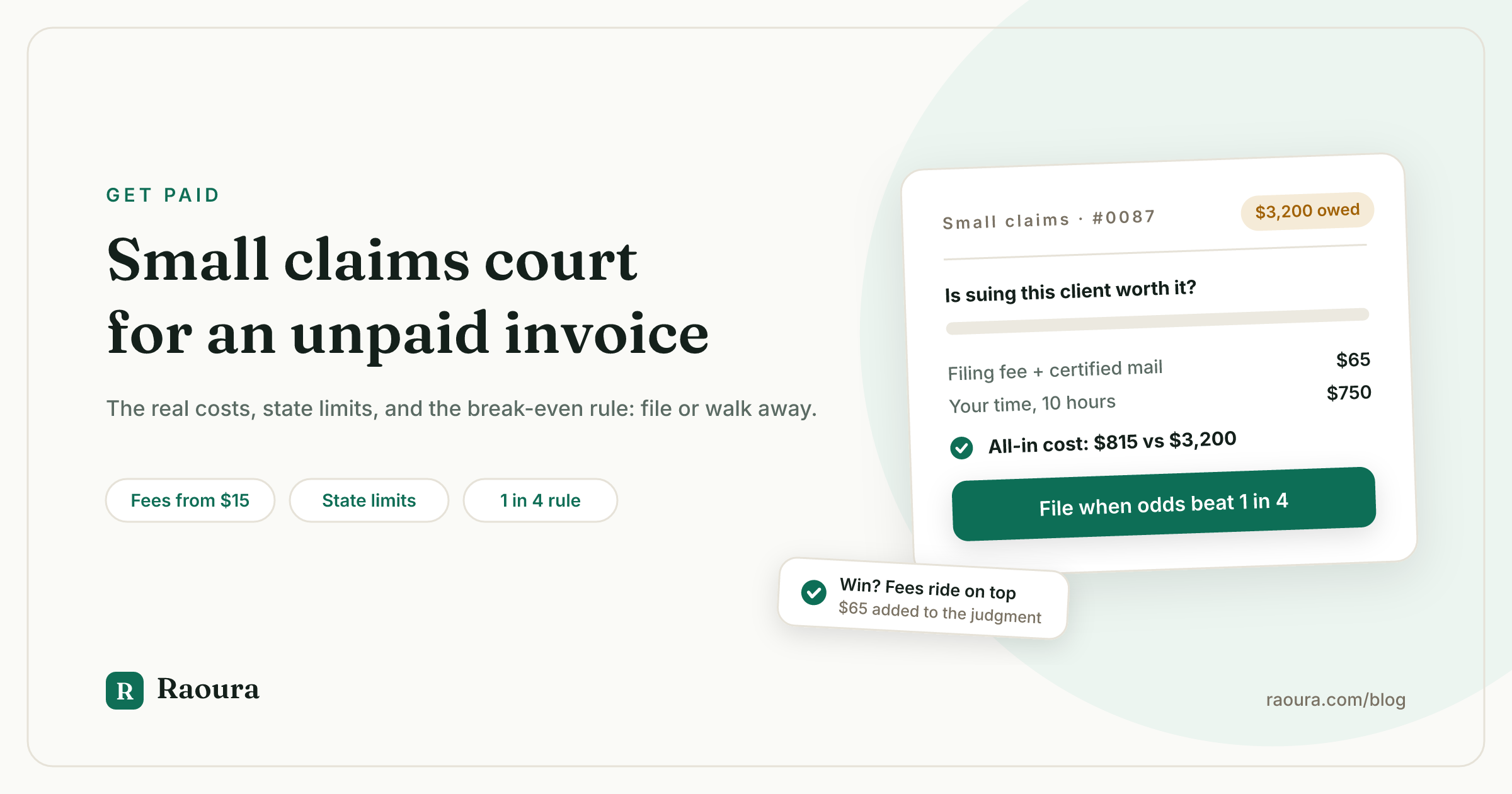
On a $3,200 invoice in California, small claims costs about $65 out of pocket and roughly $750 of billable time, an all-in cost near $815, so filing clears the bar if you judge your odds of actually collecting at better than about 1 in 4.
Here is the arithmetic, using the verified fee schedule and our 10-hour time estimate at a $75 hourly rate:
| Line item | Cost |
|---|---|
| Filing fee (claim between $1,500 and $5,000 in California) | $50 |
| Service by the clerk's certified mail | $15 |
| Out-of-pocket subtotal | $65 |
| Your time: about 10 hours at $75 per hour | $750 |
| Real all-in cost | $815 |
$815 against a $3,200 recovery is a 25% break-even: if you would put the odds of the client actually paying a judgment above one in four, the expected value is positive, and remember the $65 in fees rides back on top of the judgment if you win. Swap in your own numbers: a $9,000 invoice only needs a 1 in 11 chance of collection to justify the same effort, while a $500 invoice fails the test outright, because $795 of cost chasing $500 is negative before you start (that one belongs to reminders, late fees, and the demand letter, or to the write-off column).
Notice what this math is really telling you. The filing fee is noise. The two variables that decide everything are your hours and the client's collectability, which is why the earlier sections spent so long on both, and why "worth it" is a different answer for a $75-an-hour developer with a solvent corporate client than for anyone chasing a dissolved LLC.
Before you file: cheaper rungs and better records#
Most unpaid invoices resolve below the courthouse: a reminder cadence, a late fee, a stop-work notice, and a formal demand letter cost $0 in court fees and settle the majority of disputes. Small claims works best as the credible threat behind those steps, not the first move.
The sequence is its own playbook, and we have written each rung: the reminder system that gets invoices paid, late fees that are legal and effective, the full escalation ladder, and the demand letter with a free template. A demand letter that names the small claims court you will file in, with the filing fee already looked up, is dramatically more credible because you have read this far and mean it.
There is also a records angle that decides cases before they are heard. Small claims judges rule on paper: the contract, the invoice, the delivery evidence, the reminder trail. Freelancers who run everything through email threads walk in with a shoebox; the judge has to reconstruct the deal. This is where your tooling quietly becomes legal infrastructure. Raoura keeps the signed contract, every invoice, its due date, and the complete reminder history attached to the client record, so "gather evidence" becomes an export instead of an archaeology dig. Disclosure: Raoura is our product.

Every reminder is logged automatically, which is exactly the paper trail a small claims judge asks for.
!A signed contract in Raoura with the e-signature record attached to the client and project

A signed contract with an audit record is the single strongest exhibit you can bring to a hearing.
And the honest last word belongs to prevention, because the freelancers who never need this article are the ones who charge a real deposit and bill by milestone so no client ever owes them more than one phase of work.
Frequently asked questions
How much does it cost to take someone to small claims court?
Filing fees run $15 to $305 depending on the state and claim size ($15 to $20 in New York, $30 to $75 in California, up to $305 in Florida), plus roughly $15 to $75 to serve the papers. If you win, those costs are typically added to your judgment.
Is small claims court worth it for $500?
Usually not on pure math: even with a $45 filing-and-service cost, the roughly 10 hours of your time the process consumes will exceed $500 for most freelancers. Send a demand letter, add late fees, or write it off, and reserve court for larger invoices or for clients you want on record.
Can I sue a client without a written contract?
Yes. Verbal agreements backed by emails, invoices, deliverables, and partial payments are enforceable in small claims, but the statute of limitations for oral contracts is shorter in most states (2 years in California versus 4 for written contracts), and your evidence burden is higher.
Can I sue an out-of-state client in my local small claims court?
Generally no: you must sue where the client lives or does business. If you performed the work in your state you may file at home, but the papers usually still must be served inside your state, which defeats most remote-client cases. Weigh filing in the client's county against the travel cost, or use a demand letter and the Freelance Isn't Free laws where they apply.
Do I need a lawyer for small claims court?
No, and in California, Michigan, and Nebraska lawyers are not allowed to represent you at the hearing at all. Elsewhere they are permitted but rarely worth the cost at small claims stakes; a pre-hearing consultation is the better spend if you want legal input.
What happens if I win and the client still does not pay?
You enforce the judgment yourself through wage garnishment, a bank levy, or a property lien; the court will not collect for you. Judgments stay enforceable for many years (15 in Kentucky, 20 in Massachusetts) and accrue interest, so a judgment against a currently broke client retains value.
How long do I have to sue over an unpaid invoice?
The statute of limitations for written contracts is 3 to 10 years in most states (California and Texas 4, New York 6, Illinois 10), and 2 to 6 years for oral agreements. File well before the deadline; fresher claims are easier to prove and to collect.
All prices, limits, fees, and statutes in this article were checked against the linked primary sources and verified in July 2026.
Run your client work in one place
Send a proposal, get it signed, invoice, and get paid, with a branded portal your clients will actually use. One flat plan at $17/month, and we never take a cut of your payments.
Try Raoura free for 14 daysNo credit card required. Set up in minutes.
Keep reading
Is Upwork Worth It in 2026? A Break-Even Test for Your Situation
Upwork is worth it when its fee costs less than finding the client yourself, and that is true far more often for a first project than for a repeat client. Here is the break-even math with 2026 numbers: the 0 to 15% fee, Connects, the shrinking client base, and when to wait out the 24-month rule instead of paying to leave.
The Virtual Assistant Contract: 24 Clauses, Scored Against Every Template Ranking for This Search
We scored the four pages that publish actual virtual assistant contract text against 24 clauses a VA agreement needs. Twenty-four of 96 possible slots were filled. The best single template managed 7 out of 24. Twelve clauses appear in none of them, including every clause about the thing that makes VA work different from other freelance work: you are holding your client's passwords and running their inbox. One popular template also tells you a contract fixes your independent contractor status, then mandates client-set 9 to 5 weekday hours in the same document. Here is the clause-by-clause version, with the classification test the DOL is actually applying in 2026, the data protection terms nobody drafts, and the retainer mechanics that decide whether unused hours roll over.
Stripe vs PayPal for Freelancers: Every Fee Verified (2026)
Every page ranking for this comparison either prints in-person retail rates, contradicts itself, or skips the numbers freelancers actually pay. We read the current Stripe and PayPal pricing pages line by line, ran a $3,000 invoice through every rail, and found a $1,764 per year gap between the cheapest setup and the default one.