Freelance Payment Laws by State: Where the Law Now Collects for You (2026)
July 6, 2026
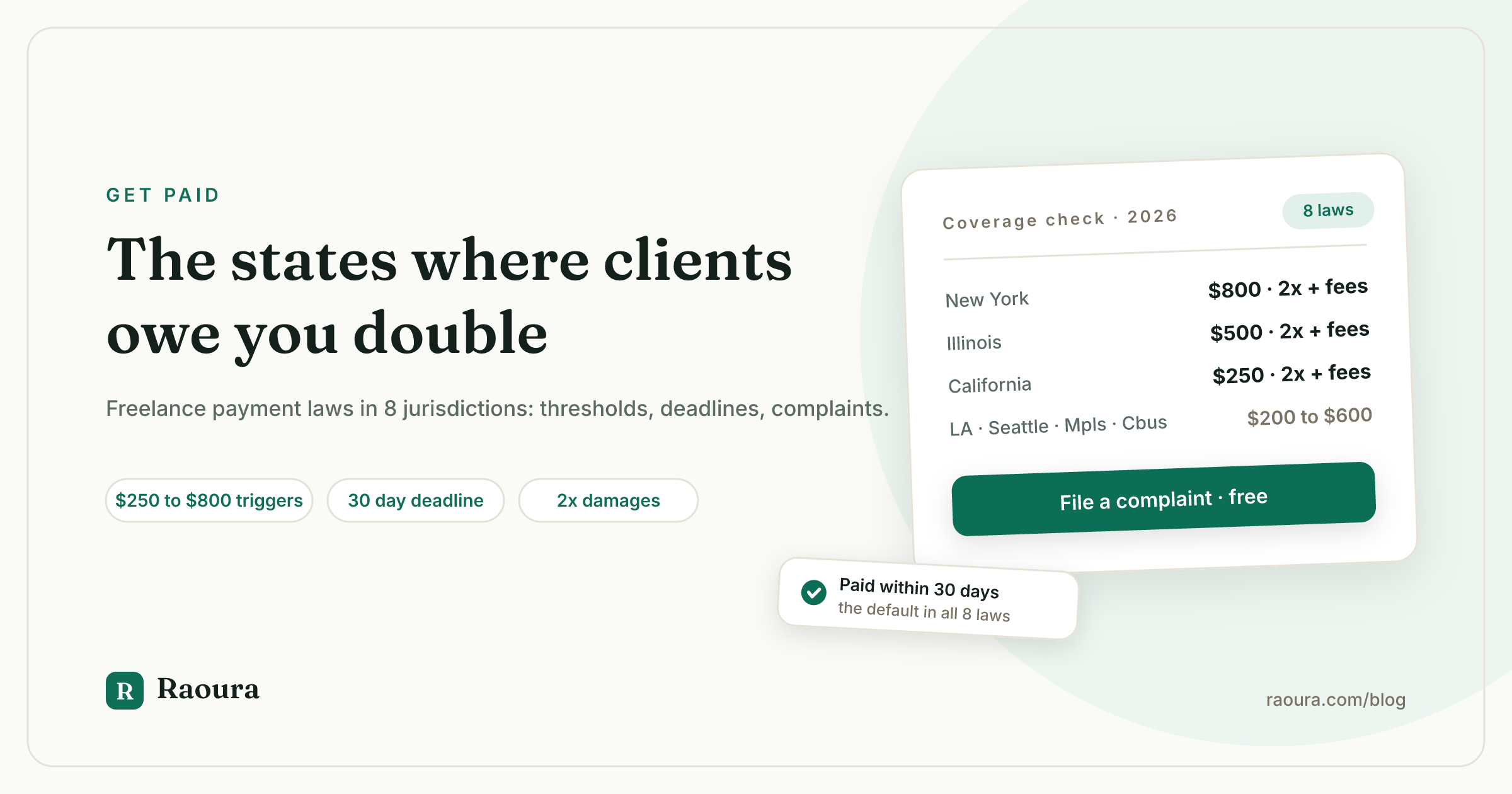
There is a decent chance a law already exists that turns your unpaid invoice into double the unpaid invoice, and nobody told you. Since 2017, three states and five cities have passed freelance payment laws, most of them named some variation of "Freelance Isn't Free." They require written contracts, set a hard payment deadline, and hand you double damages plus attorney fees when a client does not pay.
The problem is that no current, freelancer-facing map of these laws exists. The pages that rank for this topic are either single-jurisdiction government pages, law firm alerts written for the companies hiring you, or advocacy pages that quote New York City's $800 threshold as if it applied everywhere (it does not; the trigger is $500 in Illinois, $250 in California, and $600 in Los Angeles).
So freelancers in Chicago and San Francisco routinely assume they have no protection, and freelancers everywhere else assume they have protection they do not have.
This is the map. Every threshold, deadline, and damages figure below is traced to the statute text or the enforcing agency's own page, checked this month. For what to do when no statute covers you, our unpaid invoice escalation ladder picks up where the law leaves off.
What is the Freelance Isn't Free Act?#
The Freelance Isn't Free Act is a New York law requiring a written contract for freelance work worth $800 or more and entitling freelancers who are paid late to double the unpaid amount plus attorney fees. It started as a New York City ordinance in May 2017, the first law of its kind in the US, and went statewide on August 28, 2024.
The name has since become shorthand for a whole family of laws. Illinois passed its Freelance Worker Protection Act effective July 2024, California followed with SB 988 effective January 2025, and Los Angeles, Seattle, Minneapolis, and Columbus each have their own city ordinance.
They all share the same skeleton: a dollar threshold that triggers a written contract requirement, a payment deadline (in every single jurisdiction, the default is 30 days after you finish the work), damages that multiply what the client owes, and a ban on retaliation.
There is no federal version. If you have seen references to a federal "FREE Act," that is the Full Responsibility and Expedited Enforcement Act, a permitting bill with nothing to do with freelancers. As of July 2026, no federal freelance payment bill is moving.
Every US freelance payment law in force in 2026#
Eight jurisdictions have freelance payment laws in force in 2026: New York State, Illinois, California, New York City, Los Angeles, Seattle, Minneapolis, and Columbus, Ohio. Here is the whole landscape in one table. "Threshold" is the contract value that triggers the written contract requirement; in most jurisdictions smaller contracts aggregate toward it over a 120-day window.
| Jurisdiction | In force since | Contract threshold | Payment due | Core damages for nonpayment | Where to complain |
|---|---|---|---|---|---|
| [New York State](https://dol.ny.gov/freelance-isnt-free-act) | Aug 28, 2024 | $800 (aggregated over 120 days) | Contract date, else 30 days after completion | Double the unpaid amount, plus attorney fees | [NY Attorney General](https://ag.ny.gov/resources/individuals/workers-rights), or sue directly |
| [New York City](https://www.nyc.gov/site/dca/about/freelance-isnt-free-act.page) | May 15, 2017 | $800 (aggregated over 120 days) | Contract date, else 30 days | Double the unpaid amount, plus attorney fees | [DCWP online complaint](https://a866-dcwpbp.nyc.gov/worker-complaint/file-complaint?topic=freelancer) |
| [Illinois](https://labor.illinois.gov/laws-rules/legal/freelance-worker-protection-act.html) | Jul 1, 2024 | $500 (aggregated over 120 days) | Contract date, else 30 days | Double the underpayment, plus attorney fees | [Illinois DOL complaint form](https://labor.illinois.gov/laws-rules/legal/freelance-worker-protection-act/flwpa-complaint-form.html), then court |
| [California (SB 988)](https://leginfo.legislature.ca.gov/faces/billTextClient.xhtml?bill_id=202320240SB988) | Jan 1, 2025 | $250 (aggregated over 120 days), professional services only | Contract date, else 30 days | Up to double the unpaid amount, plus attorney fees | No agency; civil court only |
| [Los Angeles](https://wagesla.lacity.gov/) | Jul 1, 2023 | $600 (work performed in the city) | Contract date, else 30 days | Up to double the unpaid amount, plus attorney fees | [Office of Wage Standards](https://wagesla.lacity.gov/), or court |
| [Seattle](https://www.seattle.gov/laborstandards/ordinances/independent-contractor-protections-) | Sep 1, 2022 | $600 per year (disclosure rules, not contract terms) | Per contract or notice, else 30 days | Owed amounts via city enforcement | [Seattle Office of Labor Standards](https://laborinquiry.seattle.gov/worker-inquiry/) |
| [Minneapolis](https://minimumwage.minneapolismn.gov/wagetheft.html) | Jan 1, 2021 | $600 per year, or $200 within 7 days | Contract date, else 30 days | Up to the greater of double the amount owed or $500 | [Minneapolis Dept. of Civil Rights](https://minimumwage.minneapolismn.gov/report-a-violation.html) |
| [Columbus, OH](https://columbus.legistar.com/LegislationDetail.aspx?ID=6178197&GUID=38DD3933-90AC-46E8-A275-97277A532482&FullText=1) | May 31, 2023 | $250 (aggregated over 120 days) | Contract date, else 30 days | City sanctions on the client (no private damages schedule) | Columbus Wage Theft Prevention and Enforcement Commission |
Two observations from building this table that you will not find elsewhere.
- The contract trigger spans a full 3.2x range, from $250 in California and Columbus to $800 in New York, so "does this law apply to me" has eight different answers, but "when is payment due" has exactly one: every jurisdiction defaults to 30 days after completion.
- The laws split into two enforcement models. New York, New York City, Illinois, Seattle, Minneapolis, and Columbus give you a government complaint channel that costs nothing. California and (optionally) Los Angeles send you straight to court, which usually means small claims for typical freelance amounts.
New York: the strongest version, statewide#
In New York, a client who pays late owes you double the unpaid amount plus attorney fees, and the written contract requirement kicks in at $800 across all work in any 120-day period. The statewide Freelance Isn't Free Act (General Business Law Article 44-A) covers contracts signed on or after August 28, 2024, and the near-identical NYC law has covered the five boroughs since 2017.
What the statute actually gives you, section by section (damages are in GBL 1414):
- A written contract at $800+. That is a single contract or the running total of all your contracts with the same client over the preceding 120 days. The contract must include both parties' names and addresses, an itemization of services and their value, the rate and method of pay, and the payment date. New York publishes a free model contract.
- Payment by the contract date, or within 30 days of finishing if no date is set. Crucially, the client cannot make timely payment conditional on you accepting less than the agreed amount.
- Double damages for nonpayment, plus reasonable attorney fees and costs, with six years to sue. If the client also refused to put the deal in writing, you collect statutory damages equal to the full contract value on top.
- $250 statutory damages if you asked for a written contract before starting and the client refused (two years to sue on that piece alone).
- Retaliation damages equal to the contract value if a client threatens or blacklists you for exercising these rights, and a civil penalty up to $25,000 for clients with a pattern of violations.
Enforcement runs through the New York Attorney General statewide, or DCWP in New York City, and the NYC process has teeth: DCWP forwards your complaint, the client has 20 days to respond, and silence creates a court presumption that everything you alleged is true.
This is not theoretical. DCWP settled with BuzzFeed over late freelancer payments in June 2025 and won $528,817 in restitution from photo studio Splashlight in February 2026.
Not covered: sales representatives, practicing attorneys, licensed medical professionals, construction contractors, and any government client.
Illinois: the lowest-friction complaint process#
Illinois requires a written contract for freelance work worth $500 or more in any 120-day period and awards double the underpayment plus attorney fees for late or missing payment. The Freelance Worker Protection Act (820 ILCS 193) covers contracts taking effect after July 1, 2024, and applies when the work happens in Illinois or the client is based there, which pulls in a lot of remote arrangements.
The numbers, from the statute text: nonpayment costs the client double the underpayment plus your costs and attorney fees. Refusing your request for a written contract costs $500, and if the client both refused the contract and violated something else, statutory damages become the contract value or $500, whichever is greater. Retaliation costs the client the full contract value per violation. The Illinois Attorney General can pile on civil penalties of up to $5,000 per violation, or $10,000 for repeats within five years.
The complaint process is the most freelancer-friendly in the country. You file a free form with the Illinois Department of Labor within two years of when payment was due. IDOL notifies the client by certified mail within 20 days; if the client ignores it, that silence becomes a rebuttable presumption of guilt in court. IDOL also publishes model contracts in 12 languages and answers process questions in its FAQ. Construction workers and government contracts are excluded.
California: the lowest threshold, but you enforce it yourself#
California's Freelance Worker Protection Act covers professional services contracts of $250 or more and allows recovery of up to double the unpaid amount, but there is no state agency to complain to. SB 988 (Business and Professions Code 18100 to 18107) applies to contracts entered or renewed on or after January 1, 2025.
Three things make California different:
- It only covers "professional services" as defined in Labor Code 2778: graphic design, marketing, writing and editing, photography and videography, fine art, and similar creative and consulting work. A freelance plumber is not covered; a freelance copywriter is.
- The threshold is the lowest of any state: $250, alone or aggregated with other contracts for the same client over the prior 120 days.
- Enforcement is court-only. No agency takes complaints. You (or a public prosecutor) sue. For most freelance invoices that means small claims court, where California lets individuals claim up to $10,000 without a lawyer.
The damages schedule: $1,000 if the client refuses your pre-work request for a written contract, up to double the unpaid amount for late or missing payment, the value of the contract or of the work performed (whichever is greater) for any other violation, plus attorney fees and costs if you win.
Clients must keep the contract for four years, cannot demand less pay or extra work or your IP as a condition of paying on time, and cannot retaliate. Any contract clause waiving these rights is void.
The city laws: LA, Seattle, Minneapolis, Columbus#
Four city ordinances protect freelancers at thresholds between $200 and $600, and one of them, Minneapolis, has quietly been in force since January 2021. If you live in one of these cities (or your client operates there), you may be covered even though your state has no law:
- Los Angeles (Freelance Workers Protections Ordinance, LAMC 189.00): work performed in the city worth $600+, in force July 2023. Up to double the unpaid amount, $250 for refusing a written contract, attorney fees. Complain to the Office of Wage Standards or go straight to court. A November 2025 rule revision clarified the split with state law: from 2025 on, the city ordinance mainly covers LA work that falls outside SB 988's professional services definition, and the state law covers the rest.
- Seattle (Independent Contractor Protections Ordinance, SMC 14.34): a different model. From $600 per year per client, it requires pre-work written disclosure of terms and an itemized payment disclosure with each check, with payment per the stated terms or within 30 days. The Office of Labor Standards investigates and can order payment of what you are owed. Washington State has no statewide equivalent.
- Minneapolis (Freelance Worker Protections Ordinance, Code of Ordinances Ch. 40, Art. VI): written contract required at $600+ per calendar year with one client, or $200+ for work within seven consecutive days. Nonpayment brings the amount owed plus liquidated damages up to the greater of double that amount or $500. File with the Department of Civil Rights or dial 311.
- Columbus, Ohio (2023 wage theft code amendment): written contract at $250+ over 120 days, payment within 30 days. Enforcement is different: instead of private damages, the city's Wage Theft Prevention and Enforcement Commission can strip a violating client of tax abatements, subsidies, and city contracts. Unusually, the law covers the city itself as a hiring party.
Which law applies when you and the client are in different states?#
Coverage usually follows where the work is performed or where the client is located, not where you happen to live, and Illinois explicitly covers remote freelancers when either party is in the state. This is the question every ranking page skips, so here is the honest version:
- Illinois is the most explicit: per the IDOL FAQ, the law reaches work for products or services in Illinois or for a client located in Illinois, including remote work when either side is there. A freelancer in Texas with a Chicago client has a real Illinois claim.
- New York's statute defines protections around the hiring party relationship, and the Attorney General accepts complaints against New York clients. If your client is a New York company, file; the worst outcome is a referral elsewhere.
- California's law is written around the hiring party and the professional services relationship; out-of-state freelancers working for California companies are in a gray zone that the courts have not yet mapped.
- City ordinances (LA, Seattle, Minneapolis) turn on where the work is performed, so they rarely help fully remote out-of-town freelancers.
The practical move when jurisdiction is ambiguous: name the strongest plausibly applicable statute in your demand letter and let the client's lawyer decide whether to test it. A client staring at double damages plus your attorney fees rarely wants to litigate jurisdiction over a $3,000 invoice. Our escalation ladder covers where that letter sits in the sequence.
No law where you are? You are not unarmed#
Freelancers in the other 47 states still have contract law, small claims court up to $25,000 depending on the state, and late fee clauses that courts uphold at 1.5% per month. The statutes above add multipliers and free enforcement, but the underlying claim (you did the work, the client owes the money) exists everywhere.
Your fallback stack, in order: a signed contract with a payment deadline and late fee clause, payment terms that front-load your leverage (deposits, milestones, due on receipt), a reminder system that starts the day an invoice goes overdue (here is the full system with scripts), and small claims court, which handles most freelance-sized disputes without a lawyer.
The base rates are worth knowing: 29% of freelance invoices are paid at least a day late per Bonsai's invoice data, and QuickBooks' 2025 survey found 56% of small businesses are owed money, averaging $17,500. More context in our late payment statistics hub.
How to actually use these laws (before anything goes wrong)#
Every damages multiplier above depends on two pieces of paper you control: a written contract and a dated request for one, so the time to use these laws is at kickoff, not at day 45. The playbook:
- Put every project in writing at any dollar amount. The statutes set minimum thresholds; they do not stop you from always using a contract. Contracts correlate with 13.7% higher freelance income independent of any statute. What goes in one is covered in our clause-by-clause guide, and the required statutory contents (names, addresses, itemized services, rate, payment date) are things yours should have anyway.
- If a client refuses a written contract, ask again in writing and keep the message. In New York, that email is the difference between $0 and $250 in statutory damages, and between ordinary damages and contract-value damages stacked on top. In California it is worth $1,000. Send the ask, save the refusal.
- Put a payment date in the contract. Every statute defaults to 30 days after completion, but the contract date controls when you set one. "Due on receipt" or net 7 beats the statutory default by three weeks.
- Invoice with a dated paper trail. The statutes of limitation run from when payment was due, and complaints rise or fall on documentation: contract, invoice, due date, reminders sent.
- Escalate by citing the statute, then file. One line in a late-payment email ("this invoice is covered by the Freelance Isn't Free Act, which provides double damages and attorney fees") concentrates minds. If it does not, the complaint forms linked in the table above are free and take under an hour.
The unglamorous part is step 4, fifty-two weeks a year. This is where software earns its keep: Raoura puts the contract, the signed record, the invoice, the due date, and every reminder in one place per client, so if you ever need to file, the evidence file assembles itself. Disclosure: Raoura is our product.

One screen per client: the invoices, due dates, and paper trail sit together, so if you ever need to file a complaint the evidence is already in one place.
What is not happening (so you do not wait for it)#
No federal freelance payment law exists as of July 2026, and none is close. The things actually moving are adjacent: New Jersey adopted independent contractor classification rules effective October 1, 2026 (about who counts as an employee, not about payment deadlines), and four states (Utah, Alabama, Tennessee, Georgia) passed portable benefits laws in 2025 and 2026 that make it easier for companies to fund benefits for contractors.
Useful, but neither pays your invoice. If your state is not on the map above, your protection is the contract you write, not a statute on the way.
Frequently asked questions
Is there a federal Freelance Isn't Free Act?
No. As of July 2026 there is no federal freelance payment protection law and no active federal bill by that name. The "FREE Act" in Congress is an unrelated permitting bill. Protection exists only at the state and city level.
Does the New York City law still matter now that New York State has one?
Yes. The two coexist, and NYC's DCWP is the more experienced enforcer, with a dedicated complaint unit, a 20-day response process, and settlements against BuzzFeed (2025) and Splashlight ($528,817, 2026). If your client is in the five boroughs, DCWP is usually the better door.
My client refuses to sign a written contract. What should I do?
Ask again in writing and keep the message, because a documented request converts into statutory damages later ($250 in New York, $500 in Illinois, $1,000 in California). Then decide whether to walk. The laws also say an unwritten deal is still enforceable on the terms you can prove, so keep every email that mentions scope, rate, or timing.
Do these laws apply if my client is in a covered state but I am not?
Often yes. Illinois explicitly covers contracts where the client is located in Illinois even if you work remotely from elsewhere. New York accepts complaints against New York hiring parties. City ordinances mostly require the work to happen in the city. When in doubt, cite the statute in your demand letter and file the free complaint; the agency will tell you if it lacks jurisdiction.
Can I charge my late fee on top of statutory double damages?
They stack in the sense that your contract governs until you sue: the late fee applies to the overdue invoice, and if you end up in court under one of these statutes, the double damages calculation runs on the unpaid amount. In practice the statute makes the late fee almost irrelevant in covered states; its job is deterrence in the email phase. Details in our late fee guide.
How long do I have to file?
Illinois: two years from when payment was due, both for the IDOL complaint and a lawsuit. New York: six years for nonpayment and retaliation claims, two years for a contract-only violation. California follows standard contract limitation periods; sooner is always stronger, because the paper trail is fresher.
What counts toward the dollar threshold, one invoice or several?
In New York (state and city), Illinois, California, and Columbus, all contracts with the same client during the preceding 120 days aggregate toward the threshold. In Minneapolis it is $600 across a calendar year, or $200 in any seven-day stretch. So four $250 gigs for one Chicago client inside four months puts you over Illinois's $500 line.
---
Every threshold, deadline, damages figure, and effective date in this article was verified in July 2026 against primary sources: the New York General Business Law Article 44-A and GBL 1414, 820 ILCS 193 sections 25 and 30, California SB 988 (Business and Professions Code 18100 to 18107), the NYC DCWP, NY DOL, and Illinois DOL pages, the Los Angeles Office of Wage Standards ordinance and rules, Seattle SMC 14.34, the Minneapolis Department of Civil Rights FAQ, and the Columbus city legislative record. Statutes change; check the linked primary source before relying on any figure.
Run your client work in one place
Send a proposal, get it signed, invoice, and get paid, with a branded portal your clients will actually use. One flat plan at $17/month, and we never take a cut of your payments.
Try Raoura free for 14 daysNo credit card required. Set up in minutes.
Keep reading
Is Upwork Worth It in 2026? A Break-Even Test for Your Situation
Upwork is worth it when its fee costs less than finding the client yourself, and that is true far more often for a first project than for a repeat client. Here is the break-even math with 2026 numbers: the 0 to 15% fee, Connects, the shrinking client base, and when to wait out the 24-month rule instead of paying to leave.
The Virtual Assistant Contract: 24 Clauses, Scored Against Every Template Ranking for This Search
We scored the four pages that publish actual virtual assistant contract text against 24 clauses a VA agreement needs. Twenty-four of 96 possible slots were filled. The best single template managed 7 out of 24. Twelve clauses appear in none of them, including every clause about the thing that makes VA work different from other freelance work: you are holding your client's passwords and running their inbox. One popular template also tells you a contract fixes your independent contractor status, then mandates client-set 9 to 5 weekday hours in the same document. Here is the clause-by-clause version, with the classification test the DOL is actually applying in 2026, the data protection terms nobody drafts, and the retainer mechanics that decide whether unused hours roll over.
Stripe vs PayPal for Freelancers: Every Fee Verified (2026)
Every page ranking for this comparison either prints in-person retail rates, contradicts itself, or skips the numbers freelancers actually pay. We read the current Stripe and PayPal pricing pages line by line, ran a $3,000 invoice through every rail, and found a $1,764 per year gap between the cheapest setup and the default one.