Freelance Late Payment Statistics (2026): Every Number Traced to Its Primary Source
July 6, 2026
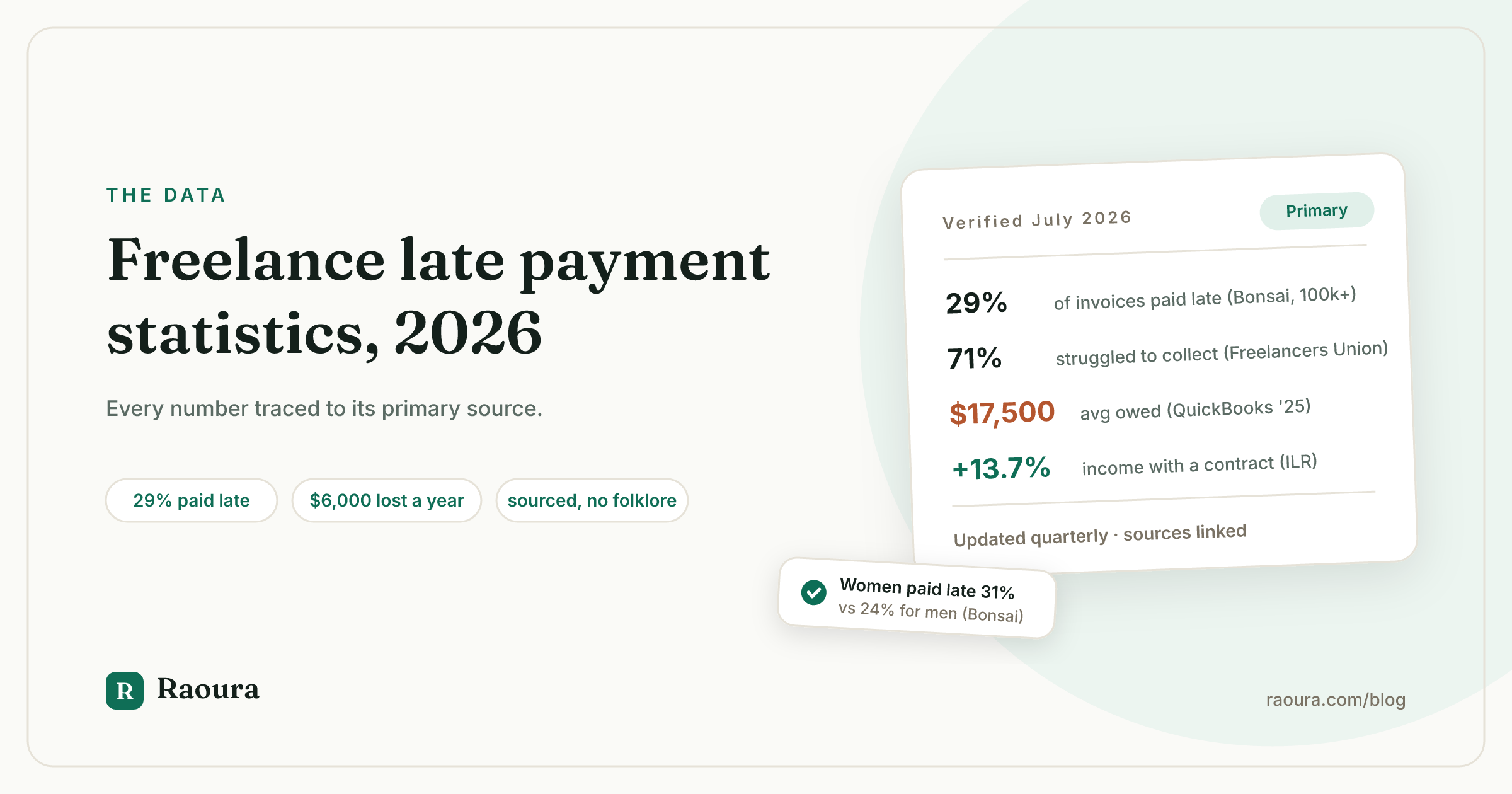
If you have researched late payments before, you have probably noticed something odd: the same numbers appear on dozens of sites, usually without a link to any study, and sometimes attributed to reports that do not seem to exist. Statistics pages cite other statistics pages, which cite other statistics pages, and somewhere along the chain the original survey (if there was one) is lost.
This page holds itself to one rule: every number links to the organization that actually collected the data, with a note on the sample and the year. Where a widely quoted figure could not be traced to a primary source, it is not here, and the most famous untraceable ones are called out at the bottom so you can stop citing them too. Last verified July 2026; we re-check quarterly.
How common are late payments?#
29% of freelance invoices are paid at least one day late. This is the single most reliable number in the field, because it is not survey recall: Bonsai analyzed three years of real invoicing data from more than 100,000 freelancers on its platform. From the same dataset: over 75% of late invoices are paid within 14 days of the due date, and about 90% within a month. Late usually means weeks, not never, which matters for how you design reminders.
71% of freelancers have struggled to collect payment at least once in their career. From the Freelancers Union's survey of more than 5,000 US freelancers, the foundational study in this area. It is older than the others here and worth pairing with newer data, but no larger US freelancer nonpayment survey has replaced it.
91% of New York freelancers have experienced late payment, and 62% have lost wages to outright nonpayment at least once. From a 2022 survey by the Freelancers Union and the Authors Guild used in the campaign that passed New York's statewide Freelance Isn't Free Act. 54% of those affected waited three months or longer.
72% of freelancers were carrying unpaid invoices for completed work in the Independent Economy Council's February 2022 report. (The same release claims 59% were owed $50,000 or more, a figure so far out of line with every other study that we recommend citing the 72% and treating the $50,000 claim with caution until the methodology is clearer.)
How much money is at stake?#
The average freelancer hit by nonpayment loses about $6,000 a year, roughly 13% of income. Freelancers Union, same 5,000+ person survey as above.
US small businesses that are owed money are owed $17,500 on average. From Intuit QuickBooks' January 2025 survey of 2,487 US small businesses (0 to 100 employees): 56% of small businesses have unpaid invoices outstanding, and 47% of those with overdue invoices have ones more than 30 days late. Not freelancer-specific, but the most recent rigorous US receivables data, and solo businesses sit inside the sample.
A 2024 FreshBooks survey put the average freelancer's outstanding unpaid invoices at about $7,150, with 29% writing off at least one invoice as uncollectible in the previous year (survey of 1,500 freelancers, reported via SUCCESS). We grade this slightly below the others because we could only verify it through press coverage rather than a published methodology.
Businesses paid late lean on debt to survive it. QuickBooks' 2025 report found late-paid small businesses were 1.7x more likely to have become more reliant on credit cards, carrying balances 1.5x higher, and 30% of them raised prices versus 21% of those paid on time. Late payment is not just an annoyance; it compounds.
Who gets paid late most?#
Women freelancers are paid late 31% of the time versus 24% for men. Also from Bonsai's invoice dataset, and one of the most under-discussed findings in the field: same work, same invoices, measurably slower payment.
Bigger invoices wait longer. In the same dataset, invoices over $20,000 were roughly three times more likely to be paid late than small ones, which is an argument for milestone billing on large projects rather than one terrifying final invoice.
The least-equipped get hit hardest. QuickBooks found businesses suffering most from late payments had markedly lower adoption of accounting or invoicing software (36% vs 56%) and were less likely to have a website (40% vs 63%). Correlation, not proof of causation, but consistent with everything else on this page: informality invites lateness. Relatedly, Clockify's compilation reports that 38% of solo business owners still build invoices in Word or Google Docs, and 54% wait more than a week to be paid after sending an invoice.
What actually reduces late payment?#
Freelancers who use written contracts earn 13.7% more, and contract use is associated with lower nonpayment. From an ILR Review study using Freelancers Union survey data, the only peer-reviewed number on this page. The same study is honest about the limit: 38.8% of freelancers who had a contract still experienced payment trouble. A contract is the floor, not the fix.
The strongest protective mechanics are the ones that move money earlier. Deposits before work starts, milestone billing so no more than one phase is ever outstanding, and automatic reminders. There is no rigorous published study quantifying exactly how much deposits reduce nonpayment (we checked; anyone quoting a precise percentage for this is guessing), but the arithmetic is not subtle: a 50% deposit halves your worst case before the project begins. Our guides to how much deposit to charge and getting clients to pay on time cover the mechanics.
Here is what the automatic-reminders piece looks like in practice: in Raoura, the reminder schedule is set once and then runs on every invoice without you touching it. (Disclosure: Raoura is our product.)

Automated reminders take the chasing out of your hands, so following up no longer depends on your nerve.
The law increasingly backs freelancers too. New York's Freelance Isn't Free Act (statewide, 2024) requires written contracts at $800+ and payment within 30 days, with double damages; Illinois' Freelance Worker Protection Act (July 2024) does the same at $500; California's SB 988 (January 2025) at $250.
The original NYC version measurably worked: the Freelancers Union reported it put a serious dent in client nonpayment after passage.
The quick-reference table#
| Statistic | Number | Source, year, sample |
|---|---|---|
| Freelance invoices paid late | 29% | Bonsai, invoice data, 100,000+ freelancers, 3 years |
| Late invoices resolved within 14 days | 75%+ | Bonsai, same dataset |
| Freelancers who ever struggled to collect | 71% | Freelancers Union, 5,000+ surveyed |
| Average annual loss when hit by nonpayment | ~$6,000 (13% of income) | Freelancers Union, same survey |
| NY freelancers who lost wages to nonpayment | 62% | Freelancers Union / Authors Guild, 2022 |
| US small businesses owed money | 56%, avg $17,500 | QuickBooks, 2,487 businesses, Jan 2025 |
| Freelancers carrying unpaid invoices | 72% | Independent Economy Council, 2022 |
| Late-payment rate, women vs men | 31% vs 24% | Bonsai, invoice data |
| Income premium for using contracts | +13.7% | ILR Review, peer-reviewed |
| Solo businesses invoicing from Word/Docs | 38% | Clockify compilation, 2025 |
The numbers we left out, on purpose#
A service to fellow researchers: the following claims circulate widely and we could not trace any of them to a primary study, so they do not appear above.
- "The average freelancer waits 39 days globally to be paid" (attributed to a 2026 report whose publisher provides no methodology).
- "85% of freelancers are paid late at least some of the time" (appears in vendor content citing a "Contractor Management Report" we could not locate).
- "Freelancers lose $15,600 a year to scope creep" (a modeled estimate presented as survey data).
If you can find the primary source for any of these, we would genuinely like to see it; until then, treat them as folklore with a decimal point.
Frequently asked questions
What percentage of freelance invoices are paid late?
29%, based on Bonsai's analysis of three years of real invoice data from over 100,000 freelancers, the largest non-survey dataset available. Survey-based figures run higher because people remember their worst clients.
How much does late payment cost freelancers?
The Freelancers Union found the average affected freelancer loses about $6,000 a year, around 13% of income. QuickBooks' 2025 data puts average outstanding receivables for owed small businesses at $17,500.
Are late payments getting better or worse?
The honest answer: nobody measures this consistently year over year for freelancers specifically. The best trend signal is legal: three states passed freelancer payment laws between 2023 and 2025, and the NYC law that preceded them measurably reduced nonpayment complaints.
What is the most effective way to avoid being paid late?
The evidence supports a stack rather than a single fix: a written contract (the only peer-reviewed protective factor), a deposit before work begins, milestone billing on anything large, and automated reminders so the chasing does not depend on your nerve.
---
Every statistic above was verified against its linked primary source in July 2026. This page is updated quarterly; if a number here goes stale or a better study appears, it gets replaced. Found a primary source we missed? Tell us and we will add it.
Run your client work in one place
Send a proposal, get it signed, invoice, and get paid, with a branded portal your clients will actually use. One flat plan at $17/month, and we never take a cut of your payments.
Try Raoura free for 14 daysNo credit card required. Set up in minutes.
Keep reading
Is Upwork Worth It in 2026? A Break-Even Test for Your Situation
Upwork is worth it when its fee costs less than finding the client yourself, and that is true far more often for a first project than for a repeat client. Here is the break-even math with 2026 numbers: the 0 to 15% fee, Connects, the shrinking client base, and when to wait out the 24-month rule instead of paying to leave.
The Virtual Assistant Contract: 24 Clauses, Scored Against Every Template Ranking for This Search
We scored the four pages that publish actual virtual assistant contract text against 24 clauses a VA agreement needs. Twenty-four of 96 possible slots were filled. The best single template managed 7 out of 24. Twelve clauses appear in none of them, including every clause about the thing that makes VA work different from other freelance work: you are holding your client's passwords and running their inbox. One popular template also tells you a contract fixes your independent contractor status, then mandates client-set 9 to 5 weekday hours in the same document. Here is the clause-by-clause version, with the classification test the DOL is actually applying in 2026, the data protection terms nobody drafts, and the retainer mechanics that decide whether unused hours roll over.
Stripe vs PayPal for Freelancers: Every Fee Verified (2026)
Every page ranking for this comparison either prints in-person retail rates, contradicts itself, or skips the numbers freelancers actually pay. We read the current Stripe and PayPal pricing pages line by line, ran a $3,000 invoice through every rail, and found a $1,764 per year gap between the cheapest setup and the default one.