How Much Deposit Should a Freelancer Charge? The Decision Table, the Clause, and the Scripts
July 6, 2026
You know the feeling. The contract is signed, you have blocked out three weeks for the project, you have turned down other work to make room, and you have not seen a dollar. Every hour you put in now is an hour you are lending to someone you may have met twice over Zoom.
A deposit is how you stop lending. And yet most advice on this topic amounts to one sentence: "charge 50% upfront." That is a fine default and a bad answer, because the right deposit for a $400 logo from a repeat client and a $15,000 site build for a stranger is not the same number.
The short answer: charge 25 to 50% upfront, with 50% as the default for new clients on typical project work, and adjust from there based on who the client is, how big the project is, and how you are collecting the money. This guide gives you the full decision table, the contract wording, what to say when a client pushes back, and the fee math on actually collecting a large deposit, which no one else covering this topic seems to mention. Everything here was checked in July 2026.
Why deposits exist: the numbers are worse than you think#
71% of freelancers have struggled to collect payment at least once, and the average freelancer hit by nonpayment loses about $6,000 a year, roughly 13% of income. That is from the Freelancers Union's survey of more than 5,000 US freelancers (The Costs of Nonpayment), and the newer data is no kinder.
- Bonsai's analysis of three years of invoices from 100,000+ freelancers found 29% of freelance invoices are paid at least one day late.
- A 2022 Independent Economy Council report found 72% of freelancers were carrying unpaid invoices.
- Intuit QuickBooks' January 2025 survey of 2,487 small businesses found 56% are owed money on unpaid invoices, averaging $17,500 each.
A deposit does three things at once against that backdrop:
- It filters. A client who balks at any deposit on a normal project is telling you something about how the final invoice will go. You are learning this before you have done the work, which is the cheapest possible time to learn it.
- It caps your exposure. With 50% down on a $6,000 project, the most you can lose is $3,000 of work, not $6,000. Structure the rest as a milestone payment and your worst case shrinks again.
- It changes the relationship. A client with money in the project treats kickoff calls, feedback rounds, and your invoices differently. As freelance pricing writer Austin L. Church puts it, people's respect follows their money.
One honest caveat: nobody has published a rigorous study measuring exactly how much deposits reduce nonpayment. The stats above tell you the risk you are exposed to without one. Treat "deposits cut your losses" as the obvious arithmetic it is, not as a precise researched percentage.
The decision table: what to charge, by situation#
Start from 50% and move down only when trust or invoice size justifies it. Here is the whole framework in one table:
| Situation | Deposit | Why |
|---|---|---|
| New client, project under $2,000 | 50% | Small enough that half the total will not scare anyone serious |
| New client, project $2,000 to $10,000 | 40 to 50% | The standard zone; pair the rest with a mid-project milestone |
| New client, project over $10,000 | 25 to 33%, plus milestones | A third of $15,000 secures commitment without stressing their cash flow; milestones do the rest of the protecting |
| Returning client with a clean payment history | 0 to 25%, or first milestone only | Reward the trust they have earned, but keep milestone structure on big work |
| Rush job or same-week turnaround | 100% | You are giving up scheduling flexibility you can never bill anyone else for |
| Tiny one-off (under about $500) | 100% | Chasing a $300 invoice costs more than it is worth |
| Any client showing red flags | 50 to 100%, or walk | Vague scope, "the last freelancer failed us", pressure to start today: raise the deposit or decline |
| Client is a large company with a formal AP process | First milestone instead | See the objection scripts below; enterprise AP genuinely cannot always do deposits |
These ranges match what the practitioner consensus has converged on:
- Toggle's 2026 guide lands on 25 to 33% for large projects and 50% as standard.
- FreshBooks cites a 20% floor and 50% ceiling.
- Long projects commonly run on thirds: a third at signing, a third at midpoint, a third at delivery.
The rule underneath all of it: the less history you have with a client, the higher the deposit.
For projects longer than about six weeks, stop thinking "deposit plus final payment" entirely and think in milestones: the deposit is simply the first milestone, and no phase starts until the previous one is paid. That way you are never owed more than one phase of work at any moment. Milestone structures deserve their own article, but the short version is that they solve the big-project version of this problem better than any deposit percentage can.
Deposit, retainer, or advance? The word you use matters#
A deposit is a partial prepayment toward a defined project; a retainer buys your availability for a period; an advance is prepayment for work not yet done. Freelancers use the words interchangeably. Courts and tax people do not, and the distinction becomes real the moment a project gets cancelled.
The clearest illustration comes from professions where this is formalized.
In law, a "true retainer" is earned the moment it is received, because it pays for the lawyer's availability, while an advance fee for future work must be refunded if the work is never done, no matter what label was stapled to it.
Wedding photographers learned the same lesson years ago and now use "non-refundable retainer" rather than "deposit" in their contracts, because the retainer framing matches what actually happens: booking a date means turning away every other inquiry for that date, which is a loss that occurs whether or not the wedding does.
The practical takeaway for you: if your upfront payment is compensating you for reserving time and turning away other work, call it a retainer in your contract and say what it covers. If it is simply the first chunk of the project price, call it a deposit and tie the rest to milestones. Do not call it whatever sounded most professional today, because the label signals your intent when a dispute lands.
Is "non-refundable" actually enforceable?#
Mostly yes, if the amount reasonably reflects a real loss; mostly no, if it works like a punishment. This is the part every other guide on this topic skips, while cheerfully advising you to stamp "non-refundable" on everything.
Here is how lawyers generally explain it. When a contract lets one side keep money after a cancellation, courts treat that as a liquidated damages question: was the amount kept a reasonable estimate, made at signing time, of the harm the cancellation would cause?
If yes, it stands. If it functions as a penalty, it does not, and in California specifically, forfeitures of deposits are disfavored as a matter of public policy under the state's liquidated damages rules (Civil Code section 1671).
Writing "non-refundable" in bold does not change the analysis.
What this means in practice:
- Keeping a deposit that covers work you already did or time you provably reserved: solid ground. That is compensation, not penalty.
- Keeping a 50% deposit when the client cancelled an hour after signing and you had done nothing: shaky ground, whatever the contract says.
- The fix: word the clause so the deposit maps to something real, like scheduling the project and beginning discovery, and pair it with a kill fee that scales with how far the work has progressed.
This is general information, not legal advice; if you are writing a non-refundable clause into contracts for five-figure projects, an hour of a contract lawyer's time is cheap insurance. But the direction is clear enough to write a sane clause, which brings us to the wording.
The deposit clause you can copy#
No page ranking for this topic gives you actual contract language. Here is a clause you can adapt:
Deposit and payment schedule. A deposit of [40%] of the total project fee ([$2,400]) is due upon acceptance of this agreement. Work begins once the deposit is received. The deposit reserves the Contractor's schedule for the project dates above and is applied against the final project fee. If the Client cancels the project after work has begun, the deposit is retained as compensation for time reserved and work performed to the date of cancellation. The remaining balance is due as follows: [30% on approval of the first milestone; 30% on final delivery]. Final files and deliverables are released upon receipt of final payment.
Why each piece is there:
- "Due upon acceptance" removes the awkward second ask after signing.
- "Work begins once the deposit is received" makes the deposit self-enforcing, so you never chase it, you just do not start.
- The "reserves the Contractor's schedule" sentence gives the retention teeth under the liquidated damages logic above.
- "Final files released upon final payment" quietly sets up your leverage at the other end of the project.
If you want the deeper treatment, we keep a free, ungated freelance contract template with this clause and the other protective ones (late fees, kill fee, scope) annotated line by line.
What to say when the client pushes back#
Three objections cover nearly every deposit conversation you will ever have. Scripts for each:
"We don't pay deposits to new vendors." This is common and often sincere; the client has been burned too, and FreshBooks is right that a stranger asking for money upfront reads as risky from their side of the table. Meet it in the middle with structure instead of trust:
"Completely understand. Here's what I do with new clients in that situation: we break the project into three milestones, and you only ever pay for the phase we just completed and approved. The first milestone is small, [$800], and covers [discovery and direction]. You are never funding work you have not seen."
You have preserved the principle (money before the next phase of work) while dropping the scary word.
"Our accounts payable can't do that." With genuine enterprise clients, this is frequently true; their systems pay invoices on net 45 against a purchase order, and there is no box for "deposit." Do not fight the AP department. Reshape the project instead:
"No problem. Can we structure phase one as its own deliverable with its own invoice and PO? I'll invoice it on day one so it can start moving through your cycle while I work."
Then confirm their actual payment terms before you sign, and price the waiting into the project.
"Can we just pay when it's done?" From a small client on a normal project, with no AP excuse, this is the one to take seriously as a signal. Hold your line, gently:
"I reserve dedicated time for every project I take on, so I schedule work once the deposit is in. It's how I make sure I can give you my full focus for [the project dates]. If the timing of the deposit is the issue, I'm happy to push the start date to whenever works better for cash flow."
If they still refuse everything, including milestones, believe them. The Freelancers Union data above is a list of people who did not.
Actually collecting it: the fee math nobody mentions#
On a $5,000 deposit, collecting by card costs you about $145 in processing fees; collecting by ACH bank transfer costs $5. This is the entire section other guides skip, and it is real money.
The standard US card rate through Stripe is 2.9% plus 30 cents. ACH direct debit runs 0.8%, capped at $5. Run the numbers on typical deposits:
| Deposit amount | Card fee (2.9% + $0.30) | ACH fee (0.8%, $5 cap) |
|---|---|---|
| $500 | $14.80 | $4.00 |
| $1,500 | $43.80 | $5.00 |
| $5,000 | $145.30 | $5.00 |
| $10,000 | $290.30 | $5.00 |
So why does anyone take deposits by card? Speed and friction. A card payment clears instantly and takes the client 30 seconds from their phone, which matters enormously for the psychology of the deposit: the best moment to collect is the moment they say yes. Every day between "let's do it" and money received is a day for second thoughts, competing priorities, and the project quietly dying in someone's inbox.
ACH saves you $140 on a $5,000 deposit but takes about four business days to settle and asks the client to go find their account and routing numbers.
A sensible policy: cards for deposits under about $2,000, offer ACH alongside for anything bigger, and let the client pick. Whatever you do, do not send a deposit request as a PDF invoice with wire instructions and hope; put a payment button on the thing they are accepting.
Two more mechanics worth getting right:
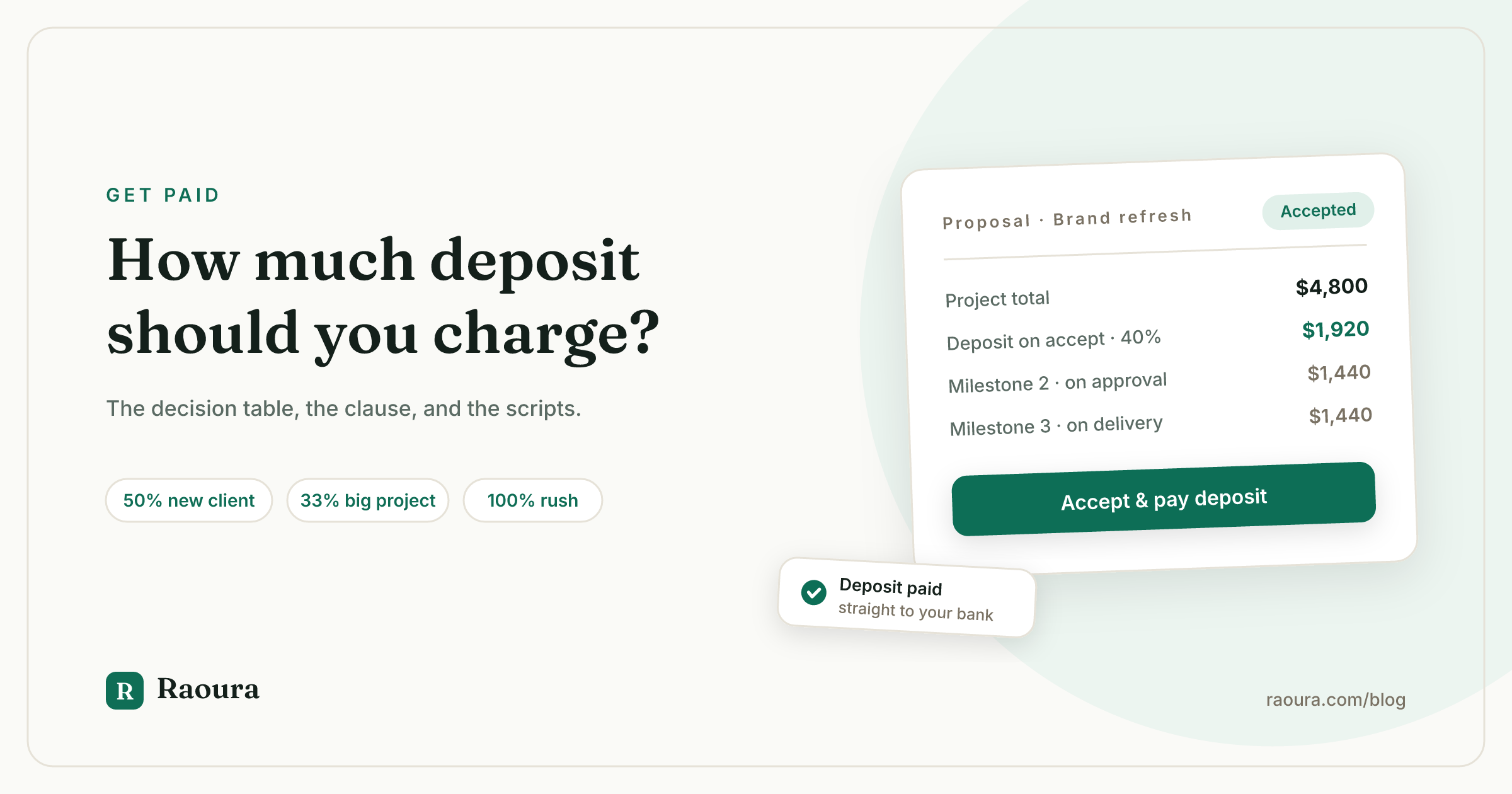
- Collect at acceptance, not after. The deposit should be built into the proposal itself, so that accepting the proposal and paying the deposit are one action, not two emails a week apart. (Disclosure: this is our product, but this is exactly what Raoura is built around. The client opens your proposal, clicks accept, and pays the deposit on the same page, by card or Apple Pay, straight into your own Stripe account. Raoura costs $17 per month flat and takes no cut of your payments.)
- Skip escrow. Marketplaces have trained some clients to expect a middleman holding the money. For direct client work you do not need one: milestones give the client the same protection (they never pay ahead for work they have not approved) without a platform sitting between you and your money.

Acceptance and deposit are the same click, so the money lands at the exact moment the client says yes.
When not to charge a deposit#
The deposit rule has real exceptions, and pretending it does not makes the advice useless:
- Long-standing clients who always pay. If a client has paid ten invoices on time, imposing a deposit out of nowhere reads as distrust. Keep milestones on large projects and leave it there.
- Enterprise AP, as above. Take the small first milestone and the PO number instead.
- Retainer relationships. Monthly retainers are already prepayment; bill at the start of each month and you have solved the same problem with a different tool.
- Tiny fast tasks for known clients. A $150 tweak for a regular does not need a payment gate; it needs to take you less time than invoicing it.
What is never on this list: new client, real project, no deposit, because asking felt awkward. That feeling costs an average of $6,000 a year.
One more thing: the law is slowly moving your way#
No state forces your clients to pay deposits, but a growing set of laws now backs up the rest of your payment terms.
- New York's Freelance Isn't Free Act (statewide since 2024) requires a written contract for work of $800 or more and payment within 30 days, with double damages for violations.
- Illinois' Freelance Worker Protection Act does the same at $500.
- California's SB 988 requires the same at $250, effective January 2025.
The common thread: the written contract where your deposit clause lives is not just leverage anymore, it is the document these laws enforce. If you work with clients in those states, you have more protection than you probably realize, and we cover the details in our state-by-state guide to the freelance payment laws.
Frequently asked questions
What deposit percentage should a new freelancer charge?
The same as an experienced one: 50% on normal new-client projects. Your inexperience is priced into your rate, not into your payment terms. If the number feels unaskable, remember you are not asking for extra money, only for part of the agreed price earlier.
Can I keep the deposit if the client cancels?
If you reserved time or did work, generally yes, and your contract should say the deposit compensates exactly that. If the client cancels before you have done anything at all, keeping the full deposit is legally shaky in many states and reputationally worse. A fair kill fee structure handles cancellation better than a blanket "non-refundable" stamp.
Should the deposit come before or after the contract is signed?
Same moment, ideally. The cleanest flow is a proposal the client accepts and pays in one step, with the contract signed alongside. Never start work with a signed contract but no deposit; the signature is not the commitment, the payment is.
Is a deposit taxable when I receive it?
For the cash-basis accounting almost all US freelancers use, yes: income counts when the money arrives, not when the project finishes. Remember that when you set aside your tax percentage in December on a project you will deliver in February.
Do I charge a deposit on hourly work?
Not a percentage deposit, since there is no fixed total. The equivalent is a prepaid block: the client buys 10 or 20 hours upfront, you bill against the block, and work pauses when it runs out. Same protection, different shape.
Should I call it a deposit or a retainer?
Call it what it is. Prepayment toward a defined project: deposit. Payment to reserve your availability for a period: retainer. The label should match the substance, because if a dispute ever reaches a lawyer, the substance is what gets examined.
---
Every price, rate, and legal reference in this article was checked in July 2026. Sources are linked inline; the nonpayment statistics come from the Freelancers Union, Bonsai, the Independent Economy Council, and Intuit QuickBooks' 2025 Late Payments Report.
Run your client work in one place
Send a proposal, get it signed, invoice, and get paid, with a branded portal your clients will actually use. One flat plan at $17/month, and we never take a cut of your payments.
Try Raoura free for 14 daysNo credit card required. Set up in minutes.
Keep reading
Is Upwork Worth It in 2026? A Break-Even Test for Your Situation
Upwork is worth it when its fee costs less than finding the client yourself, and that is true far more often for a first project than for a repeat client. Here is the break-even math with 2026 numbers: the 0 to 15% fee, Connects, the shrinking client base, and when to wait out the 24-month rule instead of paying to leave.
The Virtual Assistant Contract: 24 Clauses, Scored Against Every Template Ranking for This Search
We scored the four pages that publish actual virtual assistant contract text against 24 clauses a VA agreement needs. Twenty-four of 96 possible slots were filled. The best single template managed 7 out of 24. Twelve clauses appear in none of them, including every clause about the thing that makes VA work different from other freelance work: you are holding your client's passwords and running their inbox. One popular template also tells you a contract fixes your independent contractor status, then mandates client-set 9 to 5 weekday hours in the same document. Here is the clause-by-clause version, with the classification test the DOL is actually applying in 2026, the data protection terms nobody drafts, and the retainer mechanics that decide whether unused hours roll over.
Stripe vs PayPal for Freelancers: Every Fee Verified (2026)
Every page ranking for this comparison either prints in-person retail rates, contradicts itself, or skips the numbers freelancers actually pay. We read the current Stripe and PayPal pricing pages line by line, ran a $3,000 invoice through every rail, and found a $1,764 per year gap between the cheapest setup and the default one.