Stripe vs PayPal for Freelancers: Every Fee Verified (2026)
August 30, 2026
Search "Stripe vs PayPal" and here is what ranks: two affiliate pages that lead with in-person card-reader rates (useful if you run a coffee shop, useless if you email invoices), a POS hardware comparison, and a freelancer guide from a competing software vendor that quotes PayPal's fee as 2.9% + $0.30 in one section and 2.99% + $0.49 in another. Not one of them runs the numbers on the thing you actually do: send an invoice for a few thousand dollars and wait for a client to pay it.
So this article does only that. Every fee below was read directly from Stripe's and PayPal's current pricing pages on July 16, 2026, each number links to its source, and we run the same $3,000 invoice through every rail both companies offer. The differences are much bigger than the headline rates suggest, and the cheapest option is one neither company puts in front of you.
The short answer#
For a US freelancer invoicing clients, Stripe is cheaper on every rail that matters, and its ACH option (0.8% capped at $5) makes it dramatically cheaper on large invoices: a $5,000 invoice costs $5 in processing through Stripe ACH and about $175 through PayPal checkout.
PayPal still earns a place for one reason: some clients simply want to pay with it, and the fastest invoice to get paid is the one your client does not have to think about. The practical answer for many freelancers is Stripe as the default rail with PayPal as the exception you tolerate, not the other way around. The rest of this article is the evidence.
Every fee, verified July 2026#
Across the eight fees a freelancer actually encounters, Stripe is lower or equal on seven; PayPal wins only on standard bank withdrawals, which are free on both but arrive in 1 to 3 business days from PayPal against Stripe's 2-day payout cycle.
All numbers below come from Stripe's pricing page, Stripe's invoicing pricing, PayPal's US merchant fee schedule, and PayPal's consumer fee page, read on July 16, 2026.
| Fee | Stripe | PayPal |
|---|---|---|
| Domestic online card payment | 2.9% + $0.30 | 2.99% + $0.49 (unbranded card) or 3.49% + $0.49 (PayPal, Venmo, guest checkout) |
| Bank debit (ACH) | 0.8%, capped at $5.00 | No ACH-priced rail; bank-funded payments bill at the commercial rates above |
| Invoicing surcharge | 0.4% per paid invoice (Starter) | $0 to send invoices; the payment itself bills at commercial rates |
| International cards | +1.5% | +1.5% |
| Currency conversion | +1% | 3% spread on converting received balances |
| Dispute fee | $15 received + $15 to counter, the counter fee refunded only if you win | $15 standard, $30 high-volume tier, $20 card chargeback (unbranded) |
| Instant payout / transfer | 1.5%, minimum $0.50 | Business: 1.5%, minimum $0.50. Personal: 1.75%, minimum $0.25, capped at $25 |
| Standard payout | Free, 2 business days | Free, typically 1 to 3 business days |
Neither platform charges a monthly fee for a standard account: Stripe's page says "no setup fees, monthly fees, or hidden fees," and PayPal's business account is free unless you add optional products (its invoicing subscription service is $14.99 per month, but sending ordinary invoices costs nothing).
Two details in that table deserve emphasis because every ranking page gets them wrong.
- PayPal invoices have two rates, not one. If your client pays the invoice with a card or Apple Pay, you pay 2.99% + $0.49, and only payments funded through a PayPal or Venmo account cost 3.49% + $0.49.
- Stripe's dispute fee is no longer "a flat $15, refunded if you win." Stripe now charges $15 when a dispute arrives plus $15 if you counter it, and only the counter fee comes back on a win, so even a dispute you win costs $15.
What a $3,000 invoice actually costs on each rail#
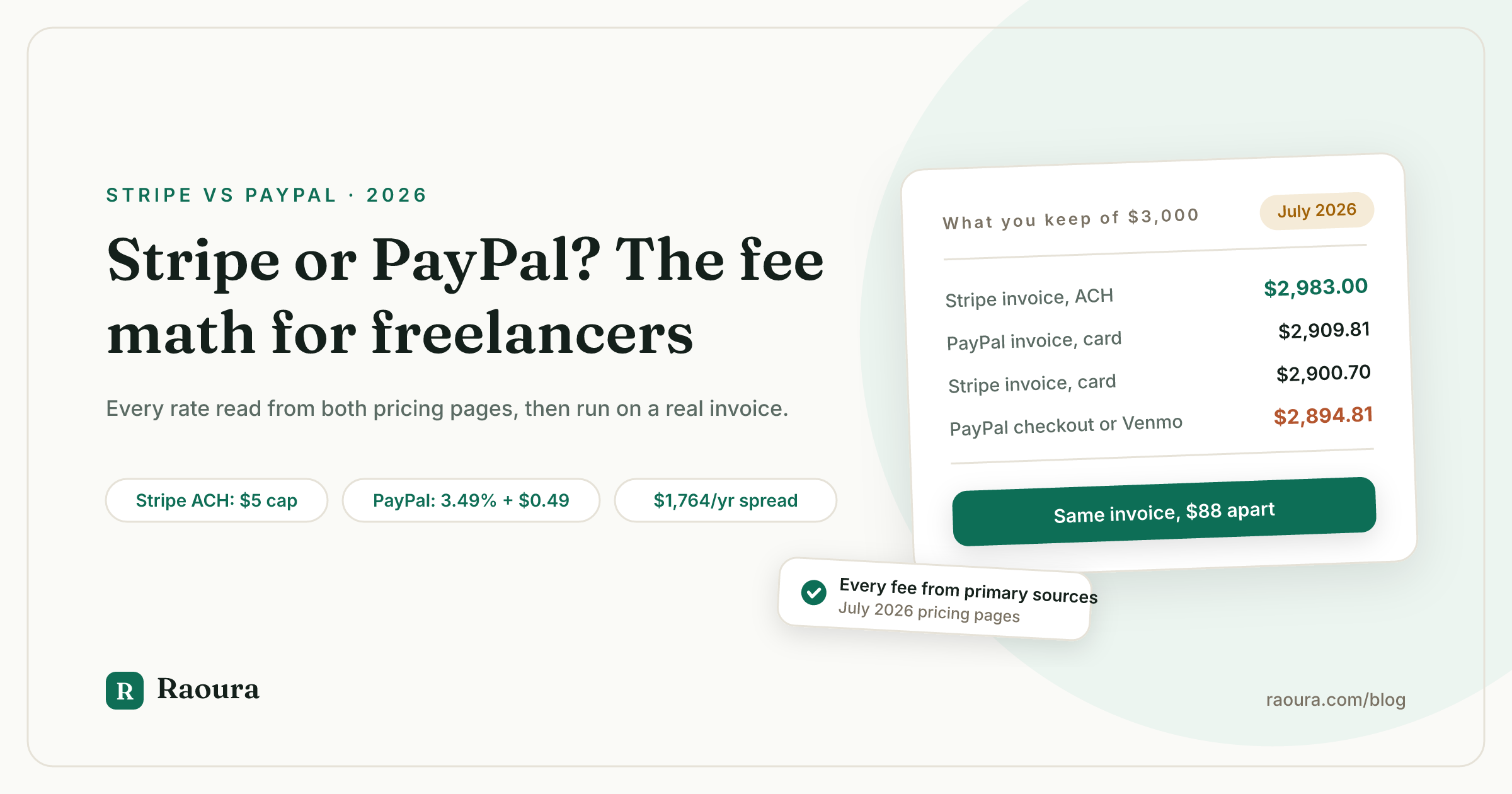
On a single $3,000 invoice, your processing cost ranges from $17.00 (Stripe ACH through an invoice) to $105.19 (PayPal invoice paid with a PayPal balance), a spread of $88 on one invoice.
Assumptions: US freelancer, US client, invoice paid online. Stripe rows include the 0.4% Stripe Invoicing fee where an invoice is used; note that a Stripe Payment Link costs nothing extra and skips that 0.4%.
| Rail | Fee math | Total fee | You keep | Cost % |
|---|---|---|---|---|
| Stripe invoice, client pays by ACH | $5.00 (0.8% capped) + $12.00 invoicing | $17.00 | $2,983.00 | 0.57% |
| Stripe Payment Link, card | 2.9% + $0.30 | $87.30 | $2,912.70 | 2.91% |
| PayPal G&S transfer from client | 2.99% | $89.70 | $2,910.30 | 2.99% |
| PayPal invoice, client pays by card | 2.99% + $0.49 | $90.19 | $2,909.81 | 3.01% |
| Stripe invoice, client pays by card | 2.9% + $0.30 + $12.00 invoicing | $99.30 | $2,900.70 | 3.31% |
| PayPal invoice, client pays with PayPal or Venmo | 3.49% + $0.49 | $105.19 | $2,894.81 | 3.51% |
Now stretch that over a year. A freelancer billing $60,000 across 20 invoices of $3,000 pays about $340 on Stripe ACH invoices, $1,986 on Stripe card invoices, $1,804 on PayPal card-paid invoices, and $2,104 if every client pays through PayPal checkout.
That is our own math from the verified rates above, and the spread between the cheapest and most expensive setup is $1,763.80 per year, roughly a month of groceries handed to a processor because of a default setting.
The single most useful sentence in this article: Stripe caps ACH fees at $5 per transaction (the 0.8% rate hits that cap at $625, so every invoice above that costs a flat $5 to process), and PayPal has nothing comparable. That one cap does more for your margins than any other line on either pricing page.
For context on how fees stack when the client is abroad, we ran the same exercise on international rails in our international invoicing fee guide.
Invoicing: what it costs you and what the client sees#
Stripe charges 0.4% per paid invoice on its Starter plan with no free tier (the 25 free monthly invoices ended November 1, 2023), while PayPal invoices are free to send and bill only when paid.
On pure invoicing mechanics the two are closer than the fee table suggests. Both let you send an unlimited number of invoices, both give the client a hosted payment page, and on both the client can pay as a guest without creating an account.
PayPal's brand recognition genuinely helps with some clients: a PayPal button is familiar to anyone who has bought anything online since 2005. Stripe's hosted invoice page reads as more neutral and more corporate, which tends to land better with business clients who route payments through accounts payable.
The real differences are around the edges. Stripe invoices can offer card and ACH side by side, which is how you get the $5-capped rail in front of a client without an awkward "can you do a bank transfer instead" conversation. PayPal invoices can surface PayPal, Venmo, and card options, which maximizes the odds a consumer-ish client just pays the thing.
Neither company will chase the invoice for you beyond basic automated reminders, and neither connects the invoice to the proposal, contract, or project it belongs to. That layer, where payment terms and reminder cadence live, is a separate problem no processor solves.
Disputes and chargebacks#
A dispute you win now costs you $15 on Stripe and $0 to $30 on PayPal depending on the transaction type, and a dispute you lose costs the disputed amount plus up to $30 in fees on either platform.
Stripe's current structure: a $15 dispute received fee the moment a cardholder disputes, which you never get back, plus a $15 dispute countered fee if you fight it, which is refunded only if you win.
PayPal's: a $15 standard dispute fee on PayPal-processed transactions, $30 if your dispute rate puts you in the high-volume tier, and $20 for card chargebacks on unbranded card payments.
For freelancers the fee is the small part. The disputed amount itself is the risk, and the defense is the same on both platforms: a signed contract, written approval of deliverables, and an invoice trail.
PayPal's Seller Protection can cover eligible goods-and-services transactions, but services disputes are notoriously hard to win on any platform, which is why the better system is preventing them upstream with clear terms and milestone billing so no single payment is big enough to fight over.
Holds, freezes, and reserves#
PayPal's own help pages say account reviews typically take 3 business days, but its reserve holds can run up to 180 days, against 30 to 90 days for a typical Stripe reserve.
This is the fear that fills freelancer forums, so here is what the companies themselves publish. PayPal lists its limitation triggers: regulatory requirements, acceptable use violations, unusually high claim or chargeback rates, and sudden changes in selling volume.
That last one matters for freelancers, because "sudden change in volume" describes any solo business landing its first five-figure project.
Stripe's reserves FAQ describes the same machinery in different clothes: a temporary hold on a portion of funds, sized to your dispute rate, refund rate, industry, and financial profile.
The practical mitigations are identical on both: use a business account, describe your services accurately at signup, invoice with contracts behind the numbers, and never run client money through rails meant for personal payments (more on that below). And whichever processor you choose, keep your money moving: a balance sitting in a processor account is the thing a freeze can trap, while money paid out on a 2-day cycle mostly is not.
Payout speed#
Stripe pays out on a 2 business day cycle in the US, PayPal balances transfer to your bank free in 1 to 3 business days, and both charge about 1.5% if you want the money instantly.
Stripe's payout documentation lists 2 business days as the US settlement timing, with instant payouts at 1.5% (minimum $0.50).
PayPal money lands in your PayPal balance immediately, which feels faster, but getting it to your actual bank takes a standard transfer of 1 to 3 business days for free, or an instant transfer at 1.5% (minimum $0.50) from a business account.
On a personal account the instant rate is worse in one way and better in another: 1.75%, but capped at $25, which oddly makes a personal-account instant transfer the cheaper option above about $1,667, where the business rate's uncapped 1.5% passes the $25 ceiling.
Net effect: end to end, the two are within a day of each other for most freelancers, and neither is the bottleneck. The bottleneck is the client paying at all, which is a systems problem, not a processor problem.
The Friends and Family trap#
A Friends and Family payment saves the client 2.99% and costs you every protection PayPal offers: the User Agreement flatly prohibits personal transactions "when you are paying for goods or services."
Freelancers get asked for this constantly, because a Friends and Family payment is free for the client's side when funded by bank or balance. Do not accept it.
The User Agreement prohibits it outright, business accounts are not even eligible to receive personal transactions, and PayPal's help center confirms that personal payments carry no Purchase Protection for anyone involved.
A pattern of commercial F&F payments is exactly the kind of signal that triggers the account reviews described above, and it leaves your income trail messy at tax time. If a client wants to avoid card fees, the answer is an ACH rail, not a ToS violation.
Stripe has no equivalent trap: every payment through Stripe is a commercial payment by construction.
Taxes: the 1099-K question#
For 2025 and later, PayPal only files a 1099-K once you exceed $20,000 in gross payments and 200 transactions, after the One Big Beautiful Bill retroactively reversed the $600 threshold.
The IRS confirmed in October 2025 that the old threshold is back for third party settlement organizations: over $20,000 and more than 200 transactions before a 1099-K is required. That covers PayPal goods-and-services volume.
Card processors are a different regime: payment card transactions are reportable without a minimum, so expect a 1099-K from Stripe regardless of your volume.
None of this changes what you owe, since freelance income is taxable whether or not a form arrives, and your own invoice records, not the processor's form, should be the source of truth your accountant works from.
Choose Stripe if, choose PayPal if#
Our verdict after pricing every rail: Stripe wins on cost for roughly 9 out of 10 freelance invoicing setups, and PayPal wins on client familiarity for consumer-facing work.
Choose Stripe if you invoice businesses, your typical invoice is over $500, you want ACH's $5 cap working for you, or you want your payment stack to look like your brand rather than a marketplace button.
Choose PayPal if your clients are individuals who already live in PayPal or Venmo, your invoices are small and frequent, or you work in markets where PayPal's buyer familiarity visibly speeds up payment.
Run both if you must, but route by rail: ACH and business cards through Stripe, the "can I just PayPal you?" clients through PayPal, and never through Friends and Family.
Whichever processor you pick, the processor is the easy 20% of getting paid. The other 80% is the system around it: the proposal that sets the price, the contract that backs it, the invoice that goes out on time, and the reminders that fire without you watching a calendar.
Disclosure: Raoura is our product. Raoura is client and project management for solo freelancers at $17 per month flat, and it takes a position on this exact comparison: invoicing runs on your own Stripe account through Stripe Connect, so you pay exactly Stripe's published rates from the tables above, with no platform markup, and your money never passes through us. (Why we built it that way is its own article.) You get the layer the processors do not provide: invoices linked to proposals, contracts, and projects, with reminders that run on your schedule.

The invoice lives next to the contract and project it belongs to, which is the paper trail that wins disputes before they start.
Your client sees a clean portal page with a pay button, no account creation, and the card and bank options you enabled in Stripe.
!A client's view of paying a Raoura invoice online, with the amount due and a pay button

What the client sees: the invoice and a pay button, running on your Stripe account at Stripe's published rates.
Frequently asked questions
Is Stripe or PayPal cheaper for freelancers?
Stripe, on almost every rail. Domestic cards cost 2.9% + $0.30 on Stripe against 2.99% to 3.49% + $0.49 on PayPal, and Stripe's ACH rail (0.8% capped at $5) has no PayPal equivalent. PayPal is only competitive when a client pays an invoice by card, where its 2.99% + $0.49 lands within a few dollars of Stripe's card rate.
Does my client need an account to pay me?
No on both. Stripe's hosted invoice and payment pages take cards and bank debits from anyone, and PayPal invoices offer a guest checkout for card payments. Clients only need a PayPal account to pay from a PayPal balance or Venmo.
Can I accept client payments through PayPal Friends and Family?
No. PayPal's User Agreement prohibits personal transactions for goods or services, business accounts cannot receive them at all, and such payments carry no protection for either side. Repeated commercial use of F&F is a known trigger for account limitation.
Which pays out faster, Stripe or PayPal?
They are within about a day of each other. Stripe settles to your bank in 2 business days in the US. PayPal credits your PayPal balance instantly, but the free transfer to your bank takes 1 to 3 business days. Both offer instant transfers for about 1.5%.
How much does a $5,000 invoice cost on each?
Through a Stripe invoice paid by ACH: $25.00 ($5 capped ACH fee plus $20 invoicing fee). Through a Stripe invoice paid by card: $165.30. Through a PayPal invoice paid by card: $149.99. Through PayPal checkout or Venmo: $174.99. The ACH rail keeps an extra $125 to $150 of that single invoice in your pocket.
What about international clients?
Both platforms add 1.5% for international cards, Stripe adds 1% for currency conversion, and PayPal applies a 3% spread when converting received balances. On a $3,000 invoice from abroad the difference between channels can exceed $200, which is why we gave that scenario its own fee guide.
Will Stripe or PayPal send me a 1099-K?
PayPal files one only if your goods-and-services volume exceeds $20,000 and 200 transactions (the threshold the IRS confirmed in October 2025). Card processors like Stripe report card volume without a minimum threshold. Your income is taxable either way.
---
Every fee in this article was read from the linked primary sources on July 16, 2026: Stripe's pricing, invoicing, and payout pages, PayPal's US merchant and consumer fee schedules and help center, and the IRS newsroom. Processor pricing changes without notice (PayPal's own fee page already schedules a crypto rate change for August 1, 2026); the linked pages outrank this article the moment they disagree. Verified July 2026.
Run your client work in one place
Send a proposal, get it signed, invoice, and get paid, with a branded portal your clients will actually use. One flat plan at $17/month, and we never take a cut of your payments.
Try Raoura free for 14 daysNo credit card required. Set up in minutes.
Keep reading
The Virtual Assistant Contract: 24 Clauses, Scored Against Every Template Ranking for This Search
We scored the four pages that publish actual virtual assistant contract text against 24 clauses a VA agreement needs. Twenty-four of 96 possible slots were filled. The best single template managed 7 out of 24. Twelve clauses appear in none of them, including every clause about the thing that makes VA work different from other freelance work: you are holding your client's passwords and running their inbox. One popular template also tells you a contract fixes your independent contractor status, then mandates client-set 9 to 5 weekday hours in the same document. Here is the clause-by-clause version, with the classification test the DOL is actually applying in 2026, the data protection terms nobody drafts, and the retainer mechanics that decide whether unused hours roll over.
The Pause Clause: How to Stop Work When an Invoice Goes Overdue
Stopping work is the strongest move a freelancer has against a late-paying client, and the least understood. Here is the legal doctrine that lets you pause even without a clause, the exact clause to add so you never have to rely on doctrine again, the day-by-day timing, and the two emails that keep the pause professional. Verified against primary sources in July 2026.
Quarterly Estimated Taxes for Freelancers (And the Uneven Quarters Trap)
The IRS calls them quarterly taxes, but the four payment periods are 3, 2, 3, and 4 months long, and that mismatch is where freelancers get hurt. We fetched the top-ranking pages in July 2026: one maps the deadlines to normal calendar quarters (wrong), another lists June 16 as a 2026 due date (that was 2025's date), and a third publishes 2025 deadlines under an April 2026 update stamp. Here is the version with every date and rule checked against the 2026 Form 1040-ES: who has to pay, the safe harbor that ends the guessing, what a missed payment actually costs at the current 7% rate, and the Schedule AI method that saves you money when your income is lumpy.