How to Invoice International Clients (Real Fee Math for 2026)
July 19, 2026
You send a $3,000 invoice to a client in Berlin. Three weeks later, $2,952 lands in your account. Nobody can tell you where the missing $48 went: your bank shrugs, the client swears they paid in full, and the wire receipt shows a code you have never seen.
International clients are one of the best things that can happen to a freelance business. The invoicing part, though, is a minefield of stacked fees, and the advice that ranks for this topic is almost all written by payment companies that carefully avoid printing any numbers, including their own.
The Wise guide to international invoicing contains zero fees. So does GoCardless. Payoneer's is written for freelancers outside the US billing American clients, which is the mirror image of what most US freelancers need. Flywire's spends half its word count on Incoterms, which govern shipping containers, not design retainers.
So this guide does the thing those pages will not: every fee below was read directly from the provider's current pricing page in July 2026, each number links to its source, and we run the same $3,000 invoice through every channel so you can see exactly what you keep. Then we cover the invoice itself, the wire codes that cause short payments, and the tax paperwork questions (W-9, W-8BEN, EU VAT) that make freelancers panic unnecessarily.
What getting paid from abroad actually costs#
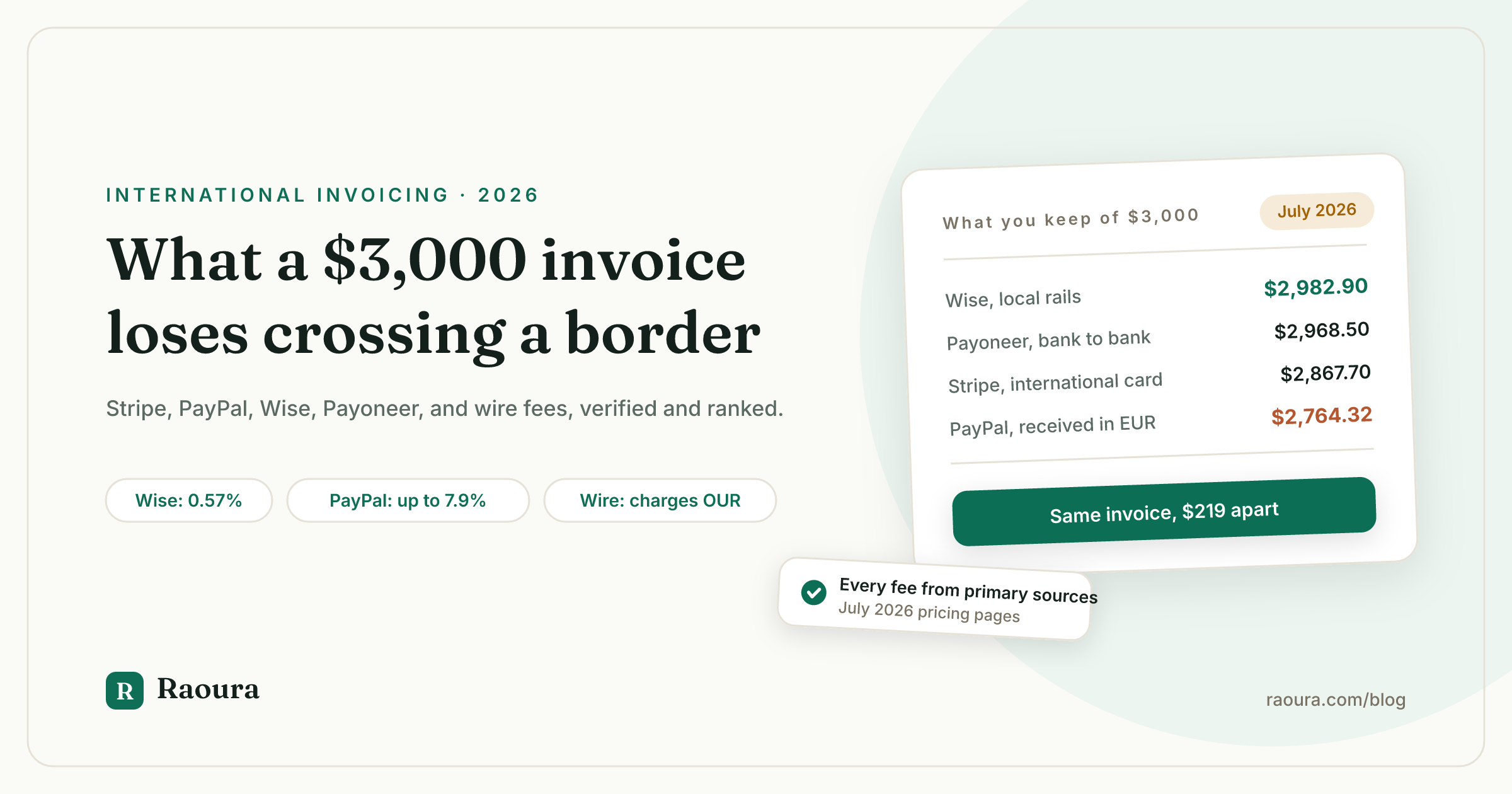
On a $3,000 invoice from an EU business, your net proceeds range from $2,982.90 to $2,764.32 depending on the payment channel, a spread of about $219 on a single invoice.
Here is the full comparison. Assumptions: you are a US freelancer, the invoice is worth $3,000 at the mid-market exchange rate, and "cost" is everything you lose against that mid-market baseline, including conversion spreads. Per-transaction fees only; one-time and conditional fees are noted in each section below.
| Channel | Fee math | Total cost | You keep | Cost % |
|---|---|---|---|---|
| Wise Business, client pays EUR by SEPA, you convert | 0% receive + 0.57% conversion | $17.10 | $2,982.90 | 0.57% |
| SWIFT wire, charges OUR (client pays all fees) | $15 incoming fee | $15.00 | $2,985.00* | 0.50%* |
| Payoneer, client pays from EU bank account | 1% receive + $1.50 withdrawal | $31.50 | $2,968.50 | 1.05% |
| SWIFT wire, charges SHA (the default) | $15 incoming + intermediary deductions | ~$25 to $45 | ~$2,955 to $2,975 | ~1% |
| Stripe, invoice in USD, EU card | 2.9% + 1.5% intl + $0.30 | $132.30 | $2,867.70 | 4.41% |
| PayPal invoice, client pays by card | 2.99% + 1.5% intl + $0.49 | $135.19 | $2,864.81 | 4.51% |
| PayPal invoice, client pays with PayPal balance | 3.49% + 1.5% intl + $0.49 | $150.19 | $2,849.81 | 5.01% |
| Stripe, invoice in EUR, settle to USD | 2.9% + 1.5% intl + 1% conversion + $0.30 | $162.30 | $2,837.70 | 5.41% |
| PayPal, receive EUR then convert the balance | $150.19 processing + 3% conversion on the rest | $235.68 | $2,764.32 | 7.86% |
*The wire looks cheap on your side, but the client's bank sets the EUR to USD exchange rate, and banks build an undisclosed markup into that rate. Bank of America confirms on its own site that exchange rate markups are set at the bank's "sole discretion" without publishing a percentage. Someone in the relationship is paying that spread; it just is not visible on your receipt.
Three facts from that table worth keeping:
Wise charges nothing to receive euros by SEPA transfer and converts to dollars at the mid-market rate plus a fee that starts at 0.57%.
PayPal adds 1.50% on every international commercial transaction, and takes another 3.00% currency conversion spread if you receive a foreign currency balance and convert it to dollars.
Chase and Bank of America each charge $15 to receive an incoming international wire, and intermediary banks along the way can deduct more before it arrives.
The worst common outcome in the table is also the default one: letting a client pay your PayPal address in their currency and converting the balance yourself costs nearly 8%. That is $235.68 on one $3,000 invoice, or a full flat-tool subscription year burned on a single payment.
The five channels, ranked by what you keep#
Local rails through a Wise Business account cost about 0.57% end to end, making them the cheapest verified way for a US freelancer to collect an international invoice in 2026.
1. Wise Business local account details (about 0.6%)#
Wise Business gives you real local account details in 22 currencies for a one-time $31 fee: an IBAN for euros, UK sort code and account number for pounds, US routing details for dollars, and so on. Your German client pays your EUR details by SEPA transfer, which for them is a free or near-free domestic payment, not an international wire. Receiving EUR, GBP, USD, AUD, CAD, NZD, SGD, HUF, and PHP over local rails is free on Wise's published pricing. You then convert to dollars at the mid-market rate plus a conversion fee starting at 0.57%, with discounts above $25,000 equivalent per month.
Total on our $3,000 invoice: $17.10. The catch: Wise is a receiving account, not an invoicing system. You still need to generate the invoice, put your Wise EUR details on it, and chase it yourself. Wise does receive SWIFT wires too ($6.11 fixed for USD wires), but the local-rails path is the whole point.
2. Payoneer (about 1%)#
Payoneer's pricing page (updated January 2026): receiving into a local-currency receiving account is free, a client paying from an EU or UK bank account costs 1% (minimum $1), and withdrawing to your US bank in dollars is $1.50 flat for most accounts. Card payments cost up to 3.99% + $0.49, so steer clients to bank payment. Watch the $29.95 annual fee, which applies only if you receive less than $6,000 equivalent in any rolling 12 months. Total on our invoice via bank payment: $31.50.
3. SWIFT wire to your US bank (cheap for you, opaque for the relationship)#
Your side is simple: Chase charges $15 for an incoming wire and Bank of America charges $15. The problems are on the way to you. Wires pass through intermediary banks that can deduct handling fees from the principal; both Chase and Bank of America confirm these deductions happen, though no bank publishes the amounts (practitioners commonly report $10 to $30 per intermediary, a figure we could not verify from any primary source).
And the sending bank sets the exchange rate with an unpublished markup. Wires make sense for large invoices where a fixed $15 to $45 beats any percentage, and only if the client sends with charges "OUR" (more on that below).
4. Stripe (4.4% to 5.4% for international cards)#
Stripe's published US pricing: 2.9% + $0.30 for domestic cards, plus 1.5% for international cards, plus 1% if currency conversion is required. So an EU client paying a USD invoice by card costs you 4.4% + $0.30; invoice them in EUR and settle to USD and it is 5.4% + $0.30. If you use Stripe's own Invoicing product, add 0.4% per paid invoice on the Starter plan. A US Stripe account can present charges in 135+ currencies, so the capability is real; you are paying for card convenience, instant checkout, and autopay, not for cheap currency movement.
5. PayPal (4.5% to 7.9%, depending on how careless the setup is)#
PayPal's business fee page: invoice payments cost 2.99% + $0.49 by card or 3.49% + $0.49 by PayPal balance, plus a flat 1.50% on all international commercial transactions. That is 4.49% to 4.99% before currency ever enters the picture. Receive euros and convert the balance and PayPal applies a 3.00% spread above its base exchange rate. PayPal's one genuine advantage is reach: some clients simply will not pay any other way, and a 5% fee beats a payment that never arrives.
If you want the deeper comparison of which client tools sit on which of these rails, and which ones work at all outside the US, we mapped that in our international tools guide.
Setting up the invoice itself#
Three lines on the invoice prevent most international payment problems: the currency stated explicitly, the exact payment instructions for that currency, and the words "please send with charges OUR" for wires.
Everything that belongs on a normal freelance invoice still applies: your business details, the client's, an invoice number, line items, a due date, and payment terms you have already agreed on. International invoices add four decisions:
Currency. Name it explicitly on every amount ("EUR 2,760", not "2,760"). Billing in your own currency (USD) moves exchange risk to the client; billing in theirs makes you easier to pay and often faster to approve, and with a Wise-style account the conversion costs you 0.57% instead of a bank spread. Whichever you choose, do not let the payment processor choose for you.
Payment instructions that match the rail. If the client pays EUR to your Wise details, print the IBAN and BIC on the invoice. If they wire USD, print your routing and account number plus your bank's SWIFT code. Vague instructions ("PayPal or bank transfer, whatever works") reliably produce the most expensive option.
The wire charge code. SWIFT wires carry a "details of charges" field with three values:
- OUR: the sender pays all fees, you receive the full amount.
- SHA (the default): intermediary and receiving fees come out of your money.
- BEN: everything comes out of your money.
The mystery $48 in this article's opening paragraph is SHA at work. One line fixes it: "For bank transfers, please send in USD with charges OUR, referencing invoice #2026-041." Flywire's help center has a plain explanation of the codes you can send to a confused client.
Due dates in absolute terms. "Net 14" plus a six-hour time difference plus a bank holiday you have never heard of equals a late payment nobody intended. Write the date: "Due August 3, 2026." Cross-border payments also genuinely take longer to land (SEPA is same-day to one day, wires one to five days), so build that into your reminder cadence instead of nudging a client whose money is mid-flight.
The paperwork nobody explains: W-9, W-8BEN, and EU VAT#
A US freelancer billing a foreign business client typically owes them zero US tax forms and charges zero EU VAT, because B2B services fall under the reverse charge.
This is where international invoicing advice gets actively confusing, because most of it is written for the opposite direction.
W-9 vs W-8BEN. Form W-9 certifies US status to US clients; you will keep providing it to American companies. Form W-8BEN is the reverse: foreign individuals give it to US payers to certify foreign status and avoid US withholding. As a US person you should never be filling out a W-8 of any kind.
If a European client sends you one, it is a mix-up; foreign clients generally need no US tax form from you at all. Some will ask for local paperwork of their own (a residency certificate, a simple vendor form); that is their compliance, not the IRS.
EU VAT. Under the EU's general place-of-supply rule, B2B services are taxed where the customer is established, and the EU's own guidance says a business receiving services from a non-EU supplier "should usually pay VAT at the applicable rate in your country, as if you had supplied the service yourself (using the reverse charge procedure)." Translation: you do not register for, charge, or remit EU VAT on services to an EU business. The client self-accounts for it.
Put their VAT number on the invoice and a note such as "VAT reverse charged" so their bookkeeper knows what they are looking at. Selling to EU consumers rather than businesses is a different regime with real registration obligations, and worth a conversation with an accountant before you take on B2C work.
We are not lawyers or tax advisors, and cross-border tax has edge cases; treat this as orientation, not advice.
A workflow that survives more than one international client#
Once the rails are picked, the remaining problem is ordinary discipline: invoices that go out on time, in the right currency, with the right instructions, and reminders that fire without you tracking time zones in your head. That is a system problem, not a payments problem, and it is the part most freelancers run out of patience for.
This is where we point at our own product, so, disclosure: Raoura is our product. Raoura is client and project management for solo freelancers at $17 per month flat, and its invoicing runs on your own Stripe account through Stripe Connect. That means international card payments cost you exactly Stripe's published rates from the table above, with no platform markup on top, and the money settles to you without ever passing through us. (Why that architecture matters is its own article.) Invoices support multiple currencies, so "EUR 2,760, due August 3, VAT reverse charged" is a line item and a note, not a workaround.
!Creating an invoice in Raoura with line items, currency, tax, and due date fields on one screen

The currency, amounts, and due date live on the invoice itself, so international clients see exactly what to pay and by when.
Your client gets a portal link and pays by card in a couple of clicks, whatever continent they are on, and overdue reminders go out on the schedule you set, in absolute dates, while you are asleep in a different time zone.
!A client's view of paying a Raoura invoice online through the client portal

What the client in Berlin sees: the invoice, the amount, and a pay button. No account creation, no wire form, no mystery fees appearing in transit.
And for the big-ticket wires where a card fee makes no sense, nothing stops you from putting your Wise details in the invoice notes and using Raoura for the tracking, reminders, and record keeping around it.
Frequently asked questions
What is the cheapest way to receive international payments as a freelancer?
Local bank rails through a multi-currency account. On Wise Business, receiving EUR by SEPA or GBP by Faster Payments is free and conversion to USD starts at 0.57%, so a $3,000 invoice costs about $17 to collect. Payoneer's bank-to-bank path runs about 1%. Cards through Stripe or PayPal cost 4.4% to 5.4% for international clients.
Should I invoice in USD or the client's currency?
Invoice in whichever currency you can receive cheaply, and say it explicitly. If you have local account details in the client's currency, billing in their currency is easier for them and costs you around 0.57% to convert. If you only have a US bank account, bill in USD and let the client's side handle conversion, knowing their bank's markup is part of what your relationship pays.
Why did my international wire arrive short?
Almost always the SHA charge code. With SHA (the default), intermediary banks and your receiving bank deduct their fees from the payment itself, so $3,000 sent becomes roughly $2,955 to $2,975 received. Ask clients to send with charges OUR, which means the sender pays all fees and you receive the full invoice amount.
Do I need to fill out a W-8BEN for a foreign client?
No. W-8BEN is for foreign persons receiving US-source income. As a US freelancer you certify US status with a W-9, and only US clients need that. Foreign clients generally require no US tax form from you.
Do I charge EU clients VAT?
Not for B2B services. The EU reverse charge makes your business client responsible for self-accounting VAT in their own country. Include their VAT number and a "VAT reverse charged" note on the invoice. Selling to EU consumers is different and can create registration obligations.
Does PayPal charge more for international clients?
Yes. PayPal adds a flat 1.50% on international commercial transactions on top of its 2.99% to 3.49% processing fee, and applies a 3.00% spread when you convert a foreign currency balance to dollars. Received in EUR and converted, a $3,000 invoice costs $235.68, the most expensive common channel we measured.
---
Every fee and rule in this article was read from the linked primary source pages on July 16, 2026: Stripe and PayPal pricing pages, Wise and Payoneer fee schedules, Chase and Bank of America fee documents, IRS form pages, and the EU's Your Europe VAT guidance. Provider pricing changes without notice; the linked pages outrank this article the moment they disagree. Verified July 2026.
Run your client work in one place
Send a proposal, get it signed, invoice, and get paid, with a branded portal your clients will actually use. One flat plan at $17/month, and we never take a cut of your payments.
Try Raoura free for 14 daysNo credit card required. Set up in minutes.
Keep reading
The Virtual Assistant Contract: 24 Clauses, Scored Against Every Template Ranking for This Search
We scored the four pages that publish actual virtual assistant contract text against 24 clauses a VA agreement needs. Twenty-four of 96 possible slots were filled. The best single template managed 7 out of 24. Twelve clauses appear in none of them, including every clause about the thing that makes VA work different from other freelance work: you are holding your client's passwords and running their inbox. One popular template also tells you a contract fixes your independent contractor status, then mandates client-set 9 to 5 weekday hours in the same document. Here is the clause-by-clause version, with the classification test the DOL is actually applying in 2026, the data protection terms nobody drafts, and the retainer mechanics that decide whether unused hours roll over.
Stripe vs PayPal for Freelancers: Every Fee Verified (2026)
Every page ranking for this comparison either prints in-person retail rates, contradicts itself, or skips the numbers freelancers actually pay. We read the current Stripe and PayPal pricing pages line by line, ran a $3,000 invoice through every rail, and found a $1,764 per year gap between the cheapest setup and the default one.
The Pause Clause: How to Stop Work When an Invoice Goes Overdue
Stopping work is the strongest move a freelancer has against a late-paying client, and the least understood. Here is the legal doctrine that lets you pause even without a clause, the exact clause to add so you never have to rely on doctrine again, the day-by-day timing, and the two emails that keep the pause professional. Verified against primary sources in July 2026.