Client Tools That Do Not Block International Freelancers (2026)
August 30, 2026
You found the perfect client management tool. You watched the demo, read the reviews, budgeted for the subscription. Then you hit the signup form, picked your country from the dropdown, and got the polite wall: "not available in your region yet, join the waitlist."
If you freelance from Lagos, Berlin, Manila, Nairobi, or Mexico City, this is not a rare experience. It is the default. Most of the tools that dominate "best client management software" lists were built for US freelancers first, and their international support ranges from genuinely global to four countries and a waitlist.
This guide does what the ranking pages do not: it verifies, from each vendor's own signup gates and help documentation, where 7 popular client management tools actually work as of July 2026, explains the payment plumbing that causes the blocks in the first place, and gives you a decision path based on which payment rails exist in your country. One of the tools, Raoura, is our own product (disclosure: Raoura is our product). It runs on your own Stripe account, so its availability is Stripe's availability, and we say exactly what that means below, including where it does not work.
Why some client tools block your country#
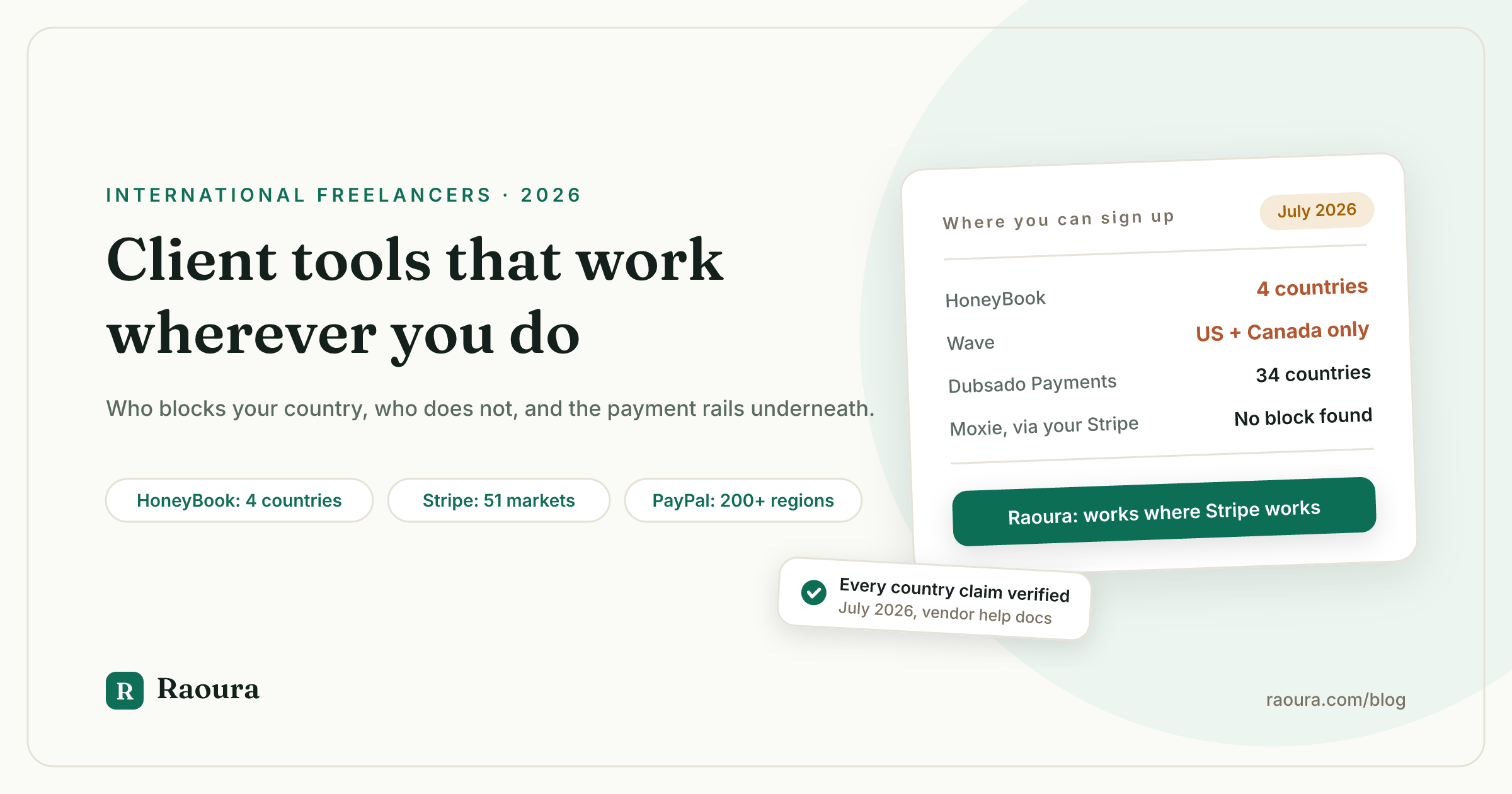
HoneyBook, the biggest name in this category, supports exactly 4 countries (the United States, Canada, the United Kingdom, and Australia), and its own waitlist form names 23 more where it does not operate.
The block is almost never about the software. Proposals, contracts, and project boards work the same in Nairobi as in Nashville. The block is about money.
Tools like HoneyBook act as the payment processor in the middle of your client relationships. That means they carry regulatory obligations (KYC identity checks, anti-money-laundering rules, local banking integrations, tax reporting) in every country where they onboard a freelancer. Each new country is a compliance project, so they launch in a handful of large markets and gate everyone else.
You can see this play out in HoneyBook's own timeline. For roughly a decade it supported only the US and Canada. In late May 2026 it launched in the UK and Australia with local GBP and AUD pricing, and the press release framed international expansion as a milestone. It was. It also took about ten years, and it added two countries.
Here is the useful observation buried in HoneyBook's own signup flow: the "notify me when HoneyBook comes to my country" form lists 23 specific countries, including Brazil, France, Germany, India, Indonesia, Ireland, Israel, Italy, Japan, Kenya, Mexico, the Netherlands, New Zealand, Nigeria, Pakistan, the Philippines, and South Africa. If your country is on a waitlist dropdown, the vendor is telling you the timeline is "not soon."
A warning about the advice you will find elsewhere: almost every third-party article ranking for these queries is out of date. Bloom's "Top HoneyBook Alternatives" page, updated February 2026, still says HoneyBook is limited to the US and Canada. That was true when it was written and wrong within four months. Country availability is the fastest-moving fact in this category, which is why every claim in this article links to a vendor page and carries a verification date.
The one question that decides everything: whose payment processor is it?#
Client tools split into two camps: embedded-processor tools that work in 4 to roughly 38 countries, and bring-your-own-processor tools that work wherever Stripe (51 markets), Square, or PayPal (200+ markets) will give you an account.
Every tool in this category has to move money from your client to you. There are only two architectures for that, and they determine everything about international availability.
Camp 1: the tool is the processor. HoneyBook and Bonsai Payments work this way. The platform sits in the money flow, underwrites you as a merchant, and holds the compliance burden. Result: short country lists. HoneyBook supports 4 countries. Bonsai Payments is available in the US, Canada, UK, and Australia, with instant payouts exclusive to US users.
Camp 2: the tool connects your processor. Dubsado, Moxie, 17hats, and Raoura work this way. You bring your own Stripe, Square, or PayPal account. The processor already did your KYC in your country, so the tool does not need a per-country launch. Result: availability is effectively the union of the processors it supports. Moxie's supported payment methods page lists Stripe for cards globally plus PayPal, with ACH flagged as US-only. Bonsai, interestingly, straddles both camps: its own processor covers 4 countries, but its Stripe integration is available in all countries Stripe supports except India.
If you take one thing from this article: check the payment rails available in your country first, then choose among the tools that connect to those rails. Choosing the tool first is how you end up on a waitlist.
We wrote more about why the embedded-processor model is a bad deal even inside the US in Why Your Client Tool Should Never Touch Your Money. Outside the US, it is not just a bad deal. It is a locked door.
Where 7 client tools actually work (verified July 2026)#
Of the 7 tools we verified, only 2 (HoneyBook and Wave) hard-block signups by country; the other 5 are limited mainly by which payment processors operate where you live.
| Tool | Signup blocked by country? | Where payments work | Source |
|---|---|---|---|
| HoneyBook | Yes, 4 countries only (US, CA, UK, AU) | HoneyBook's own processor, in those 4 countries | [HoneyBook UK/AU launch post](https://www.honeybook.com/blog/honeybook-now-available-uk-australia) |
| Wave | Yes, US and Canada only | Wave Payments, US and Canada | [Wave support notice](https://support.waveapps.com/hc/en-us/articles/27277914806804-Changes-for-Wave-users-outside-the-United-States-and-Canada) |
| Bonsai | No signup block | Bonsai Payments in 4 countries; Stripe integration wherever Stripe works except India; invoices in 100+ currencies | [Bonsai payment methods](https://help.hellobonsai.com/en/articles/1867512-the-integrated-payment-methods-supported-by-bonsai), [currencies](https://help.hellobonsai.com/en/articles/5183026-bonsai-s-supported-currencies) |
| Dubsado | No signup block | Dubsado Payments in 34 listed countries; or Square or PayPal; manual bank instructions as fallback | [Dubsado processors](https://help.dubsado.com/en/articles/580108-connect-a-payment-processor-with-dubsado-payments-square-or-paypal), [country list](https://help.dubsado.com/en/articles/8940370-manage-payments-with-dubsado-payments) |
| Moxie | No block found | Stripe cards globally, PayPal; ACH US-only | [Moxie payment methods](https://help.withmoxie.com/en/articles/5871661-supported-payment-methods) |
| 17hats | No published country policy | Via its processors: Stripe-based 17hats Payments, Square, Authorize.net, PayPal | [17hats payment options](https://help.17hats.com/en/collections/550596-online-payment-options) |
| Raoura | No signup block | Your own Stripe account, wherever Stripe supports accounts | [Stripe global page](https://stripe.com/global) |
Notes the table cannot hold:
HoneyBook now prices Starter at $29, Essentials at $49, and Premium at $109 per month billed yearly, in local currency for UK and Australia. If you are in one of its 4 countries and love it, fine, though read our cost breakdown before you commit, because the processor markup follows you everywhere. If you are anywhere else, stop waiting. Ten years passed between "US and Canada" and "plus UK and Australia."
Wave is the cautionary tale about betting on a tool that later retreats. Wave announced in November 2020 that it would focus exclusively on the US and Canada, and its support page, still being updated as of June 2026, confirms users elsewhere can no longer send invoices or reminders through Wave and points them to Zoho Books instead.
Bonsai deserves credit for honest documentation: its invoices support more than 100 currencies and it permits offline payment instructions. Two cautions:
- The fully integrated Bonsai Payments experience is 4 countries. Everyone else routes through the Stripe integration (not available in India) or PayPal.
- Zoom acquired Bonsai in late 2025, and while Bonsai remains standalone for now, international users have the most to lose if priorities shift, a dynamic we covered in Bonsai Alternatives.
Dubsado is the most internationally open of the classic clientflow tools, but we found a discrepancy worth knowing: its Dubsado Payments FAQ says the processor is "supported for users in 38 countries," while the actual country table in its help center lists 34, including India, Brazil, Mexico, the UAE, Hong Kong, and Singapore. Either way it is the longest embedded-processor country list in the category.
The real international catch is currency display: per Dubsado's own docs, your invoice displays only in your set account currency, so a client abroad sees USD and eats the conversion on their card. If your billing is genuinely multi-currency, that stings.
Its pricing also quietly climbed: the pricing page now shows Starter at $335 per year and Premier at $525 per year. If you were considering it for the automation depth, read Dubsado Alternatives first.
Moxie publishes no country restrictions we could find anywhere on its site, which effectively means Moxie works where Stripe or PayPal work. Its US-centric edges are features, not access: ACH is US-only and its phone Communicator covers only the US, Canada, and UK per its pricing page. Starter is $12 per month, Pro $25, cheaper on annual billing. A solid international pick; see how it stacks up in Moxie vs HoneyBook.
17hats publishes no country availability statement at all, which is its own kind of answer. Availability rides on its processors (Stripe-based 17hats Payments, Square, Authorize.net, PayPal). If you are outside the US, test the trial with your own processor before paying for a year. Context on its pricing problem for solos: 17hats Alternatives.
Check your payment rails first: Stripe, PayPal, and Wise by the numbers#
Counting Stripe's own global availability page in July 2026, we found 51 markets total: 44 fully supported countries, 5 more through its Paystack extended network (Ghana, Kenya, Nigeria, South Africa, and Cote d'Ivoire), and 2 in preview (India and Indonesia).
Because bring-your-own-processor tools inherit their availability from the rails, your real first question is which rails serve your country. The big three:
| Rail | Coverage (verified July 2026) | Best for | Source |
|---|---|---|---|
| Stripe | 44 fully supported countries + 5 extended network + 2 preview = 51 markets | Card payments inside a client tool; once supported, you can charge clients anywhere in the world | [stripe.com/global](https://stripe.com/global) |
| PayPal | "More than 200 countries/regions and 25 currencies" per PayPal | Fallback where Stripe is absent; client familiarity | [PayPal worldwide page](https://www.paypal.com/c2/webapps/mpp/country-worldwide) |
| Wise Business | Applications accepted from roughly 70 countries and territories, with quirks (Bahrain, Israel, and Malaysia are personal-only; Hong Kong is business-only) | Receiving bank transfers in USD, GBP, EUR at real exchange rates | [Wise country list](https://wise.com/help/articles/2813542/where-do-i-need-to-live-to-hold-money-with-wise) |
Three practical notes.
- Stripe's page carries a sentence that matters more than the country count: once Stripe supports your country, "you'll be able to sell to customers anywhere in the world." Availability constrains where you live, not where your clients live. A freelancer in Romania invoices a client in Texas through Stripe exactly as easily as a freelancer in Ohio does.
- PayPal's "more than 200 countries" needs an asterisk we rarely see printed. Being able to open an account does not mean full send-and-receive business functionality. Receive capability varies by country, so verify your specific country's receive and withdrawal options in PayPal's own documentation before building your invoicing on it.
- If Stripe does not serve your country, a client tool that only connects to Stripe cannot save you, ours included. The honest workflow in that case is a tool that supports PayPal or manual bank instructions on invoices (Dubsado explicitly supports payment instructions on invoices as a fallback), paired with a Wise or local bank account to receive transfers. Slower, but it works in far more places, and your invoices, contracts, and portal still look professional.
Where Raoura fits (and where it does not)#
Raoura costs $17 per month flat, has no country gate at signup, and processes payments through your own Stripe account, which means it works in the 40+ countries where Stripe supports accounts and does not work where Stripe does not.
Disclosure: Raoura is our product.
We built Raoura on Stripe Connect deliberately: your client pays into your Stripe account, we never touch the money, and we take no cut beyond Stripe's own at-cost fees. For international freelancers this architecture has three consequences worth stating plainly.
One, there is no waitlist. If Stripe will open an account in your country, Raoura works there today, with proposals, e-sign contracts, invoicing, milestones, and a white-label client portal on one flat plan. Invoices support per-invoice currency, so you can bill a US client in USD and a German client in EUR from the same account.

Per-invoice currency means one account can bill a US client in USD and a German client in EUR, with no country gate in the way.
Two, your money arrives on Stripe's payout schedule to your bank, not ours. There is no platform between you and your revenue that can freeze funds during a "review." Freelancers in countries with volatile banking know exactly why that matters.

Because the client pays into your Stripe account, payouts follow Stripe's schedule to your bank, with no platform holding your funds in between.
Three, we do not pretend to serve countries we cannot. If you are in Pakistan, Bangladesh, Egypt, or anywhere else Stripe has not reached, Raoura's card payments cannot help you yet, and a Dubsado-plus-bank-instructions or PayPal-based setup is the pragmatic choice today. We would rather tell you that than collect a subscription that cannot collect your invoices.
If you are comparing us directly against the incumbents, the head-to-heads are here: Raoura vs HoneyBook, Raoura vs Bonsai, and Raoura vs Dubsado.
If HoneyBook is on your shortlist, check HoneyBook pricing for the UK and Australia first, since the currency and availability story is not what the US site suggests.
Frequently asked questions
Why is HoneyBook not available in my country?
HoneyBook acts as its own payment processor, so it must build banking, compliance, and tax infrastructure separately for every country it enters. As of July 2026 it supports exactly 4 countries: the US, Canada, the UK, and Australia, the latter two added in May 2026. Its signup waitlist names 23 other countries with no announced timeline.
Which client management tools work internationally?
Tools that connect your own payment processor instead of embedding their own. As of July 2026: Dubsado (no signup block, Dubsado Payments in 34 listed countries plus Square and PayPal options), Moxie (Stripe and PayPal, no published country restriction), Bonsai via its Stripe integration (all Stripe countries except India, invoices in 100+ currencies), and Raoura (your own Stripe account; disclosure: Raoura is our product). 17hats publishes no country policy, so test before paying.
What if Stripe is not supported in my country?
No Stripe-based tool will work for card payments, so use a different rail. Options: a tool with PayPal support (PayPal operates in more than 200 countries and regions, though receive functionality varies), Stripe's Paystack extended network if you are in Ghana, Kenya, Nigeria, South Africa, or Cote d'Ivoire, or a tool that allows manual bank-transfer instructions on invoices, paired with a Wise Business account to receive foreign currency.
Did HoneyBook launch in the UK and Australia?
Yes. HoneyBook went live in the UK and Australia in late May 2026 with subscriptions priced in GBP and AUD. It was the company's first expansion beyond the US and Canada. Most third-party comparison articles have not caught up and still describe HoneyBook as US and Canada only.
Can my clients be in a different country than my tool supports?
Yes, and this is the most misunderstood point in the category. Payment processor availability restricts where you, the account holder, live. Once you have a working Stripe or PayPal account, your clients can generally pay you from anywhere in the world. Stripe states this directly on its global availability page.
The short version#
Do not start with the tool. Start with the rails. Check whether Stripe supports your country on stripe.com/global; if yes, every bring-your-own-processor tool on this page is open to you, and you can choose on features and price. If no, build on PayPal or bank transfers with a tool that permits them, and keep an eye on Stripe's expanding list.
And treat any tool that hard-gates signup by country as a signal, not just an inconvenience. It tells you where you sit on their roadmap.
Raoura is client and project management for solo freelancers: proposals, contracts, invoices, milestones, and a white-label client portal, $17 per month flat, no cut of your payments, running on your own Stripe account. Disclosure: Raoura is our product. Try it free for 14 days at raoura.com, no card required.
Every availability claim, price, and country count in this article was checked against the linked vendor pages on July 11, 2026. Country availability changes fast in this category; if you spot something newer, the vendor's own help center outranks any article, including this one. Verified July 2026.
Run your client work in one place
Send a proposal, get it signed, invoice, and get paid, with a branded portal your clients will actually use. One flat plan at $17/month, and we never take a cut of your payments.
Try Raoura free for 14 daysNo credit card required. Set up in minutes.
Keep reading
Is Upwork Worth It in 2026? A Break-Even Test for Your Situation
Upwork is worth it when its fee costs less than finding the client yourself, and that is true far more often for a first project than for a repeat client. Here is the break-even math with 2026 numbers: the 0 to 15% fee, Connects, the shrinking client base, and when to wait out the 24-month rule instead of paying to leave.
The Virtual Assistant Contract: 24 Clauses, Scored Against Every Template Ranking for This Search
We scored the four pages that publish actual virtual assistant contract text against 24 clauses a VA agreement needs. Twenty-four of 96 possible slots were filled. The best single template managed 7 out of 24. Twelve clauses appear in none of them, including every clause about the thing that makes VA work different from other freelance work: you are holding your client's passwords and running their inbox. One popular template also tells you a contract fixes your independent contractor status, then mandates client-set 9 to 5 weekday hours in the same document. Here is the clause-by-clause version, with the classification test the DOL is actually applying in 2026, the data protection terms nobody drafts, and the retainer mechanics that decide whether unused hours roll over.
Stripe vs PayPal for Freelancers: Every Fee Verified (2026)
Every page ranking for this comparison either prints in-person retail rates, contradicts itself, or skips the numbers freelancers actually pay. We read the current Stripe and PayPal pricing pages line by line, ran a $3,000 invoice through every rail, and found a $1,764 per year gap between the cheapest setup and the default one.