Moxie vs HoneyBook (2026): pricing, fees, and what each vendor gets wrong about the other
July 12, 2026
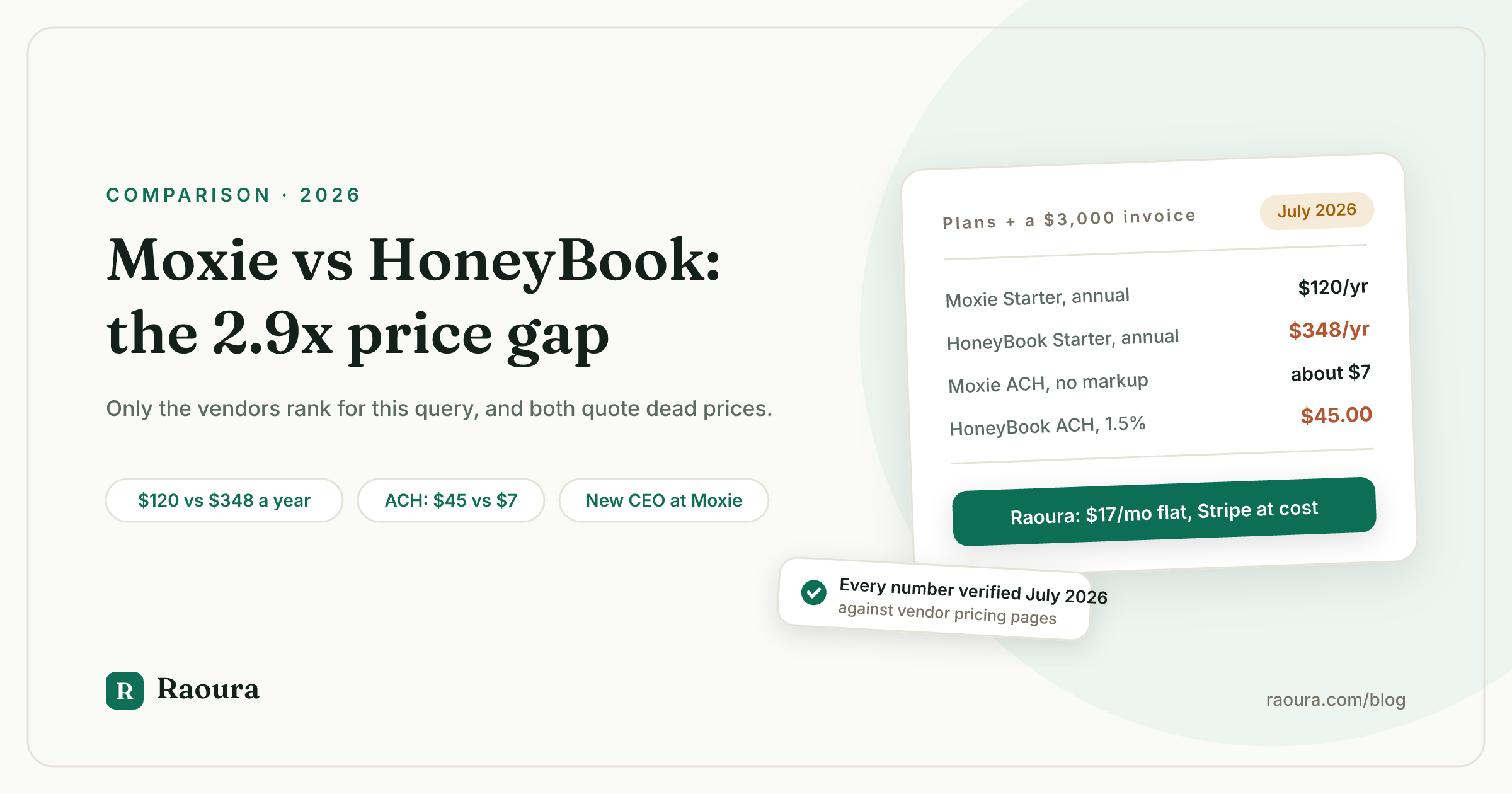
TL;DR: Moxie costs $12 to $40 per month across three plans ($120 per year on Starter, billed annually) and passes payments through your own Stripe or PayPal account with no markup. HoneyBook costs $36 to $129 per month on monthly billing ($348 per year for Starter on annual billing), processes payments itself, and charges 1.5% on every bank transfer with no cap.
HoneyBook is more polished, has AI on every plan, and just expanded to the UK and Australia; Moxie packs far more into its cheapest plan and never touches your money, but its founder moved to the board in June 2026 after acknowledging product development had slowed.
If you would use less than half of either, a simpler tool may fit better. Disclosure: Raoura, our $17 per month flat-price tool, appears at the end of this comparison.
Search "Moxie vs HoneyBook" and the top results are the two companies reviewing each other. That is not an exaggeration: as of July 2026, the highest-ranking pages for this query are Moxie's comparison of HoneyBook and HoneyBook's comparison of Moxie, followed by a third-party article that has not been updated since January 2024.
All three contain facts that are no longer true:
- Moxie's page quotes a HoneyBook Starter price of $19 per month, which died in February 2025, and says HoneyBook only works in the US and Canada, which stopped being true in May 2026.
- HoneyBook's page presents its own prices as "$29, $49, and $109 per month" without mentioning those are annual-billing rates, and claims Moxie "doesn't have native payments," which undersells Moxie's built-in Stripe and PayPal checkout.
- The stale third-party page still describes a two-tier Moxie and a $19 HoneyBook.
So this article does the boring thing: every number below was checked against the vendors' own pricing and help pages in July 2026, with links. Where we could not verify something first-hand, we say so and leave it out of the tables.
Moxie vs HoneyBook at a glance#
As of July 2026, Moxie's entry plan costs $120 per year and HoneyBook's costs $348 per year on annual billing, a 2.9x gap before payment fees are counted.
| Moxie | HoneyBook | |
|---|---|---|
| **Plans (annual billing)** | Starter $10/mo ($120/yr), Pro $20/mo ($240/yr), Teams $385/yr | Starter $29/mo ($348/yr), Essentials $49/mo ($588/yr), Premium $109/mo ($1,308/yr) |
| **Plans (monthly billing)** | Starter $12/mo, Pro $25/mo, Teams $40/mo | Starter $36/mo, Essentials $59/mo, Premium $129/mo |
| **Free trial** | 14 days | 30 days, no credit card, plus a 60-day money-back guarantee |
| **Payment processing** | Your own Stripe or PayPal, fees passed through, no Moxie markup | HoneyBook processes everything itself; you cannot connect your own processor |
| **Card fees** | Stripe's standard 2.9% + 30c | From 2.7% + 10c per the pricing FAQ; the plan table on the same page says from 2.9% + 25c |
| **ACH (bank transfer) fees** | Stripe's capped ACH fee plus a $1 Moxie verification fee, roughly $6 to $7 per payment | 1.5%, uncapped |
| **Time tracking** | Included on every plan | Included (manual entry, mobile stopwatch) |
| **Basic accounting** | Included on every plan | Not included; QuickBooks sync on Essentials and up |
| **Meeting scheduler** | Included on every plan | Essentials and up |
| **Automations** | Pro and up | Essentials and up |
| **AI features** | Moxie AI assistant on every plan | HoneyBook AI on every plan |
| **Client portal** | Yes; white label and custom domain on Pro | Yes, branded |
| **Team seats** | Up to 5 on Teams; unlimited project collaborators on Pro and Teams | 2 members on Essentials, unlimited on Premium |
| **Country availability** | Sold globally; ACH is US only | US, Canada, UK, Australia |
| **Last major price change** | None found in the last 18 months | February 2025, up to +89% |
| **2026 company news** | Founder moved to board, new CEO (June 2026) | Launched in UK and Australia (May 2026) |
Sources: Moxie pricing, Moxie supported payment methods, HoneyBook pricing, HoneyBook plan change announcement, all fetched July 2026.
Pricing: a 2.9x gap at the entry level#
HoneyBook's cheapest plan costs 2.9 times more than Moxie's cheapest plan on annual billing ($348 versus $120 per year), and the gap holds at the middle tier ($588 versus $240).
Here are the current plans, verified on both pricing pages this month:
| Plan | Monthly billing | Annual billing | Cost per year (annual) |
|---|---|---|---|
| Moxie Starter | $12/mo | $10/mo | $120 |
| Moxie Pro | $25/mo | $20/mo | $240 |
| Moxie Teams | $40/mo | about $32/mo | $385 |
| HoneyBook Starter | $36/mo | $29/mo | $348 |
| HoneyBook Essentials | $59/mo | $49/mo | $588 |
| HoneyBook Premium | $129/mo | $109/mo | $1,308 |
Two notes on the HoneyBook column. First, the $36 Starter monthly price comes from HoneyBook's own plan change announcement; the public pricing page leads with annual-billing rates.
Second, these are the prices after HoneyBook's February 2025 increase, which raised Starter by 89% (from $19), Essentials by 51%, and Premium by 63%. We track that history, and what your options are if you were caught by it, in our HoneyBook price increase guide.
HoneyBook frequently runs 25 to 40% off promotional banners for the first year; the table above is the standard rate you renew at.
Moxie's pricing has been the quieter story: we found no comparable increase in the last 18 months, and its three-tier structure (Starter, Pro, Teams) replaced the old two-tier Pro and Teams lineup that stale comparisons still quote.
The plan most solo freelancers would actually compare is Moxie Pro ($240 per year) against HoneyBook Essentials ($588 per year), since that is where both products offer automations, branding control, and QuickBooks sync. That comparison is $348 per year apart before a single payment fee is counted. Which Moxie tier a solo actually needs is its own question, and we plan to break it down in a separate teardown.
Payment fees: the percentage that outlives the subscription#
On a $3,000 invoice paid by bank transfer, HoneyBook's fee is $45 and Moxie's is about $7, because HoneyBook charges an uncapped 1.5% on ACH while Moxie passes through Stripe's capped ACH fee plus $1.
This is the section neither vendor page covers honestly, and it is where the real money moves for anyone invoicing four figures.
HoneyBook processes payments itself and does not let you connect your own Stripe, Square, or PayPal account. Its pricing page FAQ says card fees "start at 2.7% + 10 cents," while the plan comparison table on the same page says fees "starting at 2.9% + 25 cents." Both figures are HoneyBook's own, published side by side, so expect the effective rate to land in that range. Bank transfers cost 1.5% of the payment, uncapped.
Moxie takes the opposite approach: you connect your own Stripe or PayPal Business account, and Moxie states plainly that "we do not charge any additional fees on top of credit card processing fees." Cards run at Stripe's standard 2.9% + 30c. For ACH, Moxie's help center lists Stripe's capped ACH rate plus a $1 per-payment fee that covers Plaid bank verification.
One caveat we owe you: that help article was last updated in 2023, so confirm the $1 fee still applies before you rely on it. ACH through Moxie is US only.
Here is what that means at freelancer invoice sizes, paid by ACH:
| Invoice amount | HoneyBook ACH fee (1.5%, no cap) | Moxie ACH fee (Stripe cap + $1) |
|---|---|---|
| $500 | $7.50 | about $6 |
| $1,000 | $15.00 | about $7 |
| $3,000 | $45.00 | about $7 |
| $10,000 | $150.00 | about $7 |
A freelancer collecting $60,000 per year over 20 bank-transfer payments hands HoneyBook about $900 per year in ACH fees. The same payments through Moxie cost about $140. That $760 per year difference is larger than the entire annual price gap between the two subscriptions.
If your clients pay mostly by card, the two are close to a wash: 2.7 to 2.9% either way. If your clients pay by bank transfer, which is common for retainers and project balances, the structural difference compounds every single month. Why we think a client tool should never sit between you and your money is a longer argument we make in Why your client tool should never touch your money.
Features: Moxie stacks its cheapest plan, HoneyBook gates its middle one#
Moxie's $12 Starter includes time tracking, basic accounting, meeting schedulers, a sales pipeline, and its AI assistant, while HoneyBook reserves its scheduler, automations, SMS reminders, and QuickBooks sync for the $59 per month Essentials plan.
Where Moxie is ahead:
The Starter plan is unusually complete:
- Starter, $12/mo. Client and project management, invoicing and payments, proposals and contracts, time tracking, a sales pipeline, basic accounting, a form builder, meeting schedulers, and the Moxie AI assistant are all included, per Moxie's pricing page.
- Pro adds the things agencies charge for elsewhere: a white-label client portal on your own custom domain, workflow automations, a business phone line (US, Canada, UK), ticketing, QuickBooks sync, and Zapier, Make, and API access.
- Teams covers up to five people at $385 per year, a fraction of HoneyBook Premium's $1,308.
The processor pass-through covered above is a structural advantage, not a feature toggle: payment processing is part of HoneyBook's revenue model, so HoneyBook cannot copy it without cutting its own margin.
Where HoneyBook is ahead:
Polish and momentum. HoneyBook's onboarding, templates, and mobile app are consistently rated stronger, and its AI layer (chat, drafted replies, an AI automations builder, a prioritized daily list) ships on every plan including Starter. Its trial terms are the most generous in the category: 30 days free with no credit card, plus a 60-day money-back guarantee.
It also now serves four countries, having launched in the UK and Australia in May 2026, and claims over 100,000 businesses on the platform.
HoneyBook Starter does include unlimited clients and projects, invoices, proposals, contracts, a branded client portal, and two lead forms; the catch is simply that the scheduler and automations most freelancers expect at the entry price sit one tier up.
One myth to retire from HoneyBook's comparison page: Moxie does have native payments in the sense that matters to a client. Invoices carry a built-in checkout that takes cards, Apple Pay, Google Pay, and ACH. The difference is who processes the money and who profits from the fees, not whether your client can pay online.
What neither vendor page will tell you#
In a span of 16 months, HoneyBook raised prices up to 89% and expanded to two new countries, while Moxie's founder moved to the board in June 2026 after publicly acknowledging that product development had been slow.
Company trajectory matters as much as this month's feature grid, because you are choosing where your client records, contracts, and payment history will live for years.
On the HoneyBook side, the February 2025 price increase remains the defining event. It was the company's first increase for existing members, it hit the entry plan hardest at +89%, and the one-year 20% discount that softened it for existing members has now lapsed for most of them.
Since then, the signals point to expansion: a 30-day trial replaced the old 7-day one, AI shipped to every plan, and on May 28, 2026 HoneyBook launched in the United Kingdom and Australia with GBP and AUD pricing.
Growth is good news for product investment, but a company that raised prices 89% once has shown you what it will do when it needs revenue. If you are already a HoneyBook user weighing the exits, our weekend migration guide covers what exports cleanly.
On the Moxie side, the news is quieter and more mixed. In June 2026, co-founder Geoff Mina moved to the board of directors and Scarlett Riu, a 20-year tech operator, became CEO. In the announcement, Mina was candid that product development "has been on the slower side" in recent months, which matches what outside observers had noticed about the blog and release cadence.
Credit for the honesty, and a new CEO may well re-accelerate things, but if you pick Moxie in 2026, watch the changelog for a quarter before you move your whole business in.
Moxie advertises a 4.6-star Trustpilot rating on its own site; we could not independently load Trustpilot to confirm the current figure this run, so treat it as the vendor's claim.
Neither company can write this section about itself, and each conveniently omits it about the other. That is the structural problem with a SERP where only vendors rank.
The three-year math#
Over three years, a bank-transfer-heavy solo freelancer pays about $1,140 all-in on Moxie Pro versus about $4,464 on HoneyBook Essentials, with payment fees, not subscriptions, driving most of the gap.
Here is a worked example for a solo freelancer collecting $60,000 per year across 20 ACH payments of about $3,000 each, on current annual pricing:
| Cost over 3 years | Moxie Pro | HoneyBook Essentials |
|---|---|---|
| Subscription | $720 | $1,764 |
| ACH processing fees | $420 | $2,700 |
| **Total** | **$1,140** | **$4,464** |
Subscription math: Moxie Pro $240 per year and HoneyBook Essentials $588 per year, times three. Fee math: 20 payments at about $7 each is $140 per year for Moxie; 1.5% of $60,000 is $900 per year for HoneyBook. A card-heavy business will see a much smaller gap, since card rates are within a few tenths of a point of each other.
For context, and with the plain disclosure that Raoura is our product: the same three years on Raoura's single $17 per month plan is $612 in subscriptions plus about $300 in at-cost Stripe ACH fees through your own Stripe account, roughly $912 all-in. We publish that math the same way we publish the incumbents'.

The checkout your client sees in Raoura: the payment runs through your own Stripe account, so the only processing fee is Stripe's.
So which one should you pick?#
Choose Moxie if you want the most complete cheap plan and your own payment processing; choose HoneyBook if you want maximum polish and will pay for it; choose something simpler if you would configure less than half of either.
Choose Moxie if:
You want time tracking, accounting, scheduling, and a pipeline at $12 per month, you invoice meaningful amounts by bank transfer (the no-markup pass-through pays for the subscription by itself), you want a white-label portal on your own domain, or you are outside HoneyBook's four countries. Go in with open eyes about the leadership transition: watch a quarter of releases before you commit your whole workflow. Our head-to-head against it is here: Raoura vs Moxie.
Choose HoneyBook if:
You are in the US, Canada, UK, or Australia, your clients mostly pay by card, you value the strongest mobile app and onboarding in the category, and AI drafting on every plan appeals to you. Use the 30-day trial and the 60-day guarantee to test it honestly, and budget for the renewal price, not the promotional one. Our head-to-head is here: Raoura vs HoneyBook.
Consider neither if:
Your actual needs are proposals, contracts, invoices, milestones, and a client portal, and everything else in both feature grids would go unused. Both of these products are growing toward teams and automation engines, and both price accordingly. That gap is why we built Raoura: one $17 per month flat plan, the five things above, your own Stripe account with fees passed through at cost, and setup measured in an afternoon. Disclosure: Raoura is our product, so weigh this paragraph accordingly. If you are surveying the whole field first, start with HoneyBook alternatives for solo freelancers or the neutral client portal software test.
!Raoura dashboard showing clients, projects, invoices, and outstanding items together on one screen

The whole product fits on one dashboard, which is the point: proposals, contracts, invoices, milestones, and a portal, with nothing left to configure.
Frequently asked questions
Is Moxie cheaper than HoneyBook?
Yes, at every tier as of July 2026. Moxie runs $120 to $385 per year on annual billing while HoneyBook runs $348 to $1,308 per year, so HoneyBook's entry plan alone costs 2.9 times Moxie's. The gap widens for bank-transfer-heavy freelancers because HoneyBook adds a 1.5% uncapped ACH fee and Moxie adds no markup.
Does Moxie charge payment processing fees?
Moxie itself adds no markup on card payments: you connect your own Stripe or PayPal account and pay their standard rates (Stripe is 2.9% + 30c on US cards). For ACH bank transfers, Moxie's help center lists Stripe's capped ACH fee plus a $1 per-payment bank verification fee.
What are HoneyBook's payment fees?
HoneyBook's pricing page FAQ says card fees start at 2.7% + 10 cents, while the plan table on the same page says they start at 2.9% + 25 cents. Bank transfers cost 1.5% with no cap, so a $10,000 ACH payment costs $150 in fees.
Can I use Moxie or HoneyBook outside the US?
HoneyBook supports businesses in the US, Canada, the UK, and Australia, after launching in the latter two in May 2026. Moxie is sold globally with multi-currency invoicing, though its ACH bank-transfer option is US only.
What happened to Moxie's founder?
In June 2026, co-founder Geoff Mina moved from CEO to the board of directors and Scarlett Riu became CEO. Mina acknowledged in the announcement that product development had been slower in the preceding months. Moxie began life as Hectic in 2020 and rebranded to Moxie in 2022.
How long are the free trials?
Moxie's trial is 14 days. HoneyBook's is 30 days with no credit card required, and HoneyBook also offers a 60-day money-back guarantee on paid plans. Older comparison articles still quote HoneyBook's retired 7-day trial.
Is there a simpler alternative to both?
If you only need proposals, contracts, invoicing, milestones, and a client portal, simpler flat-price tools cost less and set up faster. Raoura is $17 per month flat with no markup on payments through your own Stripe account. Disclosure: Raoura is our product.
All prices, fees, and claims verified July 2026 against the linked primary sources.
Run your client work in one place
Send a proposal, get it signed, invoice, and get paid, with a branded portal your clients will actually use. One flat plan at $17/month, and we never take a cut of your payments.
Try Raoura free for 14 daysNo credit card required. Set up in minutes.
Keep reading
Is Upwork Worth It in 2026? A Break-Even Test for Your Situation
Upwork is worth it when its fee costs less than finding the client yourself, and that is true far more often for a first project than for a repeat client. Here is the break-even math with 2026 numbers: the 0 to 15% fee, Connects, the shrinking client base, and when to wait out the 24-month rule instead of paying to leave.
The Virtual Assistant Contract: 24 Clauses, Scored Against Every Template Ranking for This Search
We scored the four pages that publish actual virtual assistant contract text against 24 clauses a VA agreement needs. Twenty-four of 96 possible slots were filled. The best single template managed 7 out of 24. Twelve clauses appear in none of them, including every clause about the thing that makes VA work different from other freelance work: you are holding your client's passwords and running their inbox. One popular template also tells you a contract fixes your independent contractor status, then mandates client-set 9 to 5 weekday hours in the same document. Here is the clause-by-clause version, with the classification test the DOL is actually applying in 2026, the data protection terms nobody drafts, and the retainer mechanics that decide whether unused hours roll over.
Stripe vs PayPal for Freelancers: Every Fee Verified (2026)
Every page ranking for this comparison either prints in-person retail rates, contradicts itself, or skips the numbers freelancers actually pay. We read the current Stripe and PayPal pricing pages line by line, ran a $3,000 invoice through every rail, and found a $1,764 per year gap between the cheapest setup and the default one.