Freelance Invoice Template That Gets You Paid
August 30, 2026
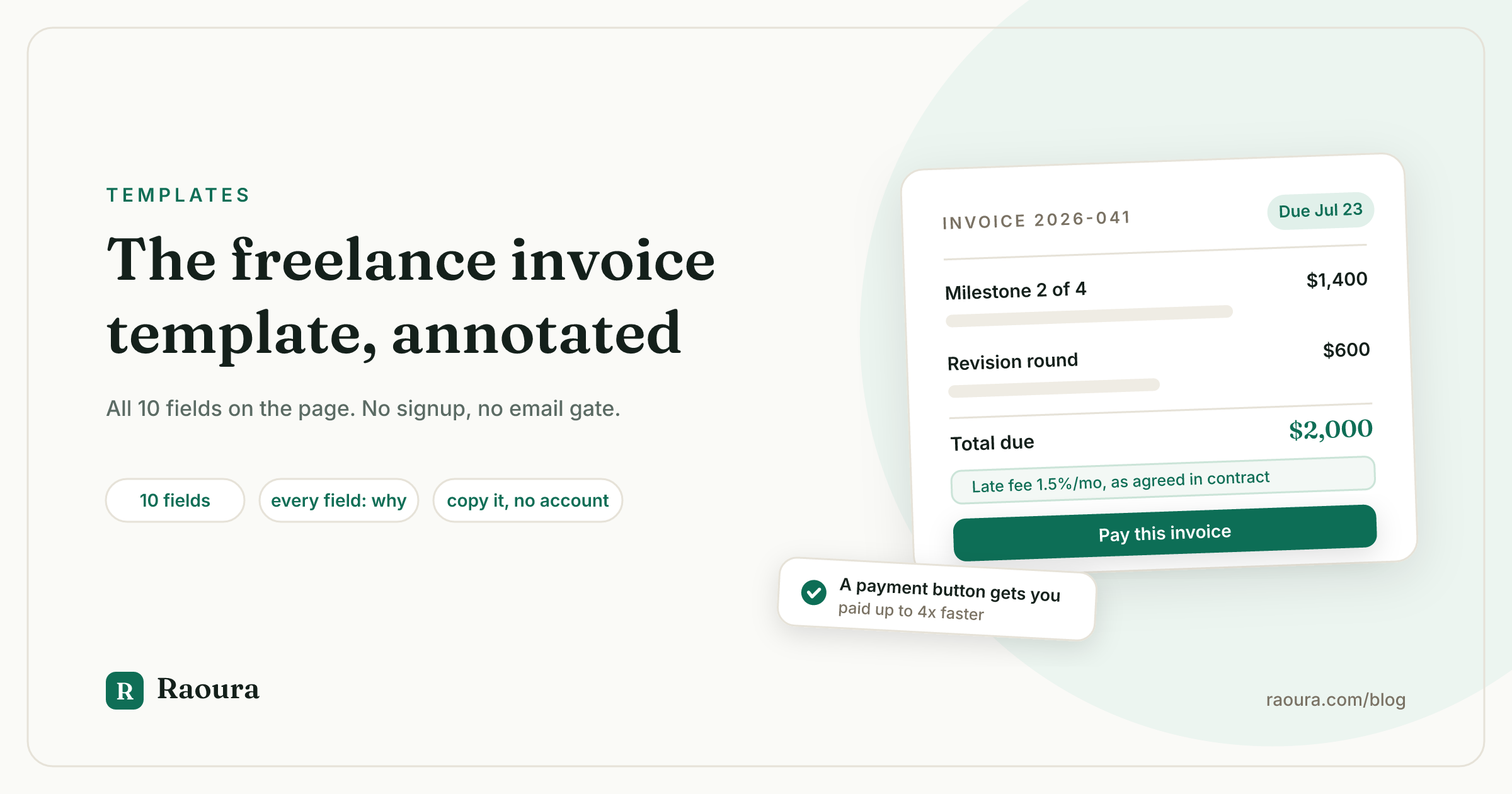
An invoice template is usually sold to you as a design problem: pick a layout, add your logo, send. But nobody pays faster because your invoice is prettier. They pay faster because the invoice lands with the right person, states an exact date, and makes paying a one-click act instead of a chore.
Bonsai's analysis of invoices from 100,000 freelancers found 29% are paid at least a day late, and Xero's US data says small businesses wait an average of 28.7 days to get paid, with invoices arriving 9.1 days late on average. The gap between a template that looks good and a template built to get paid is measured in weeks of your cash flow.
So this page does two things the top-ranking template pages do not. The template is here in full, no account, no email gate. And every field carries a short note on what it does to your payment speed, because those notes are the actual product. The file format is the least important decision you will make today.
What the top-ranking invoice templates actually give you#
We fetched the six top-ranking pages for "freelance invoice template" in July 2026: two require an account before you can use the template, and zero of the six explain why any field exists or mention the state laws that now require clients to pay freelancers within 30 days. Here is the audit:
| Source | Truly ungated | Explains each field | Payment terms guidance | Late fee wording | Covers NY/IL/CA payment laws |
|---|---|---|---|---|---|
| [Canva](https://www.canva.com/invoice/templates/freelance/) | No (account to edit or download) | No | No | No | No |
| [Adobe Express](https://www.adobe.com/express/templates/invoice/freelance) | No (app account to edit) | No | No | No | No |
| [Wise](https://wise.com/us/invoice-templates/freelancer) | Mostly (email form up top, direct links below) | Partly | Partly | No | No |
| [FreshBooks](https://www.freshbooks.com/invoice-templates/freelancers) | Yes | Partly | Partly | Mentioned once | No |
| [Bonsai](https://www.hellobonsai.com/invoice-template/freelance) | No (signup to use) | No | No | No | No |
| [QuickBooks](https://quickbooks.intuit.com/ca/resources/invoice-templates/freelancers/) | Yes | Partly | Partly | No | No (Canadian page) |
Two details from that audit are worth a laugh and a lesson. The FreshBooks freelance template page actually serves photography invoice files, down to a how-to section that begins "To make a photography invoice." And the QuickBooks page ranking for US searchers is the Canadian edition, complete with GST and CRA guidance.
When the incumbents are this careless with the page itself, you can guess how much thought went into whether the template gets you paid.
The template#
A freelance invoice needs 10 fields, and the three that move payment speed most are the exact due date, the late fee line, and the payment link. Copy the block below, replace the bracketed parts, and read the notes once. The notes are what turn a form into a system.
INVOICE
[Your name, doing business as Your Business Name]
[Mailing address] · [email] · [phone]
Bill to: [Client legal name], attn: [the person who actually pays], [email]
PO / reference: [if the client issued one]
Invoice number: [2026-041]
Issue date: [July 9, 2026]
Payment due: [July 23, 2026]
| Description | Qty / unit | Rate | Amount |
|---|---|---|---|
| [Milestone 2 of 4: homepage design, per agreement dated May 3] | 1 | $[X] | $[X] |
| [Additional revision round, approved by email June 30] | 1 | $[X] | $[X] |
Subtotal: $[X]
Sales tax ([rate]%, if applicable): $[X]
Total due: $[X]
Terms: Payment due by [July 23, 2026]. Overdue balances accrue a late fee of 1.5% per month, as provided in our agreement.
Pay online: [payment link]. Or by ACH: [bank name, routing, account].
Thank you! Once payment clears I will [deliver final files / begin the next milestone].
Now the field-by-field reasons, in order.
1. Your business block#
Use the same legal name and address that appear in your contract, so the paper trail is one continuous identity. If you have an EIN, use it wherever a client asks for a tax ID. It is free from the IRS in minutes and keeps your Social Security number out of email attachments forever.
2. Bill to#
The most common self-inflicted payment delay is invoicing your day-to-day contact when a bookkeeper, office manager, or accounts payable inbox actually pays the bills. Ask at kickoff: "Who should invoices go to, and is there anything they need on the invoice, like a PO number?" One sentence, and your invoice skips the internal forwarding queue that quietly eats a week.
3. Invoice number#
Client accounting systems track bills by reference number, and a missing or duplicate number is a legitimate reason for their software to reject or misfile yours. Numbering gets its own section below.
4. Issue date and due date#
Write the due date as an exact calendar date. FreshBooks' own guidance warns against "Net 30" and "due upon receipt" because clients read vague terms in whatever way suits them; "upon receipt" in particular has no fixed meaning to a client who opened the email on a Friday.
Seven to fourteen days is the working window for solo freelancers, and the case for short terms is not just impatience: QuickBooks' 2025 Late Payments Report found 60% of small businesses offering longer payment terms report cash flow problems, versus 40% of those collecting immediately. The full argument, including when Net 30 is worth conceding to a big client, is in payment terms that get you paid in days, not months.
5. Line items#
Mirror the language of your contract or statement of work, milestone for milestone, so the client recognizes every line instantly. An invoice that requires the client to reverse-engineer what they are paying for is an invoice that sits in the "deal with later" pile. If a line covers extra work, name the approval ("approved by email June 30"): that one clause converts a potential dispute into a receipt.
For deposit invoices, bill your deposit percentage as its own invoice before work starts, then reference it on the final invoice ("less deposit paid June 1"). Longer projects should be invoiced per milestone, never as one big number at the end.
6. Subtotal, tax, total#
Most US states do not tax most freelance services, but a meaningful minority tax some of them (design, software, digital goods, depending on the state), so check your state's revenue department once rather than guessing forever. List any tax as its own line; never bury it in your rate.
7. Terms and late fee#
The late fee line on the invoice is a reminder, not a contract. Late fees are generally enforceable only if the client agreed to them upfront, which is why your contract's late fee clause does the legal work and the invoice just restates it. 1.5% per month is the standard B2B figure, subject to state caps. And the fee is leverage you can spend: waiving it once, in writing, buys more goodwill than never having had it.
8. Pay online#
This is the single biggest lever on the page. QuickBooks reports invoices with an online Pay Now button are paid up to four times faster than paper invoicing (their own user data, so treat the multiple as directional, but every processor's data points the same way: fewer steps, faster money). Every step you remove, finding the checkbook, asking for bank details, logging into a portal, is measured in days.
9. The thank-you line#
FreshBooks' analysis of its invoice data found 89.61% of invoices that include "thank you" get paid, and 45.12% of them get paid in under seven days. Manners are not the mechanism, clarity is: the same line tells the client what happens after payment, which gives them a reason to pay now instead of eventually.
How to number invoices#
The simplest durable system is the year plus a three-digit counter: 2026-001, 2026-002, and the counter resets each January. There is no US law dictating a scheme (in the UK, by contrast, a unique sequential number is legally required), but sequential and unique is the universal accounting convention, and your future self doing taxes will thank you.
Two refinements worth stealing. If you juggle many clients, prefix the client: ACME-2026-003 tells you at a glance who owes what. And do not start your first invoice at 001 if it bothers you to advertise that it is your first invoice; starting the counter at 040 is a harmless, common practice.
Whatever you choose, never reuse a number. If you void an invoice, keep the number and issue the next one; a gap with a note beats a duplicate every time.
What it costs to get paid#
On a $2,000 invoice, the same payment collected by card costs you $58.30 through Stripe, while ACH costs $5.00: a $53.30 difference for one click of setup. Processing fees are the tax on convenience, so know the menu (verified against Stripe's and PayPal's current pricing pages, July 2026):
| Method | Fee | Cost on $2,000 | You keep |
|---|---|---|---|
| Stripe, ACH debit | 0.8%, capped at $5.00 | $5.00 | $1,995.00 |
| PayPal, pay by bank | 1%, capped at $10.00 | $10.00 | $1,990.00 |
| Stripe, US card | 2.9% + $0.30 | $58.30 | $1,941.70 |
| PayPal, card fields | 2.99% + $0.49 | $60.29 | $1,939.71 |
| PayPal, PayPal checkout | 3.49% + $0.49 | $70.29 | $1,929.71 |
The practical play: offer ACH as the default on invoices over about $1,000 and keep card as the convenient option, because a card payment today still beats a free payment that never arrives. What you should not accept is a middleman on top of the processor. Some client management platforms route your money through their own account and take their own cut or float; the reasons that matters are laid out in why your client tool should never touch your money.
What is legally required on an invoice#
No US federal law dictates invoice format, but three states now give freelance invoices legal teeth: New York, Illinois, and California require clients to pay by the contract date or within 30 days of completing the work. The IRS's only interest is that invoices exist: it lists them among the supporting documents you keep to substantiate income, so store every invoice you send.
The state laws are the bigger deal. New York's Freelance Isn't Free Act (statewide since August 2024, contracts of $800+ alone or aggregated over 120 days), Illinois's Freelance Worker Protection Act ($500+ over 120 days), and California's SB 988 ($250+) all require written contracts and timely payment, with real damages for violations.
Your invoice is the evidence exhibit for all of it, which is one more reason the amounts, dates, and names on it should match your contract exactly. State-by-state detail lives in freelance payment laws by state.
When the invoice goes unpaid anyway#
29% of freelance invoices are paid late, but more than 75% of late invoices are paid within 14 days of the due date, per Bonsai's data, so a calm, prompt reminder recovers most of them. The template's job ends at delivery; from there it is a process problem. Send the first nudge the day after the due date, not a week later, because silence teaches clients your due date was decorative. The full sequence, from friendly reminder to demand letter to small claims, is in the unpaid invoice escalation ladder, the prevention system is in how to get clients to pay invoices on time, and if the client has vanished entirely, start with the recovery playbook. More numbers on how often this happens, and to whom, are in freelance late payment statistics.
When to graduate from a template#
A template invoices one project fine. What it cannot do is remember. It will not tell you invoice 2026-037 is now nine days overdue, send the reminder you would have sent if you were not heads-down in delivery work, take the payment itself, or mark the milestone paid. That memory is the actual product you are buying when you move from files to software: the chasing, checking, and reconciling that make up so much of the unbilled admin week is mostly tracking states a system should track for you.
(Disclosure: Raoura is our product.) Raoura is that system built for a business of one: invoices generated from the milestones in your project, sent from your own domain, paid by card or ACH straight into your own Stripe account with no platform cut, with automatic reminders you approve before they send, for $17 a month flat.
But nothing above requires it. The template is yours either way, and a freelancer with this template, exact due dates, and an ACH link will out-collect one with beautiful software and vague terms every time.

This is what graduating from the template looks like: the invoice knows its own due date, takes the payment, and the money lands in your Stripe with nothing skimmed off.
Verified July 2026. Primary sources: Stripe and PayPal current pricing pages, QuickBooks 2025 Late Payments Report, Bonsai late payment analysis, Xero US invoice payment guide, FreshBooks invoicing data, IRS recordkeeping guidance, NY DOL, Illinois DOL, California SB 988, GOV.UK invoicing rules. Competitor template audit (gating, field coverage) performed against live pages July 2026. Fee math computed on current published rates. This article is general information, not legal or tax advice.
Frequently asked questions
Is this freelance invoice template really free?
Yes. Copy it from this page into a Google Doc, a Word file, or your invoicing tool. No download gate, no email, no account.
What payment terms should I put on a freelance invoice?
An exact calendar date, 7 to 14 days after the issue date, stated as "Payment due by [date]." Avoid "Net 30" and "due upon receipt": vague terms get read in the client's favor, and longer terms correlate with cash flow trouble (60% vs 40% in QuickBooks' 2025 data).
Can I charge a late fee on an invoice?
Only if the client agreed to it beforehand, in your contract. The invoice line restates the agreed fee, typically 1.5% per month, subject to state caps. A late fee that first appears on the invoice itself is generally not enforceable.
Should I put my SSN on an invoice?
No. If a client needs a tax ID for their 1099 records, give them an EIN via a W-9 form. An EIN is free from the IRS and takes minutes to get online.
What is the difference between an invoice and a receipt?
An invoice requests payment; a receipt confirms it happened. B2B clients rarely need a formal receipt because their payment record suffices, but if one asks, reissue the invoice marked "PAID [date]" with the payment method noted.
How should I number my first invoice?
Year plus counter: 2026-001. If you would rather not advertise that it is your first, start the counter higher; just keep every number unique and sequential from there, and never reuse a voided number.
Do freelancers charge sales tax?
Depends on your state and your service. Most services are untaxed in most states, but design, software, and digital goods are taxable in some. Check your state revenue department once, then encode the answer in your template.
---
Run your client work in one place
Send a proposal, get it signed, invoice, and get paid, with a branded portal your clients will actually use. One flat plan at $17/month, and we never take a cut of your payments.
Try Raoura free for 14 daysNo credit card required. Set up in minutes.
Keep reading
Is Upwork Worth It in 2026? A Break-Even Test for Your Situation
Upwork is worth it when its fee costs less than finding the client yourself, and that is true far more often for a first project than for a repeat client. Here is the break-even math with 2026 numbers: the 0 to 15% fee, Connects, the shrinking client base, and when to wait out the 24-month rule instead of paying to leave.
The Virtual Assistant Contract: 24 Clauses, Scored Against Every Template Ranking for This Search
We scored the four pages that publish actual virtual assistant contract text against 24 clauses a VA agreement needs. Twenty-four of 96 possible slots were filled. The best single template managed 7 out of 24. Twelve clauses appear in none of them, including every clause about the thing that makes VA work different from other freelance work: you are holding your client's passwords and running their inbox. One popular template also tells you a contract fixes your independent contractor status, then mandates client-set 9 to 5 weekday hours in the same document. Here is the clause-by-clause version, with the classification test the DOL is actually applying in 2026, the data protection terms nobody drafts, and the retainer mechanics that decide whether unused hours roll over.
Stripe vs PayPal for Freelancers: Every Fee Verified (2026)
Every page ranking for this comparison either prints in-person retail rates, contradicts itself, or skips the numbers freelancers actually pay. We read the current Stripe and PayPal pricing pages line by line, ran a $3,000 invoice through every rail, and found a $1,764 per year gap between the cheapest setup and the default one.