The 6 Unbilled Hours: Your Admin Leak Quantified
August 30, 2026
You did not become a freelancer to format invoices. Yet somewhere between the proposal you rewrote from scratch, the third "just checking in on that payment" email, and the twenty minutes spent hunting for the file version the client actually approved, a full workday of your week disappeared. Nobody paid for it.
Most articles about freelance admin time are either a stat dump with no advice or a personal essay with no numbers. This one does the boring thing first: it traces every figure to the survey it came from (including one number that almost everyone quotes wrong), adds up what the hours cost you at real freelance rates, and then works through the fixes in order of minutes saved.
How much time do freelancers actually spend on admin?#
Across the three most credible recent surveys, freelancers lose roughly 4 to 6 hours per week to unbilled administrative work, which is about 10 to 15 percent of a full-time schedule.
Three independent data points converge on that range:
The most-cited number comes from freelancermap's annual freelancer study, and here is the correction worth knowing: the primary source says 5 hours, not 6. The exact finding is that 43% of freelancers spend around 10 to 20% of their time, approximately 5 hours per week, on unproductive tasks such as client acquisition, accounting, and customer care.
Clockify's popular stats roundup rounds this up to "approximately 6 hours," and nearly every page that ranks for this topic quotes Clockify's version rather than the original. We checked the top-ranking pages in July 2026, and not one of them cites the 5-hour primary figure correctly.
The freshest data point is Smallpdf's 2026 Freelancer Freedom Index, a 397-person survey reported in July 2026, which found freelancers lose an average of 204 hours a year to admin and paperwork. That is about 4.25 hours per week over a 48-week working year. The same survey found that 38% of freelancers name document formatting as their single biggest weekly time sink, and 79% of millennial freelancers do admin outside normal business hours.
The third leg is not a freelancer survey at all, but it explains why the first two undercount. Harvard Business Review researchers tracking 137 knowledge workers found they toggled between applications roughly 1,200 times per day, adding up to just under 4 hours per week spent purely reorienting after switching, about 9% of their time at work. Freelancers running a 5-to-8-tool stack pay that same tax, and it hides inside "real work" hours, so no time-use survey captures it as admin.
So where does our title's "6 unbilled hours" come from? It is a composite: the survey range of 4.25 to 5 hours of nameable admin tasks, plus a conservative slice of the toggle tax that survey respondents never report. The next section itemizes it.
The admin leak ledger: where the 6 hours go#
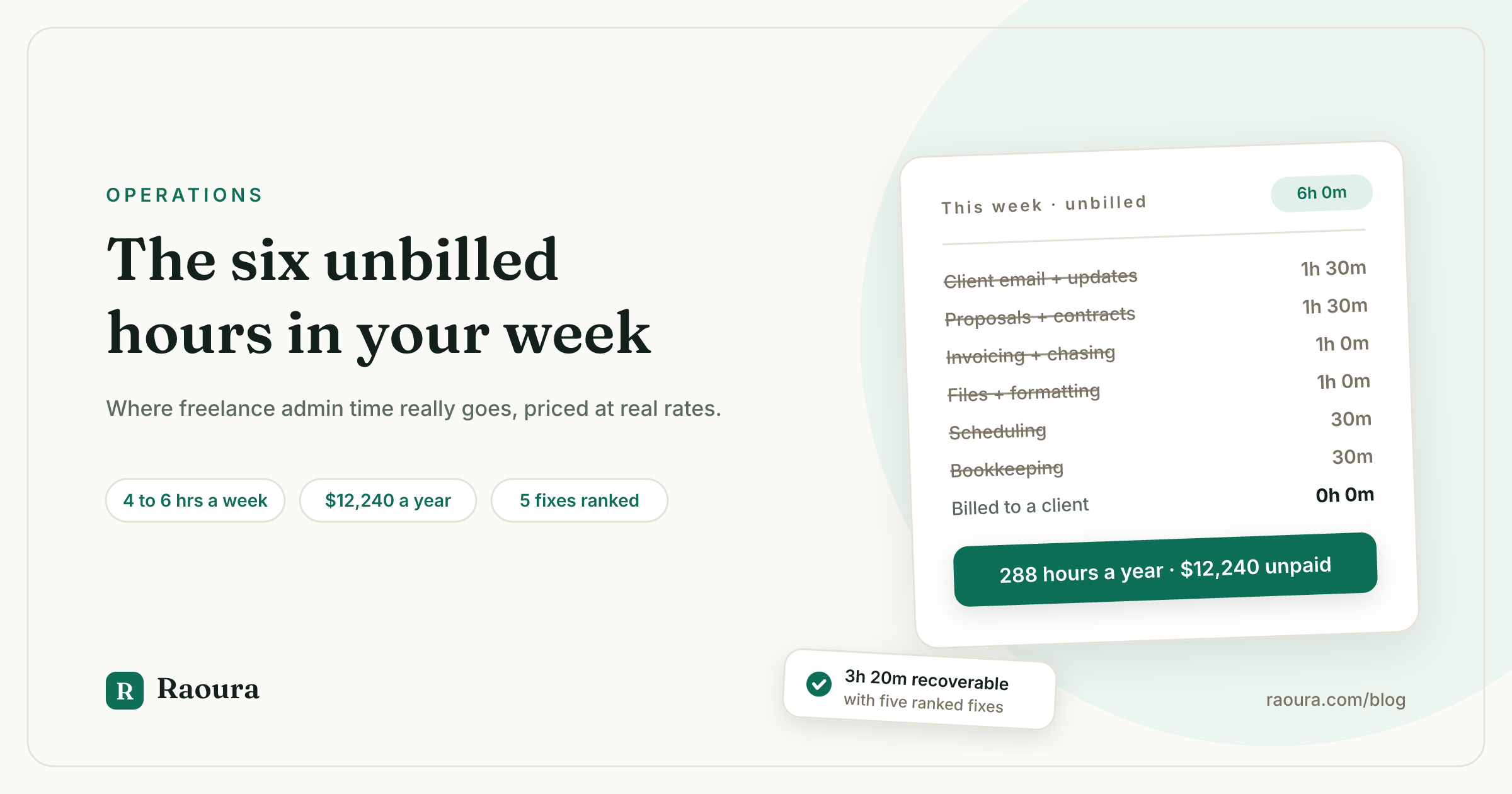
A working itemization of the weekly admin leak assigns 90 minutes to client communication, 90 minutes to proposals and contracts, 60 minutes to invoicing and payment chasing, 60 minutes to file wrangling and formatting, 30 minutes to scheduling, and 30 minutes to bookkeeping: 6 hours in total.
No ranking page breaks the hours down by task, so we built the ledger ourselves. The weights are our own estimates, anchored to the task-level stats that do exist. Treat it as a template: your own split will differ, but the categories will not.
| Task | Weekly estimate | What the data says |
|---|---|---|
| Client email, status updates, "any update?" replies | 1h 30m | 79% of millennial freelancers do admin like this outside business hours (Smallpdf, 2026) |
| Writing proposals, quotes, and contracts | 1h 30m | 31% of freelancers lost a client or undercharged in the past year due to paperwork friction (Smallpdf, 2026) |
| Invoicing and chasing payments | 1h 0m | 29% of freelance invoices are paid at least a day late ([Bonsai invoice data](https://www.hellobonsai.com/blog/late-freelance-payment)); 56% of US small businesses are owed money, averaging $17,500 ([QuickBooks, 2025](https://quickbooks.intuit.com/r/small-business-data/small-business-late-payments-report-2025/)) |
| File handoffs, version hunting, document formatting | 1h 0m | 38% of freelancers call document formatting their biggest weekly time sink (Smallpdf, 2026) |
| Scheduling and meeting coordination | 30m | Part of the 1,200 daily app toggles ([HBR, 2022](https://hbr.org/2022/08/how-much-time-and-energy-do-we-waste-toggling-between-applications)) |
| Bookkeeping and tax records | 30m | Bundled into freelancermap's "unproductive tasks" bucket ([freelancermap survey](https://www.freelancermap.com/blog/freelancer-hours-survey/)) |
| **Total** | **6h 0m** |
Two things stand out once you see it itemized:
- The biggest lines are communication and paperwork, not bookkeeping, even though bookkeeping is what most people picture when they hear "admin."
- Four of the six rows exist mostly because information lives in the wrong place: the client emails you because they cannot see project status, you hunt for files because delivery happened across three email threads, you retype the same scope into a proposal, a contract, and an invoice.
That pattern matters when you get to fixes, because it means most of the leak is a systems problem, not a discipline problem. We made the longer version of that argument in You Don't Need a CRM. You Need These 5 Things.
What 6 unbilled hours actually cost you per year#
At the verified $85,000 median income for full-time US freelancers, 6 weekly admin hours represent roughly $12,200 per year of unpaid labor, and even the survey-reported figure of 4.25 hours works out to about $8,700.
Here is the math, so you can rerun it with your own numbers.
The Upwork Research Institute's Future Workforce Index, a survey of 3,000 US skilled knowledge workers, found that full-time freelancers earned a median income of $85,000, out-earning their full-time employee counterparts. At 1,900 to 2,000 working hours a year, that median implies an effective rate of about $42.50 to $44.75 per hour. We will use $42.50 to stay conservative.
| Scenario | Weekly admin | Annual hours (48 weeks) | Value at $42.50/hr |
|---|---|---|---|
| Smallpdf survey figure | 4.25 hours | 204 | $8,670 |
| freelancermap survey figure | 5 hours | 240 | $10,200 |
| Composite with toggle tax | 6 hours | 288 | $12,240 |
For a sanity check: freelancers in the Smallpdf survey self-reported that admin costs them nearly $6,800 a year in potential income. Their gut estimate lands below the low end of our calculation, which is what you would expect, since people undercount time they never track.
One honest caveat: an admin hour is not automatically a billable hour. Cutting 3 hours of admin does not print $130, it prints capacity. Whether that capacity becomes billable work, an earlier finish on Friday, or a pipeline you finally have time to fill is up to you.
But pricing the leak at your effective rate is the only way to compare a $17 or $30 software subscription, a template library, or an hour spent building a system against what the mess actually costs. A monthly tool bill of $30 breaks even if it saves you 43 minutes a month at the median rate.
The per-freelancer numbers also scale to an economy-wide observation: skilled freelance work generated over $1.5 trillion in US earnings in 2024 across roughly 20 million workers. If those workers leak even 4 hours a week, freelance admin is a multi-billion-hour annual drain that no employer is motivated to fix, because freelancers are their own employers.
The toggle tax: why your tool stack multiplies the leak#
Knowledge workers switch apps roughly 1,200 times per day and spend just under 4 hours per week, about 9% of work time, purely reorienting after each switch.
The HBR study behind those numbers tracked employees at three Fortune 500 companies, not freelancers. But a solo freelancer running the typical stack (invoicing app, e-signature tool, scheduler, project board, file storage, notes, email) toggles through more distinct systems per client than most corporate employees touch per task. Each switch costs seconds; the reorientation afterward costs minutes.
This is the leak that time-use surveys miss, because no one writes "toggling" on a timesheet. It hides inside your billable hours as slower delivery, and inside your admin hours as friction: five logins to answer one client question is not a task, so it never gets counted as one.
It is also why the fix for admin time is consolidation before automation. Automating a 7-tool stack gives you 7 automated silos and the same toggle tax. We ran the consolidation math, with verified July 2026 pricing, in The Minimalist Freelance Stack: a typical 7-tool stack runs about $85 a month, and at least 4 of the 7 tools touch the same client workflow.
The reduction playbook: fixes ranked by minutes saved#
The five fixes below recover an estimated 3 hours 20 minutes of the 6-hour weekly leak, and none of them requires working faster, only relocating where information lives.
These estimates are ours, mapped to the ledger rows above. Start at the top; each fix compounds the ones after it.
- Put project status somewhere the client can see it (saves about 60 minutes a week). The single biggest ledger row, client email, is mostly clients asking questions they could answer themselves: what is the status, where is the file, what do I owe. A shared project page or client portal turns "any update?" emails into a link the client bookmarks. This is the highest-leverage fix because it deletes work instead of speeding it up.
- Template your proposals and contracts (saves about 45 minutes a week). You should never type your payment terms, revision policy, or late-fee clause twice. A proposal template with swap-in scope blocks cuts a 90-minute document to 30 minutes, and it directly attacks the paperwork friction that cost 31% of freelancers a client or a proper fee last year.
- Automate payment reminders (saves about 30 minutes a week). With 29% of freelance invoices paid late, chasing is not an exception, it is a recurring workload, and QuickBooks' UK research found 56% of payment chasing happens outside the working day. Scheduled reminders at 3, 7, and 14 days overdue send themselves at 9 a.m. instead of you drafting guilt-management prose at 9 p.m. Our full escalation system is in How to Get Clients to Pay Invoices on Time.
- Deliver files from one place with one link (saves about 30 minutes a week). Version hunting exists because delivery is scattered across email attachments, Dropbox links, and chat threads. One canonical delivery location per project ends the "is this the final-final?" loop and the re-sending of lost links.
- Consolidate the stack (saves about 35 minutes a week). This is the toggle tax fix: every tool you remove deletes its logins, its notification channel, and its slice of the 1,200 daily switches. Cutting a 7-tool stack to 3 plausibly recovers a meaningful share of HBR's 4 weekly reorientation hours; we claim only 35 minutes here to stay conservative.
Total: about 3 hours 20 minutes a week, or roughly $7,000 a year at the median effective rate. Disclosure: Raoura is our product, and this playbook is essentially its design brief. It combines proposals, contracts, invoicing with automated reminders, milestones, file delivery, and a white-label client portal in one tool at a flat $17 per month, and payments run through your own Stripe account so there is no per-transaction commission on top. A tool only earns its subscription if it clears the break-even math above; at $17 a month, Raoura needs to save you about 24 minutes a month at the median rate. You can also assemble the same playbook from separate tools, and the fixes work either way.

The playbook in one screen: the chasing, the follow-ups, and the stalled proposal surface themselves each morning instead of living in your head.
How to run your own one-week admin audit#
Tracking every task switch for 5 working days, in half-hour blocks with a one-word label, is enough to build your personal version of the ledger and usually surfaces 1 to 2 hours of weekly admin you did not know you had.
You cannot fix a leak you have not measured, and your split will not match the survey averages. The lightweight version:
- For one week, keep a note open. Every time you switch tasks, write the time and one word: "invoice," "email," "design," "chase," "files," "call."
- Do not change your behavior to look better. The audit only works if the week is typical.
- On Friday, total the non-billable labels and sort them into the six ledger rows above.
- Multiply your weekly admin hours by 48, then by your effective hourly rate (annual income divided by annual working hours, not your quoted rate).
- Fix the biggest row first, using the playbook order above as a tiebreaker.
Freelancers who run this audit almost always find their real leak is lumpier than the averages: one brutal category, not six even ones. That is good news. It means one fix can recover a disproportionate share.
Not convinced a tool beats what you already have? We timed both in Raoura vs a spreadsheet and email.
Frequently asked questions
How much time do freelancers spend on admin per week?
The two most recent surveys put it at approximately 5 hours per week (freelancermap, 43% of freelancers spending 10 to 20% of their time on unproductive tasks) and 204 hours per year, about 4.25 per week (Smallpdf Freelancer Freedom Index, 2026). Add the app-switching overhead documented by HBR and 6 hours is a defensible working number.
What counts as admin time for a freelancer?
Anything a client does not pay for directly: proposals, quotes, contracts, invoicing, payment chasing, scheduling, status-update emails, file management, document formatting, bookkeeping, and tax records. Client acquisition is sometimes counted too; the freelancermap survey bundles it into the same bucket.
Should you bill clients for admin time?
Project-specific admin (kickoff calls, status reporting, revision coordination) belongs inside your project price, not on a separate line item clients will dispute. Business-wide admin (your bookkeeping, your invoicing) cannot be billed to anyone, which is exactly why reducing it matters: it comes straight out of your effective hourly rate.
Is AI reducing freelance admin work?
Mostly not yet. In the 2026 Smallpdf survey, 58% of solopreneurs said AI has done little to reduce their admin workload, and respondents still reported losing 204 hours a year to paperwork. AI drafts text well, but most admin pain is coordination (chasing, versioning, status), which drafting does not fix.
What percentage of a freelancer's hours should be billable?
Be skeptical of the "50 to 70% billable" figure that circulates; we could not trace it to any live primary source. The verified freelancermap data implies most freelancers keep unproductive time to 10 to 20% of hours, suggesting 80%+ billable is common. Your target depends on how much marketing and pipeline work your niche demands; measure your own week before adopting anyone's benchmark.
---
Every statistic above was checked against the linked source in July 2026. The Smallpdf Freelancer Freedom Index figures are cited via ContentGrip's July 2026 report, as the original study page was not directly reachable when we verified. Verified July 2026.
Run your client work in one place
Send a proposal, get it signed, invoice, and get paid, with a branded portal your clients will actually use. One flat plan at $17/month, and we never take a cut of your payments.
Try Raoura free for 14 daysNo credit card required. Set up in minutes.
Keep reading
Is Upwork Worth It in 2026? A Break-Even Test for Your Situation
Upwork is worth it when its fee costs less than finding the client yourself, and that is true far more often for a first project than for a repeat client. Here is the break-even math with 2026 numbers: the 0 to 15% fee, Connects, the shrinking client base, and when to wait out the 24-month rule instead of paying to leave.
The Virtual Assistant Contract: 24 Clauses, Scored Against Every Template Ranking for This Search
We scored the four pages that publish actual virtual assistant contract text against 24 clauses a VA agreement needs. Twenty-four of 96 possible slots were filled. The best single template managed 7 out of 24. Twelve clauses appear in none of them, including every clause about the thing that makes VA work different from other freelance work: you are holding your client's passwords and running their inbox. One popular template also tells you a contract fixes your independent contractor status, then mandates client-set 9 to 5 weekday hours in the same document. Here is the clause-by-clause version, with the classification test the DOL is actually applying in 2026, the data protection terms nobody drafts, and the retainer mechanics that decide whether unused hours roll over.
Stripe vs PayPal for Freelancers: Every Fee Verified (2026)
Every page ranking for this comparison either prints in-person retail rates, contradicts itself, or skips the numbers freelancers actually pay. We read the current Stripe and PayPal pricing pages line by line, ran a $3,000 invoice through every rail, and found a $1,764 per year gap between the cheapest setup and the default one.