Client Ghosted You After Delivery: The Recovery Playbook
August 30, 2026
There is a specific silence that follows hitting send on final files. The project thread that got replies within hours now gets nothing. The invoice sits unopened, or worse, opened and unanswered. You re-read your last message checking for something offensive in it. There is nothing. The client is just gone.
Before writing this guide we fetched every page ranking on the first page for this query in July 2026, and the field is strange.
- One page reframes your missing money as a "client experience" problem and never mentions the invoice.
- One was last substantively updated in 2021.
- One is a collections agency pitch from 2017.
- The best of them spends most of its words on ghosting before a project starts.
Zero of the four mention the copyright leverage you still hold over delivered, unpaid work, and zero mention the state payment laws passed in 2024 and 2025 that can double what a silent client owes you. This playbook covers both, in the order you should actually use them.
First, confirm it is a ghost and not a delay#
Treat silence as ghosting only after three unanswered contacts on at least two different channels over 14 days; before that, the odds heavily favor an ordinary late payment. Bonsai's analysis of three years of invoices from more than 100,000 freelancers found 29% of invoices are paid late, but over 75% of those late invoices are paid within 14 days of the due date, and about 90% within a month. Statistically, the client who has you drafting angry emails on day 6 will most likely pay by day 14 without ever knowing you were composing them.
A ghost is defined by channels, not by days. One unanswered email is an inbox. Three unanswered contacts across email and phone is a decision.
That distinction matters because the boring explanations are common and unglamorous:
- Your email landed in spam or a "later" pile.
- The person who hired you is on vacation or has left the company.
- The invoice is sitting in an approval queue behind someone else's signature.
- A company card expired.
- Larger clients add a structural one: your contact was never the person who pays, and accounts payable has never heard of you.
So the first 14 days are diagnosis, not war. Your job is to rule the boring explanations out one channel at a time, while keeping every message so professional it could be read aloud in small claims court later. Because if this does go the distance, it will be.
The 21-day recovery sequence#
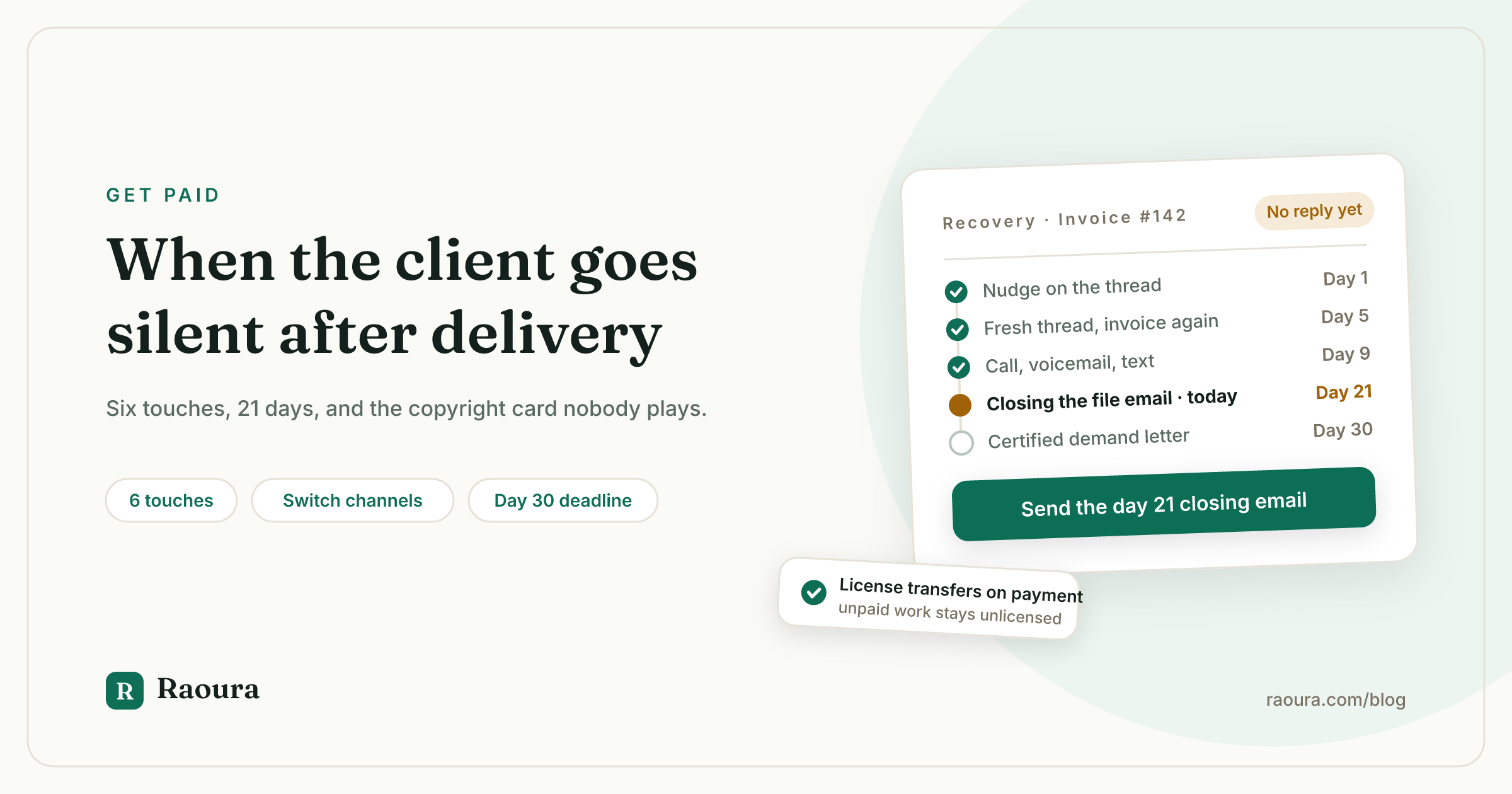
Run six touches over 21 days and switch channels every second touch: same-thread email, fresh-thread email, phone plus voicemail, a second human at the company, a reissued invoice, and a final closing-the-file email. Repetition on one channel gets filtered by the same habit that ignored the first message. Switching channels is what breaks a ghost, because each new channel re-asks the question "are you really choosing not to answer this?"
| Day | Channel | What you send | Why it works |
|---|---|---|---|
| 1 | Email, same thread | One-line nudge with amount, invoice number, payment link | Rules out "missed it" |
| 5 | Email, new thread | Fresh subject line ("Invoice #142, payment link inside"), invoice reattached | Beats spam filters and buried threads |
| 9 | Phone, then a text | A call, a 20-second voicemail, and a same-day text | Voice converts an ignorable thread into a person |
| 13 | A second contact | Short note to accounts payable, the project stakeholder, or the info@ address | Routes around a vanished or departed contact |
| 17 | Reissued invoice | Invoice re-sent with the agreed late fee as a line item, second contact copied | Turns waiting into something that costs money |
| 21 | Email, closing the file | Deadline, consequences, and the license paragraph from the next section | Makes day 30 real before it arrives |
Three of those touches deserve exact words.
The day 9 voicemail: "Hi [name], it's [you]. The [project] invoice for [amount] came due on [date] and I want to make sure nothing's stuck on your end. The payment link is in my email from [day]. If something's wrong, call me back today and we'll sort it out." Then the text: "Just left you a voicemail about invoice #142. All good on your end?" You are giving them a face-saving exit at every step; most late payers take it.
The day 13 note to a second person: "Hi, I'm the [role] who delivered [project] for [contact name] on [date]. Invoice #142 for [amount] is now [X] days past due and [contact] hasn't been reachable. Could you point me to the right person for payment status?" No accusations. Companies pay invoices; individuals ghost them. Your goal is to get the invoice back inside a process.
The day 21 closing email is the one that recovers ghosts, and it works by being calm about consequences: "I haven't been able to reach you since [date] despite several attempts, so I'm setting a final date. If invoice #142 ([amount]) isn't paid by [day 30 date], I'll send a formal demand letter by certified mail and pursue the remedies available to me, and I want to flag one of them now: my contract licenses the delivered work upon full payment, so until payment clears, the files I delivered aren't licensed for use. I'd much rather close this the easy way. Here's the payment link." Then stop. No more reminders between day 21 and day 30. Silence from you, for once, does the talking.
If reminders feel impossible to keep up with on top of billable work, that is a systems problem rather than a courage problem, and the fix is covered in our guide to getting clients to pay invoices on time.
The leverage you still hold: the work itself#
Under US copyright law, ownership of freelance work does not transfer automatically: a transfer of copyright requires a written, signed agreement under 17 U.S.C. § 204(a), which means a client who never paid very often never acquired the rights they are using. Freelancers consistently underrate this card. The client has your files, so it feels like they hold everything. Legally, possession of a file and license to use it are different things.
The mechanics, briefly and carefully. Work you create as an independent contractor is yours at creation, it only becomes the client's "work made for hire" in specific categories and only with a signed written agreement, and it only transfers by written assignment.
If your contract conditions the license on full payment (good contracts do, and our contract guide covers the clause), an unpaid client using the work is using it without a license. If your contract is silent, the picture is muddier, because courts can find an implied license once you hand work over voluntarily, which is exactly why the payment-condition clause belongs in every future contract.
What this is worth in practice: one factual sentence in your day 21 email and your demand letter, as shown above. A client who ignores "please pay me" often answers "the site you launched is using unlicensed work" very quickly, especially if their own clients or legal counsel might hear about it.
Two hard warnings.
- Do not engage in self-help repossession. Logging into their site with credentials you still have and taking the work down can expose you to civil and even criminal liability under computer access laws, and it converts you from creditor to defendant. Say the words, never touch their systems.
- This section is general information, not legal advice. It covers how US copyright works, not your specific dispute. If real money rides on the licensing question, an hour with an IP lawyer is cheap.
What to do when a ghost has actually published your unpaid work, including DMCA takedowns, is its own topic on our roadmap.
Day 30: silence becomes nonpayment#
At 30 days of documented silence, stop chasing and start enforcing: a certified demand letter, then the state laws that award double damages on contracts as small as $250 in California, $500 in Illinois, and $800 in New York, then small claims court, which handles claims from $2,500 up to $25,000 depending on the state for a $15 to $100 filing fee. From this point on, a ghosted freelancer and a refused freelancer are in the same process, and we maintain the complete version in the unpaid invoice escalation ladder: the demand letter anatomy, the New York, Illinois, and California statutes in detail, and the small claims mechanics state by state.
Two additions specific to ghosts.
- Confirm the client still exists before spending anything on enforcement. Spend ten minutes searching the state's Secretary of State business registry for their entity, checking whether the website and socials have gone dark, and searching the owner's name plus "LLC" for a new company. A ghost who dissolved their LLC is a different problem from a ghost who is dodging you, and the registry search is free.
- Let the statute of limitations lower your blood pressure. Written contract debt remains enforceable for 3 to 10 years depending on the state. You have been ghosted, not beaten. The deadline pressure you feel is emotional, not legal.
And you are not an outlier who got uniquely unlucky. A Freelancers Union survey found 71% of freelancers have struggled to collect payment at least once, losing an average of nearly $6,000 a year to nonpayment, and Intuit QuickBooks' January 2025 survey of 2,487 small businesses found 56% are owed money on unpaid invoices, averaging $17,500 each. How late is normal, and how often invoices die entirely, is quantified in our freelance late payment statistics hub.
Ghost-proofing the next project#
The structural fix is to never be owed 100% of anything: a 25% to 50% deposit before work starts, milestone billing so no single payment exceeds one phase, and final files that transfer only when the final payment clears. Every one of those is a norm, not an imposition, and each has its own guide: how much deposit to charge, payment terms that surface problems early, and the late fee clause that makes silence expensive. Milestone billing, the single strongest ghost-proofing structure, is on our roadmap as its own guide.
The delivery mechanics matter as much as the paperwork. A ghosting is only catastrophic when the client already has everything. Deliver watermarked previews or a staging link for approval, invoice the final payment, and release final files on payment. That is not distrust; it is the same order of operations as every store you have ever walked out of.
The honest failure mode of all this advice is that it requires you to notice, on the right day, that an invoice crossed a threshold, and then to do an uncomfortable task instead of billable work, six separate times.
Raoura exists for that gap: it tracks every invoice, runs your reminder sequence automatically on the schedule you set, applies your agreed late fee after the grace period, and keeps delivered files behind a client portal where final versions unlock on payment, so the sequence above happens even when you would rather not think about it. Disclosure: Raoura is our product, and everything in this playbook works the same if you run it from a calendar and a spreadsheet.

The client can review everything and take nothing: final files unlock themselves when the payment clears, which makes ghosting pointless.
Frequently asked questions
The client is opening my emails but not replying. Does that change anything?
No, except to confirm the diagnosis. Read receipts and link clicks tell you the channel works and the silence is a choice, which means channel switching and the day 21 closing email matter more, not less. Do not mention that you can see the opens; it reads as surveillance and burns goodwill you may still need.
They ghosted me and then published the work. Now what?
That is the strongest position a ghosted freelancer can hold, uncomfortable as it feels. Document the use with dated screenshots before saying anything, then raise the licensing issue factually in your demand letter. Published use of unlicensed work converts "please pay your invoice" into a copyright question, and clients resolve copyright questions quickly. If it is on a platform with a takedown process, a DMCA notice is available to you as the copyright holder; that process is its own topic on our roadmap.
Should I contact the owner or my contact's boss directly?
Yes, once, at day 13 of the sequence, in the neutral accounts-payable phrasing above. What you should never do is go public: a factual review is legal, but naming and shaming a client on social media while money is in dispute invites a defamation claim and poisons any settlement. Every message you send should read fine to a judge.
What if they ghosted me mid-project instead of after delivery?
Stop work immediately and hold the undelivered portion; that leverage is exactly what the ghosted-after-delivery freelancer wishes they had. The revival sequence is similar, but the decision tree around pausing, kill fees, and restarting is different, and a stalled-project guide is on our roadmap.
There was no written contract. Am I out of luck?
No. Emails, texts, the delivered work, and the invoice establish an agreement small claims courts accept every day. The copyright position is actually stronger without a contract (nothing transferred rights), though the implied-license question gets murkier. The double-damages statutes are harder to invoke without a written contract, and New York and Illinois penalize clients for refusing to provide one you requested.
How long should I keep trying before escalating?
Follow the sequence: 21 days of structured contact, enforcement beginning at day 30. Stretching the chase phase past a month mostly signals that silence works on you. The one exception is a long-standing client with a known crisis; a human allowance is fine, but put a date on it.
The company seems to have shut down entirely. Is the money gone?
Not automatically. Check the Secretary of State registry for the entity's status first; a dissolved LLC, a bankruptcy filing, and an owner who simply started a new company under a new name lead to three different paths. How to run that trace, and when a dead client company still pays, is on our roadmap.
---
Every statistic, statute, and legal claim in this article was verified against primary sources in July 2026: Bonsai's invoice dataset, the Freelancers Union nonpayment survey, Intuit QuickBooks' 2025 Late Payments Report, 17 U.S.C. § 204 and US Copyright Office Circular 30 for the copyright mechanics, the Illinois Department of Labor, New York State DOL, and California Legislature pages for the state payment laws, and Nolo's 50-state statute of limitations and small claims charts.
Run your client work in one place
Send a proposal, get it signed, invoice, and get paid, with a branded portal your clients will actually use. One flat plan at $17/month, and we never take a cut of your payments.
Try Raoura free for 14 daysNo credit card required. Set up in minutes.
Keep reading
Is Upwork Worth It in 2026? A Break-Even Test for Your Situation
Upwork is worth it when its fee costs less than finding the client yourself, and that is true far more often for a first project than for a repeat client. Here is the break-even math with 2026 numbers: the 0 to 15% fee, Connects, the shrinking client base, and when to wait out the 24-month rule instead of paying to leave.
The Virtual Assistant Contract: 24 Clauses, Scored Against Every Template Ranking for This Search
We scored the four pages that publish actual virtual assistant contract text against 24 clauses a VA agreement needs. Twenty-four of 96 possible slots were filled. The best single template managed 7 out of 24. Twelve clauses appear in none of them, including every clause about the thing that makes VA work different from other freelance work: you are holding your client's passwords and running their inbox. One popular template also tells you a contract fixes your independent contractor status, then mandates client-set 9 to 5 weekday hours in the same document. Here is the clause-by-clause version, with the classification test the DOL is actually applying in 2026, the data protection terms nobody drafts, and the retainer mechanics that decide whether unused hours roll over.
Stripe vs PayPal for Freelancers: Every Fee Verified (2026)
Every page ranking for this comparison either prints in-person retail rates, contradicts itself, or skips the numbers freelancers actually pay. We read the current Stripe and PayPal pricing pages line by line, ran a $3,000 invoice through every rail, and found a $1,764 per year gap between the cheapest setup and the default one.