What Should Be in a Freelance Contract: Every Clause, What It Does, and the Wording That Works
July 6, 2026
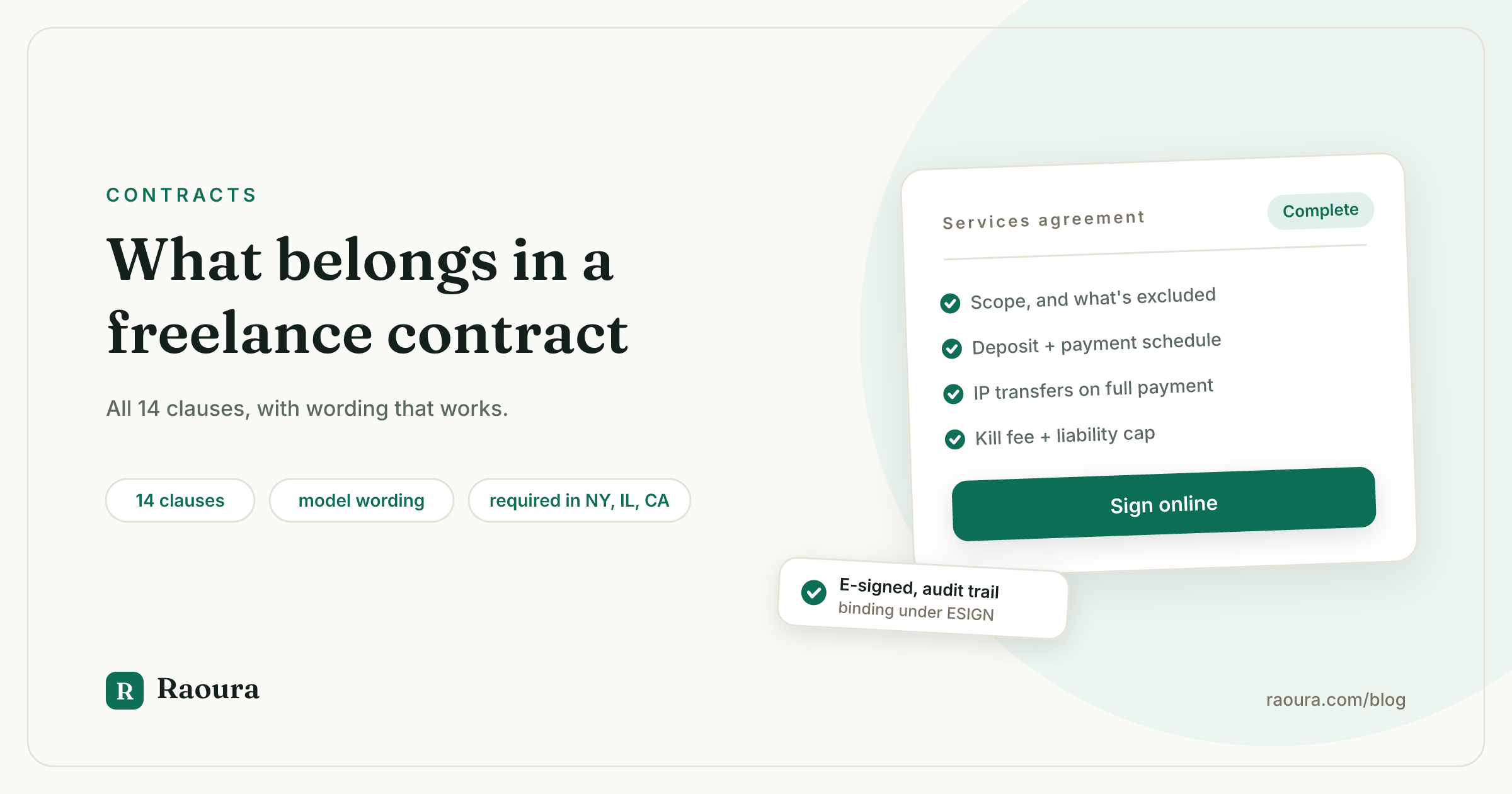
Here is what a freelance contract actually is, once you strip away the legal costume: it is every argument you might have with a client, held in advance, while everyone still likes each other. How many revisions? Argued and settled. Who owns the files if they never pay? Settled. What happens if they vanish for three weeks and come back expecting the old deadline? Settled, in writing, before it cost you anything.
The data says this argument-in-advance pays: freelancers who use written contracts earn 13.7% more, per a peer-reviewed ILR Review study of Freelancers Union survey data. The same study contains the caveat the contract-template industry never quotes: 38.8% of freelancers with contracts still hit payment trouble. A contract is the floor, not the whole building, and we will come back to what sits on top of it.
Most guides on this topic list six clause names, explain none of them, and link a gated template. This one goes clause by clause through all 14, each with the why, model wording you can adapt, and what tends to happen without it. Verified July 2026.
First: in three states, this is no longer optional#
If your client is in New York, Illinois, or California, a written contract is now required by law above surprisingly low thresholds: $800, $500, and $250 respectively. New York's Freelance Isn't Free Act went statewide in August 2024, Illinois' Freelance Worker Protection Act took effect July 2024, and California's SB 988 in January 2025, with municipal versions in Los Angeles, Seattle, Minneapolis, and Columbus. All of them require essentially the same five contract elements:
- Names and mailing addresses of both parties
- An itemized list of the services
- The value of those services, and the rate and method of pay
- The payment due date, or the mechanism that determines it
- In NY and CA, the date by which you must submit your invoice or list of services
Every clause list below starts from that compliance floor. The teeth are real: these laws carry double-damages provisions for unpaid freelancers, and NYC's enforcement office alone has recovered over $3.5 million since its original 2017 law. The paperwork your flaky client calls "too formal" is the paperwork three states now insist they sign.
The 14 clauses#
For each: what it does, wording you can adapt (adapt, not worship; this is general information, not legal advice), and the failure mode it prevents.
1. Parties and addresses. Full legal names, business names, mailing addresses. Boring, and the first thing the state laws above require, and the thing that makes a demand letter deliverable later. Without it: you discover "Mike from Meridian" is legally nobody.
2. Scope of work, and what is excluded. The itemized deliverables, plus the sentence almost everyone omits: what is not included. Scope creep is not born in month two; it is born here, on the day the scope was written as "website redesign" instead of five named page templates, two revision rounds, and no copywriting.
Deliverables are limited to those listed above. Work not described in this agreement or an approved change order is not included.
Without it: every "I assumed that was included" becomes a negotiation you fund.
3. Payment terms. Rate, schedule, method, and the deposit. Our deposit guide covers the amounts; the contract states them:
A deposit of 40% ($2,400) is due on acceptance; work begins on receipt. The remaining balance is due 30% on approval of milestone one and 30% on final delivery. Invoices are due on receipt.
"Due on receipt" is a choice: net 30 is a corporate habit, not a law of nature, and you are allowed to not offer it. Without it: you are extending interest-free credit in unlimited amounts on undefined dates.
4. Late fees. A stated monthly percentage (1 to 2% per month is the common range, capped where state law says so) does two jobs: it occasionally collects, and it always signals that your invoices have consequences.
Overdue balances accrue a late charge of 1.5% per month or the maximum permitted by law, whichever is lower.
Without it: the only cost of paying you late is your discomfort, which many clients price at zero.
5. Revisions. Define the number of rounds, what one round means, and the rate after the limit.
The fee includes two rounds of revisions per deliverable. A round is one consolidated set of change requests. Additional rounds are billed at $95/hour via change order.
Without it: round 14 exists. You have met round 14.
6. Timeline, with a client-delay carve-out. Deadlines bind both sides, so tie yours to theirs:
Delivery dates assume client feedback within 5 business days of each submission. Delays in feedback extend subsequent deadlines by the same number of days.
Without it: the client disappears for three weeks and reappears expecting the original launch date, and the contract, which names only your obligations, agrees with them.
7. Intellectual property: assignment on full payment. This is the clause the ranking guides get most dangerously wrong, so here is the actual law.
By default, an independent contractor owns the copyright in what they create. Your client does not own the work by paying an invoice; they own it when a written agreement says so.
And the phrase "work made for hire" alone often fails: per the US Copyright Office's Circular 30, a commissioned work only qualifies if it falls into one of nine narrow statutory categories (contributions to collective works, film, translations, tests, atlases, and similar), and most freelance deliverables, including logos, websites, code, and photographs, do not.
What a freelance contract needs is an assignment, and the professional move is conditioning it on payment:
Upon receipt of full payment, Contractor assigns to Client all rights in the final deliverables. Until full payment, Contractor retains all rights. Contractor retains a non-exclusive license to display the work for portfolio purposes.
That first sentence is also your collections department: a client who has not paid does not own the work, which transforms the final invoice from a request into a transaction. Without it: either the client is exposed (no written transfer means you still own their logo) or you are (a broad "all work product, all rights, on signing" clause means an unpaid project they own anyway).
8. Termination and kill fee. Either side can end it; the question is what ending costs. State the notice period, that work completed to date is payable, and the kill fee that compensates the schedule you cleared. Deposits do double duty here:
Either party may terminate with 14 days' written notice. On termination, Client pays for all work completed plus a cancellation fee of 25% of the remaining contract value. The deposit is non-refundable once work has begun.
Without it: "we're going another direction" arrives in week three of eight, and your calendar, cleared for five more weeks, earns nothing.
9. Change orders. One sentence in the base contract makes every future scope conversation easy: any change to scope, price, or timeline requires a written change order approved before the changed work begins. The full change order system is its own article; the clause is the hook it hangs on. Without it: scope changes get negotiated from scratch, every time, usually at invoice time.
10. Independent contractor status. States that you are a contractor, not an employee: you control your methods, provide your tools, receive no benefits, and handle your own taxes. One honest note: this clause documents intent, but classification is decided by the working reality, not the label, and the federal test is in flux right now (the Department of Labor proposed in February 2026 to replace the 2024 rule with a framework weighing control and opportunity for profit; a final rule is pending).
The clause still belongs in every agreement, because when a question arises, the documented intent plus your actual independence is the defense. Without it: nothing bad on most projects, and a mess on exactly the project where a client's HR department or a state auditor starts asking questions.
11. Confidentiality. A mutual, plain-language promise to protect each other's non-public information, with standard carve-outs (already public, independently known, legally compelled). Resist the urge to sign the client's 9-page unilateral NDA as your only paper; a two-sentence mutual clause covers most freelance realities. Without it: clients hesitate to share the access and context you need, or you sign theirs and accept obligations no solo can track.
12. Limitation of liability. Here is a fact worth sitting with: in corporate contracting, limitation of liability has been the single most negotiated clause for over a decade per World Commerce & Contracting's annual studies. Companies with legal departments fight hardest over this one, and most freelance contracts, including most templates, do not contain it at all.
Contractor's total liability under this agreement is limited to the fees actually paid by Client. Neither party is liable for indirect or consequential damages.
Without it: your $3,000 website project theoretically carries unlimited exposure if something downstream goes wrong, which is an insane trade you never consciously made.
13. Dispute resolution and governing law. Which state's law applies and what happens first when you disagree (good order: direct negotiation, then mediation, then small claims or arbitration). Pick your home state while you are the one writing the paper. Without it: the fight over where to have the fight costs more than the fight.
14. Signatures, electronically. Under the federal ESIGN Act and state equivalents, electronic signatures carry the same weight as ink, provided there is intent, consent, and a kept record. A proper e-signature flow with an audit trail (who signed, when, from where) satisfies exactly those elements, and a clear "agreed" reply to an emailed contract is generally enforceable too, if less tidy in a dispute. What does not work: starting the project while the contract sits unsigned, which is the most common contract failure of all. No signature, no kickoff.
One clause worth adding in 2026: AI#
New this cycle, and worth a sentence even if your answer is simple: whether you may use AI tools in producing the work, whether AI-generated material may appear in final deliverables, and who is responsible for checking it. Clients increasingly ask; a contract that already answers reads as professionalism, not evasion. (Note that under current US Copyright Office guidance, purely AI-generated material is not copyrightable, which quietly interacts with the IP clause: deliverables you assign should be your authorship.)
What actually gets fought over#
If you negotiate nothing else, negotiate in this order: payment terms, IP transfer timing, revisions, termination, and, with bigger clients, the liability cap, because their draft will cap their liability and not yours. When a client insists on their paper instead of yours, the game is not to win every clause; it is to read their draft against this list and price or push back on the gaps. A client contract with no revision limit is not a dealbreaker; it is a quote adjustment.
The contract is the floor, not the system#
Remember the 38.8%: freelancers with contracts who still had payment trouble. Paper does not chase invoices, pause work when balances age, or notice scope drifting. The contract creates the rights; a follow-through system enforces them: deposits collected at acceptance, milestones that keep exposure to one phase, reminders that send themselves, and change orders that reprice scope in real time.
(Disclosure: Raoura is our product.) This article is also, frankly, a description of why we built Raoura's contract feature the way we did: a guided builder with 11 contract types where you check the clauses you need, from a curated library covering everything above, with the parties pre-filled, e-signature with a full audit trail, and the contract living next to the proposal, invoices, and milestones it governs. $17 a month flat. But every clause above works in a Google Doc too; the wording is yours either way.

Clause 14 in action: the e-signature arrives with the who, when, and where already recorded, so proving the agreement is never the hard part.
Verified July 2026. Legal references: US Copyright Office Circular 30 (revised 2024), NY GBL Article 44-A, 820 ILCS (IL FWPA), California SB 988, the ESIGN Act, and DOL's February 2026 proposed rulemaking on contractor classification (pending; re-verify at publish). Income statistics from the ILR Review (Freelancers Union Independent Worker Survey data). This article is general information, not legal advice.
Frequently asked questions
What must a freelance contract include to be legal in New York, Illinois, or California?
The same five elements, roughly: both parties' names and mailing addresses, itemized services, the value and rate of pay, the payment due date or mechanism, and (NY and CA) the date for submitting your invoice. Thresholds: $800 in NY, $500 in IL, $250 in CA.
Does "work made for hire" in my contract give the client ownership?
Often not by itself. For independent contractors, work-for-hire status only applies to nine narrow categories of commissioned works under US copyright law. Most freelance deliverables need an assignment clause instead, and conditioning the assignment on full payment protects you.
Is a contract signed by email or e-signature legally valid?
Yes. Under ESIGN and state equivalents, electronic signatures are as binding as ink when there is intent to sign and a kept record. An e-signature flow with an audit trail is the strongest form; a plain "agreed" email reply is generally enforceable but messier to prove.
What if the client insists on using their contract?
Read it against the 14 clauses here and negotiate the gaps rather than rejecting it outright: revision limits, IP transfer timing, payment schedule, and a liability cap are the usual holes. Whose paper wins matters less than whether the paper is complete.
Do I need all 14 clauses for a $400 project?
No. For small projects, a one-page version covering parties, scope and exclusions, price and deposit, revision limit, IP on payment, and a kill fee sentence covers 90% of the risk. Below the state thresholds nothing is legally required, but nothing about a small project makes nonpayment hurt less.
How many freelancers actually use contracts?
No rigorous current count exists, which is itself telling. What the peer-reviewed data shows: contract users earned 13.7% more, and contracts alone still left 38.8% with payment trouble, which is why the system around the contract matters as much as the paper.
---
Run your client work in one place
Send a proposal, get it signed, invoice, and get paid, with a branded portal your clients will actually use. One flat plan at $17/month, and we never take a cut of your payments.
Try Raoura free for 14 daysNo credit card required. Set up in minutes.
Keep reading
Is Upwork Worth It in 2026? A Break-Even Test for Your Situation
Upwork is worth it when its fee costs less than finding the client yourself, and that is true far more often for a first project than for a repeat client. Here is the break-even math with 2026 numbers: the 0 to 15% fee, Connects, the shrinking client base, and when to wait out the 24-month rule instead of paying to leave.
The Virtual Assistant Contract: 24 Clauses, Scored Against Every Template Ranking for This Search
We scored the four pages that publish actual virtual assistant contract text against 24 clauses a VA agreement needs. Twenty-four of 96 possible slots were filled. The best single template managed 7 out of 24. Twelve clauses appear in none of them, including every clause about the thing that makes VA work different from other freelance work: you are holding your client's passwords and running their inbox. One popular template also tells you a contract fixes your independent contractor status, then mandates client-set 9 to 5 weekday hours in the same document. Here is the clause-by-clause version, with the classification test the DOL is actually applying in 2026, the data protection terms nobody drafts, and the retainer mechanics that decide whether unused hours roll over.
Stripe vs PayPal for Freelancers: Every Fee Verified (2026)
Every page ranking for this comparison either prints in-person retail rates, contradicts itself, or skips the numbers freelancers actually pay. We read the current Stripe and PayPal pricing pages line by line, ran a $3,000 invoice through every rail, and found a $1,764 per year gap between the cheapest setup and the default one.