The Payment Reminder Schedule That Works: 7 Touches Across 33 Days
July 19, 2026
Ask the internet when to send payment reminders and you get ranges. Send the first one "3 to 7 days before the due date." Follow up "1 to 7 days after." Escalate "as needed."
We fetched the five pages that rank for payment reminder schedule in July 2026 and found exactly one that commits to specific days, and zero, none of the five, that cite any data for the intervals they recommend.
All five are written for accounts receivable teams, complete with advice about registered mail and credit departments you do not have.
Ranges are useless to you for one practical reason: you cannot put "1 to 7 days" on a calendar, and a reminder schedule only works if it runs without judgment calls. So this article does the opposite of the ranking pages. It commits to exact days, shows the data behind each interval, and then shows you how to shift the whole grid when your payment terms, invoice size, or client type changes.
One boundary up front: this is the timing article, not the wording article. Every touch below links to a matching copy-paste email in the payment reminder template library, and the wider collection system (deposits, terms, escalation) lives in how to get clients to pay invoices on time. This page is the clock.
The schedule: 7 touches across 33 days#
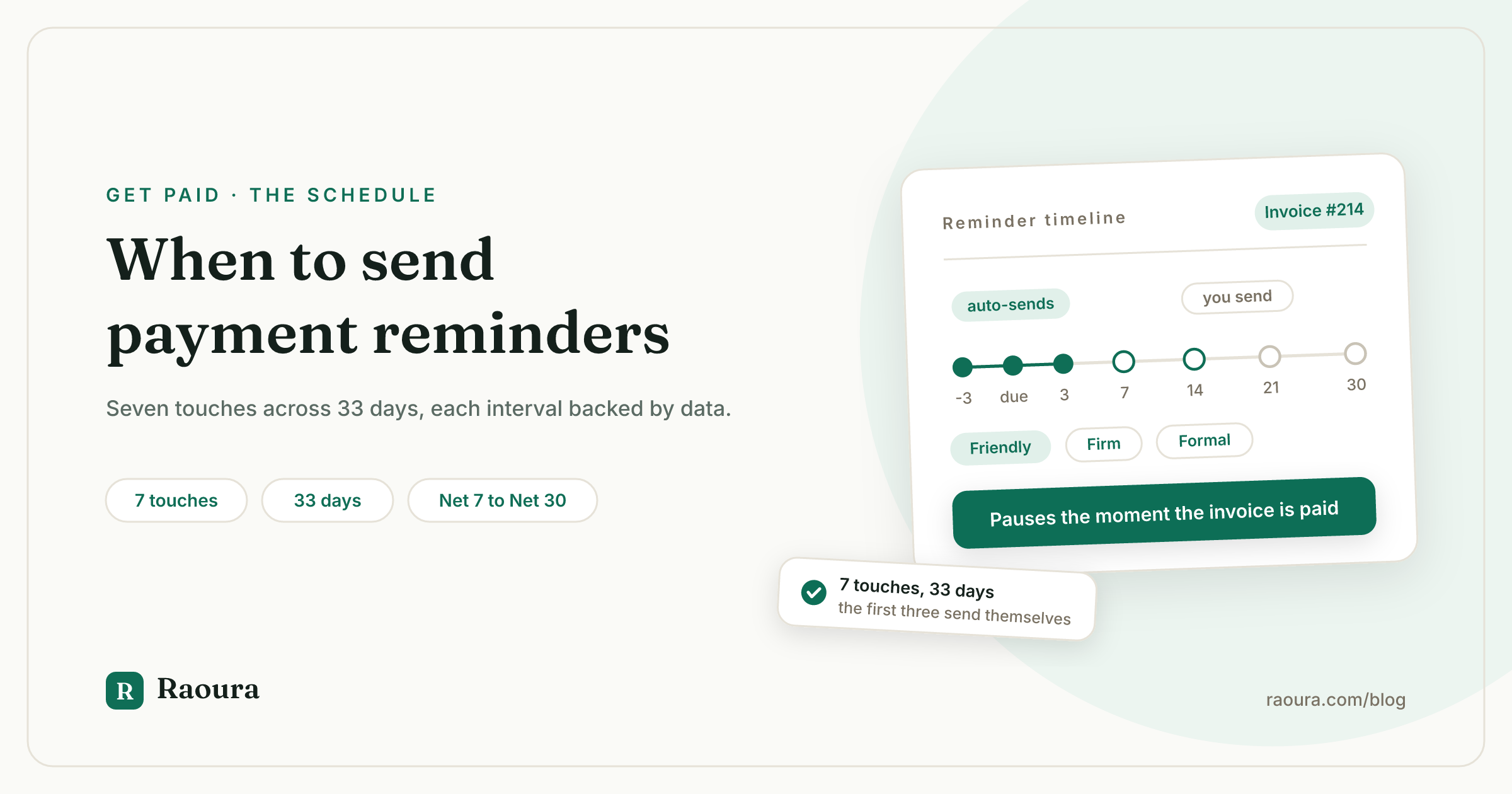
The schedule that works is seven touches across 33 days: one reminder 3 days before the due date, one on the due date, then five more at 3, 7, 14, 21, and 30 days overdue. The first three are clockwork and should be automated. The last four need a human, because they involve reading the relationship.
| Touch | When | Tone | Channel | Who sends it |
|---|---|---|---|---|
| 1 | 3 days before due | Warm heads-up | Software | |
| 2 | Due date | Friendly | Software | |
| 3 | 3 days overdue | Light nudge | Software | |
| 4 | 7 days overdue | Direct, asks for a payment date | You | |
| 5 | 14 days overdue | Firm, invokes late fee if contracted | You | |
| 6 | 21 days overdue | Serious, pauses work, switches to phone | Email + phone | You |
| 7 | 30 days overdue | Formal final notice | You |
Why seven and not three? Because the data says persistence is the whole game. Chaser's 2026 Accounts Receivable Report found that businesses that follow up on 100% of their overdue invoices are 76% more likely to be paid within a week than those that do not, and that 31% of businesses leave some invoices unchased every single month.
The schedule is not about being tough. It is about being complete.
Why these exact days#
Each interval maps to a documented shift in payment behavior: 92% of businesses are now typically paid late, so the pre-due reminder assumes lateness, and over 75% of late freelance invoices resolve within 14 days of the due date, so the first two weeks stay polite. Here is the evidence, touch by touch.
- 3 days before due. Late payment is the default, not the exception: 92% of businesses are typically paid after their invoice due date, up from 87% in 2022, per Chaser's 2026 research. A pre-due heads-up with the invoice reattached kills the "never received it" excuse and flushes out routing problems while the invoice is still current. It is the highest-return email in the sequence and the one most freelancers skip.
- Due date. Xero's Small Business Insights, drawn from 32,000+ US small businesses, puts the average wait to get paid at 28.8 days and the average late invoice at 9.0 days past due (March quarter 2026). Nine days late is not a crisis, it is an inbox problem, and a due-date note is how you keep your invoice on page one of that inbox.
- Day 3. The first overdue nudge does most of the collecting. Trove, an invoice-chasing tool, reports that of invoices chased through its system and eventually paid, 58% are paid after just one reminder and roughly 80% within two. One light, early nudge converts the forgetful majority before any tension exists.
- Day 7. Bonsai analyzed three years of invoicing data from its 100,000+ freelancer user base and found 29% of freelance invoices are paid at least a day late, but over 75% of those late invoices are paid within 14 days of the due date. Day 7 sits in the middle of that resolution window, which is why its job changes from nudging to asking a direct question: when will payment go out? You want a reply while the odds are still heavily in your favor.
- Day 14. The same Bonsai data says 90% of late invoices are paid within a month, so a client silent at two weeks is drifting toward the stubborn 10%. This is where you invoke the late fee, if and only if your contract provides one. The wording effect is measurable: FreshBooks scanned over one million invoices and found that payment terms mentioning "interest" get paid 92.15% of the time, the strongest single wording effect in the study, against a 78.62% baseline. What is legal and how much is covered in the freelance late fee guide.
- Day 21. Email has failed by definition, so the channel changes. Chaser's 2026 data: businesses using both SMS and email get paid within two weeks 73% of the time, versus 49% for email alone. For a solo, the channel switch is usually a phone call plus a paused project, which changes the cost of ignoring you.
- Day 30. More email past this point has sharply diminishing returns, and the wider trend is grim: QuickBooks' 2026 Late Payments Report found 59% of small businesses now have invoices overdue by more than 30 days, up from 47% a year earlier, with businesses owed $17.7K on average. Day 30 closes the reminder phase with a formal final notice and opens the unpaid invoice escalation ladder: demand letter, then small claims or a state complaint. If your client is in New York, Illinois, or California, state freelance payment laws may add double damages to what the final notice can credibly promise.
A standalone fact worth keeping: most late payers are not refusing to pay. Bonsai's numbers show three quarters of late freelance invoices resolve within two weeks of the due date, which is why a schedule that is dense and calm early beats one that is sparse and angry late.
Adjusting the schedule for your payment terms#
The overdue half of the schedule never changes: 3, 7, 14, 21, 30. Only the pre-due half stretches with your terms, which means Net 30 terms put your final notice a full 60 days after you send the invoice. That lag is an argument for shorter terms, not a looser schedule.
| Your terms | Pre-due touches | Overdue touches | Invoice sent to final notice |
|---|---|---|---|
| Due on receipt | None (the invoice email is the heads-up) | Days 3, 7, 14, 21, 30 | 30 days |
| Net 7 | 3 days before due | Days 3, 7, 14, 21, 30 | 37 days |
| Net 14 | 3 days before due | Days 3, 7, 14, 21, 30 | 44 days |
| Net 30 | 7 days and 1 day before due | Days 3, 7, 14, 21, 30 | 60 days |
Two notes on the math. First, on Net 30 you add a second pre-due touch because a single heads-up sent three days before a month-old invoice comes due is asking one email to carry 27 days of silence.
Second, notice what the right-hand column implies: the terms you set move your worst-case timeline far more than any reminder does. FreshBooks' million-invoice study found terms that specify "14 days" get paid 91.51% of the time, nearly matching the effect of mentioning interest.
Shortening your terms is upstream of everything on this page, and the payment terms guide makes that case in full.
When to break the schedule#
Break the schedule in four situations: invoices over about $10K, clients with an AP department, recurring retainers, and any time a promised payment date passes.
Big invoices run late more often, not less. Bonsai's data found invoices over $20,000 were three times more likely to be paid late than invoices under $100. For anything that would hurt to write off, do not stretch the schedule, shrink the invoice: split the project into milestone payments so no single invoice is ever worth a month of anxiety. That system is milestone billing, and it quietly replaces half of this article for larger projects.
Clients with an accounts payable department are a different animal: your contact is not the payer, and reminders aimed at the wrong inbox accomplish nothing. Use the pre-due touch to confirm the routing (PO number, AP contact, portal submission), then send every subsequent reminder to the AP contact with your client CCed.
Retainers and recurring invoices should not need this schedule at all. If you are chasing the same client every month, the fix is the billing structure, not the cadence.
And when a client names a payment date, the schedule pauses until that date passes. If it passes unpaid, resume wherever the calendar says you are, not where you left off. Two broken promises is a pattern, and the sequence should keep moving through it.
The best time of day to send reminders (an honest answer)#
There is no behavioral data linking reminder send time to payment speed, so the honest recommendation is mid-morning, midweek, in the client's time zone, and consistency matters far more than clock time.
The ranking pages present send-time advice as settled science. It is not. The closest thing to evidence is marketing email data: HubSpot's survey of 150+ US marketers found the highest engagement between 9 AM and 12 PM, with Tuesday the most-picked best day, and that is marketers reporting on marketing emails, not anyone measuring invoice reminders.
Borrow the heuristic, skip the certainty. What the payment data does support is chasing everything on schedule: the 76% follow-up effect is measured, the perfect send hour is folklore.
Put the clockwork half on autopilot#
The first three touches contain zero judgment calls, so they should be sent by software, and the 31% of businesses that leave invoices unchased every month are the reason why. Nobody forgets to chase because they are lazy. They forget because chasing is emotionally expensive and always loses to billable work. Moving the pre-due, due-date, and day-3 emails to software removes the touches most likely to be skipped, and skipping is the failure mode the whole schedule exists to prevent.
This split is how reminders work in Raoura, which is client and project management for solo freelancers at one flat $17/mo: proposals, contracts, invoicing, and a client portal, with payments through your own Stripe account so nobody marks up your money. (Disclosure: Raoura is our product.) You attach a reminder schedule to an invoice once, the early nudges go out on time in your voice, and everything pauses automatically the moment the invoice is paid.

The schedule from this article, set once in Raoura's reminder settings: early touches friendly, later ones firm, and everything stops the moment the invoice is paid.
The judgment touches stay yours. Day 14 decides whether to invoke a fee, day 21 decides whether to pause work and pick up the phone, and no tool should make those calls for you. Raoura's automations are built on that line: routine nudges send on their own, and anything with teeth stays a draft until you approve it.

The dividing line in Raoura's automations hub: clockwork touches run on their own, and nothing binding ever goes out without you.
If you would rather stay manual, the schedule works fine as seven calendar entries created the day you send each invoice. The only rule is that you create them on invoice day, while you are calm, because the sequence you improvise at day 14 while annoyed is always worse than the one you scheduled at day zero.
Verified July 2026. Chaser figures (76% follow-up effect, 92% typically paid late versus 87% in 2022, 31% leaving invoices unchased monthly, 73% versus 49% SMS-plus-email effect) are from Chaser's 2026 Accounts Receivable Report summary page, checked this month. Freelance late payment behavior (29% paid at least a day late, over 75% of late invoices resolved within 14 days, 90% within a month, $20K+ invoices 3x more likely to be late) is from Bonsai's analysis of three years of invoicing data across its 100,000+ freelancer user base. Payment timing (28.8 days average to be paid, 9.0 days late on average) is from Xero Small Business Insights, US series, March quarter 2026 release. Invoice wording effects (interest 92.15%, 14 days 91.51%, 78.62% baseline) are from FreshBooks' analysis of over one million invoices. The 59% of small businesses with invoices 30+ days overdue (up from 47%) and $17.7K average owed are from the QuickBooks 2026 Late Payments Report, published July 2026. First-reminder recovery figures (58% after one reminder, roughly 80% within two, among chased invoices that were eventually paid) are from Trove's published chasing data. The ranking-page audit (5 pages fetched for "payment reminder schedule" in July 2026, 1 committing to exact days, 0 citing data for their intervals) is our own review.
Frequently asked questions
How many payment reminders should you send?
Seven across 33 days: one 3 days before the due date, one on it, and five more at 3, 7, 14, 21, and 30 days overdue. Trove's chasing data suggests most invoices that get paid are recovered by the second reminder, but the later touches exist for the invoices that matter most: the ones that did not resolve early.
How long should you wait between payment reminders?
Three to seven days early on, stretching to a week later in the sequence. The 3-7-14-21-30 spacing is dense in the window where Bonsai's data says 75% of late invoices resolve, and slower afterward, when each email is doing legal paper-trail work as much as collecting.
Is it unprofessional to send a reminder before the invoice is due?
No. With 92% of businesses typically paid late, a pre-due heads-up is the single most effective touch in the schedule. Framed as a courtesy with the invoice attached, it reads as organized, not pushy.
Should the schedule differ for new clients versus long-time clients?
Keep the same days but let software handle more of a long-time client's sequence, since the tone is already established. For a brand-new client, send touch 1 personally: it quietly teaches them that you track your invoices, which is the cheapest payment insurance there is.
What if the due date falls on a weekend or holiday?
Shift the due-date reminder to the next business morning and leave the rest of the grid alone. Reminders that land Saturday get buried by Monday, which wastes the touch.
When do you stop sending reminders?
At day 30. Past that point the paper trail is complete and more email just signals that email is all you will ever do. Move to the escalation ladder, and if the client has vanished entirely, run the ghosted-after-delivery playbook first to find out whether anyone is still there to pay you.
---
Run your client work in one place
Send a proposal, get it signed, invoice, and get paid, with a branded portal your clients will actually use. One flat plan at $17/month, and we never take a cut of your payments.
Try Raoura free for 14 daysNo credit card required. Set up in minutes.
Keep reading
The Virtual Assistant Contract: 24 Clauses, Scored Against Every Template Ranking for This Search
We scored the four pages that publish actual virtual assistant contract text against 24 clauses a VA agreement needs. Twenty-four of 96 possible slots were filled. The best single template managed 7 out of 24. Twelve clauses appear in none of them, including every clause about the thing that makes VA work different from other freelance work: you are holding your client's passwords and running their inbox. One popular template also tells you a contract fixes your independent contractor status, then mandates client-set 9 to 5 weekday hours in the same document. Here is the clause-by-clause version, with the classification test the DOL is actually applying in 2026, the data protection terms nobody drafts, and the retainer mechanics that decide whether unused hours roll over.
Stripe vs PayPal for Freelancers: Every Fee Verified (2026)
Every page ranking for this comparison either prints in-person retail rates, contradicts itself, or skips the numbers freelancers actually pay. We read the current Stripe and PayPal pricing pages line by line, ran a $3,000 invoice through every rail, and found a $1,764 per year gap between the cheapest setup and the default one.
The Pause Clause: How to Stop Work When an Invoice Goes Overdue
Stopping work is the strongest move a freelancer has against a late-paying client, and the least understood. Here is the legal doctrine that lets you pause even without a clause, the exact clause to add so you never have to rely on doctrine again, the day-by-day timing, and the two emails that keep the pause professional. Verified against primary sources in July 2026.