Quarterly Estimated Taxes for Freelancers (And the Uneven Quarters Trap)
August 30, 2026
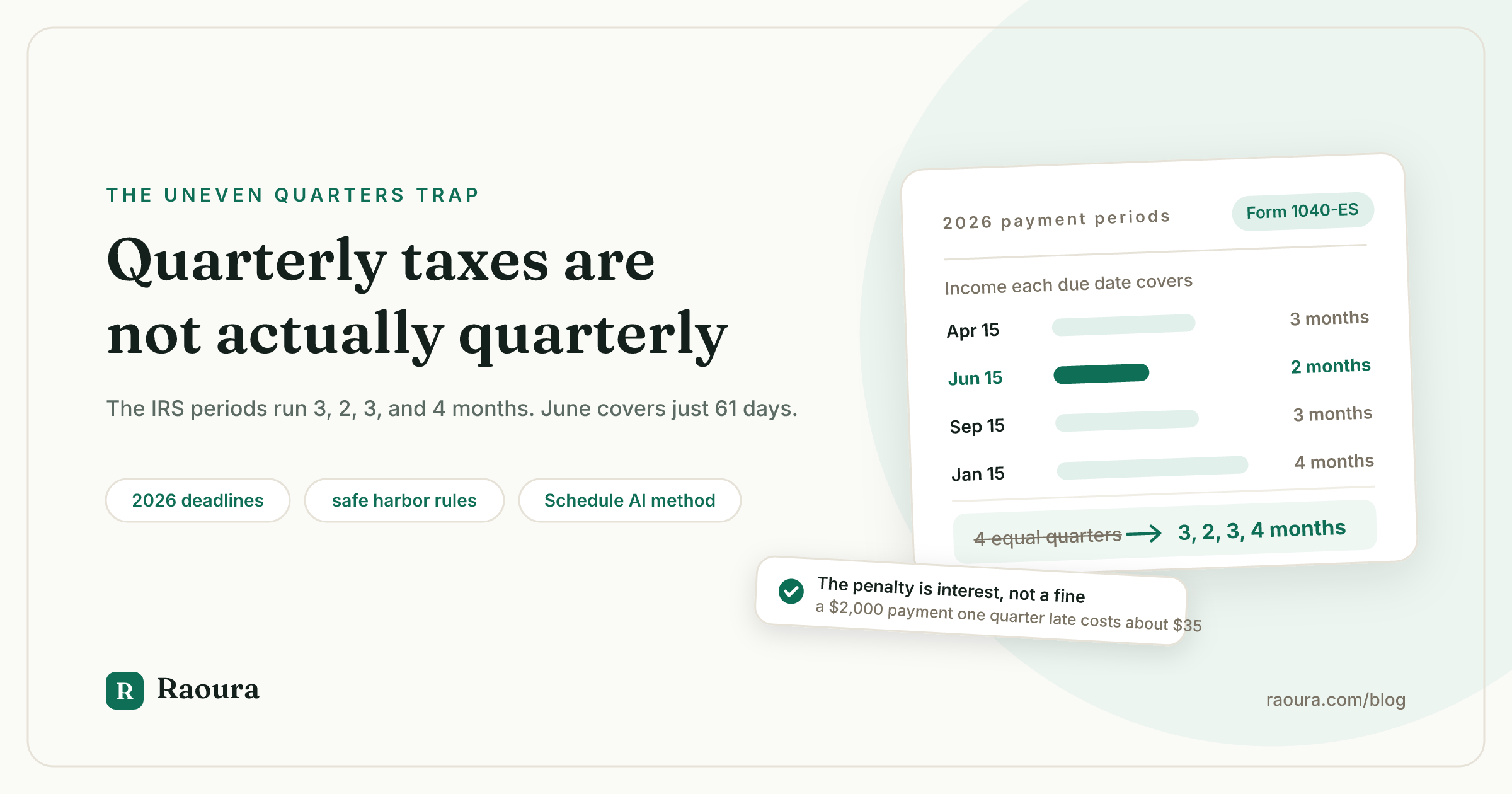
Quarterly taxes have a naming problem. The IRS calls them quarterly, every blog post calls them quarterly, and then the second deadline shows up two months after the first and the fourth period quietly runs four months. The payment periods are 3, 2, 3, and 4 months long, and if you plan around normal calendar quarters, June will ambush you every single year.
The pages ranking for this topic do not help. We fetched the top results in July 2026:
- One major payroll company's guide maps the deadlines to even calendar quarters (April through June due in June, July through September due in September), which is exactly wrong.
- A top personal finance site's 2026 headline lists June 16, which was the 2025 date (June 15, 2025 fell on a Sunday; June 15, 2026 is a Monday).
- A freelancer-focused guide carries an April 2026 update stamp above a list of 2025 deadlines.
Two of the five top-ranking pages we checked list wrong or stale 2026 dates.
So this is the checked version. Every date and rule below comes from the 2026 Form 1040-ES, IRS.gov, or California's FTB, all verified this month. One caveat up front: this is general information, not tax advice. A CPA who can see your full return beats any article.
Who actually has to pay quarterly taxes#
You generally must make estimated tax payments if you expect to owe $1,000 or more when you file your return.
That is the IRS rule for individuals, and it catches most working freelancers fast. Owing $1,000 in total tax takes only around $7,000 of freelance profit once self-employment tax enters the picture, because SE tax runs 15.3 percent of most of your net earnings and no employer is withholding anything on your behalf.
There is one clean escape hatch: you owe no estimated taxes for this year if you had zero tax liability last year, were a US citizen or resident alien for the whole year, and your prior tax year covered 12 months. That combination mostly applies to brand-new freelancers who earned little or nothing the year before. Everyone else should assume the four deadlines apply.
One point of confusion worth killing early: there is no separate payment for self-employment tax. Each estimated payment is a single combined amount covering your income tax and SE tax together. You send one number, four times a year.
If you have not yet worked out what fraction of each payment to set aside in the first place, start with our breakdown of the 25 to 30 percent rule, which runs the full 2026 math at three income levels. This article picks up where that one ends: when and how the saved money actually goes out the door.
The 2026 deadlines and the uneven quarters trap#
The four IRS payment periods are 3, 2, 3, and 4 months long, so the June 15 payment covers only 61 days of income while the January payment covers 122.
Here are the tax year 2026 deadlines from the 2026 Form 1040-ES, with the income period each one actually covers per the IRS estimated tax FAQ. None of the 2026 dates fall on a weekend or holiday, so nothing shifts this cycle.
| Payment | Income earned | Period length | Due date |
|---|---|---|---|
| 1st | January 1 to March 31, 2026 | 3 months (90 days) | April 15, 2026 |
| 2nd | April 1 to May 31, 2026 | 2 months (61 days) | June 15, 2026 |
| 3rd | June 1 to August 31, 2026 | 3 months (92 days) | September 15, 2026 |
| 4th | September 1 to December 31, 2026 | 4 months (122 days) | January 15, 2027 |
The trap lives in that second row. April 15 is already the heaviest cash day of a freelancer's year: your final payment for last year and your first estimated payment for this year are due on the same date. Then the next payment arrives 61 days later, on June 15, with only two months of income behind it. Freelancers who budget by calendar quarters walk into June short, every year, and the top-ranking pages that map the periods to normal quarters make it worse.
The fix is not complicated, but it has to be deliberate: fund each payment from a running tax account you feed with every client payment, not from whatever happens to be in checking when a deadline arrives. If a slow-paying client is what usually wrecks your June, that is a receivables problem wearing a tax costume; our system for getting invoices paid on time attacks that side directly.
Two small footnotes on the table. You can skip the January 15, 2027 payment entirely if you file your full 2026 return and pay the balance by February 1, 2027. And when a deadline does land on a weekend or legal holiday in other years, it moves to the next business day.
How much to send: the safe harbor that ends the guessing#
Pay 100 percent of last year's total tax (110 percent if your prior-year AGI was over $150,000), split across the four dates, and you cannot be penalized no matter how much you earn this year.
The IRS gives you two ways to be safe: pay at least 90 percent of what you will owe for the current year, or pay at least 100 percent of the tax shown on last year's return, whichever is smaller. If your 2025 adjusted gross income was above $150,000 ($75,000 if married filing separately), the prior-year target becomes 110 percent instead of 100.
For most freelancers the prior-year option is the whole strategy, because it converts an unknowable number (this year's income) into a known one (line 22 of last year's 1040). If your 2025 total tax was $12,000, sending $3,000 on each of the four dates makes you penalty-proof for 2026, even if this year turns out to be your biggest ever. You will still owe the difference in April 2027, but you will owe it without a penalty, and you had the use of the money all year.
The 90-percent-of-current-year route only wins when your income is dropping. If you earned a lot last year and expect much less this year, paying 100 percent of last year's tax over-sends badly; in that case estimate this year's tax and pay 90 percent of that instead, or use the annualized method below and pay as you actually earn.
Whichever target you pick, the default schedule is equal quarters: one quarter of the annual target per deadline, despite the unequal periods. The equal-installment rule is why lumpy income creates penalties, and it is why Schedule AI exists.
What missing a payment actually costs#
Underpaying a $2,000 installment for one quarter costs about $35 at the 7 percent rate in effect for the third quarter of 2026.
The estimated tax penalty is not a fine, a percentage surcharge, or the scary flat number people imagine. It works like interest: Form 2210 figures it per installment, for the number of days each underpayment remains unpaid, at the federal short-term rate plus 3 points. The current individual underpayment rates are 7 percent for January through March 2026, 6 percent for April through June, and 7 percent for July through September.
Concrete example: you skip the entire $2,000 June 15 payment and catch up on September 15, 92 days later. The cost is roughly $2,000 x 7% x 92/365, about $35. Annoying, not catastrophic. The penalty compounds into real money when you skip all four payments on a large bill: underpay by $12,000 across a full year at around 7 percent and you are handing the IRS several hundred dollars for nothing.
Three practical consequences follow from the interest-like structure:
- Pay late rather than never. The meter runs daily, so a payment sent two weeks after the deadline costs pennies compared to one sent the following April.
- You usually do not need to compute this yourself. The IRS will bill you if you skip Form 2210.
- The IRS can waive the penalty in limited cases, mainly disaster or casualty situations, or if you retired after age 62 or became disabled and had reasonable cause.
Uneven income: the annualized income installment method#
Schedule AI lets you pay 22.5, 45, 67.5, and 90 percent of the current year's tax based on income you have actually earned by each period, instead of four equal installments.
This is the fix for the freelancer whose year is a hockey stick. Suppose you land most of your income in the fourth quarter: under the default equal-installment rule you were technically underpaid in April, June, and September, and the penalty meter ran on each of those shortfalls even though the money did not exist yet.
The annualized income installment method (Form 2210, Schedule AI) recomputes each installment from your actual year-to-date income. Mechanically, you total your income through each period's end date, multiply by an annualization factor (4 for the first period, then 2.4, 1.5, and 1, per the 2025 Form 2210), figure the tax on that annualized amount, and owe only the applicable percentage cumulatively: 22.5 percent by April, 45 percent by June, 67.5 percent by September, and 90 percent by January.
Notice the annualization factors track the uneven periods: 12 divided by 3 months is 4, 12 divided by 5 cumulative months is 2.4, and so on. The method is the one place the IRS itself admits the quarters are not quarters.
The trade is paperwork for fairness. Schedule AI requires knowing your actual income through March 31, May 31, and August 31, which means books that can answer "what did I earn by this exact date" without an afternoon of spreadsheet archaeology. If you file through tax software, it handles the form; your job is having the per-period numbers. And if the real problem is that all your revenue lands in one lump per project, milestone billing spreads the same project money across the year and quietly makes your estimated tax life easier too.
How to pay (and how to make the money exist)#
IRS Direct Pay is free; paying by credit card costs 1.75 to 1.85 percent, which turns a $3,000 installment into $3,052 or more.
The mechanics are the easy part:
- IRS Direct Pay pulls from your bank account free with no registration; select "Estimated Tax" and the form defaults to 1040-ES.
- EFTPS does the same after a one-time enrollment and lets you schedule all four payments in advance, which is the closest thing to making this automatic.
- Your IRS Online Account shows payment history, useful when you cannot remember whether June actually happened.
- Cards work through third-party processors at 1.75 to 1.85 percent for credit (about $2 flat for consumer debit), which only makes sense if a signup bonus outearns the fee.
- Paper vouchers from the 1040-ES package still work if you enjoy stamps.
The hard part is that the money must exist on four specific dates that ignore how freelance income actually arrives. The habit that survives contact with reality: transfer your tax percentage the day each client payment lands, into a separate account that is never borrowed from. Percentage-of-payment beats fixed monthly transfers for the same reason Schedule AI beats equal installments: it tracks the income you actually received.
That habit is only as good as your visibility into what you were actually paid each period. This is one of the quiet reasons we built Raoura the way we did (disclosure: Raoura is our product): payments go through your own Stripe account, so every client payment lands directly in your bank with a record you own, and your invoice history answers "what came in between April 1 and May 31" in one glance instead of a statement-diving session. Any system that gives you a clean paid-invoices-by-date view works; the point is having one before June 15 asks.

A paid-invoices-by-date view like this one in Raoura answers "what did I earn by May 31" without the statement-diving session.
State estimated taxes are their own calendar#
California wants 30, 40, 0, and 30 percent of the annual amount across the four dates, and skipping its June payment is a common out-of-state-article casualty.
If your state has an income tax, it almost certainly has its own estimated tax system, and copying the federal schedule can burn you. California is the loudest example: the FTB requires 30 percent of the annual payment in April, 40 percent in June, nothing in September, and 30 percent in January, on the same due dates as federal, with a $500 threshold and its own 110 percent rule above $150,000 of AGI. A freelancer who mirrors the federal equal quarters is underpaid in California by June and does not know it.
Other states mostly follow the federal 25/25/25/25 pattern and dates, but thresholds, safe harbors, and forms vary. Check your state's revenue department page once, set the amounts alongside your federal ones, and stop thinking about it. If you live in a state with no income tax on wages and self-employment income, the federal schedule is your whole calendar.
Frequently asked questions
What happens if I miss a quarterly payment?
Pay it as soon as you notice, even mid-period. The penalty accrues daily like interest (7 percent annualized as of the third quarter of 2026), so a two-week slip costs a few dollars on a typical installment. Do not wait for the next deadline to catch up, and do not skip filing over it; the IRS will calculate the penalty for you if you leave Form 2210 alone.
Do I have to pay quarterly taxes in my first year of freelancing?
If you had zero total tax liability last year, were a US citizen or resident all year, and your prior year covered 12 months, you owe no estimated payments this year. Enjoy it once: next year the $1,000 rule applies, and the first April after a good freelance year (full balance due plus first installment on the same day) is the most common cash shock in freelancing.
Can I just pay everything in January instead?
Not without cost. The installments are due through the year, and each missed one runs its own penalty meter from its own due date. The one big exception is withholding: tax withheld from a W-2 paycheck is treated as paid evenly across all four periods no matter when it happened, per the Form 2210 instructions. Freelancers with a day job can raise W-4 withholding late in the year to retroactively cover all four quarters, a play that deserves its own article.
Can I pay monthly instead of quarterly?
Yes. The deadlines are ceilings, not floors: the IRS happily accepts more frequent payments, and EFTPS lets you schedule them. Twelve smaller monthly transfers hurt less than four uneven ones and remove the June surprise entirely. Just make sure the cumulative totals by each deadline meet your safe harbor target.
Do quarterly payments cover self-employment tax too?
Yes. Each estimated payment is one combined amount covering income tax plus the 15.3 percent self-employment tax. There is no separate SE tax payment, which is exactly why the $1,000 threshold arrives at such a low income level.
---
One standalone fact worth keeping: the IRS payment periods are 90, 61, 92, and 122 days long. Nothing about your tax year is quarterly except the number of deadlines.
Every date and rule above was verified against irs.gov (2026 Form 1040-ES, Form 2210 and instructions, Publication 505, the estimated taxes and payments pages) and ftb.ca.gov in July 2026. Interest rates change quarterly and the Q4 2026 rate was not yet announced at verification time; this article gets refreshed when it publishes. This is general information, not tax advice.
Run your client work in one place
Send a proposal, get it signed, invoice, and get paid, with a branded portal your clients will actually use. One flat plan at $17/month, and we never take a cut of your payments.
Try Raoura free for 14 daysNo credit card required. Set up in minutes.
Keep reading
Is Upwork Worth It in 2026? A Break-Even Test for Your Situation
Upwork is worth it when its fee costs less than finding the client yourself, and that is true far more often for a first project than for a repeat client. Here is the break-even math with 2026 numbers: the 0 to 15% fee, Connects, the shrinking client base, and when to wait out the 24-month rule instead of paying to leave.
The Virtual Assistant Contract: 24 Clauses, Scored Against Every Template Ranking for This Search
We scored the four pages that publish actual virtual assistant contract text against 24 clauses a VA agreement needs. Twenty-four of 96 possible slots were filled. The best single template managed 7 out of 24. Twelve clauses appear in none of them, including every clause about the thing that makes VA work different from other freelance work: you are holding your client's passwords and running their inbox. One popular template also tells you a contract fixes your independent contractor status, then mandates client-set 9 to 5 weekday hours in the same document. Here is the clause-by-clause version, with the classification test the DOL is actually applying in 2026, the data protection terms nobody drafts, and the retainer mechanics that decide whether unused hours roll over.
Stripe vs PayPal for Freelancers: Every Fee Verified (2026)
Every page ranking for this comparison either prints in-person retail rates, contradicts itself, or skips the numbers freelancers actually pay. We read the current Stripe and PayPal pricing pages line by line, ran a $3,000 invoice through every rail, and found a $1,764 per year gap between the cheapest setup and the default one.