The 25-30% Rule: How Much to Set Aside for Freelance Taxes in 2026
August 30, 2026
Ask how much to save for freelance taxes and every result gives you the same two numbers: 25 to 30 percent. What the ranking pages do not give you is a calculation you can check. We fetched them in July 2026, and here is what we found:
- The most useful one runs its worked example on a standard deduction that expired years ago.
- The most current one mixes 2025 rates with 2026 brackets in a single example and manages to contradict its own math two paragraphs apart.
- None of them mention the IRS safe harbor rules, which are the single most useful planning fact a freelancer can know.
So this is the version with the 2026 numbers done properly, every figure traced to irs.gov or ssa.gov. The short version: 25 to 30 percent is a reasonable default, but it is not where most solos actually land. Run the real math on a single filer with no other income and the federal bill comes to roughly 19 to 24 percent of profit between $40,000 and $120,000. The rest of the famous rule is state tax, and whether you owe any depends entirely on where you live.
One caveat before the numbers: this is general information, not tax advice. Your situation (spouse's income, other jobs, dependents, your state) moves these numbers, and a CPA who can see your whole return beats any rule of thumb.
Where the 25 to 30 percent rule comes from (and when it is wrong)#
The rule bundles three separate taxes: self-employment tax at 15.3 percent of most of your profit, federal income tax at your bracket rate, and state income tax that ranges from 0 to over 9 percent depending on where you live.
The reason freelance taxes shock people who came from employment is that an employer used to pay half of Social Security and Medicare invisibly. Work for yourself and you pay both halves: the self-employment tax is 15.3 percent, split as 12.4 percent for Social Security and 2.9 percent for Medicare. It applies to 92.35 percent of your net earnings, and it starts at just $400 of net self-employment income, long before you owe any income tax at all.
Two details the rule-of-thumb pages get wrong.
First, SE tax is owed on all net self-employment earnings whether or not anyone sent you a 1099. One top-ranking page claims it only applies to income reported on a 1099, and that is simply false: the client's paperwork does not change your tax bill.
Second, the 12.4 percent Social Security piece stops at the annual wage base, which is $184,500 for 2026 (up from $176,100 in 2025), while the 2.9 percent Medicare piece never stops, and an extra 0.9 percent Medicare tax kicks in above $200,000 of income for single filers ($250,000 married filing jointly).
On top of SE tax sits ordinary federal income tax, and this is where the rule of thumb quietly overshoots, because it tends to skip three deductions working in your favor:
- You deduct half of your SE tax before income tax is figured.
- You take the 2026 standard deduction of $16,100 single or $32,200 married filing jointly.
- Most solo freelancers get the 20 percent Qualified Business Income deduction, which the 2025 tax law made permanent.
Stack those and your taxable income is far below your profit.
The actual 2026 math at three income levels#
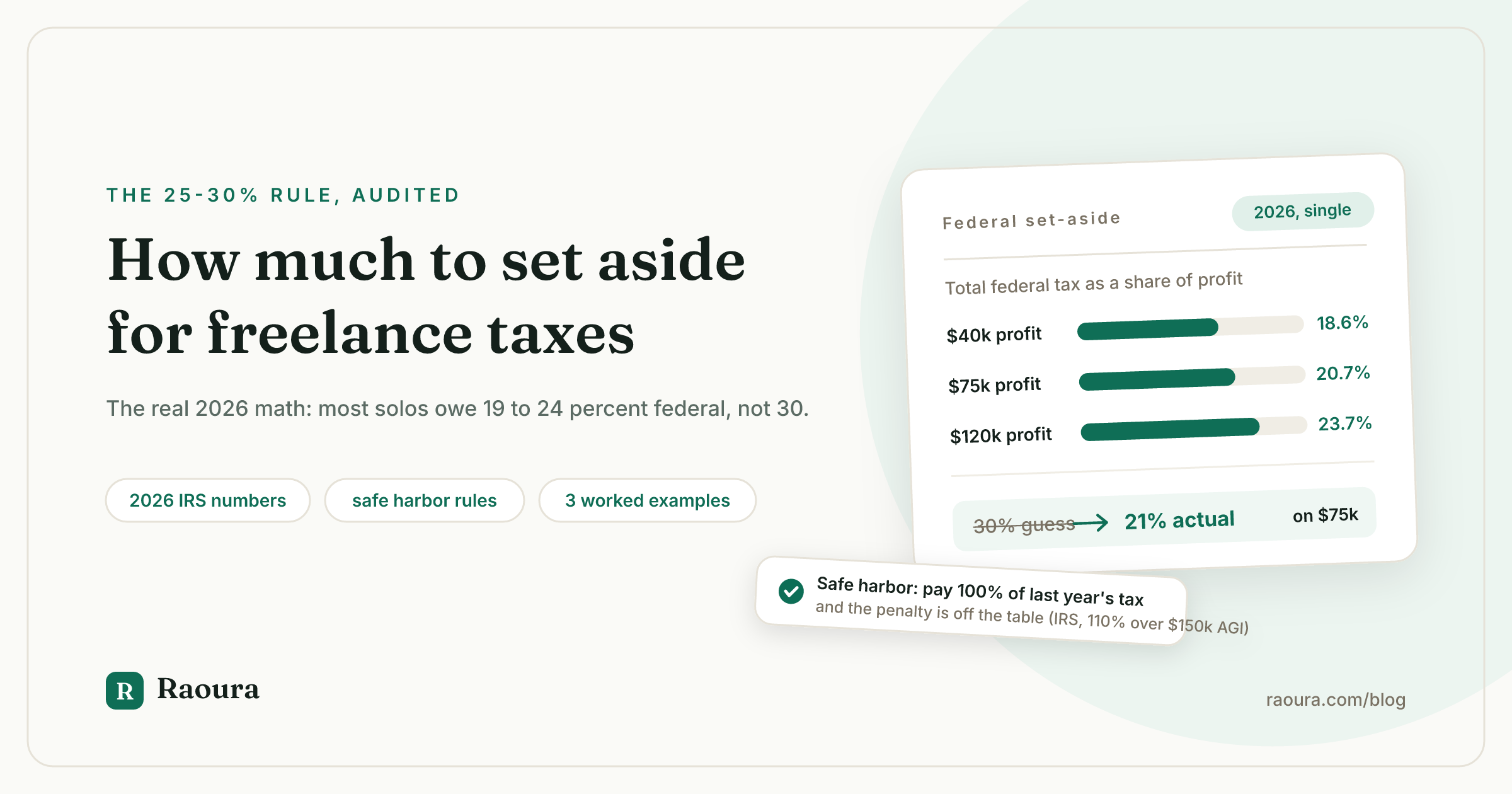
A single freelancer with no other income owes federal taxes of about 19 percent of profit at $40,000, 21 percent at $75,000, and 24 percent at $120,000 under 2026 rules, before state tax.
Here is the calculation nobody on page one runs from start to finish with one consistent set of numbers. Assumptions: single filer, 2026 rules, all income from freelancing, standard deduction, full QBI deduction, no dependents or credits. "Profit" means revenue minus business expenses, the Schedule C bottom line.
| $40,000 profit | $75,000 profit | $120,000 profit | |
|---|---|---|---|
| Self-employment tax (92.35% of profit x 15.3%) | $5,652 | $10,597 | $16,955 |
| Deduct half of SE tax | -$2,826 | -$5,299 | -$8,478 |
| Standard deduction (single, 2026) | -$16,100 | -$16,100 | -$16,100 |
| QBI deduction (20%) | -$4,215 | -$10,720 | -$19,084 |
| Taxable income | $16,859 | $42,881 | $76,338 |
| Federal income tax (2026 brackets) | $1,775 | $4,898 | $11,506 |
| **Total federal tax** | **$7,427** | **$15,495** | **$28,462** |
| **Set-aside as % of profit** | **18.6%** | **20.7%** | **23.7%** |
Every input is public: the 2026 brackets and standard deduction from Form 1040-ES (10 percent to $12,400, then 12 percent to $50,400, then 22 percent to $105,700 for single filers), the SE tax mechanics from the IRS, and the QBI deduction capped at 20 percent of taxable income before it. Worth stating as one sentence you can quote: for a single freelancer with $75,000 of 2026 profit and no other income, the federal tax bill is about $15,495, which is 21 percent, not 30.
So why does everyone say 25 to 30? Three honest reasons:
- State income tax adds 0 to 9 or more points depending on your state (next section).
- A spouse's salary or a day job stacks your freelance profit on top of income that has already used up the low brackets, pushing your marginal rate up.
- A buffer that lands you a refund hurts less than a shortfall that lands you a penalty.
The rule is not wrong as a default. It is wrong as a description of what most solos actually owe federally, and if money is tight, knowing the real number at your income level means you can set aside 22 percent deliberately instead of 30 percent fearfully.
Note the direction of the error, though. These percentages apply to profit. If you set aside a percentage of every gross payment while your expenses run, say, 20 percent of revenue, you are automatically over-saving, which is a fine problem.
Setting aside 25 percent of gross covers roughly a 30 percent bill on profit for a freelancer with typical expenses. Pick one base and be consistent; the failure mode is computing the percentage on profit but remembering to transfer it only on the invoices you notice.
Safe harbor: pay a known-safe number instead of guessing#
You owe no underpayment penalty if your estimated payments cover 90 percent of this year's tax, or 100 percent of last year's tax bill (110 percent if your AGI was over $150,000), whichever is smaller.
This is the most useful thing on this page and it is missing from every result that outranks it. The IRS does not require you to predict your income perfectly. Under the safe harbor rules, you avoid the estimated-tax penalty entirely if, through the year, you pay in at least 90 percent of what you will actually owe, or at least 100 percent of the total tax shown on last year's return.
If last year's adjusted gross income was over $150,000, the prior-year target becomes 110 percent. You also owe no penalty if your total balance due at filing is under $1,000.
Read that again as a strategy: last year's tax bill is a number you already know. Take line 24 from last year's 1040, divide by four, pay that each quarter, and you are penalty-proof no matter how much more you earn this year. You will still owe the difference next April, so keep saving the percentages above, but the penalty risk is gone and the guessing is over. This is the difference between "set aside 30 percent and hope" and "pay a number the IRS has already told you is safe."
The percentage method and the safe harbor method answer different questions. The percentage tells you how much to move into savings so April is boring. The safe harbor tells you the minimum to send the IRS each quarter so penalties never enter the picture. Run both: transfer your percentage on every payment that lands, remit the safe harbor quarterly, and true up at filing.
The 2026 quarterly deadlines and what missing one costs#
Freelancers who expect to owe $1,000 or more must pay estimated taxes four times a year, and the current underpayment rate is 7 percent, compounded daily, so a $5,000 shortfall carried for a year costs about $360.
If you expect to owe at least $1,000 when you file, the IRS wants the money as you earn it, not in one April lump. The 2026 schedule from Form 1040-ES:
| Payment | Covers | Due date |
|---|---|---|
| 1st | Jan 1 to Mar 31, 2026 | April 15, 2026 |
| 2nd | Apr 1 to May 31, 2026 | June 15, 2026 |
| 3rd | Jun 1 to Aug 31, 2026 | September 15, 2026 |
| 4th | Sep 1 to Dec 31, 2026 | January 15, 2027 |
Two quirks worth knowing. The quarters are not equal: the second one is two months and the third is three, so a "quarterly" payment calculated as a flat one-fourth is an approximation the IRS accepts, not what the calendar implies. And you can skip the January 15 payment entirely if you file your full return and pay the balance by early February 2027.
Missing a payment is not a cliff, it is a meter. The penalty works like interest on the shortfall from each due date until you pay, at the federal short-term rate plus 3 points: 7 percent for the third quarter of 2026, compounded daily. Concretely, being $5,000 short for a full year costs about $360.
Annoying, not fatal, and worth exactly zero panic if you catch it mid-year: pay when you notice, and the meter stops. If a brutal month means choosing between rent and the estimated payment, pay rent; the 7 percent meter is cheaper than a payday loan, just turn it off as soon as you can.
Paying takes two minutes and no account: IRS Direct Pay pulls from your bank for free, or use EFTPS if you want scheduled payments. The IRS also explicitly allows paying weekly or monthly instead of quarterly, as long as each deadline's cumulative total is in. If your income is lumpy, a fixed transfer every time an invoice is paid beats four scary lump sums.
State taxes: the part of the rule that varies most#
Nine states tax none of your freelance income, while a single California freelancer hits a 9.3 percent marginal state rate once taxable income passes about $73,000, so the right state buffer is anywhere from 0 to 10 points.
The spread between the 21 percent federal reality and the 30 percent folk rule is mostly this line item. Per the Tax Foundation's 2026 survey of state rates, nine states levy no tax on wage or self-employment income: Alaska, Florida, Nevada, New Hampshire, South Dakota, Tennessee, Texas, Washington, and Wyoming (Washington does tax some high-earner capital gains, which is not freelance income). Freelance in one of them and your set-aside can genuinely stop at the federal number.
At the other end, California's 2025 rate schedule (the latest published) puts a single filer in the 9.3 percent bracket from $72,724 of taxable income up to $371,479. Your effective state rate is lower than your marginal one because the brackets below it are smaller, but a mid-earning California solo should hold 5 to 7 points of profit for Sacramento on top of the federal bill. Most states with an income tax land between these poles, in the 3 to 6 percent range, and most offer their own estimated-payment system with similar quarterly timing. Look up your state's rate schedule once, add the points to your percentage, and you have replaced the fuzziest part of the 25-30 rule with your actual number.
The mechanics: making the set-aside automatic#
The system that works is one separate account and one fixed percentage transferred every time a client payment lands, so the tax money is gone before it ever looks spendable.
Everything above is arithmetic; this part is behavior. The freelancers who hit April relaxed all run some version of the same loop: a separate savings account that is only for taxes, a fixed percentage decided once (your row from the table above, plus your state points, computed on profit or gross but never alternating), and a transfer that happens the same day a payment arrives, not at month-end when the balance already looks like yours.
Keep the account at a different bank if you do not trust yourself with instant transfers. What makes this workable at all is knowing the moment money actually lands, which is also the fastest-payment problem and the reason milestone billing smooths the set-aside too: four mid-project payments mean four small transfers instead of one giant one you will be tempted to shave.
This is also a place where your tooling either helps or hides the number. Raoura invoices through your own Stripe account, so client payments hit your bank directly and the dashboard shows exactly what was paid this quarter, which is the number your set-aside percentage runs on; at $17 per month flat it is deliberately cheap enough that it never competes with the tax account for a slow month's cash. Disclosure: Raoura is our product.

Your set-aside percentage needs the amount actually paid this quarter, and Raoura's business report surfaces that number directly.
Two adjacent notes while you are setting this up.
Your rates should be quoted with this percentage already priced in, which is one more reason an annual rate review is not optional, and if you are choosing how to price projects in the first place, remember every model's take-home is post-tax.
And platform fees come out before taxes do: if you sell through Upwork, the real fee math means your taxable profit is smaller than your gross, so compute your percentage on what actually reaches you.
Frequently asked questions
How much should I set aside for taxes as a freelancer?
Start with 25 to 30 percent of profit as a default. If you are a single filer with no other income, the 2026 federal math comes to roughly 19 percent at $40,000 of profit, 21 percent at $75,000, and 24 percent at $120,000; add your state's points (0 in nine states, 5 to 7 for a mid-earning Californian). Round up to the nearest 5 for buffer.
Do I have to pay taxes if I made less than $600 freelancing?
The $600 figure is about the client's paperwork (whether they must issue a 1099-NEC), not your obligation. You owe self-employment tax once net self-employment earnings hit $400, and all freelance income is taxable income regardless of whether any form was filed. Separately, the 1099-K threshold for payment apps reverted to over $20,000 and 200 transactions under the 2025 law.
What happens if I skip a quarterly estimated payment?
You accrue an underpayment penalty that works like interest: currently 7 percent annually on the shortfall, compounded daily, from the due date until you pay. A $2,000 shortfall carried six months costs about $70. Pay as soon as you notice, and consider the prior-year safe harbor next year so it cannot happen again.
Is the 25-30 percent rule based on gross income or profit?
The tax math runs on profit (revenue minus business expenses), and the percentages in this article are percentages of profit. Many freelancers transfer a percentage of every gross payment instead because it is automatic; that over-saves by roughly your expense ratio, which is a safe error. Just pick one base and stick to it.
Does the 20 percent QBI deduction still exist in 2026?
Yes. The One Big Beautiful Bill Act made the Qualified Business Income deduction permanent, per the IRS's own 2026 guidance for gig workers. For most solo freelancers it effectively knocks 20 percent off taxable income before the brackets apply, which is a big part of why real federal bills run below the folk rule.
Should I save for taxes in a separate bank account?
Yes, and transfer on the day each payment lands rather than on a schedule. A high-yield savings account adds a small bonus: your tax money earns interest for up to a year before the IRS needs it. The only rule that matters is that the account is boring, separate, and never borrowed from.
---
Every figure above was verified against irs.gov, ssa.gov, ftb.ca.gov, or taxfoundation.org in July 2026. Tax numbers change annually: the 2026 amounts here come from the 2026 Form 1040-ES and the SSA wage base page, and this article gets refreshed when the 2027 figures publish. This is general information, not tax advice.
Run your client work in one place
Send a proposal, get it signed, invoice, and get paid, with a branded portal your clients will actually use. One flat plan at $17/month, and we never take a cut of your payments.
Try Raoura free for 14 daysNo credit card required. Set up in minutes.
Keep reading
Is Upwork Worth It in 2026? A Break-Even Test for Your Situation
Upwork is worth it when its fee costs less than finding the client yourself, and that is true far more often for a first project than for a repeat client. Here is the break-even math with 2026 numbers: the 0 to 15% fee, Connects, the shrinking client base, and when to wait out the 24-month rule instead of paying to leave.
The Virtual Assistant Contract: 24 Clauses, Scored Against Every Template Ranking for This Search
We scored the four pages that publish actual virtual assistant contract text against 24 clauses a VA agreement needs. Twenty-four of 96 possible slots were filled. The best single template managed 7 out of 24. Twelve clauses appear in none of them, including every clause about the thing that makes VA work different from other freelance work: you are holding your client's passwords and running their inbox. One popular template also tells you a contract fixes your independent contractor status, then mandates client-set 9 to 5 weekday hours in the same document. Here is the clause-by-clause version, with the classification test the DOL is actually applying in 2026, the data protection terms nobody drafts, and the retainer mechanics that decide whether unused hours roll over.
Stripe vs PayPal for Freelancers: Every Fee Verified (2026)
Every page ranking for this comparison either prints in-person retail rates, contradicts itself, or skips the numbers freelancers actually pay. We read the current Stripe and PayPal pricing pages line by line, ran a $3,000 invoice through every rail, and found a $1,764 per year gap between the cheapest setup and the default one.