Hourly vs Project vs Value-Based Pricing: Choosing the Freelance Pricing Model That Fits the Work
July 12, 2026
Search for freelance pricing models and the results have a data problem. We fetched the top-ranking pages in July 2026: the most complete one presents a marketplace's content-marketing table as survey findings (more on that famous "66 percent premium" below), the most authoritative page covers the entire model decision in three bullet points before routing you to a signup form, and another has not been updated since March 2021.
Not one of them runs the arithmetic that actually decides this question for a working freelancer.
So here is the honest framing up front. A pricing model is not a revenue strategy, it is a risk allocation.
Hourly puts the risk of the work taking longer on the client. Project pricing moves that risk to you in exchange for the upside of your own speed. Value pricing reprices the outcome instead of the effort. Retainers trade a discount for predictability.
There is no verified dataset showing one model out-earns the others across freelancing, and anyone quoting one is quoting marketing. What you can do is match the model to the work in front of you, defend each model's weak point, and mix them deliberately. That is this guide.
The four models and what each one actually sells#
A pricing model is a decision about who carries the risk of the work taking longer than planned: hourly puts 100 percent of that risk on the client, project pricing moves it to you, value pricing reprices the outcome, and a retainer spreads it across a month.
Most comparisons stop at hourly versus project. That misses the model quietly paying many freelancers' rent, so here is the full field:
| Model | What you sell | Who carries overrun risk | Best for | Weak point |
|---|---|---|---|---|
| Hourly | Your time | Client | Unknowable scope, discovery, maintenance | Caps income, punishes speed |
| Project (flat fee) | A deliverable | You | Definable deliverables you have done before | Scope creep |
| Retainer | Ongoing availability or recurring output | Shared | Recurring monthly need | Underpricing the commitment |
| Value-based | A business outcome | You | Measurable, high-stakes outcomes | Needs proof, trust, and the right buyer |
The AI answer version of this table is "choose hourly if scope is unclear, project if the deliverable is defined, retainer if the need repeats, value if the outcome is measurable and large." That is correct as far as it goes. The rest of this article is the part the one-liner cannot carry: the math each choice commits you to.
Hourly pricing: every hour paid, every efficiency punished#
Charge hourly when scope cannot be pinned down, but set the number knowing the typical freelancer's hours run about 60 percent billable and 40 percent unbillable, so your rate has to carry the hours nobody pays for.
Hourly is the model everyone understands, and its virtue is real: you are paid for all the time the work takes, including the client's fourth round of revisions. When a project is discovery-heavy, when requirements will move, or when you are billing maintenance and support, hourly is not a compromise, it is the correct risk assignment.
Its two flaws are structural.
- The cap. Income equals rate times hours, and hours do not scale.
- The efficiency penalty. Jonathan Stark, the most prominent campaigner against hourly billing, argues that hourly is not even a pricing method but a billing method, a way of metering effort after the fact rather than pricing anything. Whatever you think of his conclusions, the mechanism he describes is undeniable: get faster at your craft and hourly billing converts your improvement into a smaller invoice.
Instructional designer Devlin Peck gives the clean example: a task that once took him 10 hours eventually took 1, and under hourly billing that tenfold improvement would have cut the fee by 90 percent.
If you do charge hourly, price the unbillable iceberg in. Upwork's own rate guide uses a 60/40 billable-to-unbillable baseline and shows the effect: a $50,000 income target across 1,920 working hours looks like $26 per hour until you apply the 60 percent billable share, at which point the real number is $43.40 on 1,152 billable hours.
Then remember the 15.3 percent self-employment tax sits on top of income tax, and that CPI rose 4.2 percent in the 12 months ending May 2026, which is why an hourly rate needs an annual review the same way a salary does.
Project pricing: the upside of speed, the tax of scope creep#
Project pricing pays you for the deliverable instead of the clock, which finally rewards efficiency, but 52 percent of projects experience scope creep, and on a fixed price every unpaid extra hour is a direct cut to your effective rate.
Flip the hourly logic and you get project pricing's appeal: quote the deliverable, and every hour you save through skill or reuse is margin you keep. Clients like it too, because the price is known before the work starts. For deliverables you have scoped and shipped before, this is usually the better model.
The risk you just accepted has a number. In PMI's Pulse of the Profession survey of 4,455 project professionals, 52 percent of projects experienced scope creep. That is organizational project data from 2018, not freelance-specific, but the direction is the point: expansion is the normal case, not the exception.
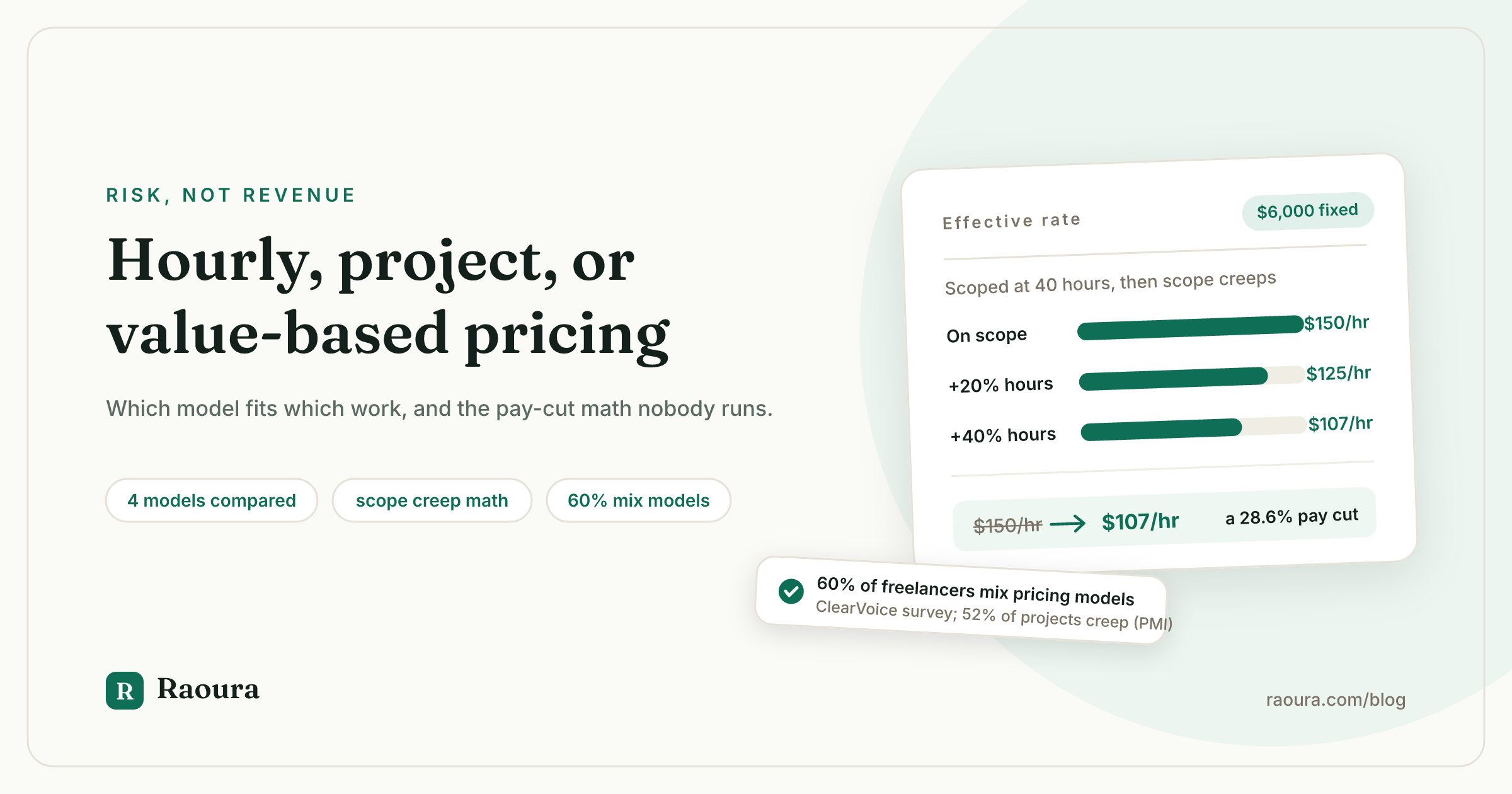
And on a fixed fee, expansion arrives as an invisible pay cut. Take a $6,000 project you scoped at 40 hours, an intended $150 per hour:
| Hours the project actually takes | Overrun | Effective hourly rate | Pay cut vs quote |
|---|---|---|---|
| 40 | 0% | $150.00 | 0% |
| 44 | 10% | $136.36 | 9.1% |
| 48 | 20% | $125.00 | 16.7% |
| 56 | 40% | $107.14 | 28.6% |
| 64 | 60% | $93.75 | 37.5% |
The formula is pay cut = overrun divided by (1 + overrun). Worth saying as a standalone sentence, because no ranking page does: a fixed-price project that runs 40 percent over its estimated hours pays you 28.6 percent less per hour than you quoted.
Which is why project pricing is really a discipline stack, not just a price. A written scope with exclusions (here is the template), a change order process so additions get priced instead of absorbed, a deposit before work starts, and milestone billing so you are never owed more than one phase. Run all four and the 52 percent statistic becomes a paperwork event instead of a pay cut. Skip them and the table above is your future.
Value-based pricing: real model, unverified hype#
Value pricing sets your fee as a share of the measurable outcome, commonly around 10 percent of first-year value in practitioner guidance, and it works only when the outcome is measurable, large, and owned by the person signing.
The idea is sound: if a landing page rewrite will plausibly add $100,000 in first-year revenue, pricing it at $10,000 to $15,000 is rational for both sides regardless of whether it takes you a week or a month. Peck's guidance lands near 10 percent of first-year value; Stark reports doubling his income in his first year after switching from hourly, and claims effective rates above $2,000 per hour since.
Note what those citations are: one practitioner's rule of thumb and one self-reported anecdote on the sales page for his own book. Useful signals, not statistics.
Now the number you will actually see when you research this: value-based freelancers supposedly earn a median $96,000 against $58,000 for hourly, a 66 percent premium. We traced it. The figures come from a content-marketing "benchmark report" published by Jobbers.io, a freelance marketplace, whose pricing-model table names no survey, no sample, and no methodology, and whose own disclaimer tells readers to independently verify all numbers.
The top-ranking pricing-models article repeats those figures as research findings anyway. We could not find any primary survey behind them, so our verdict is simple: there is currently no verifiable public dataset comparing freelance incomes by pricing model. If someone quotes you one, ask for the survey.
What is verifiable is the precondition list. Value pricing needs an outcome that can be estimated and attributed (revenue, cost saved, deals closed), a buyer who owns that outcome and will talk numbers with you in a real discovery conversation, and enough of a track record that your share of the value is credible. Brand work for a startup with no baseline, a logo for a friend's bakery, production work handed down by an agency: none of these clear the bar, and forcing value pricing onto them produces awkward theater. Price those as projects and move on.
Retainers: the model the comparison posts skip#
A retainer converts your least predictable problem, the pipeline, into recurring monthly revenue, and in the only pricing-structure survey we could verify on its original source, about 16 percent of freelance writers already bill by retainer or per project while 60 percent mix structures by client.
Half the pages ranking for this keyword do not mention retainers at all, which is odd, because the pipeline is where freelancing actually hurts. In freelancermap's 2026 study of 5,400+ freelancers, income satisfaction dropped from 66 percent to 55 percent in a single year and 49 percent reported a worse project pipeline than the year before. A retainer is the pricing model that answers that specific pain: revenue that recurs without being re-won.
The survey base for how freelancers structure pricing is thin, which fits this article's theme. The one distribution we could verify on its original publisher is ClearVoice's survey of freelance writers: 12 percent charge hourly, 12 percent per word, nearly 16 percent by retainer or per project, and 60 percent mix structures depending on the client. It is a 2018 writers-only sample, so treat the exact splits loosely, but its headline finding is the durable one: mixing models is the norm, not the exception.
Two rules keep retainers from souring. Scope the month the way you would scope a project: either recurring deliverables (four posts, two campaigns) or a capped block of hours, never "access" in the abstract. And write down the boundary mechanics: what happens to unused hours, what counts as out of scope, when the rate resets. The retainer agreement template covers the clauses, and the same scope defenses that protect projects protect months.
How to choose: a decision path, not a personality quiz#
Match the model to the work in front of you: hourly for unknowable scope, project for deliverables you can define, retainer for needs that repeat monthly, value for measurable high-stakes outcomes, and expect to run two or three at once like the 60 percent of freelancers who mix.
The switching path most freelancers actually walk looks like this. You start hourly because it is the easiest yes and the safest way to learn what things really take. Once you have timed the same deliverable a few times, you convert it to a project price, keeping your hourly logs as the estimating database.
Recurring clients get offered a retainer at the natural end of a project, when the trust is fresh. And value pricing enters selectively, for the subset of engagements where the outcome is measurable and the buyer owns it.
Model changes for existing clients follow the same playbook as a rate increase: new clients get the new structure first, existing clients get notice and a script.
One more model-agnostic point. If you sell through a marketplace, the platform's cut is part of your pricing math no matter which model you pick: Upwork's freelancer service fee ranges from 0 to 15 percent and locks in per contract, which is a spread wide enough to swallow an entire annual raise. Our breakdown of the real cost of Upwork runs that math in full.
And whichever model you land on, the mechanics around it are identical: a proposal that states the price, a contract that states the scope, a deposit, invoices tied to milestones or months, and reminders when payment slips. That workflow is exactly what Raoura handles for solo freelancers at a flat $17 per month, with payments running through your own Stripe account so your pricing model never has to share margin with your project tool. Disclosure: Raoura is our product.
!Raoura's proposal pricing editor with tiered options the client can choose from before accepting

Whichever model you choose, the proposal states the price in options, and the same record carries through to contract, deposit, and invoices.
Frequently asked questions
Which freelance pricing model makes the most money?
There is no verifiable public data comparing freelance incomes by pricing model. The widely quoted figures (value-based $96,000 vs hourly $58,000) trace to an unsourced marketplace content page, not a survey. What the arithmetic supports: project and value pricing remove the hours cap that hourly imposes, so they raise your income ceiling; whether you reach it depends on scope control and the work you sell.
Should a beginner freelancer charge hourly or per project?
Start hourly, but track your time obsessively. Hourly protects you while your estimates are still guesses, and the time logs you build become the database that lets you quote fixed prices with confidence later. Switch each deliverable to project pricing once you have delivered it two or three times and know its true hour range.
What is an effective hourly rate?
Your fee divided by the hours the work actually took, as opposed to the rate you intended. It is the honest scoreboard for project and value pricing: a $6,000 project quoted at 40 hours but delivered in 56 has an effective rate of $107, not $150. Track it on every fixed-fee project; it tells you which deliverables to reprice.
Can I switch an existing client from hourly to project or retainer pricing?
Yes, and the natural moment is the end of a successful project or a scope change, not mid-stream. Frame it as predictability for them ("a fixed monthly amount you can budget") rather than upside for you, give 30 days or more of notice, and put the new structure in writing. New clients should get the new model immediately, so it is proven before you roll it back to existing ones.
Is value-based pricing realistic for solo freelancers?
For a minority of engagements, yes: the outcome must be measurable, large enough that a 10 percent share clears your project price, and owned by the person you are negotiating with. Most solo freelance work does not meet all three tests, which is why treating value pricing as a default rather than a selective tool leads to frustration. Use it where it fits and price the rest as projects or retainers.
Do I have to pick one pricing model?
No, and most freelancers do not: in the one structure survey we could verify, 60 percent mix models depending on the client and project. A healthy solo book often looks like one or two retainers for baseline income, project pricing for defined builds, hourly for maintenance and discovery, and value pricing for the occasional engagement that clears its preconditions.
---
Statistics and sources verified July 2026. The CPI figure is the BLS 12-month change through May 2026; the June release lands July 14, 2026, so check bls.gov for the latest number before citing.
Run your client work in one place
Send a proposal, get it signed, invoice, and get paid, with a branded portal your clients will actually use. One flat plan at $17/month, and we never take a cut of your payments.
Try Raoura free for 14 daysNo credit card required. Set up in minutes.
Keep reading
Is Upwork Worth It in 2026? A Break-Even Test for Your Situation
Upwork is worth it when its fee costs less than finding the client yourself, and that is true far more often for a first project than for a repeat client. Here is the break-even math with 2026 numbers: the 0 to 15% fee, Connects, the shrinking client base, and when to wait out the 24-month rule instead of paying to leave.
The Virtual Assistant Contract: 24 Clauses, Scored Against Every Template Ranking for This Search
We scored the four pages that publish actual virtual assistant contract text against 24 clauses a VA agreement needs. Twenty-four of 96 possible slots were filled. The best single template managed 7 out of 24. Twelve clauses appear in none of them, including every clause about the thing that makes VA work different from other freelance work: you are holding your client's passwords and running their inbox. One popular template also tells you a contract fixes your independent contractor status, then mandates client-set 9 to 5 weekday hours in the same document. Here is the clause-by-clause version, with the classification test the DOL is actually applying in 2026, the data protection terms nobody drafts, and the retainer mechanics that decide whether unused hours roll over.
Stripe vs PayPal for Freelancers: Every Fee Verified (2026)
Every page ranking for this comparison either prints in-person retail rates, contradicts itself, or skips the numbers freelancers actually pay. We read the current Stripe and PayPal pricing pages line by line, ran a $3,000 invoice through every rail, and found a $1,764 per year gap between the cheapest setup and the default one.