How to Raise Your Freelance Rates: The Data, the Math, and the Decision
August 30, 2026
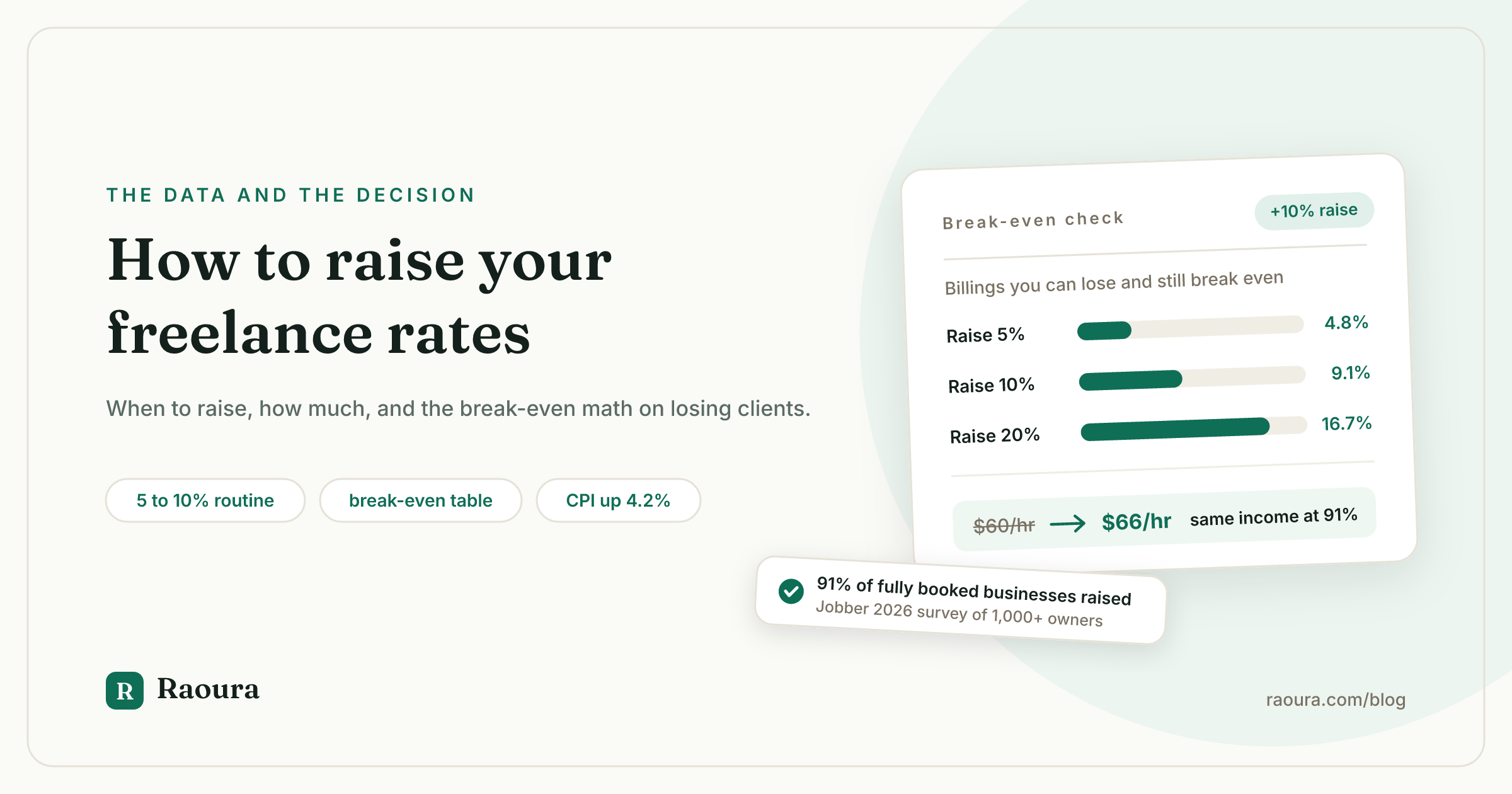
Search for how to raise freelance rates and you get advice frozen in amber. We fetched the five pages ranking for this keyword in July 2026: every single one anchors its inflation argument to 2022 numbers, the freshest was last updated in March 2025, and between them they cite exactly zero current data. Their how-much guidance scatters from 3 percent to 25 percent depending on which page you trust, and not one of them shows you the arithmetic that makes the whole decision less scary.
Here is that arithmetic up front: if you raise your rates 10 percent, you can lose up to 9 percent of your billings to departing clients and still earn exactly what you earned before, while working less. Almost nobody loses that much. That is the shape of the whole decision, and this guide walks through it in order: the signals that say raise now, the method for picking your exact number, the sequence that protects your income while you roll it out, and what to expect after. When you are ready to actually send the email, the wording lives in our companion piece, rate increase email scripts for 5 scenarios.
When to raise your rates: the four signals#
Raise your rates when any one of these is true: your rate has not moved in 12 months, you are booked at or near capacity, you are winning almost every proposal, or your scope has quietly outgrown your price.
The 12-month signal is the floor, and in 2026 it has teeth. The Consumer Price Index rose 4.2 percent over the 12 months ending May 2026, per the Bureau of Labor Statistics, and the trend through spring was accelerating (2.4 percent through February, 3.3 percent through March, 3.8 percent through April). A rate you have not touched since mid-2025 buys roughly 4 percent less than it did when you set it. Holding your rate flat is not neutral, it is a pay cut you gave yourself without noticing.
The capacity signal is the strongest one, and the data says busy businesses act on it. In Jobber's 2026 Home Service Trends Report, 65 percent of over 1,000 service business owners surveyed raised prices in the past year, and among the most established, fully booked businesses, 91 percent did. Those are home service companies rather than freelancers, but the correlation is the lesson: being fully booked at your current rate is not a reason to protect that rate, it is the market telling you the rate is too low.
The win-rate signal works the same way in reverse. If every proposal you send gets a yes with no negotiation, you are underpriced. A healthy close rate has some no in it. If you want a benchmark for what a competitive proposal process looks like, our guide to the freelance proposal that wins covers close-rate data in detail.
And the scope signal: if what you deliver for the price has grown since you set the price, you do not have a rate problem, you have a scope creep problem wearing a rate problem's clothes. Reprice to the actual scope.
One contrast worth sitting with: in employment, nearly 2 in 5 workers have never asked for a pay raise, per a FlexJobs survey of over 3,000 US professionals. Freelancers do not have to ask anyone. You set the price. The only approval step is the one in your head.
How much to raise: what the advice says and what the math says#
For a routine increase, raise 5 to 10 percent; for a correction after years of flat rates, 20 percent or more phased in steps; and whatever you pick, the break-even math says a 10 percent raise survives losing up to 9 percent of your billings.
First, what the internet tells you. The published guidance is all over the map, which is exactly why it feels arbitrary:
| Source | Suggested increase | Suggested notice |
|---|---|---|
| Jobber (2026) | 3 to 10% for inflation-driven raises | 1 to 3 months |
| Kat Boogaard | 10 to 20% | 1 month |
| Xolo | 10 to 25% | 1 to 2 months, 3 to 4 for enterprise |
| Column Content | 3% annual cost-of-living clause | Built into the contract |
| Our recommendation | 5 to 10% routine, 20%+ corrections phased | 30 to 60 days, 60 to 90 for corrections |
Now the math that none of those pages runs. The fear behind every rate increase is losing clients. So calculate the actual break-even: how much of your billings can walk away before the raise costs you money?
| Raise | Billings you can lose and still break even |
|---|---|
| 5% | 4.8% |
| 10% | 9.1% |
| 15% | 13.0% |
| 20% | 16.7% |
| 25% | 20.0% |
The formula is loss threshold = raise divided by (1 + raise). Check the 10 percent row: if 90.9 percent of your billings stay and all of it pays 10 percent more, 0.909 times 1.10 equals 1.0, the same revenue for less work. Everything above that threshold is profit plus reclaimed hours. And in practice, most rate emails get a one-line acceptance: the well-documented pattern (which our scripts article covers) is that the anticlimax, not the exodus, is the normal outcome.
There is also evidence that freelancers who move their rates actually move the market. Payoneer's global income survey found the worldwide average freelance hourly rate climbed from $21 to $28 in two years, driven, in Payoneer's words, by the 40 percent of freelancers who started charging more. That report is from 2022, so treat the dollar figures as historical, but the mechanism has not changed: rates rise because individuals raise them.
Picking your exact number: floor, market, demand#
Your new rate is the highest of three numbers: your cost floor (target income divided by realistic billable hours), the market benchmark for your skill, and your current rate plus the demand adjustment your pipeline justifies.
The cost floor comes first because it is the only number that is entirely yours. Take the annual income you need, add taxes, software, insurance, and unpaid admin time, and divide by honest billable hours (most solos bill far fewer hours than they work). If your current rate is below this floor, your raise is not optional and the size of it is not a negotiation with yourself.
The market benchmark is the sanity check. Useful anchors, each verified this run: US knowledge workers who freelance exclusively report a median income of $85,000, ahead of the $80,000 for their full-time employee counterparts, per the Upwork Research Institute's 2025 Future Workforce Index (3,000 US workers surveyed). In Europe, freelancermap's 2026 study of 5,400+ freelancers puts the average hourly rate in the DACH region at 103 euros. Your niche and region will differ, but if your effective rate implies an income far below the medians for your skill level, the market is not the thing holding you back.
The demand adjustment is where your own pipeline talks. Booked solid for two months out: add more. Bench is thin: raise for new clients only and hold existing rates until the pipeline recovers. Which brings us to sequencing.
Sequencing: who gets the new rate first#
Quote the new rate to all new clients immediately, let it prove itself for one or two closed deals, then roll it to existing clients with 30 to 60 days of notice, longest-tenured and most underpriced clients last and most carefully.
New clients first is the risk-free test. A new prospect has no anchor to your old price, so quoting higher costs you nothing but that one proposal. Two or three acceptances at the new number is real market evidence, and it does more for your nerve than any pep talk.
Existing clients come second, in order of gap size. Clients within 10 percent of your new rate get the routine annual increase treatment. The legacy client paying a rate from three years ago needs the phased correction, and both the decision table and the exact wording are in the scripts article.
Give corrections 60 to 90 days of notice, honor everything already scoped at the old rate, and put the new number in writing: your contract should carry a term and a renewal date precisely so rate reviews have a natural home. A clause as simple as "rates are reviewed each January" turns every future raise from an event into a calendar entry.
Timing matters more for the big corrections. Land them inside the client's budgeting window (September to November for January budgets is the classic play), never mid-crisis and never mid-project. And raise on schedule, not in a panic: the worst rate emails are sent the week a project falls through.
What happens after, and why losing a client can be the right outcome#
Expect most clients to accept without negotiation, one or two to push back, and occasionally one to leave, and remember the break-even table: at a 10 percent raise, you are ahead as long as more than 91 percent of your billings stay.
For the pushback conversation, hold the rate and flex the scope, which is script 5 in the companion piece. For the client who leaves, run the math before you mourn. If they were 8 percent of billings and everyone else absorbed a 10 percent raise, you are earning slightly more with a free slot in your calendar.
That slot is only scary if your pipeline is cold, which is why the smartest pre-raise move is not wordsmithing the email, it is warming your lead flow first. That fear is rational and common: 58 percent of freelancers name project acquisition as their top challenge, per freelancermap's 2025 study, and a raise feels very different when you know where your next clients come from.
Then make the new rate boring. It should flow into your next proposal, the renewal agreement, and your invoices without you retyping it anywhere, because a rate increase that first appears as a surprise line item is how a clean yes turns into a dispute. This is the part Raoura handles for you: change the rate once and every new proposal, contract, and invoice quotes it from the effective date, while in-flight projects keep their agreed pricing. Disclosure: Raoura is our product, it costs $17 a month flat, and everything above works the same if you track rates in a spreadsheet.
!Raoura proposal pricing editor where an updated rate flows into new proposals without retyping

Change the rate once and every new proposal quotes the new number, so the increase never resurfaces as a surprise line item.
Last habit: schedule next year's review the same day you finish this year's raise. The freelancers who find this process agonizing are almost always the ones who waited three years and now need a 40 percent correction. The ones who nudge 5 to 10 percent annually barely think about it, and neither do their clients.
Frequently asked questions
How often should I raise my freelance rates?
Review annually, raise when the review says so. With CPI up 4.2 percent in the 12 months ending May 2026, skipping even one annual review is a measurable real-terms pay cut. An annual cadence also normalizes increases for clients, which makes each one smaller and easier.
How much should I raise my rates as a freelancer?
Five to 10 percent for a routine annual increase, 20 percent or more (phased in two steps) when correcting years of flat pricing. Run the break-even math before you decide: a 10 percent raise still pays off even if clients representing up to 9 percent of your billings walk away.
Will I lose clients if I raise my rates?
Usually not, and losing a few is survivable by design. In Jobber's 2026 survey, 65 percent of service businesses raised prices in the past year, and 91 percent of the most fully booked ones did: if raises routinely destroyed client bases, the busiest businesses would not be the ones raising most. Use the break-even table above to know your exact cushion.
Should I raise rates for new clients and existing clients at the same time?
No. New clients first, immediately and with no announcement needed, because they have no old price to compare against. Existing clients after the new rate has closed a deal or two, with 30 to 60 days of notice. The gap between the two rates should be temporary, not a permanent two-tier system.
What is the best time of year to raise freelance rates?
The months your clients plan budgets: September to November for January effective dates is the most common pattern, and January itself works for annual adjustments. Avoid mid-project, mid-crisis, and the week before invoices go out. The scripts and notice periods per scenario are in our rate increase email scripts.
Do I need to justify a rate increase to clients?
One grounding sentence, not a defense. "My rates are changing to reflect current costs and demand" is complete. Longer justifications invite line-by-line negotiation, and your payment terms and contract should do the formal talking.
---
Statistics and sources verified July 2026. The CPI figure is the BLS 12-month change through May 2026; the June release lands July 14, 2026, so check bls.gov for the latest number before citing.
Run your client work in one place
Send a proposal, get it signed, invoice, and get paid, with a branded portal your clients will actually use. One flat plan at $17/month, and we never take a cut of your payments.
Try Raoura free for 14 daysNo credit card required. Set up in minutes.
Keep reading
Is Upwork Worth It in 2026? A Break-Even Test for Your Situation
Upwork is worth it when its fee costs less than finding the client yourself, and that is true far more often for a first project than for a repeat client. Here is the break-even math with 2026 numbers: the 0 to 15% fee, Connects, the shrinking client base, and when to wait out the 24-month rule instead of paying to leave.
The Virtual Assistant Contract: 24 Clauses, Scored Against Every Template Ranking for This Search
We scored the four pages that publish actual virtual assistant contract text against 24 clauses a VA agreement needs. Twenty-four of 96 possible slots were filled. The best single template managed 7 out of 24. Twelve clauses appear in none of them, including every clause about the thing that makes VA work different from other freelance work: you are holding your client's passwords and running their inbox. One popular template also tells you a contract fixes your independent contractor status, then mandates client-set 9 to 5 weekday hours in the same document. Here is the clause-by-clause version, with the classification test the DOL is actually applying in 2026, the data protection terms nobody drafts, and the retainer mechanics that decide whether unused hours roll over.
Stripe vs PayPal for Freelancers: Every Fee Verified (2026)
Every page ranking for this comparison either prints in-person retail rates, contradicts itself, or skips the numbers freelancers actually pay. We read the current Stripe and PayPal pricing pages line by line, ran a $3,000 invoice through every rail, and found a $1,764 per year gap between the cheapest setup and the default one.