How to Get Freelance Clients Without Upwork
July 12, 2026
We fetched the five top-ranking pages for "get clients without Upwork" in July 2026. Four are vendor blogs selling something adjacent, none of the five cites a single primary source, and only one was written by a working freelancer. The advice is interchangeable: build a portfolio, be active on LinkedIn, ask for referrals. All true, none of it operational. Nobody tells you how many pitches, what reply rate to expect, how long each channel takes, or what to do when a conversation actually starts.
This article is the operational version. It covers five channels with costs and realistic timelines, the benchmarks behind them, the conversion layer that turns interest into signed work, and a 30-day starting sequence you can run while a marketplace still pays your bills. One disclosure up front: this is the Raoura blog, Raoura is our product, and it appears once near the end. The advice stands on its own first.
Can you actually get clients without Upwork?#
Yes: 28% of US skilled knowledge workers now freelance and exclusive freelancers report a median income of $85,000, above the $80,000 median for full-time employees, but the honest caveat is that 58% of freelancers name project acquisition as their single biggest challenge.
Start with the market. Per Upwork's own Future Workforce research (April 2025, surveying 3,000 US skilled knowledge workers), more than 1 in 4 skilled knowledge workers freelance, over 20 million people, and those who earn exclusively through freelance work report a median income of $85,000. The overwhelming majority of that work does not flow through any marketplace feed. Clients hire freelancers they were referred to, freelancers they found, and freelancers who found them.
Now the caveat. In freelancermap's 2025 freelancer study, 58% of freelancers named project acquisition their top challenge, ahead of planning uncertainty (45%) and fluctuating income (39%). Getting clients without a feed is a skill you build, not a switch you flip. The channels below are ranked roughly by how fast they produce a first client, and every one of them rewards consistency over intensity.
One more framing note: this is the pillar guide for the how, not the exit plan. If your actual question is how to wind down an Upwork account without torching income, that is a staged 90-day process we wrote up separately in Leaving Upwork: A 90-Day Plan to Go Direct.
What the feed is really costing you#
Upwork's freelancer service fee runs 0% to 15% per contract at Upwork's discretion, every proposal costs Connects at $0.15 each with no refund if the client hires nobody, and the buyer pool you are bidding into shrank 3% in a year to 784,000 active clients.
The reason to build your own channels is not that marketplaces are evil. It is that the economics quietly moved against you and you have no vote. Three verified numbers:
The fee is now variable and opaque. Per Upwork's service fee page, the fee "ranges from 0% to 15% per contract," set by Upwork and locked once a proposal or contract is sent. You find out what a contract costs you when you bid, not before.
Bidding itself costs money. Connects cost $0.15 each, the number required per proposal "varies per job," and Connects are not refunded when a job expires without a hire. You pay to apply to jobs where nobody gets hired.
The pool is shrinking while spend concentrates. Upwork's Q1 2026 earnings release reported 784,000 active clients, down 3% from 812,000 a year earlier, with gross services volume roughly flat at $987.1 million and spend per active client up 5% to $5,138. Fewer buyers, spending more, contested by the same supply of freelancers.
The full-year math on what this adds up to, including Connects spend and the subscription, is in The Real Cost of Upwork in 2026. The short version: on a $60,000 year the gap between platform and direct works out to four to seven thousand dollars. That gap is the budget for everything below, and everything below costs mostly time.
The five channels that replace the feed#
Five channels cover nearly every direct client a solo freelancer wins: referrals and repeat business are the fastest to first revenue (typically 2 to 6 weeks in our estimate), while your own website is the slowest (6 to 12 months) but the only one that compounds while you sleep.
Timelines below are our editorial estimates from running these channels, not survey data; treat them as planning defaults.
| Channel | Cash cost to start | Typical time to first client | Works best when |
|---|---|---|---|
| Referrals and repeat clients | $0 | 2 to 6 weeks | You have any past clients at all |
| Cold outreach | $0, time only | 4 to 12 weeks | You can name exactly who your buyer is |
| LinkedIn and visible expertise | $0 | 1 to 3 months | Your buyers scroll it during work hours |
| Communities and agency overflow | $0 to low | 1 to 3 months | You have a nameable specialty |
| Your own site and SEO | Domain and hosting | 6 to 12 months | You can publish consistently |
1. Referrals and repeat clients: the unglamorous majority#
Ask any freelancer who has survived five years where their work comes from and the answer is boringly consistent: people who already know their work. Veteran designer Benek Lisefski, whose piece is the only practitioner-written page ranking for this query, reports repeat clients alone at 20% to 50% of his workload in any given year, before counting referrals.
The system, not the platitude: make the ask a standard step of closing every project, not a thing you do in slow months. When you deliver final files, two sentences go in the wrap-up email: "I have room for one more client like you this quarter. If you know someone who needs X, an introduction would mean a lot." Past clients get the same message twice a year.
That is the whole machine. It works because the request is specific (one client, like you, this quarter) and timed to the moment your work is freshest in their mind.
If your past clients are all on Upwork, careful: soliciting off-platform work from them on-platform violates Upwork's terms. The rules, the 2-year clock, and what you may legally say are covered in How to Move Upwork Clients to Direct Contracts.
2. Cold outreach: the channel with actual published benchmarks#
Cold outreach has a terrible reputation because most people do it as spray-and-pray. The data says the difference between spam and pipeline is personalization and follow-up. The largest public study, Backlinko's analysis of 12 million outreach emails, found:
| Backlinko finding (12M emails) | Number |
|---|---|
| Baseline reply rate | 8.5% |
| Reply lift from a single follow-up | +65.8% |
| Reply lift from personalized subject line | +30.5% |
| Reply lift from personalized body | +32.7% |
| Reply lift from multi-contact, multi-message sequences | +160% |
Two honest caveats: the corpus is link-building and PR outreach, not freelance pitching, and it dates from 2019. Use it directionally: over 90% of one-shot cold emails get no reply, follow-up is the single cheapest lift available, and personalization is not optional.
For a freelancer the operational shape is ten genuinely researched pitches a week: companies that visibly need what you do, a first line that proves you looked, one specific idea, no attachment, and one follow-up a week later. Ten researched pitches beat a hundred sprayed ones, and unlike Upwork proposals they cost nothing per send.
3. LinkedIn and visible expertise: fish where buyers already scroll#
LinkedIn is the largest professional network at more than 1.3 billion members, and for most B2B services it is where your buyer kills time between meetings. The mistake is treating it as a job board. Treat it as a publishing channel: two or three short, concrete posts a week aimed at your buyer, not your peers. Concrete beats clever every time: "what a $4,000 website project includes, line by line" outperforms think pieces about passion.
The goal is not virality. It is that when a past client forwards your name (channel 1) or a cold prospect googles you (channel 2), what they find confirms you are real, specific, and current. Visibility is the channel that multiplies the other four.
4. Communities and agency overflow: borrowed pipelines#
Two variants.
Niche communities (Slack groups, forums, local meetups where your buyers or peers gather) generate work slowly through answered questions and demonstrated competence; pick one or two and be usefully present rather than joining ten and lurking.
Agency overflow is faster for specialists: small agencies constantly need reliable freelancers for capacity spikes, and a short, specific pitch to ten agencies that serve your niche ("I take overflow X work, here are three samples, here is my rate") can produce steadier work than any other cold channel because agencies buy repeatedly.
Agency work pays below direct rates. That is fine at the start: it is paid pipeline while slower channels mature.
5. Your own site and SEO: the compounding asset#
The slowest channel and the only one that appreciates. One credible page beats a half-finished portfolio: what you do, for whom, three work samples, and a way to start a conversation. Add publishing only when the basics exist, and aim every piece at a question your buyer actually types. This channel takes 6 to 12 months to produce inbound leads, which is exactly why you start it now and never depend on it early.
The conversion layer: where ranking articles go silent#
A written contract is associated with 13.7% higher freelance income per a peer-reviewed ILR Review study, which makes the paperwork after the "yes" worth more than most freelancers' entire marketing effort.
Here is what none of the ranking pages covers: what happens when a channel works. A referral lands, a cold email gets a reply, and the freelancer who spent months building pipeline loses the deal, or wins it and gets burned, because the conversion layer is improvised. Four pieces, each with a deep dive already written:
The proposal. Send it fast and structure it around their problem, not your biography. Our teardown of what each section is doing psychologically is in the Freelance Proposal Template.
The contract. The peer-reviewed ILR Review study of Freelancers Union survey data found contract use associated with 13.7% higher income, and 21.7% higher for New York respondents. The same study is a caution: even with a contract, 38.8% of respondents still had payment trouble, which is why the contract needs the right clauses, not just a signature line. Start from What Should Be in a Freelance Contract or grab the annotated Freelance Contract Template.
The deposit. Off-platform there is no escrow, so the deposit is your escrow. How much to charge by project type is in How Much Deposit Should a Freelancer Charge.
The vetting. Marketplaces pre-filter clients badly, but they do pre-filter. Direct clients get twenty minutes of diligence before you invest a proposal: the checklist is in the Client Red Flags Database.
This layer is also where a systems tool earns its keep, because five channels producing conversations means leads, proposals, contracts, and invoices scattered across inboxes unless something holds the pipeline.
Raoura is our product and this is the job we built it for: one place where a lead becomes a proposal, the proposal becomes a signed contract, the contract becomes milestone invoices, and the client sees all of it in a portal under your brand, with payments landing in your own Stripe account, no commission, for a flat $17 a month. (Disclosure: Raoura is our product.)
A spreadsheet honestly works at low volume; the point is to pick a system before the channels start producing, not after two leads fall through the cracks.

Five channels producing conversations need one place to land; a lead form is where an inquiry becomes a pipeline entry instead of a buried email.
!The Raoura client portal showing a project under the freelancer's own brand

Direct clients lose the marketplace's interface, so a branded portal with the proposal, contract, and invoices in one place replaces it.
Your first 30 days: the starting sequence#
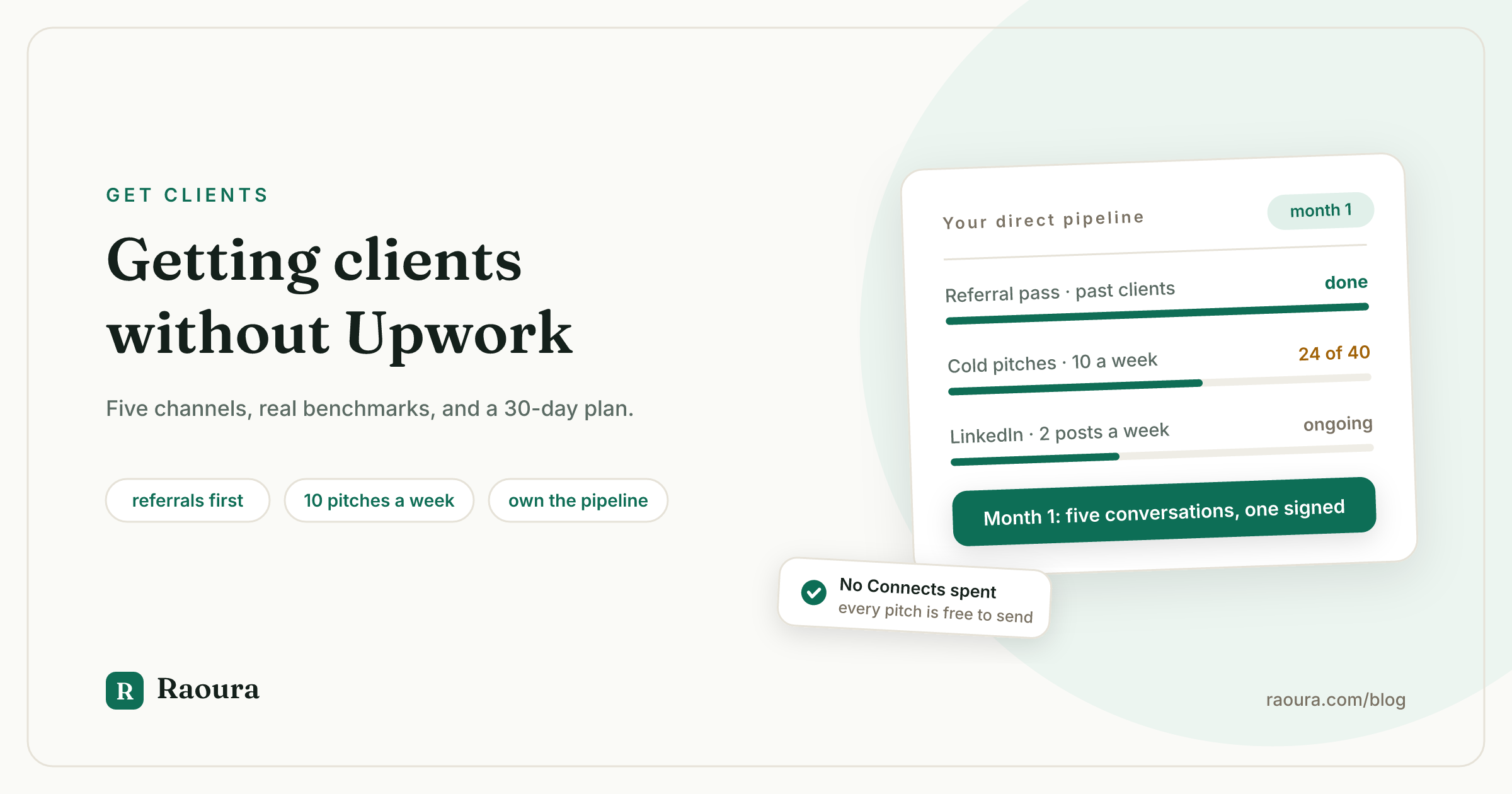
Ten researched pitches a week for four weeks is 40 pitches; at the 8.5% baseline reply rate that is 3 to 4 conversations before follow-ups, and Backlinko's data says a single follow-up lifts replies another 65.8%, so the realistic month-one outcome is 5 or 6 real conversations.
Run this while your current income source, marketplace or otherwise, keeps paying the bills:
- Days 1 to 3: define the buyer. One sentence: "I help [specific kind of company] do [specific outcome]." Every channel below breaks if this is vague.
- Days 4 to 7: stand up the minimum assets. One credible page about your work, a contract template you understand, a proposal template, and a pipeline tracker (a spreadsheet is fine on day 4).
- Week 2: the referral pass. Message every past client and every professional contact who has seen your work, with the two-sentence specific ask from channel 1. For Upwork-originated clients, stay inside the conversion rules.
- Weeks 2 to 4: the outreach cadence. Ten researched pitches a week, one follow-up each a week later, logged in the tracker. No exceptions on the follow-up; it is the cheapest lift in the entire system.
- Weeks 2 to 4: the visibility habit. Two concrete posts a week where your buyers scroll. Repurpose the thinking you already do for pitches.
- Day 30: review the funnel. Pitches sent, replies, conversations, proposals. Whatever the numbers are, they are your baseline, and every month after this you are tuning a machine instead of guessing.
The target for month one is not replacing an income. It is one signed direct client, however small, forcing every piece of your stack through one live test.
Where a marketplace still fits#
A marketplace as one channel of five is a hedge; a marketplace as your only channel is a landlord, and Upwork's own 2025 research says only 10% of freelancers want to return to traditional employment while over a third of full-time employees are considering freelancing, so the direct market keeps deepening either way.
Nothing in this article requires deleting your Upwork profile. Plenty of freelancers keep a marketplace presence for pipeline smoothing, filling slow months at a known fee. The distinction that matters is dependency: when the feed is one of five channels, an algorithm change is an annoyance; when it is your only channel, it is an existential event.
Build the other four until the platform is optional, then decide what to do with it from a position where either answer is fine. If the answer is a full exit, the staged plan is in Leaving Upwork: A 90-Day Plan to Go Direct.
Frequently asked questions
Is it legal to take my existing Upwork clients off the platform?
Not for the first two years of a relationship that started there, unless you pay Upwork's conversion fee. After two years, only a small fee applies. The mechanics, costs, and safe scripts are in our conversion guide.
How long until direct channels replace a marketplace income?
Plan on 3 to 6 months of overlap for a first meaningful base of direct work, with referrals and outreach producing first, and 6 to 12 months before inbound channels contribute. Anyone promising 30 days is selling a course.
Do I need a website before I start?
One credible page, yes; a full site, no. Referrals and cold outreach, the two fastest channels, need proof you exist and samples of your work. That is one page, not a month of web design.
How many cold pitches does it take to land one client?
No honest universal number exists, but the arithmetic frames it: at the 8.5% baseline reply rate, 40 researched pitches with follow-ups yields roughly 5 or 6 conversations, and how many of those convert depends on your proposal and pricing. Track your own funnel from pitch one; your numbers beat anyone's benchmark.
What about Fiverr and other marketplaces instead?
Same math, different landlord. Any marketplace is fine as one channel among several. The failure mode is dependency, not the specific platform, and platforms themselves can vanish: Fiverr shut down Fiverr Workspace in March 2026 and deleted its data.
Verified July 2026. Every statistic links to the primary source that published it, checked this month.
Run your client work in one place
Send a proposal, get it signed, invoice, and get paid, with a branded portal your clients will actually use. One flat plan at $17/month, and we never take a cut of your payments.
Try Raoura free for 14 daysNo credit card required. Set up in minutes.
Keep reading
Is Upwork Worth It in 2026? A Break-Even Test for Your Situation
Upwork is worth it when its fee costs less than finding the client yourself, and that is true far more often for a first project than for a repeat client. Here is the break-even math with 2026 numbers: the 0 to 15% fee, Connects, the shrinking client base, and when to wait out the 24-month rule instead of paying to leave.
The Virtual Assistant Contract: 24 Clauses, Scored Against Every Template Ranking for This Search
We scored the four pages that publish actual virtual assistant contract text against 24 clauses a VA agreement needs. Twenty-four of 96 possible slots were filled. The best single template managed 7 out of 24. Twelve clauses appear in none of them, including every clause about the thing that makes VA work different from other freelance work: you are holding your client's passwords and running their inbox. One popular template also tells you a contract fixes your independent contractor status, then mandates client-set 9 to 5 weekday hours in the same document. Here is the clause-by-clause version, with the classification test the DOL is actually applying in 2026, the data protection terms nobody drafts, and the retainer mechanics that decide whether unused hours roll over.
Stripe vs PayPal for Freelancers: Every Fee Verified (2026)
Every page ranking for this comparison either prints in-person retail rates, contradicts itself, or skips the numbers freelancers actually pay. We read the current Stripe and PayPal pricing pages line by line, ran a $3,000 invoice through every rail, and found a $1,764 per year gap between the cheapest setup and the default one.