How to Move Upwork Clients to Direct Contracts, Legally: The 2-Year Rule, the $1 Secret, and the Scripts
July 6, 2026
Somewhere in your Upwork messages is a client you have worked with for a year or two, who pays on time, likes your work, and would happily keep you busy indefinitely. Every invoice you send them, Upwork takes its cut (we added up what that cut really amounts to in a year if you want the damage in dollars). And every freelancer in that position has typed, then deleted, some version of the same message: "would you want to just... work directly?"
Deleted, because the fear is real. Upwork suspends accounts for circumvention, and the horror stories travel fast.
What travels slower is the fact that there is a completely legal, Upwork-documented way to take a client off the platform, and if the relationship is at least two years old, it costs exactly one dollar. That number is not a rumor; it is written into Upwork's own User Agreement. The help pages just describe it vaguely as "a small fee."
This guide is the piece Upwork will never write: the rules in plain English from the actual Terms of Service, the real fee math including the floor and cap the help center leaves out, the decision table for your specific situation, the exact click path, scripts that stay on the right side of the rules, and what you need in place the day after you leave. Everything was verified against Upwork's live help pages and User Agreement in July 2026.
The rule you agreed to, in plain English#
Upwork's non-circumvention rule requires you to keep all work and payments with a client on the platform for 24 months from the day you first identified each other there, unless someone pays a Conversion Fee. The details, from Upwork's User Agreement and its circumvention policy, matter more than the summary:
- The clock starts at first contact, not first contract. The agreement counts two years "from the date you first identify or meet your Client or Freelancer on the Site." If a client messaged you in March 2024 and hired you in June 2024, your clock started in March.
- It applies per relationship, and to whole companies. The rule covers the business behind the account, including its other employees. Working "directly" with your contact's coworker at the same company does not reset anything.
- Merely asking is a violation. Upwork's policy is explicit that requesting off-platform payment breaks the rules "even if the request isn't completed." The ban risk people fear is mostly people doing exactly this in the chat.
- Closing your account changes nothing. The agreement states the obligation survives if you stop using Upwork, and that violating it makes you liable for the Conversion Fee itself plus Upwork's costs of coming after you. Quitting is not an exit strategy; it converts a fee into a potential debt.
- One clean exception exists: if you and the client genuinely knew each other before Upwork, the rule does not apply at all. Upwork's own conversion page confirms relationships that "started outside the platform, come onto Upwork, and are then taken back outside" are excluded. If this is you, keep the evidence: old emails, invoices, or contracts that predate the Upwork connection.
One myth to retire while we are here: there is no "14-day rule" that lets you take clients off-platform. We could find no trace of it in the current terms or help center. It appears to be folklore, possibly borrowed from another platform.
What leaving actually costs: the numbers the help pages skip#
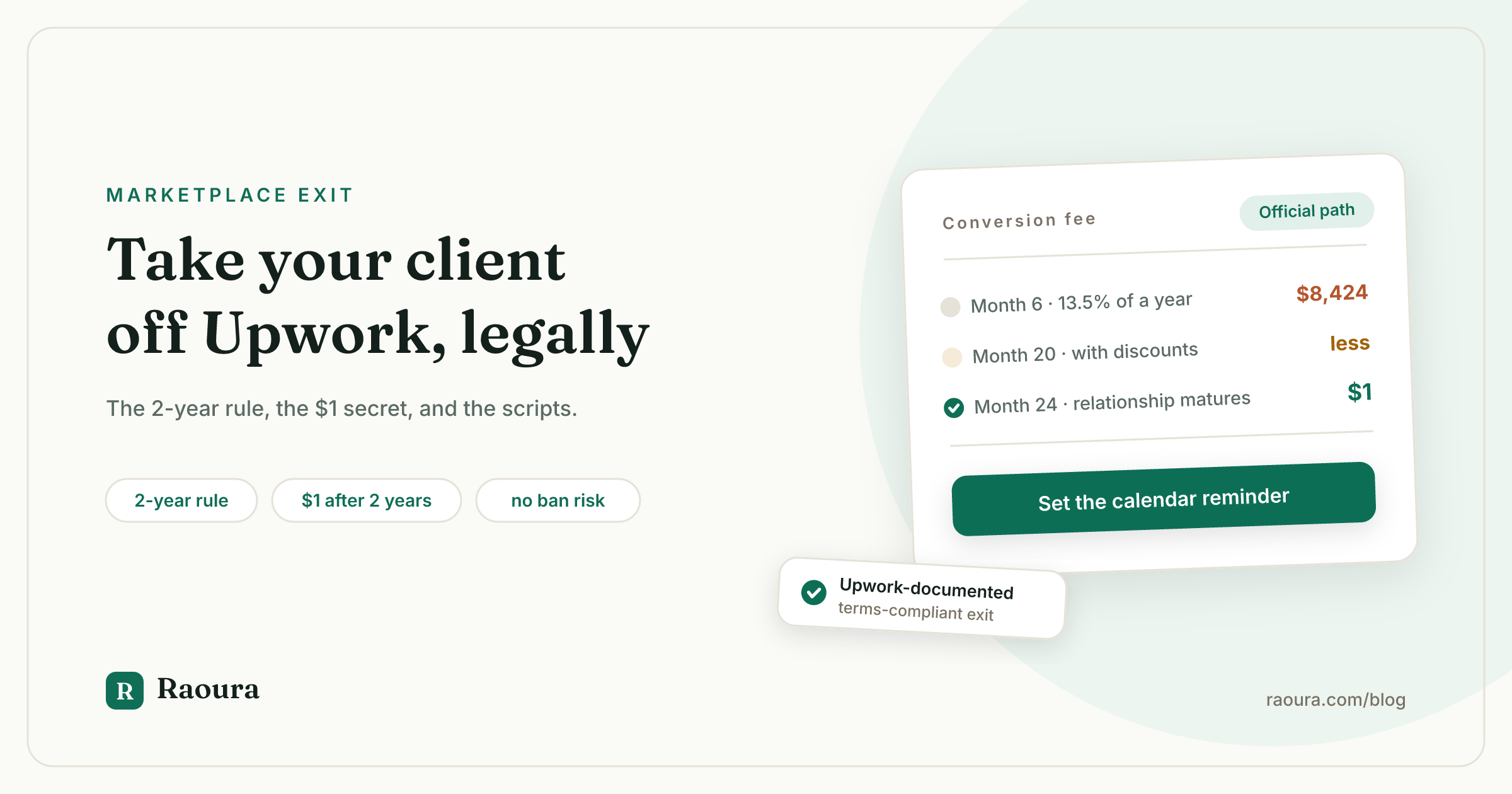
The Conversion Fee is 13.5% of the client's estimated annual value, but it has a floor of $1,000, a cap of $50,000, real discounts, and it drops to a flat $1 once the relationship is two years old. The help center article gives you the formula; the floor, cap, and the $1 figure come from the User Agreement itself.
| Element | The rule |
|---|---|
| Formula | 13.5% of your hourly rate x 2,080 hours (the highest hourly rate you charged that client; your profile rate if the work was fixed-price) |
| Example at $30/hr | $8,424 |
| Example at $50/hr | $14,040 |
| Minimum | $1,000, even after discounts |
| Maximum | $50,000 |
| Discount | Reduced by the marketplace fees your client paid Upwork on your contracts in the preceding 12 months, plus time and activity discounts shown at checkout |
| After a 2-year relationship | $1, described in the agreement as "for administrative purposes" |
| Payment | One payment, one payment method, client or freelancer (you decide between yourselves), non-refundable |
Run the honest math before deciding anything. Say your client pays you $30 an hour for about 20 hours a week, roughly $30,000 a year, and your service fee on the contract is 10%. Staying on Upwork costs you about $3,000 every year, forever.
Converting today, 14 months into the relationship, costs $8,424 minus discounts shown at checkout, which frequently lands somewhere in the mid four figures. Painful, but it pays for itself in roughly two years, and everything after that is yours.
Now the version almost nobody calculates: if the relationship is 20 months old, doing nothing for four more months takes the price from thousands of dollars to one. For most freelancers with a maturing client, the winning move is not circumvention and not an immediate buyout. It is a calendar reminder.
Which path fits your situation#
| Your situation | Your move |
|---|---|
| Relationship is 2+ years old | Convert now for $1. There is no reason to keep paying the service fee |
| 18 to 24 months in | Wait for the anniversary, then convert. Set the reminder from the date of first contact, not first contract |
| Under 18 months, high-value ongoing client | Price a conversion: 13.5% minus the discounts shown at checkout, against your service fee projected over the months remaining until the free exit. Sometimes buying out early wins, usually waiting does |
| Under 18 months, small or occasional client | Stay put. The fee will never pay back on a $2,000-a-year relationship, and the $1,000 minimum guarantees that |
| Client knew you before Upwork | You are exempt. Document the prior relationship, then invoice directly with a clear conscience |
| New client you found yourself, never on Upwork | Do not bring them to the marketplace at all. Upwork's [Direct Contracts](https://support.upwork.com/hc/en-us/articles/360025040794-Direct-Contracts-bring-a-client-to-Upwork) product (5% fee, 0% with Freelancer Plus) only works for clients who have no Upwork account, and once they are in, the 2-year logic applies to that relationship too. Your own contract and invoice cost 0% |
And one more myth from that table worth stating plainly, because the help page says it outright: existing Upwork contracts cannot be switched to Direct Contracts. You cannot downgrade a marketplace client to the cheaper fee tier. The only doors out are conversion or the two-year anniversary.
The conversation: what you may legally say#
Here is the part that surprises people: discussing a compliant conversion with your client is not a violation. Upwork's own conversion page encourages exactly that, recommending that both sides "carefully discuss how it will impact work, why it makes more sense, how they plan to process payments and transfer work."
The violations are sharing contact details before a contract exists and paying outside the platform without the fee. Talking about the sanctioned exit, using the platform's own vocabulary, is safe.
A script for the two-year case:
"I've loved working together this past couple of years, and I'd like to keep this going long-term. Upwork has an official process for moving an established relationship off the platform; since we've worked together more than two years, the conversion fee is nominal. It would save you the 5% client fee and the per-contract charges, and I can set us up with contracts, invoicing, and a project portal on my end so everything stays as smooth as it is now. Want me to send over how it works?"
And for the earlier, high-value case:
"Something worth knowing: Upwork's terms let us move to a direct relationship through their official conversion process. There's a one-time fee based on the contract, and after our two-year mark it becomes almost nothing. Given what we both pay in platform fees, it may be worth planning for. No rush, but I wanted it on your radar before we scope the next project."
What never to type, even casually:
- Your email address before a contract exists. The agreement's definition of "Means of Direct Contact" is broad enough to include a portfolio site with a contact form.
- Any suggestion of off-platform payment before a conversion is paid for.
- An under-reported invoice.
Third-party reports say Upwork's message scanning is automated and aggressive. Upwork does not document its methods, but the policy it enforces is written down, and the penalty list includes account closure plus the fee charged to your payment method as a debt.
The click path#
The conversion is client-initiated in the interface, so your job is to make it effortless for them:
- The client goes to Jobs, then All Contracts, opens your contract, clicks the (...) menu, and selects Hire talent full time. Upwork's page notes this same option covers continuing as an independent contractor, not just employment.
- You receive a notification and accept the request.
- The fee, with time and activity discounts applied, is calculated and shown. One party pays it in a single payment. If you are splitting it, settle that between yourselves first; Upwork only takes one payment method.
- Upwork confirms completion to both sides. The contract stays in your work history, the earnings still count toward your profile totals, your Job Success Score is unaffected, and both sides can leave feedback.
If the client is on a Business or Enterprise plan, the process runs through their Upwork account manager instead, and enterprise conversions can be priced differently.
The day after: replacing Upwork's rails#
Converting removes the service fee, and it also removes escrow, payment protection, and dispute resolution. That is not a reason to stay; it is a checklist. Three things replace the marketplace:
- A real contract. Scope, revision limits, late fee, kill fee, IP transfer on payment. On Upwork, the platform's terms papered over this; directly, your agreement is the whole ballgame. Our clause-by-clause contract guide covers it in depth, and milestones in the contract replace escrow: the client approves and pays each stage before the next begins, so neither side is ever exposed for more than one phase. That structure, not a middleman holding funds, is what actually protected you all along.
- A deposit and milestone billing habit. The first direct invoice should follow the same rules we lay out in our deposit guide: money lands before work starts, then approve-and-pay per milestone.
- The tax paperwork, which is lighter than people fear. On Upwork, the platform handled reporting and your client never filed anything. Directly, one of two simple things happens.
If your client pays you by check, ACH, or wire, they should collect a W-9 from you and issue a 1099-NEC above the IRS threshold ($600 for 2025 payments, rising to $2,000 for payments from January 2026 under the new reporting law). Send the W-9 proactively with your first invoice and you have handled their entire compliance burden in one attachment.
If instead they pay by card through your own Stripe account, the processor reports it on a 1099-K and your client files nothing at all, which makes card payment the lowest-friction pitch to a client's finance person.
Either way, your income was always taxable and your quarterly estimates were always your job; nothing about leaving changes that.
(Disclosure: Raoura is our product, and this is precisely the gap it fills for marketplace graduates. Proposals, e-signed contracts, deposit and milestone invoicing, and a branded client portal, at $17 a month flat, with payments through your own Stripe going straight to your bank. Your converted client gets one link where everything lives, which answers the only real objection they had to leaving the platform: "but it was all in one place.")

Approve and pay per milestone, visible to both sides: the structure that actually protected you on Upwork, minus the middleman.
Verified July 2026 against Upwork's User Agreement (non-circumvention section) and help center pages on conversion, circumvention, the Conversion Fee, and Direct Contracts. Policies change; re-check the linked pages before acting. This article is general information, not legal or tax advice.
Frequently asked questions
Does the 2-year rule apply if my client found me somewhere else first?
No. If the relationship genuinely started off-platform, the non-circumvention period does not apply at all. Keep evidence of the prior relationship (emails, an old invoice) in case it is ever questioned.
What is the minimum Upwork Conversion Fee?
$1,000 per the User Agreement, no matter how small the contract or how large the discounts, unless the relationship is at least two years old, in which case the fee is a nominal $1.
Can Upwork come after me if I just close my account and work with the client anyway?
The agreement says yes: the obligation survives account closure, and Upwork reserves the right to charge the Conversion Fee to your payment method plus its costs of pursuing the breach. Whatever you think of the rule, the clean paths are cheaper than testing it.
Is it against the rules to tell my client about the conversion process?
No. Upwork's own help content recommends discussing a planned conversion openly. The violations are sharing direct contact details before any contract exists and moving payment off-platform without paying the fee.
Can I switch an existing Upwork client to Direct Contracts for the lower fee?
No. Upwork states existing contracts cannot be changed to Direct Contracts. That product is only for clients who have never had an Upwork account, and existing marketplace relationships can only leave via conversion or the two-year anniversary.
Who pays the Conversion Fee, me or the client?
Either, but Upwork accepts exactly one payment from one payment method. Many freelancers split it with the client informally, since the client is also escaping their own 5% marketplace fee and the $0.99 to $14.99 initiation fee on every new contract.
---
Run your client work in one place
Send a proposal, get it signed, invoice, and get paid, with a branded portal your clients will actually use. One flat plan at $17/month, and we never take a cut of your payments.
Try Raoura free for 14 daysNo credit card required. Set up in minutes.
Keep reading
Is Upwork Worth It in 2026? A Break-Even Test for Your Situation
Upwork is worth it when its fee costs less than finding the client yourself, and that is true far more often for a first project than for a repeat client. Here is the break-even math with 2026 numbers: the 0 to 15% fee, Connects, the shrinking client base, and when to wait out the 24-month rule instead of paying to leave.
The Virtual Assistant Contract: 24 Clauses, Scored Against Every Template Ranking for This Search
We scored the four pages that publish actual virtual assistant contract text against 24 clauses a VA agreement needs. Twenty-four of 96 possible slots were filled. The best single template managed 7 out of 24. Twelve clauses appear in none of them, including every clause about the thing that makes VA work different from other freelance work: you are holding your client's passwords and running their inbox. One popular template also tells you a contract fixes your independent contractor status, then mandates client-set 9 to 5 weekday hours in the same document. Here is the clause-by-clause version, with the classification test the DOL is actually applying in 2026, the data protection terms nobody drafts, and the retainer mechanics that decide whether unused hours roll over.
Stripe vs PayPal for Freelancers: Every Fee Verified (2026)
Every page ranking for this comparison either prints in-person retail rates, contradicts itself, or skips the numbers freelancers actually pay. We read the current Stripe and PayPal pricing pages line by line, ran a $3,000 invoice through every rail, and found a $1,764 per year gap between the cheapest setup and the default one.