Freelance Proposal Template (With the Pricing Psychology)
July 12, 2026
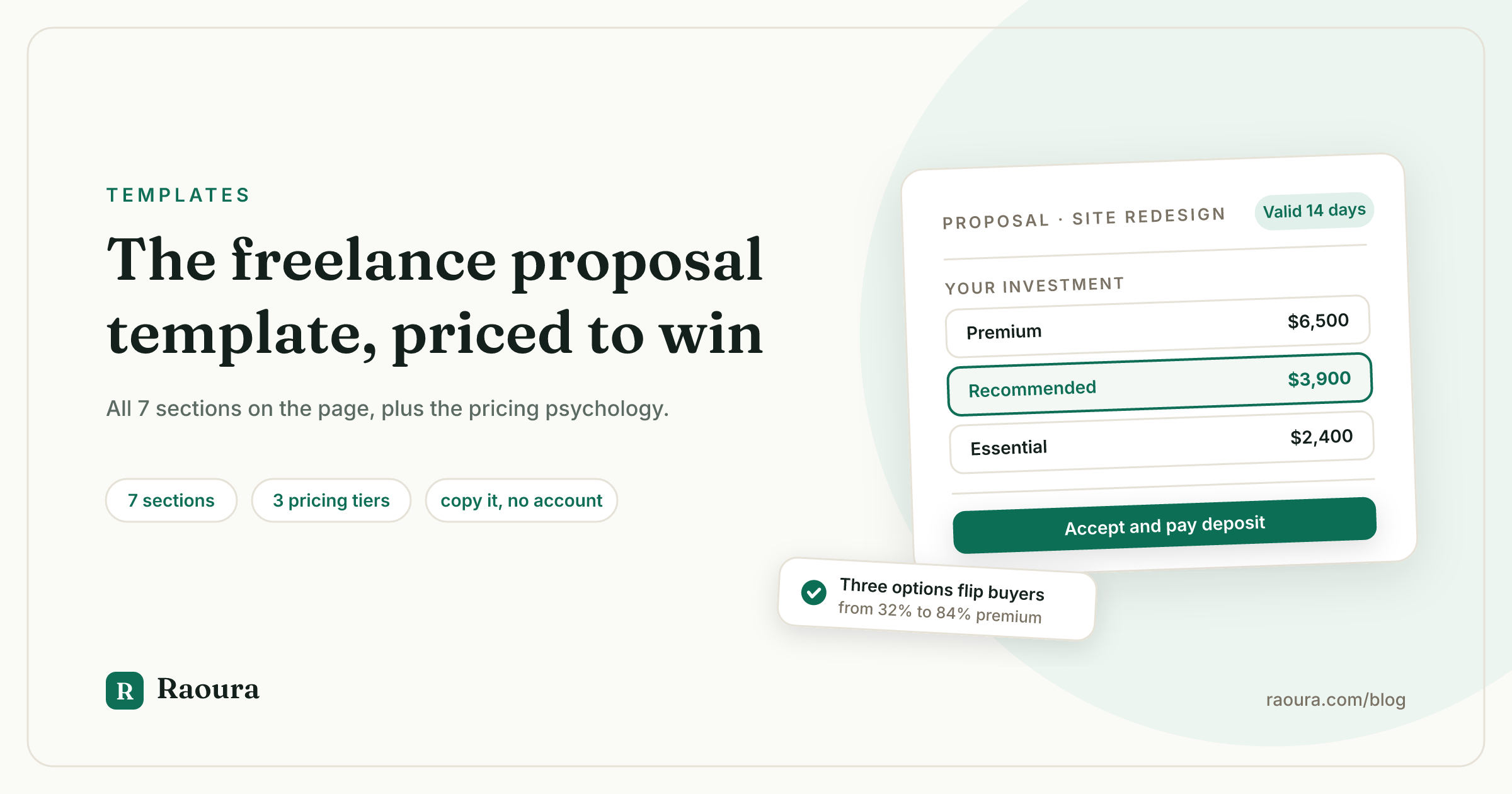
A proposal template is usually sold to you as a formatting problem: pick a layout, drop in your logo, list your services. But proposals are not won on layout. They are won in a surprisingly narrow window, on a surprisingly small number of decisions, and most of those decisions are about price.
Proposify's benchmark data shows 50% of proposals are opened within 74 minutes of sending, and the median time from open to closed-won is 51.4 hours. Your client decides in about two days. The template below is built for that window.
This page does two things the top-ranking template pages do not. The full template is here, on the page, no account, no email gate. And it comes with the part every competitor skips entirely: the pricing psychology, with the actual research linked, because how you present your price moves your win rate more than any design choice you will make.
What the top-ranking proposal templates actually give you#
We fetched the five top-ranking pages for "freelance proposal template" in July 2026: four gate the template behind an account or email address, and zero of the five mention anchoring, tiered pricing, or any citable win-rate data. Here is the audit:
| Source | Template on the page | Ungated | Explains why sections exist | Pricing psychology | Cited win-rate data |
|---|---|---|---|---|---|
| [Bonsai](https://www.hellobonsai.com/proposal-template/freelance) | No (long article, no template text) | No (signup to use) | Partly | No | No |
| [PandaDoc](https://www.pandadoc.com/business-proposal-templates/freelance-proposals/) | No (gallery, opens in app) | No (account or trial) | Barely | No | No |
| [Reedsy](https://reedsy.com/freelancer/freelance-proposal-template) | Checklist only | No (email or Google signup for the file) | Lightly | No | No |
| [Better Proposals](https://betterproposals.io/templates/freelance) | Previews only | No (14-day trial account) | On template subpages | No | Unsourced claims |
| [Spectroomz](https://www.spectroomz.com/blog/a-freelance-proposal-example-and-template) | Yes (short bid message) | Yes | Briefly | No | No |
Two details from that audit are worth noting. Better Proposals' freelance writing template carries a title tag claiming it "won $13M of business" while the page copy says over $31 million, with no methodology for either number. And the only truly ungated result is a five-sentence marketplace bid message, not a proposal document with scope, pricing, or terms. The data that would actually help you, Proposify's own proposal benchmarks, appears on none of the ranking pages.
The template: 7 sections, in the winning order#
The average winning proposal has 7 sections across 11 pages, and winning proposals are shorter than losing ones (11 pages versus 13), per Proposify's proposal benchmarks, drawn from the hundreds of thousands of proposals sent through its platform. Longer does not mean more persuasive. It means more places for the client to stall. Copy the block below, replace the bracketed parts, and read the section notes once, because the notes are the actual product.
[Project name]: Proposal for [Client company]
Prepared for [decision maker's name] · Prepared by [your name, your business] · [Date] · Valid until [date + 14 days]
1. The situation
[Two short paragraphs, in the client's own words wherever possible: what they are trying to achieve, what is in the way, and what it costs them to leave it unsolved. No mention of you yet.]
2. The outcome
[What will be true when this project is done, stated as results: "a site that loads in under 2 seconds", "a launch-ready brand kit", "12 posts per month you never have to think about". One paragraph.]
3. The plan
[3 to 5 named phases. For each: what happens, what you deliver, what you need from the client. This section quietly defines scope: what is listed is included, what is not listed is not.]
4. Timeline
[A phase-by-phase table with dates, including the client's review turnarounds as line items. "Client feedback on drafts: within 3 business days" belongs here.]
5. Your investment
[Three named options in a table, recommended one in the middle or highlighted. Each option: name, what is included, price. Below the table: deposit amount, payment schedule, what happens with out-of-scope requests.]
6. Why me
[One short case study with a number in it, one or two testimonials, relevant credentials. Half a page. Proof, not biography.]
7. Next steps
[Exactly what accepting looks like: "Sign below, pay the [X]% deposit, and we start on [date]." Signature block. The validity date repeated.]
Now the section-by-section reasons, in order.
1. The situation and the outcome (sections 1 and 2)#
These two sections are your executive summary, and they carry more weight than anything else you write. Proposify's State of Proposals data found that customizing at least half of the executive summary raises close rates by 50%. Template-reusing freelancers customize the price and the name and nothing else, which is exactly why their proposals read like templates.
Rewrite these two sections from scratch for every client, using phrases from your discovery call. The rest of the document can be 80% reusable.
2. The plan (section 3)#
This is scope, wearing friendlier clothes. Every phase you name and every deliverable you list is a boundary that protects you later, because "that was not in the proposal" is a sentence you can only say if the proposal was specific. If the project is large enough to need formal scope language, write a separate statement of work and reference it; if a client starts stretching the edges mid-project, that is a scope creep conversation, and it goes better when the proposal was precise.
3. Timeline (section 4)#
Put the client's obligations in the timeline as dated line items. Most blown deadlines are actually blown feedback rounds, and a timeline that says "client review: 3 business days" converts the eventual delay conversation from an accusation into a reference to a document they signed.
4. Your investment (section 5)#
The pricing section gets its own chapter below, because it is where proposals are won and lost. One mechanical note here: Proposify's data shows proposals with pricing tables have 6% higher close rates, and nearly 98% of proposals include pricing, so the occasional advice to "leave the price for the call" mostly just adds a meeting to your sales process.
5. Why me (section 6)#
One case study with a concrete number beats four paragraphs of biography. Clients spend their reading time on scope and price, not on your story. Keep this to half a page and make every sentence proof.
6. Next steps (section 7)#
Winning proposals make acceptance a single action. Proposify's State of Proposals data found proposals with e-signatures are 3.3 times more likely to close and close 30% faster. A proposal that ends with "let me know your thoughts" ends with silence; a proposal that ends with a signature line and a deposit link ends with a project. For how much that deposit should be, see how much deposit a freelancer should charge.
The pricing psychology: how to present the same price and win more#
Three priced options beat one: in the classic decoy experiment, adding a third option flipped the share of buyers choosing the premium package from 32% to 84%. None of the five top-ranking template pages mentions any of what follows, which is strange, because it is the best-documented part of the entire proposal literature.
| Tactic | What the evidence says | Primary source |
|---|---|---|
| Anchor high, first | Arbitrary initial numbers pull estimates toward them; medians moved from 25 to 45 in the original experiment | [Tversky and Kahneman, 1974](https://www.simplypsychology.org/what-is-the-anchoring-bias.html) |
| Offer three options | With two options, 68% of buyers picked the cheap one; adding a decoy flipped 84% to premium | [The Economist experiment](https://theconversation.com/the-decoy-effect-how-you-are-influenced-to-choose-without-really-knowing-it-111259) |
| Mind the left digit | $2,999 is perceived as meaningfully smaller than $3,000 because the leftmost digit changes | [Thomas and Morwitz, 2005](https://academic.oup.com/jcr/article-abstract/32/1/54/1796360) |
| Use a pricing table | Proposals with pricing tables close 6% more often | [Proposify State of Proposals](https://www.proposify.com/state-of-proposals-2024) |
1. Anchoring: the first number wins#
In Tversky and Kahneman's 1974 experiment, people who saw a wheel land on 10 estimated a median of 25 for an unrelated question; people who saw 65 estimated 45. The number came from a wheel and it still dragged the answer.
In your proposal, the first price the client sees becomes the reference point for every price after it. So lead your pricing table with the premium option, not the cheap one. The premium price does its job even if nobody buys it: it makes your recommended option look reasonable instead of expensive.
2. Three options: the decoy effect#
In the experiment popularized by Dan Ariely and documented by The Conversation, The Economist offered a web subscription for $59 and a print subscription for $125, and 68% chose the cheaper web option. Adding a third option, print-only at the same $125, flipped the result: 84% now chose the $125 print-and-web package. The effect, first published by Huber, Payne, and Puto in 1982, is called asymmetric dominance: a slightly worse version of your target option makes the target feel like the obviously smart choice.
For a freelancer, the practical version is one scoped-down option, one recommended option, and one premium option, built so the recommended one is the clear best value. You are not tricking anyone. All three options are real work at real prices. You are giving the client a comparison set that lives inside your proposal instead of letting them build one from your competitors.
3. The left digit, used honestly#
Thomas and Morwitz's research in the Journal of Consumer Research found nine-ending prices are perceived as smaller only when the leftmost digit changes: $2,999 reads meaningfully cheaper than $3,000, while $3,049 versus $3,050 does nothing. So if your project price sits just above a left-digit boundary, know that the client feels that boundary.
Whether to use it is a positioning call: charm prices read as retail, and many freelancers price in round numbers on purpose to signal confidence. What the research settles is where the perception jump happens, so at minimum, stop pricing at $3,020 when $2,990 feels dramatically different and costs you $30.
4. One more mechanical finding#
Proposify's data also shows interactive pricing, where the client can toggle options and quantities, lifts close rates 12.6% over static pricing. You do not need special software for the principle: even in a PDF, listing optional add-ons with prices lets the client build their own version of the project, and people commit harder to things they configured.
The 48-hour window: sending, tracking, following up#
Half of all proposals are opened within 74 minutes of sending, and 42.5% of proposals that win are won within 24 hours of the first open, per Proposify. The corollary: a proposal that has sat unsigned for a week is not "still being considered" in most cases, it is losing. Winning proposals get viewed 2.5 times on average; losing ones get viewed 3.5 times. More re-reads mean more doubt.
Three practices follow directly from those numbers.
- Send the proposal while the discovery call is still warm, same day if you can, because the 74-minute open statistic means the client's attention peak is right after they ask for it.
- Make acceptance one action, signature plus deposit, because the decision happens fast when it happens at all.
- Follow up after two days, once, referencing the validity date, because Proposify's own guidance is that two days of silence is the follow-up trigger, and your "valid until" line gives the follow-up a reason to exist beyond nudging.
This workflow, send, track the open, take the signature, collect the deposit, is the part where tooling either helps or gets in the way. Raoura does it as one motion: the proposal goes out with e-signature and a deposit invoice attached, you see when the client opens it, and acceptance triggers the deposit automatically, for a flat $17 per month with no percentage of your money taken. Disclosure: Raoura is our product.
A Google Doc and a Stripe payment link can do a workable version of the same thing, and either beats a PDF attachment that tells you nothing about whether it was ever opened.

What one-action acceptance looks like: the client signs and pays the deposit in the same click, and the project starts.
From proposal to contract, without retyping everything#
Freelancers who use written contracts report income 13.7% higher than work done without one, per the ILR Review study of Freelancers Union survey data. That is an association, not a guarantee, and the same study found 38.8% of freelancers with contracts still hit payment trouble. But the direction is clear, and a signed proposal is not a substitute for a contract: it usually lacks IP transfer, liability, and termination language.
The efficient pattern is proposal first, contract immediately after acceptance, with the scope and pricing carried over word for word so nothing gets renegotiated in the gap. Our freelance contract template is built to receive exactly what section 3 and section 5 of this proposal define, and what should be in a freelance contract explains every clause. Then the first invoice mirrors the payment schedule from section 5; the freelance invoice template covers that handoff, and larger projects should bill per milestone exactly as the timeline section promised.
Verified July 2026. Primary sources: Proposify proposal benchmarks and State of Proposals data, Tversky and Kahneman (1974) via Simply Psychology, The Conversation on the decoy effect (Huber, Payne, and Puto), Thomas and Morwitz (2005) in the Journal of Consumer Research, ILR Review 67(3S) on contract use and freelancer income. Competitor template audit (gating, coverage) performed against the five live top-ranking pages July 2026. This article is general information, not legal or pricing advice.
Frequently asked questions
Is this freelance proposal template really free?
Yes. Copy it from this page into a Google Doc, a Word file, or your proposal tool. No download gate, no email, no account.
How long should a freelance proposal be?
Around 7 sections and roughly 10 pages, often less for small projects. Proposify's data on winning proposals averages 7 sections across 11 pages, and winners are consistently shorter than losers. If a section is not doing persuasive work, cut it.
Should I put pricing in the proposal or discuss it on a call?
Put it in the proposal. Nearly 98% of proposals include pricing, and proposals with pricing tables close 6% more often. Discuss the budget range before you write the proposal, on the discovery call, so the written price is a confirmation rather than a surprise.
How many pricing options should a freelance proposal offer?
Three: a scoped-down option, a recommended option, and a premium option. The premium anchors the price, and the comparison makes the recommended option the clear best value. One option invites a yes/no decision; three invite a which-one decision.
How long should a proposal be valid?
7 to 14 days. The decision data says clients who accept mostly do so within about 48 hours of opening, so a short validity window matches reality, gives your follow-up a reason, and protects you from honoring January pricing in June.
When should I follow up on a proposal?
Two days after sending, once, referencing the validity date. Half of proposals are opened within 74 minutes, and most winners close within about two days of the first open, so at day two the proposal is either being decided or going cold.
Is a signed proposal a contract?
A signed proposal can be legally binding, but it is usually a bad contract: no IP transfer, no liability cap, no termination clause. Send a proper contract immediately after acceptance, with the scope and price carried over unchanged.
---
Run your client work in one place
Send a proposal, get it signed, invoice, and get paid, with a branded portal your clients will actually use. One flat plan at $17/month, and we never take a cut of your payments.
Try Raoura free for 14 daysNo credit card required. Set up in minutes.
Keep reading
Is Upwork Worth It in 2026? A Break-Even Test for Your Situation
Upwork is worth it when its fee costs less than finding the client yourself, and that is true far more often for a first project than for a repeat client. Here is the break-even math with 2026 numbers: the 0 to 15% fee, Connects, the shrinking client base, and when to wait out the 24-month rule instead of paying to leave.
The Virtual Assistant Contract: 24 Clauses, Scored Against Every Template Ranking for This Search
We scored the four pages that publish actual virtual assistant contract text against 24 clauses a VA agreement needs. Twenty-four of 96 possible slots were filled. The best single template managed 7 out of 24. Twelve clauses appear in none of them, including every clause about the thing that makes VA work different from other freelance work: you are holding your client's passwords and running their inbox. One popular template also tells you a contract fixes your independent contractor status, then mandates client-set 9 to 5 weekday hours in the same document. Here is the clause-by-clause version, with the classification test the DOL is actually applying in 2026, the data protection terms nobody drafts, and the retainer mechanics that decide whether unused hours roll over.
Stripe vs PayPal for Freelancers: Every Fee Verified (2026)
Every page ranking for this comparison either prints in-person retail rates, contradicts itself, or skips the numbers freelancers actually pay. We read the current Stripe and PayPal pricing pages line by line, ran a $3,000 invoice through every rail, and found a $1,764 per year gap between the cheapest setup and the default one.