How to Write a Statement of Work That Prevents Disputes
July 6, 2026
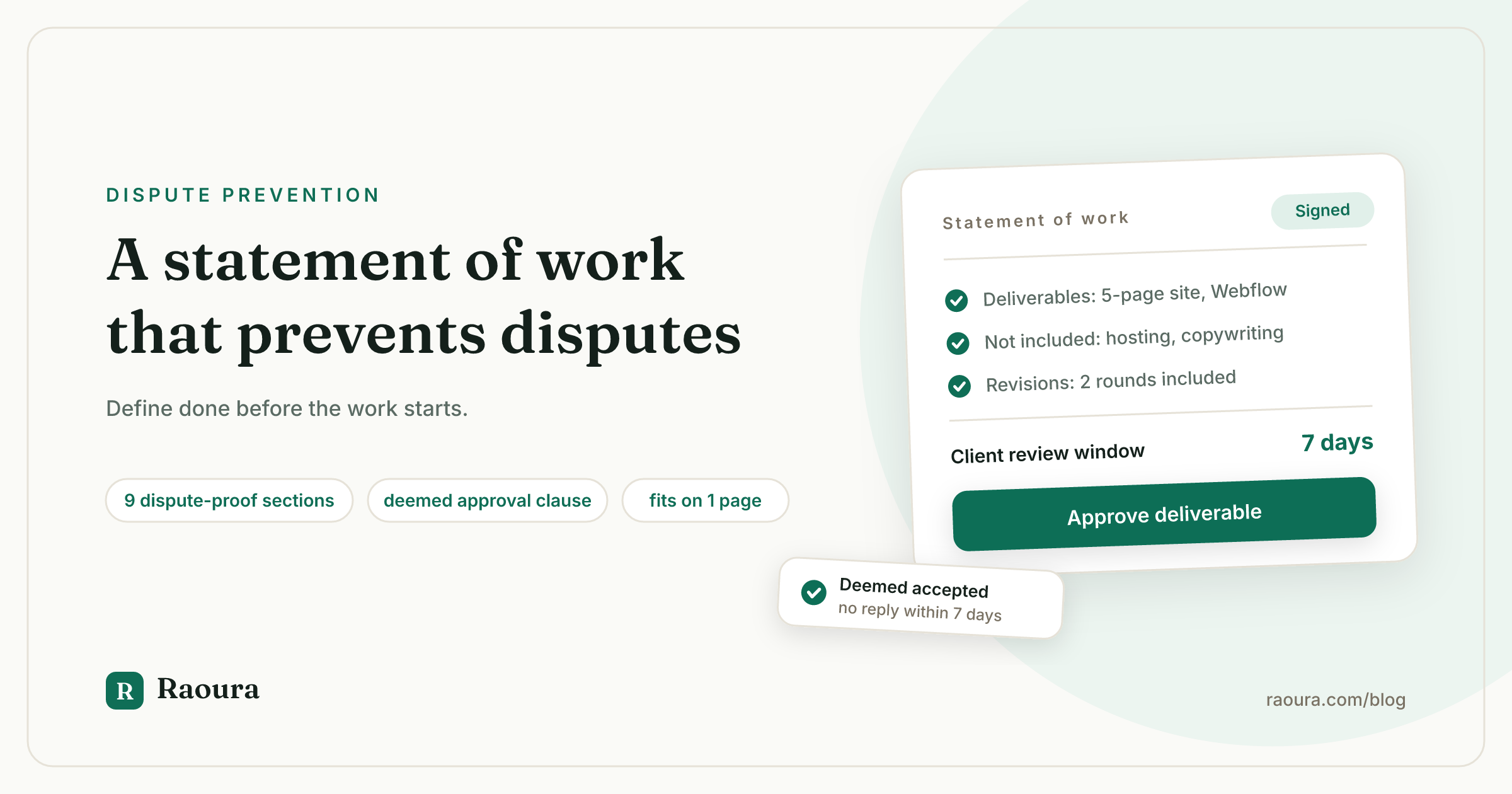
A statement of work (SOW) is the document that spells out exactly what you will deliver, by when, for how much, and how both sides will know the work is done. That is the textbook definition, and it is where most guides stop, because most guides are written for corporate project managers hiring vendors. You are not a procurement department. You are one person, and for you the SOW is something more specific: it is the dispute-prevention document.
Think about the last freelance horror story you read, or lived.
- The client who "just assumed" hosting setup was included.
- The feedback that arrived in round six of a two-round project.
- The deliverable that sat unapproved for five weeks while the final invoice aged.
None of those are contract disputes in the lawyer sense. They are all definition disputes, and every one of them dies in a well-written SOW before it is ever born.
52% of projects experienced scope creep or uncontrolled changes in the preceding 12 months, according to PMI's Pulse of the Profession survey of over 5,000 project practitioners.
And 71% of freelancers have struggled to collect payment at least once in their career, per the Freelancers Union nonpayment survey.
Both numbers are downstream of the same root cause: nobody wrote down what done meant.
What a statement of work is (and what it is not)#
A statement of work is one of 4 documents freelancers routinely mix up, and it is the only one whose job is defining "done" for a specific project. The proposal sells, the contract governs the relationship, the scope of work lists the what, and the SOW wraps the what in dates, money, and acceptance rules.
| Document | Job | Signed? | Typical timing |
|---|---|---|---|
| Proposal | Convince the client to hire you | No | Before the deal |
| Contract (or MSA) | Set legal terms: IP, liability, termination, late fees | Yes | Once per client |
| Scope of work | List what is included, item by item | Usually inside the SOW | Per project |
| Statement of work | Define deliverables, dates, price, and acceptance for one project | Yes | Per project, attached to the contract |
The practical pattern for a solo freelancer: one contract per client covering the legal terms that never change (see what should be in a freelance contract), then one short SOW per project referencing that contract. On small projects most freelancers merge the two into a single signed document, which is fine. What is not fine is having neither, or having a proposal standing in for both.
One quotable rule: if a sentence affects money, dates, or ownership, it belongs in a signed document, not in an email thread.
The 9 sections of a dispute-proof SOW#
A freelance SOW needs 9 sections, and the 3 that prevent the most disputes (exclusions, acceptance criteria, and deemed approval) are the 3 that most templates skip. We checked the five top-ranking SOW guides while researching this article: their recommended section counts were 7, 8, 11, 11, and 13, and only one of the five included an acceptance section at all. Corporate templates are long where it does not matter and silent where it does.
1. Project summary and objective#
Two or three sentences: who the client is, what the project is, and what business outcome it serves. This section settles arguments later, because ambiguous clauses get interpreted against the drafter and in light of the stated purpose. "Redesign the marketing site to increase demo signups" tells everyone what the project is not: it is not an app, not a rebrand, not SEO.
2. Deliverables#
List every deliverable as a noun someone could point to: "a 5-page website built in Webflow", "12 edited product photos delivered as TIFF and web-ready JPEG", "a 2,000 to 2,500 word article in Google Docs". Apply the pointing test: if you cannot point at it when it is finished, it is not written concretely enough. Include file formats, quantities, and the delivery method.
3. Exclusions: what is not included#
The highest-value section per word in the entire document, and the one almost no template includes. Every field has its predictable "I assumed that was included" items. Write yours down:
Not included in this SOW: copywriting, stock photo licensing fees, hosting setup or fees, post-launch maintenance, additional page templates beyond the five listed, and printing costs. These can be added by change order.
Disputes start where assumptions differ. Three lines of exclusions cost you nothing and delete the most common fight in freelancing before it starts.
4. Assumptions and client responsibilities#
Your price and timeline rest on assumptions: the client provides brand assets by a date, feedback arrives consolidated from one contact, existing code or files are in working order. State them, and state the consequence when one fails:
Client will deliver all product copy and imagery by March 3. Timeline dates shift day for day with any delay in client materials or feedback. If materials are more than 14 days late, Freelancer may invoice for work completed to date and re-schedule the remainder.
That second sentence is the polite version of a pause clause, and it is the difference between a delayed project and a delayed project you are still contractually on the hook to finish at the original price.
5. Timeline and milestones#
Dates for each deliverable and each client obligation, not just a final deadline. Milestones do double duty as payment triggers, which is the core idea behind milestone billing: never be owed for more than one phase at a time.
6. Acceptance criteria#
For each deliverable, an objective test a reasonable stranger could apply: "renders correctly in current Chrome, Safari, and Firefox", "matches the approved wireframes", "delivered in the agreed formats at the agreed dimensions". The point is to replace "the client likes it" (unverifiable, infinitely movable) with "the deliverable does X" (checkable). Subjective taste still gets its say, but inside the revision rounds below, not as a permanent veto over your invoice.
7. Deemed acceptance: the client-silence clause#
A deemed acceptance clause gives the client a fixed review window, usually 5 to 10 business days, after which silence counts as approval. This is the single most underused sentence in freelance paperwork:
Client will review each deliverable and provide written acceptance or itemized revision requests within 7 business days of delivery. Deliverables receiving no written response within that period are deemed accepted, and the associated invoice becomes due.
If that feels aggressive, note that the biggest freelance marketplace runs on exactly this mechanic: on Upwork fixed-price contracts, funds release automatically 14 days after work is submitted if the client takes no action. Clients accept deemed approval every day; they just have not been asked to accept it from you.
Without this clause, a silent client can hold your final payment hostage indefinitely, which is exactly the scenario in the ghosted-after-delivery playbook. With it, silence has a price and a deadline.
8. Revisions#
Define the number of rounds, what a round is, and what extra rounds cost:
The price includes 2 rounds of revisions per deliverable. A round is one set of consolidated, written revision requests submitted together. Revisions that change the scope, and any rounds beyond the second, are billed at $95/hour or by change order.
Two rounds is the most common baseline across creative fields. The definition of a round matters as much as the count: without "consolidated and written", ten drip-fed Slack messages are ten rounds you cannot bill for.
9. Price, payment schedule, and the change process#
State the price, the deposit, the payment triggers (tied to the milestones in section 5), and the payment window on each invoice. Then close the loop on scope: changes happen through a written change order, priced before the work is done.
If a client pushes back on any of this, that reaction is data; the specific clauses clients try to strike are covered in contract red flags. Signature blocks for both parties go at the bottom, and yes, e-signatures count.
How long should it be? Shorter than you think#
For a typical solo project under $5,000, a dispute-proof SOW fits on 1 to 2 pages. Length is not protection; specificity is.
The corporate 13-section format exists because enterprises staff both sides of it. Your client is often one busy founder or marketing manager, and a document they actually read beats a document that impresses them.
Our rule of thumb: every sentence must change what happens in at least one plausible disagreement, or it gets cut.
The freelancers who use written agreements are not just avoiding fights, they are earning more: contract users reported 13.7% higher income than comparable freelancers working without contracts in the ILR Review study of Freelancers Union survey data (the association held across 2007 to 2011 waves; it is correlation, but the mechanism, clearer scope and enforceable payment terms, is exactly what an SOW provides).
Your SOW is now (sometimes) legally required#
Three states now require written agreements for freelance work above thresholds of $250 to $800, and a signed SOW with payment terms satisfies the requirement. If you or your client are in one of these states, the document in this guide stopped being best practice and became compliance:
| State | Law | Written contract required at | Payment due |
|---|---|---|---|
| New York | Freelance Isn't Free Act (statewide Aug 2024) | $800+ (aggregated over 120 days) | Contract date or within 30 days of completion |
| Illinois | Freelance Worker Protection Act (Jul 2024) | $500+ (aggregated over 120 days) | Contract date or within 30 days, double damages for violations |
| California | SB 988 (Jan 2025) | $250+ (aggregated over 120 days, professional services) | Contract date or within 30 days of completion |
Sources: NY DOL, Illinois DOL, California SB 988. The full state-by-state picture, including what to do when you and the client are in different states, is in freelance payment laws by state.
Making the SOW part of the workflow, not extra admin#
A good proposal already contains 4 of the 9 SOW sections (deliverables, exclusions, timeline, and price), so converting it should take minutes, not an afternoon.
The reason freelancers skip SOWs is not ignorance, it is friction: writing a fresh document per project feels like unbillable overhead. The fix is making the SOW the same document that already has to exist.
- Your proposal's scope section, written with the pointing test, becomes the deliverables section.
- Your standard exclusions and revision clause live in a template and take thirty seconds to adapt.
- The milestones become your invoice schedule without retyping.
That is the workflow Raoura is built around: a proposal converts into the signed agreement, milestones carry over into invoices automatically, and each deliverable's approval happens in the client portal with a visible timestamp, so deemed acceptance windows are enforceable instead of arguable (Disclosure: Raoura is our product).
But the system works with any tools, including a Google Doc and an e-signature app. The document is the protection; the software just removes the excuse.

Your SOW's milestones, acceptance, and payment sections running live: each phase carries its price and approval status, so acceptance is a visible state instead of an email thread.
Verified July 2026. Scope creep figure from PMI Pulse of the Profession 2018 (surveyed 5,000+ practitioners); collection and income figures from the Freelancers Union 2015 nonpayment survey and the ILR Review analysis of Freelancers Union member data (Rodgers, Horowitz, and Wuolo, 2014); state law details confirmed against the NY DOL, Illinois DOL, and California Legislative Information; Upwork auto-release mechanics from Upwork's own support documentation. The five-guide section-count comparison (7, 8, 11, 11, 13) is our own count of the top-ranking SOW guides, July 2026.
Frequently asked questions
Is a statement of work legally binding?
Yes, when it is signed by both parties and contains the essential terms (work, price, payment), or when it is incorporated into a signed contract. A signed SOW is a contract about one project. What it usually lacks are relationship-level terms like IP transfer and liability, which is why pairing it with a base contract is the standard pattern.
What is the difference between a statement of work and a scope of work?
The scope of work is the list of what is included; the statement of work is the full project document that contains the scope plus timeline, price, acceptance criteria, and signatures. Corporate writing uses SOW for both, which is where the confusion comes from.
Do I need both a contract and an SOW for a small project?
No. Under roughly $2,000 to $3,000, merge them: one signed document with your legal terms on top and the project specifics below. Split them once a client starts giving you repeat projects, so you sign the legal terms once and only the SOW changes.
Who should write the SOW, me or the client?
You, whenever possible. The drafter chooses the defaults: review windows, revision definitions, exclusions. If a client insists on their own SOW format, read it against the 9 sections above and add whatever is missing as a signed addendum.
What if the client refuses to sign anything?
A client who will not put the work and the price in writing is telling you how the invoice conversation will go. At minimum, send a recap email ("Confirming we agreed: deliverables X and Y, $Z, two revision rounds, final payment within 7 days of delivery") and get a written yes. In NY, IL, and CA above the thresholds, a written agreement is their legal obligation, not a favor to you.
Does an SOW replace a proposal?
No, they answer different questions. The proposal answers "why hire me"; the SOW answers "what exactly happens now that you have". The efficient move is writing the proposal's scope section carefully enough that it can be pasted into the SOW when the client says yes.
---
Run your client work in one place
Send a proposal, get it signed, invoice, and get paid, with a branded portal your clients will actually use. One flat plan at $17/month, and we never take a cut of your payments.
Try Raoura free for 14 daysNo credit card required. Set up in minutes.
Keep reading
Is Upwork Worth It in 2026? A Break-Even Test for Your Situation
Upwork is worth it when its fee costs less than finding the client yourself, and that is true far more often for a first project than for a repeat client. Here is the break-even math with 2026 numbers: the 0 to 15% fee, Connects, the shrinking client base, and when to wait out the 24-month rule instead of paying to leave.
The Virtual Assistant Contract: 24 Clauses, Scored Against Every Template Ranking for This Search
We scored the four pages that publish actual virtual assistant contract text against 24 clauses a VA agreement needs. Twenty-four of 96 possible slots were filled. The best single template managed 7 out of 24. Twelve clauses appear in none of them, including every clause about the thing that makes VA work different from other freelance work: you are holding your client's passwords and running their inbox. One popular template also tells you a contract fixes your independent contractor status, then mandates client-set 9 to 5 weekday hours in the same document. Here is the clause-by-clause version, with the classification test the DOL is actually applying in 2026, the data protection terms nobody drafts, and the retainer mechanics that decide whether unused hours roll over.
Stripe vs PayPal for Freelancers: Every Fee Verified (2026)
Every page ranking for this comparison either prints in-person retail rates, contradicts itself, or skips the numbers freelancers actually pay. We read the current Stripe and PayPal pricing pages line by line, ran a $3,000 invoice through every rail, and found a $1,764 per year gap between the cheapest setup and the default one.