Freelance Contract Red Flags: 12 Clauses You Should Never Sign as Written
August 30, 2026
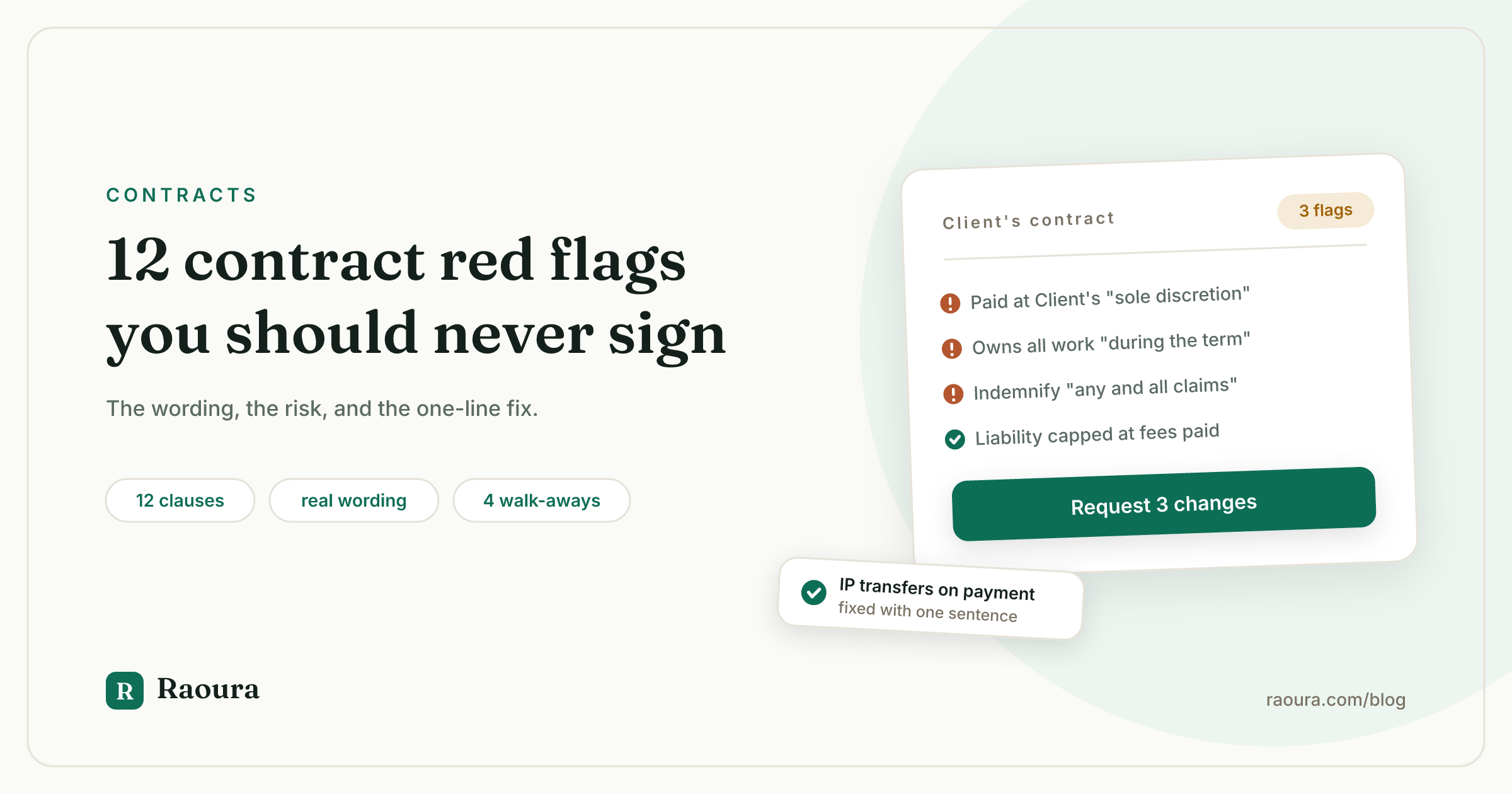
A bad clause never looks dangerous when you sign it. It looks like boilerplate. "Payment upon satisfactory completion." "Contractor assigns all intellectual property created during the term." "Contractor shall indemnify Client against all claims." You skim it at 11pm because the client is excited and the deposit is real money, and six weeks later you learn what "satisfactory" means to a person who has decided not to pay.
This guide is the read-before-you-sign checklist: 12 clauses, the exact wording that gives each one away, what it costs you in practice, and the fix you can ask for in one or two sentences. The examples are not hypothetical. Where a clause has been publicly documented by the Authors Guild, the Columbia Journalism Review, or working media lawyers, you will see the real language.
One observation of our own before we start. We pulled the five pages ranking for "freelance contract red flags" in July 2026: four of the five are marketing funnels for contract-review products, none of them names a single state statute, and the top result miscites the Copyright Office circular it leans on (it says Circular 9; the work-for-hire circular is Circular 30). Read the actual sources. They are linked throughout.
This article is general information, not legal advice. For a full walkthrough of what a healthy contract contains, start with our clause-by-clause freelance contract guide.
The 30-second scan#
Four of the 12 red flags below (discretionary payment, term-wide IP grabs, noncompetes, and naked indemnity) are walk-away clauses unless rewritten; the other 8 are fixable with one or two sentences.
| # | Red flag | The wording that gives it away | Severity | Your move |
|---|---|---|---|---|
| 1 | Payment at client discretion | "as determined by Client in its sole discretion" | Walk unless rewritten | Tie payment to delivery dates, not approval feelings |
| 2 | Vague payment timing | "within a reasonable time," Net 60, Net 90 | Negotiate | Due on receipt or Net 14, plus a late fee clause |
| 3 | IP transfers before money | Ownership passes "upon delivery" | Negotiate | "IP transfers upon receipt of final payment" |
| 4 | Term-wide IP grab | Assigns all IP "created during the term of this Agreement" | Walk unless rewritten | Limit to deliverables created for this project |
| 5 | All-rights work for hire | "Work made for hire" plus a catch-all assignment | Negotiate | License, or reversion of rights after a set period |
| 6 | Noncompete or exclusivity | "Shall not provide similar services to any competitor" | Walk unless rewritten | Delete, or narrow to named clients and a short window |
| 7 | Naked indemnification | "Indemnify Client against any and all claims" | Walk unless rewritten | Limit to your breach, exclude their edits |
| 8 | No liability cap | Silence, or "liable for all damages arising from" | Negotiate | Cap liability at fees paid under the agreement |
| 9 | Undefined scope and revisions | "Revisions as needed until Client is satisfied" | Negotiate | Numbered deliverables, 2 rounds, change orders after |
| 10 | One-sided exit | Client may terminate "at any time without further obligation" | Negotiate | Kill fee plus payment for work completed |
| 11 | Portfolio and credit ban | "Shall not disclose the existence of this engagement" | Negotiate | Portfolio carve-out after launch |
| 12 | Their court, your cost | Venue in their state, one-way attorney fees | Negotiate | Mutual attorney fees, neutral or your venue |
Now each one, with the reasoning and the fix.
The money red flags (1 to 3)#
The two most reported client red flags in Skynova's survey of 615 freelancers are being asked to work for free (52%) and not being paid on time (51%), and the three clauses in this group are exactly how those outcomes get written into paper you agreed to.
1. Payment at the client's sole discretion#
The wording: "Client shall pay Contractor upon satisfactory completion of the deliverables, as determined by Client in its sole discretion."
Read that as a lawyer would: payment is optional. "Satisfactory" has no definition, "sole discretion" means their opinion cannot be challenged, and together they convert your invoice into a request. A client who is happy pays the same under a fair clause. A client who hits a budget crunch in week six now has a contractual escape hatch you signed for them.
The fix: payment triggers on delivery, not on approval feelings. "Payment for each milestone is due within 14 days of delivery of the milestone's listed deliverables." If the client wants an acceptance step, bound it: "Deliverables are deemed accepted unless Client provides specific written objections within 7 business days of delivery." That single deemed-acceptance sentence is the difference between a defined review window and an indefinite one.
2. Vague or glacial payment timing#
The wording: "within a reasonable time," "upon final funding," Net 60, Net 90, or simply no payment date at all.
"Reasonable" is not a date, and Net 90 is you making your client a three-month interest-free loan. The scale of the problem is well documented: the Freelancers Union's Costs of Nonpayment survey found the average unpaid freelancer loses almost $6,000 a year, about 13% of income, and 71% of freelancers have struggled to collect at least once.
Also worth knowing: a missing payment date now has legal consequences for the client in several states. Under Illinois' Freelance Worker Protection Act and California's SB 988, if the contract names no date, payment is due within 30 days of completion by statute.
The fix: a real due date (due on receipt or Net 14), a deposit before work starts, and a late fee clause. We cover the norms in detail in our guides to payment terms that get you paid in days and late fees that are legal and effective.
3. Your work transfers before your money arrives#
The wording: "All right, title, and interest in the deliverables shall pass to Client upon delivery."
Upon delivery, not upon payment. Sign this and the moment you hit send, the client owns the work and owes you a debt, which is a much weaker position than owning the work and being owed a debt. Ownership is the only leverage you hold once the work is done; this clause hands it over first.
The fix is one sentence: "All intellectual property in the deliverables transfers to Client upon Contractor's receipt of final payment in full." Pair it with a deposit (here is how much to charge) and milestone billing so no single unpaid invoice ever represents the whole project.
The ownership red flags (4 to 6)#
US copyright law recognizes only 9 categories of specially commissioned work that can qualify as a work made for hire, and most freelance work (logos, websites, code, photography, general articles) fits none of them. That number, from the Copyright Office's Circular 30, is the key to this whole section.
4. The term-wide IP grab#
The wording: "Contractor hereby assigns to Client all right, title, and interest in any and all work product, inventions, ideas, and intellectual property created during the term of this Agreement."
Read the scope: not "created for Client," but "created during the term." Taken literally, this captures work you do for other clients and your own side projects for as long as the agreement runs, and retainer agreements can run for years. This is employee-grade language pasted into a contractor agreement, and it is a walk-away unless rewritten.
The fix: "Contractor assigns to Client all intellectual property in the deliverables created specifically for Client under this Agreement." Then protect your toolkit with a background IP sentence: "Contractor retains all pre-existing materials, templates, frameworks, and general know-how, and grants Client a perpetual license to any that are embedded in the deliverables."
5. All-rights work for hire, forever#
The wording: "The deliverables shall constitute a work made for hire, and Contractor waives all rights, including moral rights, in perpetuity, in all media now known or hereafter devised."
Two things here.
- The legal irony: for an independent contractor, work-for-hire status only sticks if the work falls into one of the nine statutory categories and the contract says so in writing. Fail either test and, per Circular 30, "it is not a work made for hire," which is why these contracts always carry a backup assignment clause.
- The practical cost: all-rights language means no future for the work. AHCJ, the health journalism association, documents what this does to writers: if a book, script, or podcast opportunity later grows out of the story, the publication owns it, not the writer. The CJR review of freelance media contracts found work-for-hire terms so broad that writers could not post their own published story on their own website without permission.
The fix depends on your field. Writers: sell first publication rights or a time-limited exclusive, not all rights. If the client insists on ownership, ask for a reversion clause returning rights to you after a set period, a fix AHCJ documents working in practice. Designers and developers: assignment on full payment is normal for the deliverable itself; the thing to protect is your background IP (see flag 4) and your portfolio rights (see flag 11).
6. The noncompete, 2026 edition#
The wording: "Contractor shall not provide similar services to any competitor of Client for a period of two (2) years following termination."
For a freelancer, "similar services to competitors" is not a restriction, it is your entire business model. A designer who cannot work for anyone in the client's industry for two years has handed over their niche for the price of one project.
The legal landscape moved a lot recently, and none of the pages ranking for this keyword has caught up. The FTC's national noncompete ban, issued April 2024, was set aside by a federal court in August 2024; in September 2025 the FTC formally dropped its appeals and acceded to the vacatur, and the rule came off the books in February 2026. There is no federal ban. What you have instead is state law: California, Minnesota, North Dakota, and Oklahoma void nearly all noncompetes (Minnesota's statute explicitly covers independent contractors), and everywhere else enforceability is a case-by-case fight you do not want to fund.
And the overreach is not hypothetical. The Authors Guild quotes standard publishing language barring authors from publishing anything "likely to compete with the Work," and documents a publisher blocking a novelist from releasing any fiction until six months after publication.
The fix: ask for deletion first; many clients drop it without argument because it was template filler. If they hold firm, narrow it to something survivable: a non-solicit of the client's named customers for 6 to 12 months, which protects their actual concern without confiscating your market.
The liability red flags (7 and 8)#
A fair liability cap is 1x the fees paid under the contract; without one, a $1,000 project can carry $1,000,000 of exposure, a mismatch of 1,000 to 1 that IP lawyers flag as exactly backwards.
7. Naked indemnification#
The wording: "Contractor shall indemnify, defend, and hold harmless Client from any and all claims, damages, and expenses, including attorney's fees, arising out of or related to the services."
Indemnification means you pay their legal bills. "Any and all claims arising out of the services" means you pay them even when the claim is caused by something the client did: their edits, their marketing promises, their decision to publish. Charles Glasser, formerly global media counsel for Bloomberg News, is blunt about this clause: a naked indemnity covering any legal costs and claims is "toxic," and his advice is to never agree to one.
The fix, per Glasser's own acceptable version: indemnify only for claims arising from your actual breach (plagiarism, infringement in materials you supplied, factual claims you fabricated), only for the work as you submitted it, and never for changes made after it left your hands. Ask for it to be mutual while you are at it: they indemnify you for materials they supplied.
8. No liability cap#
The wording: usually silence. The contract details everything you owe them and says nothing about the ceiling.
Without a cap, your downside on a project is unbounded while your upside is the fee. IP attorney David Lizerbram's framing in CJR is the one to remember: "If you're getting $1,000 for the story, you shouldn't have $1 million of liability."
The fix: "Each party's total liability under this Agreement is limited to the fees paid or payable to Contractor hereunder, and neither party is liable for indirect or consequential damages." Clients with real legal departments see this clause every day and rarely fight a 1x cap from a solo contractor.
The control and exit red flags (9 to 12)#
52% of projects experience scope creep per PMI's Pulse of the Profession, and the four clauses in this group decide whether that creep is billable work or free work.
9. Undefined scope and unlimited revisions#
The wording: "Contractor will perform revisions as needed until Client is satisfied with the deliverables."
"As needed" plus "satisfied" is an infinite loop with your hours inside it, and it interacts viciously with flag 1: an undefined satisfaction standard controlling both the work and the payment. PMI's 52% figure is for managed corporate projects with professional project managers; freelancer surveys routinely report worse.
The fix: an itemized deliverables list with exclusions, a numbered revision limit (two rounds is the working norm), and a rate for everything beyond it. Our scope creep scripts give you the words for the conversation, and change orders give you the paper trail that turns "one quick change" into a signed, billable addition.
10. The one-sided exit#
The wording: "Client may terminate this Agreement at any time, for any reason, without further obligation to Contractor." Meanwhile your termination rights require 30 days notice, or do not exist.
"Without further obligation" means a client can cancel in week three of a four-week project and owe you nothing for weeks one through three. Termination clauses are not inherently red flags; asymmetric ones are.
The fix: "Either party may terminate with 7 days written notice. Upon termination, Client shall pay for all work completed and expenses incurred through the termination date." On larger projects, add a kill fee (a percentage of the remaining contract value) to compensate for the calendar you reserved. If the client has already gone quiet instead of formally cancelling, that is a different playbook: here is the ghosted-after-delivery recovery plan.
11. The portfolio and credit ban#
The wording: "Contractor shall not disclose the existence or terms of this engagement" with no carve-outs, sometimes paired with a byline or credit prohibition.
Confidentiality about terms and internal information is reasonable. A blanket ban on ever saying the work exists deletes the marketing value of every project you complete, and for a freelancer the portfolio is the pipeline. Signed silently, this clause means your best work recruits no one.
The fix: "Following public launch, Contractor may display the deliverables in Contractor's portfolio and identify Client by name, excluding Client's confidential information." If the client needs secrecy (agencies with white-label arrangements, sensitive industries), price that in: anonymous case studies, or a higher rate for ghost work.
12. Their court, your cost#
The wording: "This Agreement is governed by the laws of Delaware, and all disputes shall be resolved exclusively in the courts of New Castle County. Client shall be entitled to recover its attorney's fees in any action to enforce this Agreement."
Two tricks in one clause:
- Venue in the client's home state means enforcing a $4,000 invoice requires flying to their courthouse, which they know you will not do.
- The attorney fee clause is one-way: they recover legal fees if they win, you do not.
One-way fee shifting plus distant venue equals a contract that is, in practice, unenforceable by you.
The fix: mutual attorney's fees ("the prevailing party shall recover reasonable attorney's fees") and either your venue, a neutral one, or binding arbitration you can attend remotely. If the relationship does go wrong, the escalation path from reminder to demand letter to small claims is laid out in our unpaid invoice escalation ladder.
Red flags in the process, not the paper#
Even the clients agree paper matters: in Skynova's employer-side data, 42% of clients say a freelancer refusing to sign a contract is a red flag, so treat a client who resists a contract as self-reporting.
Some warnings never appear in a clause:
- The client who will not sign anything. "We do things on a handshake here" translates to "you will have no evidence later." Notably, this is now illegal above small thresholds in three states (next section).
- The client who pressures you to sign today. Contracts do not expire overnight. Urgency is applied precisely so you will not read flags 1 through 12.
- The verbal promise that never makes it into the draft. "Obviously we'd never enforce the noncompete" is legally worth nothing beside a signed clause that says they can. If it is true, they can put it in writing.
- The redline refusal. A client who treats any negotiation as an insult is showing you the collaboration style you are about to marry for the length of the project. In the Skynova data, more than 1 in 5 freelancers flagged clients who argue over every invoice item; the contract negotiation is your free preview of that behavior.
The legal floor: three states now require written contracts#
If your client is in New York, Illinois, or California, a written freelance contract is required by law above $800, $500, and $250 respectively.
This is the newest reason a contract-shy client has run out of excuses. New York's Freelance Isn't Free Act (statewide since August 2024, $800 threshold in any 120-day period) carries double damages plus attorney's fees for nonpayment. Illinois' Freelance Worker Protection Act sets the bar at $500 over 120 days with double damages. California's SB 988 applies at just $250, aggregated over 120 days.
All three also default payment to within 30 days of completion when the contract is silent, which quietly neutralizes flag 2 for covered work. The full state-by-state picture, including the municipal ordinances, is in our freelance payment laws guide.
How to push back without losing the deal#
Freelancers who work under written contracts report 13.7% higher income than those without, per a peer-reviewed ILR Review study of Freelancers Union survey data, so the goal is never "no contract," it is "not this contract."
Three moves, in order of preference:
- Send your paper first. The cheapest negotiation is the one that never happens because your contract was already on the table when they went looking for theirs. Your template has none of the 12 flags, because you built it that way (start from the clause-by-clause guide).
- Redline, do not reject. When the client's contract arrives first, mark the specific clauses and propose the specific fixes above. "I can sign this today with three small changes" closes faster than a philosophical objection to indemnification. Most of these clauses came from a template the client has never read; you are usually negotiating with a PDF, not a person.
- Know your walk-aways in advance. Flags 1, 4, 6, and 7 as written, plus a client who refuses any redline at all. The ILR Review study carries the honest caveat here: even with a contract, 38.8% of freelancers still had payment trouble. Paper filters bad clients; it does not fully replace judgment about who you work with.
The operational piece matters too. If sending a clean contract takes you 20 minutes of copy-paste and a signature app you pay for separately, you will skip it on small projects, and small projects are where handshake deals go to die. This is the workflow Raoura was built around: proposal, contract, and e-signature in one flow, a deposit invoice that fires on signature, and milestone payments that keep ownership and money moving in step, for $17/mo flat. Disclosure: Raoura is our product.

What sending your paper first looks like from the client's side: your contract, one typed name, one click, and no separate signature app for anyone to pay for.
Verified July 2026. Primary sources: US Copyright Office Circular 30 (rev. 08/2024); FTC press release of September 5, 2025 on vacatur of the Non-Compete Clause Rule; NYC DCWP Freelance Isn't Free guidance; Illinois DOL FWPA FAQ; California SB 988; PMI Pulse of the Profession (2018 scope creep data); Rodgers, Horowitz and Wuolo, ILR Review 67 (2014); Freelancers Union Costs of Nonpayment survey (2015); Skynova freelancer red flags survey (615 freelancers, 405 employers); AHCJ and CJR contract reporting; Authors Guild "Delete the Non-Compete." This article is general information, not legal advice.
Frequently asked questions
Is it rude to redline a client's contract?
No, it is expected. Businesses redline each other's paper constantly; a clean signature on a first draft is the unusual event. Propose specific replacement wording rather than objections, keep it to the clauses that matter, and you will read as professional, not difficult.
Are noncompetes in freelance contracts enforceable in 2026?
There is no federal ban: the FTC's rule was vacated and formally removed in February 2026. California, Minnesota, North Dakota, and Oklahoma void nearly all noncompetes, and Minnesota's ban explicitly covers independent contractors. Everywhere else it depends on reasonableness of scope, geography, and duration, which means an expensive argument. Negotiate it out rather than betting on unenforceability.
What is the difference between work for hire and an assignment clause?
Work for hire means the client is the author from the moment of creation, but for contractors it only applies to nine narrow categories of commissioned works under US copyright law. An assignment transfers copyright from you to the client by contract, which works for any kind of work. Most freelance contracts use both belt-and-suspenders; your lever is timing the assignment to final payment.
Do these red flags matter on a $500 project?
The dollar exposure is smaller but the clauses read the same, and an indemnification clause does not know your project was small. For small work, scan for the big four (flags 1, 4, 6, 7), confirm a payment date exists, and confirm IP transfers on payment. That is a 5-minute read.
Should I pay a lawyer to review every contract?
Not every contract, but yes for anything unusually large, anything with indemnification you cannot get rewritten, and any agency or platform master agreement you will work under repeatedly. One review of a repeat-use contract is cheap insurance amortized over every project it covers.
What if the client says the contract is "standard" and cannot be changed?
"Standard" describes where the template came from, not what you must accept. Genuinely unchangeable contracts exist (large platforms, procurement systems), and for those the question becomes whether the work is worth the terms as written. For everyone else, "our legal team requires these three changes" works in both directions.
---
Run your client work in one place
Send a proposal, get it signed, invoice, and get paid, with a branded portal your clients will actually use. One flat plan at $17/month, and we never take a cut of your payments.
Try Raoura free for 14 daysNo credit card required. Set up in minutes.
Keep reading
The Virtual Assistant Contract: 24 Clauses, Scored Against Every Template Ranking for This Search
We scored the four pages that publish actual virtual assistant contract text against 24 clauses a VA agreement needs. Twenty-four of 96 possible slots were filled. The best single template managed 7 out of 24. Twelve clauses appear in none of them, including every clause about the thing that makes VA work different from other freelance work: you are holding your client's passwords and running their inbox. One popular template also tells you a contract fixes your independent contractor status, then mandates client-set 9 to 5 weekday hours in the same document. Here is the clause-by-clause version, with the classification test the DOL is actually applying in 2026, the data protection terms nobody drafts, and the retainer mechanics that decide whether unused hours roll over.
Stripe vs PayPal for Freelancers: Every Fee Verified (2026)
Every page ranking for this comparison either prints in-person retail rates, contradicts itself, or skips the numbers freelancers actually pay. We read the current Stripe and PayPal pricing pages line by line, ran a $3,000 invoice through every rail, and found a $1,764 per year gap between the cheapest setup and the default one.
The Pause Clause: How to Stop Work When an Invoice Goes Overdue
Stopping work is the strongest move a freelancer has against a late-paying client, and the least understood. Here is the legal doctrine that lets you pause even without a clause, the exact clause to add so you never have to rely on doctrine again, the day-by-day timing, and the two emails that keep the pause professional. Verified against primary sources in July 2026.