Rate Increase Email Scripts for 5 Scenarios (Copy, Paste, Send)
July 12, 2026
Search for a rate increase email template and the top result hands you a letter from a fictional paper wholesaler announcing a 3% increase on office supplies. We fetched the six pages that rank for this keyword in July 2026 and counted: 17 templates between them, and only two of the six pages are written in a solo freelancer's first person. The strongest page on the SERP is built for HVAC and lawn care companies. Not one page covers repricing a retainer, and not one scripts the email you actually dread, which is the reply after a client says "that is not in our budget."
That gap matters because the hard part of raising rates is not the announcement. It is picking the number, picking the notice period, and knowing in advance what you will say to the one client who negotiates. Get those three decisions made and the email takes four sentences.
This article makes the three decisions with you, then gives you five scripts for the five situations freelancers actually face. Once the new rate is accepted, it needs to show up in your paperwork: your proposal, your contract, and your payment terms all quote a rate, and they should all quote the same one.
How much to raise, and how much notice to give#
For a routine annual increase, raise 5 to 10 percent and give 30 to 60 days of notice; save corrections of 20 percent or more for legacy clients paying an old rate, and give those clients 60 to 90 days, phased in two steps if the gap is large.
The inflation anchor for 2026: the Consumer Price Index rose 3.8 percent over the 12 months ending April 2026, per the Bureau of Labor Statistics. A raise below 3.8 percent is not a raise, it is a slow pay cut.
That is why the small-increase advice in generic guides skews upward now: Jobber's price increase guide puts inflation-driven increases in the 3 to 10 percent band and general notice at one to three months, with 30 to 60 days for ongoing contracts. Millo's guide sets the floor at 30 days of notice. Nobody credible recommends less.
You are also not the outlier you feel like. In Jobber's 2026 Home Service Trends survey of over 1,000 service business owners, 65 percent raised prices in the past year, and among the most established, fully booked businesses, 91 percent did.
Those are service businesses rather than freelancers, but the pattern is the useful part: the busier and more established the business, the more routinely it raises prices. Raising rates is what healthy demand looks like, not a betrayal of your clients.
Here is the decision table for all five scenarios. The raise sizes are our recommendations from the verified ranges above plus the correction math explained under each script.
| Scenario | Typical raise | Notice | Script |
|---|---|---|---|
| Routine annual increase, healthy client | 5 to 10% | 30 to 60 days | 1 |
| Underpriced legacy client | 20 to 50%, phased if over 30% | 60 to 90 days | 2 |
| Retainer that outgrew its scope | Reprice to actual scope, often 15 to 30% | Next billing cycle, 30+ days out | 3 |
| Returning client after a gap | Current standard rate, no bridge | None: the new quote is the notice | 4 |
| Client pushes back on the increase | Hold the rate, flex the scope | Not applicable | 5 |
One planning note before the scripts: raise on your schedule, not in a panic. The worst time to send this email is the month a project falls through, because desperation leaks into wording. Pick an annual date (January and September are the common ones, budget season for your clients) and put it on your calendar now.
Three rules that make every rate email work#
A rate increase email needs exactly three facts (the new rate, the date it starts, and what happens to work already in progress) and it should deliver them in under 150 words.
First, state, do not justify. One grounding sentence is fine ("my rates are changing for 2027"). Three paragraphs about your costs, your growth, and your journey read as an invitation to debate each point. You do not ask permission to set your prices, and the email should not sound like you are.
Second, never apologize. "I'm sorry to do this" and "I hope this is okay" tell the client the number is negotiable and that guilt is the lever. The warm version of confidence is gratitude: thank them for the work, then state the change.
Third, give every increase an effective date and honor in-flight work. Anything already scoped and signed finishes at the old rate. Anything new after the effective date is at the new rate. This single line kills 90 percent of potential objections, because the client's real fear is usually the invoice for the project you are in the middle of, not the next one.
The five scripts#
Every script below is under 140 words, states the new rate and effective date in the first two sentences of the body, and closes without an apology. Swap the bracketed details and keep the length.
1. The routine annual increase#
For the healthy, ongoing client getting your standard yearly adjustment.
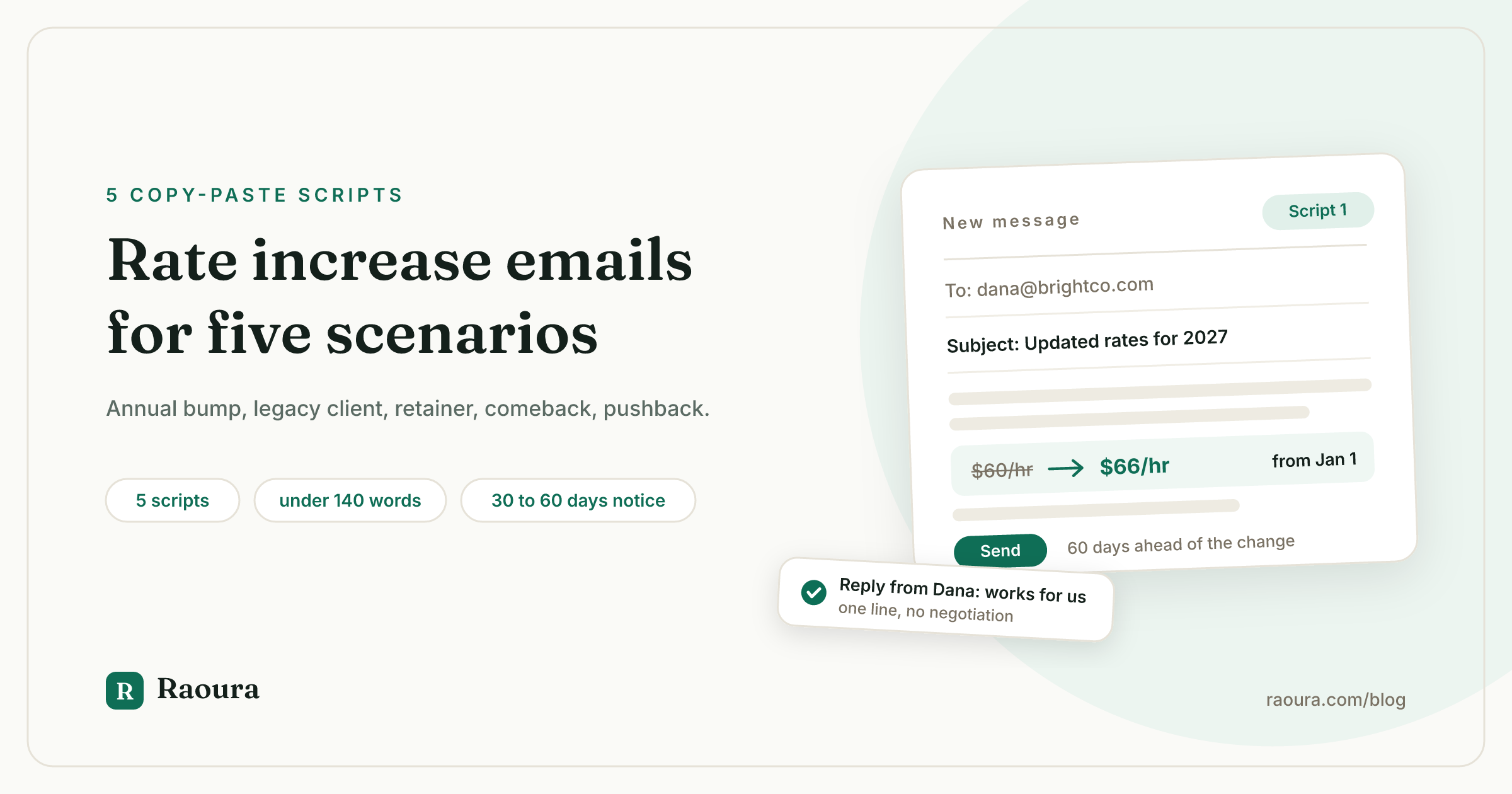
Subject: Updated rates for 2027
Hi Dana,
A quick business note: starting January 1, my hourly rate moves from $60 to $66. Anything we have already scoped stays at the current rate through completion, so nothing changes on the homepage project.
Working with you this year has been a highlight, and the goal is to keep that going: this adjustment keeps my rates in line with costs and lets me keep the schedule room your projects need.
No action needed on your side. I will send an updated agreement in December so the paperwork matches. Any questions, just ask.
Thanks!
Sam
The math on this one: $60 to $66 is a 10 percent increase, the top of the routine band. Sent November 1 for a January 1 effective date, it carries 60 days of notice, which is more generous than the 30-day floor and lands inside the client's budgeting window for next year. The "no action needed" line matters: it frames the email as an announcement, not a negotiation. Most replies to this script are one line long.
2. The underpriced legacy client#
For the client who has been paying your 2023 rate while every new client pays 40 percent more. The correction is too big for one jump, so you phase it and say so.
Subject: Rate adjustment starting September 1
Hi Dana,
You have been one of my longest-running clients, and I have kept your rate at $50 while my standard rate has moved to $75. I cannot hold that gap open any longer, but I also do not want to hand you one big jump.
So here is the plan: from September 1, your rate moves to $65. From March 1, it aligns with my standard $75. Everything currently in progress finishes at $50.
That is six months of below-market rates as a thank you for the years of steady work. I would love to keep building on them.
Best,
Sam
Check the math before you copy it: $50 to $65 is a 30 percent step, $65 to $75 is another 15 percent, and the full correction is 50 percent over six months. Naming your standard rate does the persuasive work here, because the client is not being asked to pay a premium, they are being asked to stop receiving a discount they never knew they had. The phase-in is the goodwill gesture, so resist adding another one on top of it.
3. The retainer that outgrew its price#
For the monthly retainer where the scope quietly doubled. This is a reprice, not a raise, and the email should say what the retainer now includes. If the scope has been creeping for months, pair this script with the scope creep scripts so it never gets this far again.
Subject: Updating the retainer for what it actually covers
Hi Dana,
When we set the retainer at $1,500 a month, it covered two posts and one campaign review. Over the past few months it has grown to four posts, the campaign work, and the weekly analytics call, and I have been glad to grow with you.
To match the actual scope, the retainer moves to $1,800 a month starting with the October cycle. That covers everything we are currently doing, listed here: [link to one-page scope].
If you would rather trim the scope back to the original two posts and review, the current $1,500 works fine. Happy to do either, just tell me which by September 15.
Thanks,
Sam
The numbers: $1,500 to $1,800 is a 20 percent increase, announced a full billing cycle ahead. The two-option close is the engine of this script. It converts "pay more" into "pick the version you want," which is a choice the client can say yes to either way. Notably, only 16 percent of businesses use tiered pricing consistently, per Jobber, which is exactly why offering two clean tiers reads as refreshingly reasonable instead of pushy.
4. The returning client who expects old pricing#
For the client who disappears for a year and comes back asking to "pick up where we left off." There is no notice period to give, because there is no ongoing engagement. The new quote is the notice.
Subject: Great to hear from you + current rates
Hi Dana,
Great to hear from you, and yes, I would be glad to take this on.
One update since we last worked together: my project rates have changed, so this piece would be $1,200 rather than the $900 from last time. Same process you remember, two revision rounds included, and I can start the week of the 14th.
If that works, I will send over the proposal and we can lock in the start date.
Best,
Sam
That is a 33 percent difference stated in one sentence, with zero drama. The mistake freelancers make here is offering the old rate "one last time" out of reflex. Do not. A returning client is proof your work was worth coming back for, which is the strongest negotiating position you will ever hold. Put the number in a real proposal the same day, while the enthusiasm is fresh.
5. The pushback reply#
For the client who answers script 1 or 2 with "we cannot fit that in our budget." You hold the rate and flex the scope, which keeps the conversation collaborative without discounting your work.
Subject: Re: Updated rates for 2027
Hi Dana,
Completely understand, budgets are real. The new rate is firm because it reflects what the work costs to do well, but there is flexibility in how we use it.
Two options that keep us inside your number: we scope the monthly work to eight hours instead of ten, and I will flag anything that will not fit, or we shift the blog posts to a quarterly batch, which trims my setup time and your spend.
If neither works for this year's budget, I would genuinely rather know now so we can plan a clean handoff. But my strong preference is to find the version that works.
What do you think?
Sam
The structure is rate firm, scope flexible, exit named. Naming the handoff option is not a bluff, it is what makes the two real options credible. If the client takes the exit, the rate increase did its job anyway: it freed capacity for work at your current rate, in a market where 58 percent of freelancers name project acquisition as their top challenge (Freelancermap's 2025 study), which is a reminder to have your pipeline warm before you send corrections like script 2 to your biggest client.
After you hit send#
Expect the anticlimax: most rate increase emails get a one-line acceptance or no reply at all, and if 7 days pass in silence you proceed as announced, because the effective date does the deciding, not the reply. You do not need a signed acknowledgment of the email itself, you need the next agreement to carry the new number.
So the real follow-through is paperwork hygiene. The new rate goes into your contract or an updated agreement before the effective date, onto your rate sheet, and into your invoicing tool so the first invoice at the new rate is boring and correct. A rate increase that appears for the first time as a surprise line item is how you turn a yes into a dispute, and if that dispute goes unpaid you are suddenly reading payment reminder templates for a fight you created.
This is the unglamorous part Raoura was built for: you change your rate once in settings, and every new proposal, contract, and invoice quotes the new number from the effective date, while in-flight projects keep their agreed pricing. Disclosure: Raoura is our product, it is $17 a month flat, and the advice above works the same if you manage this in a spreadsheet.

Paperwork hygiene without the paperwork: new proposals in Raoura quote the updated rate from the effective date, while in-flight projects keep their agreed pricing.
One more habit worth stealing from the data: put your next rate review on the calendar for 12 months out, the same week you send this year's emails. The freelancers who dread this email are almost always the ones who waited three years and now need script 2. The ones who send script 1 every year barely think about it.
Frequently asked questions
Can I raise rates in the middle of a contract?
Not if the contract states a fixed rate or fixed project price: you honor it through the end of the term, then raise at renewal. If you are on an open-ended arrangement with no written term, you can raise with proper notice (30 days minimum, 60 is kinder). This is one of the quiet arguments for putting a term and renewal date in every agreement, which is covered in our freelance contract template.
How often should a freelancer raise rates?
Review once a year, raise when the review says so. With CPI up 3.8 percent in the 12 months ending April 2026, a flat rate two years running is roughly an 8 percent real pay cut. Annual small increases also train clients to expect them, which makes every future email easier.
How much notice is standard for a rate increase?
Do I need to give a reason for the increase?
One sentence of grounding, yes. A defense brief, no. "My rates are changing to reflect current costs and demand" is a complete reason. Every additional justification is a new surface for the client to negotiate against.
Should I tell clients by email or by phone?
Email, always, because you want the rate and effective date in writing. For your one or two largest clients, a heads-up call first is a classy touch, followed by the same email "to put it in writing." Never let the phone call be the only record.
What if the client just says no?
Send script 5. If they decline both scope options, finish in-flight work at the agreed rate, part warmly, and treat the freed hours as sales capacity. A client who only stays at a rate you resent is not retention, it is slow attrition of your business.
---
Rates, statistics, and sources verified July 2026. CPI figure is the BLS 12-month change through April 2026; check bls.gov for the latest release before citing.
Run your client work in one place
Send a proposal, get it signed, invoice, and get paid, with a branded portal your clients will actually use. One flat plan at $17/month, and we never take a cut of your payments.
Try Raoura free for 14 daysNo credit card required. Set up in minutes.
Keep reading
Is Upwork Worth It in 2026? A Break-Even Test for Your Situation
Upwork is worth it when its fee costs less than finding the client yourself, and that is true far more often for a first project than for a repeat client. Here is the break-even math with 2026 numbers: the 0 to 15% fee, Connects, the shrinking client base, and when to wait out the 24-month rule instead of paying to leave.
The Virtual Assistant Contract: 24 Clauses, Scored Against Every Template Ranking for This Search
We scored the four pages that publish actual virtual assistant contract text against 24 clauses a VA agreement needs. Twenty-four of 96 possible slots were filled. The best single template managed 7 out of 24. Twelve clauses appear in none of them, including every clause about the thing that makes VA work different from other freelance work: you are holding your client's passwords and running their inbox. One popular template also tells you a contract fixes your independent contractor status, then mandates client-set 9 to 5 weekday hours in the same document. Here is the clause-by-clause version, with the classification test the DOL is actually applying in 2026, the data protection terms nobody drafts, and the retainer mechanics that decide whether unused hours roll over.
Stripe vs PayPal for Freelancers: Every Fee Verified (2026)
Every page ranking for this comparison either prints in-person retail rates, contradicts itself, or skips the numbers freelancers actually pay. We read the current Stripe and PayPal pricing pages line by line, ran a $3,000 invoice through every rail, and found a $1,764 per year gap between the cheapest setup and the default one.