The Freelance Proposal That Wins (Structure + Benchmarks)
August 30, 2026
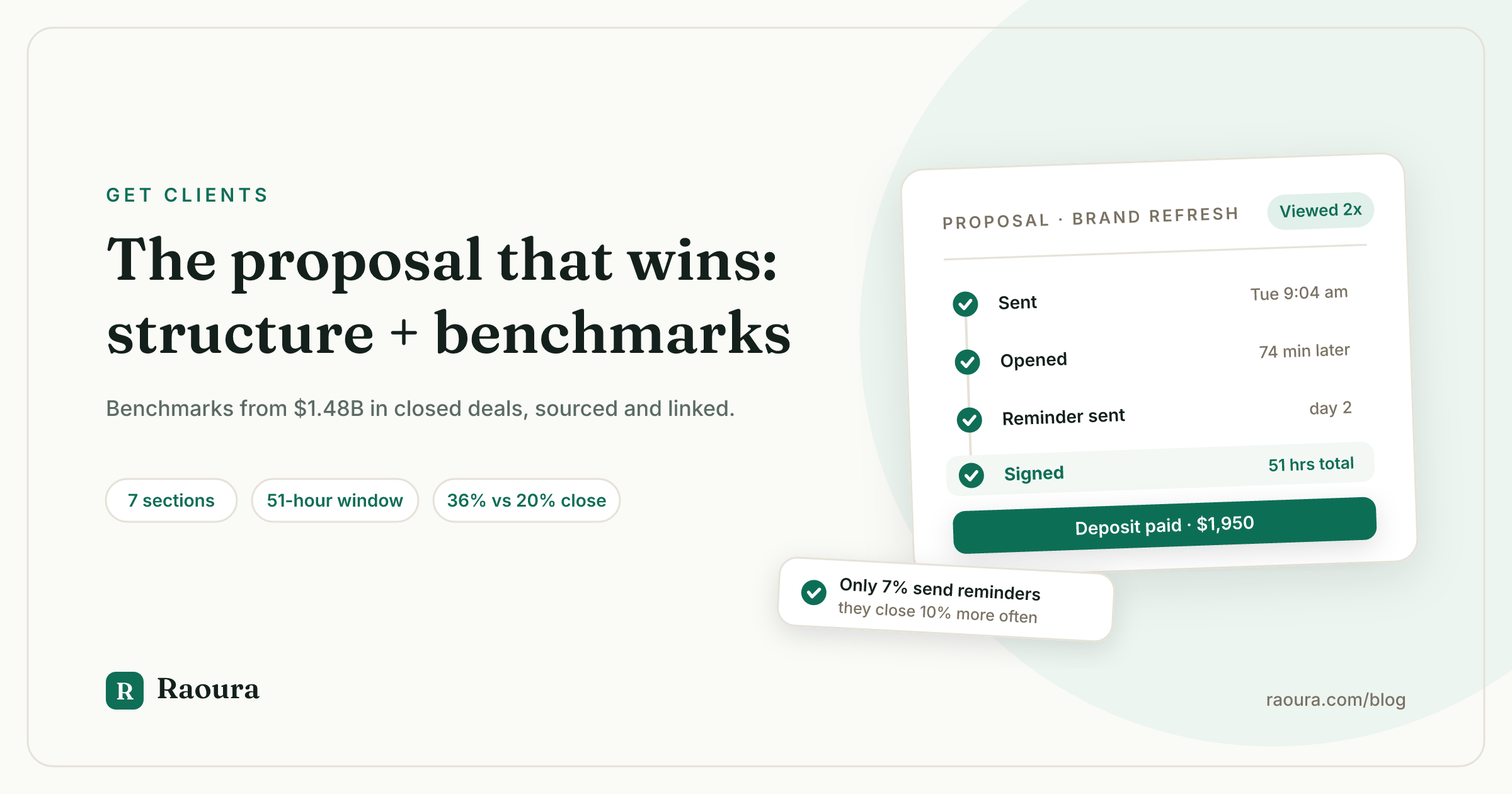
Almost everything written about freelance proposals is opinion: make it professional, show your value, keep it concise. Opinion is cheap.
What is rare is data, and proposal data exists, because two proposal software companies have published benchmarks from hundreds of thousands of real proposals. Proposify's benchmark research and its State of Proposals 2024, plus Better Proposals' report analyzing $1.48 billion in closed deals, tell you how long a winning proposal is, how fast clients decide, and which behaviors move close rates. This guide is built on those numbers, with every one linked to its source.
One note before you start: this is the structure-and-benchmarks guide. If you want the full copy-paste document with section-by-section wording, that lives in our freelance proposal template, which also covers the pricing psychology (anchoring, three tiers, decoys) in depth.
What the ranking advice gets wrong#
We fetched the top-ranking pages for "how to write a freelance proposal" in July 2026 and counted the cited win-rate benchmarks across all of them: zero. That is our own observation from this month's audit, and it is the gap this article fills.
The two strongest ranking pages illustrate it. PandaDoc's guide walks through an 11-step structure with sample copy, but its only number is an unsourced claim that its own product lifts close rates 18%, and it says nothing about following up. Freelancermap's guide offers a checklist and a free template, but its follow-up advice is one vague bullet with no timing, and its pricing guidance amounts to "include a price."
So the standard advice tells you what a proposal contains. It does not tell you that half of clients open the proposal within 74 minutes, that the median winning proposal closes in 51.4 hours, or that the single highest-leverage behavior (a reminder) is used by only 7% of senders. Those numbers change how you write, when you send, and what you do afterward.
The benchmarks: what a winning proposal looks like in numbers#
The average winning proposal has 7 sections across 11 pages, and proposals sent through tracked proposal software close at 36% versus a 20% industry average, per Proposify's State of Proposals 2024.
Here is the full benchmark table. Every row links to the primary source that published it.
| Benchmark | Number | Source |
|---|---|---|
| Sections in the average winning proposal | 7 | [Proposify](https://www.proposify.com/blog/proposal-best-practices) |
| Pages, won versus lost proposals | 11 vs 13 | [Proposify SOP 2024](https://www.proposify.com/state-of-proposals-2024) |
| Best-converting section count | 6 to 7 | [Better Proposals](https://betterproposals.io/reports/2022/) |
| Proposals opened within 74 minutes of sending | 50% | [Proposify](https://www.proposify.com/blog/proposal-best-practices) |
| Median time to close after sending | 51.4 hours | [Proposify](https://www.proposify.com/blog/proposal-best-practices) |
| Closed-won deals signed within 24 hours of opening | 42.5% | [Proposify](https://www.proposify.com/blog/proposal-best-practices) |
| Close rate, tracked software vs industry average | 36% vs 20% | [Proposify SOP 2024](https://www.proposify.com/state-of-proposals-2024) |
| Close-rate lift when 30% of the executive summary is customized | +50% | [Proposify SOP 2024](https://www.proposify.com/state-of-proposals-2024) |
| Conversion lift from sending within 24 hours of the meeting | +42% | [Better Proposals](https://betterproposals.io/reports/2022/) |
| Close-rate lift from automated reminders (used by only 7%) | +10% | [Proposify SOP 2024](https://www.proposify.com/state-of-proposals-2024) |
| Proposals opened on mobile | 58% | [Better Proposals](https://betterproposals.io/reports/2022/) |
Two patterns run through that table. Shorter wins: losing proposals average two pages more than winning ones. And speed wins: the decision happens in roughly two days, so a proposal you polish for a week has usually already lost to one sent the day after the call.
The structure: 7 sections in the order that closes#
Winning proposals average 7 sections, and two of them, the introduction and the pricing, absorb 67% of the client's total reading time, per Better Proposals' analysis of $1.48 billion in closed deals.
That reading-time number is the most useful editing instruction you will ever get: clients skim the middle and study the beginning and the price. Structure accordingly.
- Executive summary. Their problem, your outcome, in their words. Proposify's data shows customizing just 30% of this section lifts close rates by 50%. This is where reused boilerplate quietly kills proposals.
- The problem and the goal. One short section proving you heard them on the call. Numbers from their business beat adjectives.
- Approach and scope. What you will do, and just as important, what you will not. Ambiguity here becomes scope creep later; a tight scope of work is the antidote.
- Timeline and milestones. Dated phases, each tied to a deliverable. This also sets up milestone billing naturally.
- Pricing. See the next section. This is half of where their attention goes.
- Proof. One or two relevant results or testimonials. Relevant beats voluminous.
- Next steps and signature. Tell them exactly what happens when they sign, and let them sign on the spot: proposals with e-signatures close at several times the rate of those without, in Proposify's data.
If you want this as a filled-in document rather than a skeleton, the full template with section-by-section wording is ungated.
Pricing presentation: where proposals are actually won#
Proposals with interactive pricing close 12.6% higher in Proposify's benchmarks, and Better Proposals' data shows naming the section "Investment" outconverts "Costs" or "Fees".
Three data-backed rules for the section that gets half the reading time:
- The name matters. "Investment" frames the number as something that returns value; "cost" frames it as something to minimize. This is the cheapest conversion lift available to you.
- Options beat ultimatums. Interactive pricing, where the client can pick a tier or toggle add-ons, closed 12.6% higher and lifts upsell revenue by up to 30%. Even in a static document you can capture most of this with three named tiers. The pricing psychology behind the three-option structure is its own topic.
- Do not discount preemptively. Proposals offering a discount closed 13% lower in Proposify's 2021 data. A discount you volunteer reads as a price that was padded. If the number needs to move, trade scope instead, and anchor the payment schedule early: a deposit and clear payment terms belong in the proposal, not in a surprise invoice later.
Timing: the 51-hour window#
Half of all proposals are opened within 74 minutes of sending, and the median winning proposal closes within 51.4 hours, per Proposify.
Clients decide fast or not at all: 42.5% of closed-won proposals are signed within 24 hours of first open. Which means the enemy is not a competitor's proposal. It is your own delay. Better Proposals found that sending within 24 hours of the meeting increases conversion by 42%, because you are landing inside the enthusiasm window instead of after it has cooled.
Two practical consequences.
- Keep a mostly-built proposal skeleton so the same-day send is realistic; you are customizing the executive summary and pricing, not writing from scratch.
- Design for a phone: 58% of proposals are opened on mobile, so a dense multi-column PDF is a worse first impression than a clean single-column page.
The PDF itself is fading anyway: only 12% of proposals were downloaded as PDFs in 2022, down from 55% in 2018.
Follow-up: the highest-leverage behavior almost nobody uses#
Proposals with automated reminders are 10% more likely to close, yet only 7% of senders use them, per Proposify's State of Proposals 2024.
That is the entire opportunity in one sentence: a documented lift, ignored by 93% of your competition. Proposify's recommended triggers turn into a simple cadence:
| Signal | When to act | What to send |
|---|---|---|
| Not opened | 1 day after sending | Short nudge: "Wanted to make sure this reached you" |
| Opened, no reply | 2 days after the open | One question: "What did you think of the approach?" |
| Repeated views, no signature (around 7 views) | As soon as you notice | Offer a 15-minute call to resolve the sticking point |
View behavior is a real signal: winning proposals are viewed about 2.5 times before signing, while losing ones are viewed more, around 3.5 times, which usually means hesitation or a committee. Repeated silent opens are your cue to pick up the phone, not to wait politely.
And if you worry that following up annoys clients, the outreach data says the opposite: Backlinko's study of 12 million emails found a single additional follow-up produces 65.8% more replies.
What the close-rate gap is worth in dollars#
The gap between the 20% industry-average close rate and the 36% tracked-proposal close rate, on six $4,000 proposals a month, is $46,080 a year. That is our own arithmetic, and here it is in full.
Six proposals a month is 72 a year. At a 20% close rate you win 14.4 of them, worth $57,600 at $4,000 each. At 36% you win 25.9, worth $103,680.
Same effort, same pipeline, $46,080 difference, and the behaviors separating the two rates are the ones above: send fast, customize the summary, price in options, follow up on a schedule.
The only benchmark that ultimately matters is your own, so track it: proposals sent, opened, and won, by month. Twenty minutes of bookkeeping shows you whether your win rate problem is at the open (subject line, timing), the read (pricing, length), or the silence afterward (follow-up). If you are still deciding where those proposals should come from in the first place, that pipeline question is covered in how to get clients without Upwork.
Where a tool fits (and where it does not)#
Everything above works with a well-formatted document and a calendar reminder. Software earns its keep on the parts humans reliably skip: knowing when the proposal was opened, nudging on a schedule, and letting the client sign and pay the deposit in one motion instead of three emails.

The follow-up table above only works if you know when the proposal was opened; tracked views are what turn it from guesswork into a schedule.
Disclosure: Raoura is our product. It is a $17/mo flat-price client and project management tool for solo freelancers, and its proposals do the things this article says move the numbers: tracked opens, e-signature, an acceptance flow that rolls straight into the contract and deposit invoice, and payments through your own Stripe account with no commission taken.
If your proposals live in Google Docs and close fine, keep them there; the benchmarks above are free.

Signature and deposit in one motion instead of three emails: the handoff where deals inside the 51-hour window usually stall.
Frequently asked questions
How long should a freelance proposal be?
Shorter than you think. Winning proposals average 11 pages and 7 sections versus 13 pages for losing ones, per Proposify, and Better Proposals found 6 to 7 sections convert best. For a small project, a tight 3-page proposal beats a padded 12-page one.
What is a normal proposal close rate?
The industry average is about 20%, and proposals sent through tracked software average 36%, per Proposify's State of Proposals 2024. If you close under 20% consistently, look at qualification first, not formatting.
Should I send my proposal as a PDF or a link?
Either can win, but the trend is clear: only 12% of proposals were downloaded as PDFs in 2022, down from 55% in 2018, and 58% of proposals are opened on mobile, per Better Proposals. Whatever you send, make it readable on a phone and make the signature one tap away.
When should I follow up on a proposal?
One day after sending if it is unopened, two days after an open with no reply, and immediately with a call offer if it is being viewed repeatedly without a signature. Reminders lift close rates 10% and only 7% of senders use them, per Proposify.
How fast do clients decide?
Fast. Half of proposals are opened within 74 minutes, 42.5% of eventual wins sign within 24 hours of first open, and the median winning proposal closes in 51.4 hours, per Proposify. Send while the conversation is warm.
Verified July 2026. Every statistic links to the primary source that published it, checked this month.
Run your client work in one place
Send a proposal, get it signed, invoice, and get paid, with a branded portal your clients will actually use. One flat plan at $17/month, and we never take a cut of your payments.
Try Raoura free for 14 daysNo credit card required. Set up in minutes.
Keep reading
Is Upwork Worth It in 2026? A Break-Even Test for Your Situation
Upwork is worth it when its fee costs less than finding the client yourself, and that is true far more often for a first project than for a repeat client. Here is the break-even math with 2026 numbers: the 0 to 15% fee, Connects, the shrinking client base, and when to wait out the 24-month rule instead of paying to leave.
The Virtual Assistant Contract: 24 Clauses, Scored Against Every Template Ranking for This Search
We scored the four pages that publish actual virtual assistant contract text against 24 clauses a VA agreement needs. Twenty-four of 96 possible slots were filled. The best single template managed 7 out of 24. Twelve clauses appear in none of them, including every clause about the thing that makes VA work different from other freelance work: you are holding your client's passwords and running their inbox. One popular template also tells you a contract fixes your independent contractor status, then mandates client-set 9 to 5 weekday hours in the same document. Here is the clause-by-clause version, with the classification test the DOL is actually applying in 2026, the data protection terms nobody drafts, and the retainer mechanics that decide whether unused hours roll over.
Stripe vs PayPal for Freelancers: Every Fee Verified (2026)
Every page ranking for this comparison either prints in-person retail rates, contradicts itself, or skips the numbers freelancers actually pay. We read the current Stripe and PayPal pricing pages line by line, ran a $3,000 invoice through every rail, and found a $1,764 per year gap between the cheapest setup and the default one.