Freelance Retainer Agreement Template: The Prepaid Version, Annotated
July 12, 2026
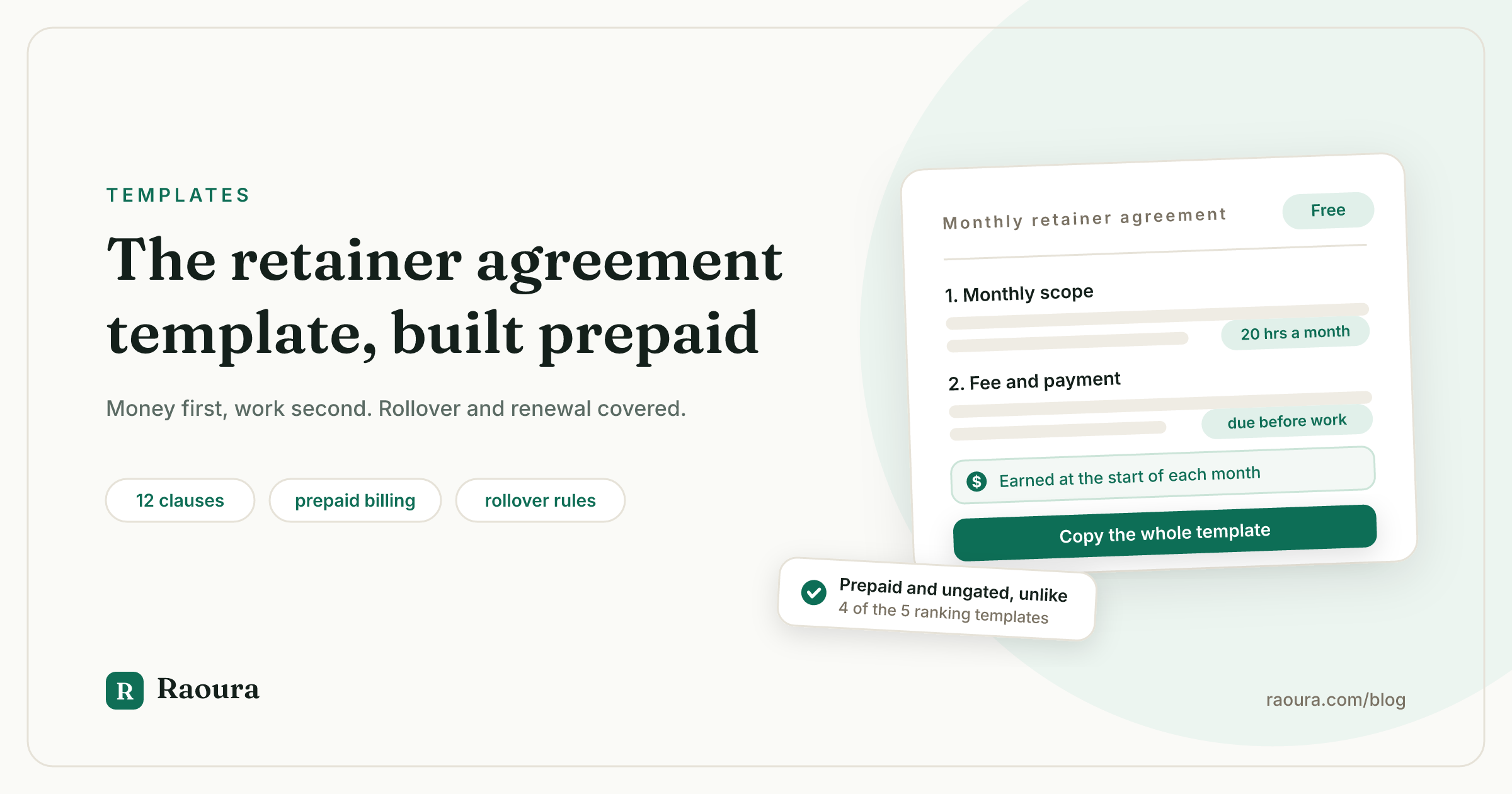
A retainer is supposed to fix the worst thing about freelancing: the money arrives before the work, every month, on a date you chose.
So here is the strange thing about the templates that rank for "retainer agreement template": two of the five top-ranking pages have the client pay after the work is done, and only one of the five is both ungated and genuinely prepaid.
That is not a retainer. That is a regular invoice wearing a retainer's name tag, and it hands back the exact cash-flow advantage you set up the retainer to get.
The template below is built prepaid, and every clause carries a short note on why it exists. It is on this page in full, with no signup, no email gate, and no account.
It also covers the four questions the ranking templates skip entirely: what happens to unused hours, what an hour beyond the cap costs, how your rate changes at renewal, and whose money the unused balance is when the relationship ends.
This is general information, not legal advice. Adapt the wording to your work, and for a large retainer have a lawyer read your final version once.
What the top-ranking retainer templates actually give you#
We fetched the five top-ranking pages for "retainer agreement template" in July 2026: only one of the five is both ungated and genuinely prepaid, two bill the client in arrears, and zero of the five cover rollover hours, overage rates, or what happens to unused funds. Here is the audit:
| Source | Truly ungated | Prepaid (money before work) | Rollover policy | Overage rate | Rate change at renewal | Unused funds on exit |
|---|---|---|---|---|---|---|
| [eForms](https://eforms.com/employment/independent-contractor/consulting/retainer/) | Yes | Yes (one-time advance) | No | No | No | Refundable checkbox only |
| [LegalTemplates](https://legaltemplates.net/form/employment-contract/independent-contractor/consulting/retainer/) | No (email required) | Partly (replenishment option) | No | No | No | No |
| [Signaturely](https://signaturely.com/contracts/retainer-agreement-template/) | Partly (download gated) | No (bills in arrears) | No | No | No | No |
| [Bonsai](https://www.hellobonsai.com/contract-template/monthly-retainer-agreement) | No (app signup) | Not shown on page | No | No | No | No |
| [SignWell](https://www.signwell.com/contracts/retainer-agreement/) | Yes | No (bills in arrears) | No | No | No | No |
Two details from that audit are worth a second look.
eForms, the only fully ungated option with a genuinely prepaid structure, opens by calling a retainer "a non-refundable deposit," which is close to the opposite of how courts treat unearned advance payments (more on that two sections down).
And Bonsai describes its retainer contract as "an employment agreement," which is precisely the word a freelancer's contract exists to avoid: you are an independent contractor, and your paper should say so in those terms.
The two kinds of retainer, and which one this template is#
A retainer has exactly two working models: pay-for-work, where the client prepays each month for a defined block of hours or deliverables, and pay-for-access, where the client pays to reserve your availability and priority whether or not they use it.
Pay-for-work is the model behind almost every freelance retainer you will actually be offered: 20 hours of design a month, four blog posts a month, ongoing site maintenance up to a cap. The client is buying output, in advance, at a predictable price.
Pay-for-access is rarer and mostly senior: a fractional CMO who guarantees 48-hour turnaround, a developer who keeps weekend capacity free for emergencies. The client is buying the option on your time, and the fee is earned whether they exercise the option or not.
The template below is a pay-for-work retainer, because that is what most solo freelancers sell. If part of your value really is availability (priority response, reserved capacity), price it as a named line inside the fee rather than leaving it implied. Naming it matters legally, not just commercially, as the next section explains.
Whose money is the retainer? Earned vs unearned#
California courts have distinguished three kinds of retainer since T & R Foods v. Rose (1996), and only one of them, the true availability retainer, is earned the moment it is paid.
The three types, per the Bar Association of San Francisco's plain-language summary:
- A "true" or "classic" retainer, paid purely to reserve availability, which is earned when paid.
- A "security retainer," where the money stays the client's until work earns it.
- An "advanced payment," prepayment for work to be performed.
The case law is about attorneys, but the principle it applies is general contract logic and it is the one worth internalizing: courts look at what the money was for, not what the contract labeled it.
As the same summary puts it, unearned funds from a prepaid work retainer "must be refunded at the end of the work," and writing "non-refundable" on money you have not earned does not make it yours.
For your agreement, that principle turns into two practical drafting rules.
- Define when the fee is earned. In the template below, the monthly fee is earned at the start of each month, because that is when you reserve the capacity, turn away conflicting work, and take on the obligation.
- Say explicitly what happens to genuinely unearned money if the agreement ends mid-cycle: refund it, promptly, on a named timeline.
A refund clause costs you almost nothing in practice (termination notice means you rarely owe one), and it is exactly the clause that makes a hesitant client comfortable prepaying, which is the concession you actually care about.
The template#
The template below has 12 clauses, runs about two pages, and is built prepaid: each month's fee is invoiced before the month begins and work pauses if it does not arrive. Copy the shaded blocks, replace the bracketed parts, delete the notes. It pairs with the general-purpose freelance contract template; where a clause is explained in depth there (late fees, IP, e-signature), the note here stays short.
Monthly Retainer Agreement#
This agreement is between [Your full legal name, doing business as Your Business Name] of [your mailing address] ("Contractor") and [Client's full legal name / company legal name] of [client's mailing address] ("Client"), effective [date].
Why it is here: full legal names and mailing addresses are the first requirement of the New York, Illinois, and California freelance contract laws, and a retainer crosses their dollar thresholds faster than almost any other engagement (see the state law section below).
1. Retainer services and monthly scope.
Each month, Contractor will provide up to [20 hours of design and development services / the following deliverables: four blog posts of up to 1,500 words each] ("the Monthly Scope"). The following are not included: [exclusions: e.g. "new-feature builds, print design, paid ad management"]. Work outside the Monthly Scope is handled under Section 4.
Why it is here: a retainer without a cap is an all-you-can-eat subscription to you. The Monthly Scope is the single most important number in this agreement, and the exclusions sentence does more work than the inclusions, because retainer scope disputes argue about what was assumed, not what was listed. The same drafting logic as a scope of work, applied to a month instead of a project.
2. Fee and payment.
The monthly fee is [$X], earned at the start of each monthly period in consideration of Contractor reserving capacity for Client. Contractor invoices on the [1st] of each month [or: N days before the period begins], due within [5] days, paid by [ACH / bank transfer / card on file]. The first monthly period does not begin until the first payment is received, and if any monthly payment is not received by its due date, the Monthly Scope pauses until it is.
Why it is here: this is the clause the ranking templates get backwards. Money first, work second, every cycle, or the retainer is just Net 30 with extra steps. The "earned at the start of each monthly period" language implements the earned-vs-unearned rule from the section above.
One mechanical note worth real money: put the payment on autopay via ACH rather than card if you can. At Stripe's standard US pricing of 2.9% plus 30 cents for cards versus 0.8% capped at $5 for ACH, a $2,000 monthly retainer costs $58.30 a month by card and $5 by ACH. That is $699.60 versus $60 a year, a $639.60 difference on a single client, for one checkbox at setup.
3. Unused time.
Hours within the Monthly Scope that are unused at the end of a monthly period [choose one: expire and do not roll over / roll over for one additional month, up to a maximum of [X] banked hours, then expire / roll over until termination]. Unused hours have no cash value and are not refundable while this agreement remains in effect, except as provided in Section 7.
Why it is here: "do my hours roll over?" is the first question every retainer client asks, and none of the five ranking templates answers it. Pick your policy deliberately:
| Rollover policy | Client's view | Your risk | Use it when |
|---|---|---|---|
| No rollover (use it or lose it) | Feels strict, resembles a gym membership | Client churns when usage dips | Your capacity is genuinely reserved and turned away from others |
| Roll over one month, capped | Feels fair, still predictable | A heavy month can double your workload | Default for most freelancers |
| Bank until termination | Feels generous | You carry an open-ended liability that grows silently | Almost never; avoid |
The one-month capped rollover is the honest middle: the client is not punished for a slow month, and you are never on the hook for more than one month of banked time on top of the current scope.
4. Additional work.
Work beyond the Monthly Scope in any period is billed at [$X] per hour [or: quoted separately]. Contractor will notify Client before exceeding the Monthly Scope and will not proceed past [2] additional hours without written approval. Larger requests outside the services described in Section 1 require a written change order.
Why it is here: the overage rate turns "can you squeeze in one more thing?" from scope creep into revenue. Set it at or slightly above your standard hourly rate, never below it: the retainer block is the discounted commitment, and overflow should not be cheaper than the commitment.
5. Term and renewal.
This agreement runs month to month from the effective date and renews automatically unless either party gives written notice of non-renewal at least [30] days before the next period. Contractor may change the monthly fee or Monthly Scope with at least [30] days' written notice, effective at the next renewal. Client's payment for the following period is acceptance of the new terms.
Why it is here: auto-renewal is what makes a retainer a retainer rather than twelve separate negotiations a year, and the rate-change sentence is the one that saves you from being locked into 2026 pricing in 2028. When you do raise the rate, pair this clause with a proper note; rate increase email scripts here.
One legal footnote: the FTC's "click-to-cancel" rule on subscription cancellations was vacated by the Eighth Circuit on July 8, 2025 (status summary), and it targeted consumer subscriptions, not business-to-business retainers. You are not legally required to make cancellation effortless.
Make it easy anyway: a client who knows they can leave with 30 days' notice signs faster and stays longer.
6. Late payment.
Overdue amounts accrue a late fee of [1.5]% per month or the maximum allowed by law, whichever is lower. Section 2's pause applies in addition to, not instead of, this fee.
Why it is here: on a prepaid retainer the pause in Section 2 does most of the enforcement work, but the fee matters for overage invoices and the final cycle. Percentages, state limits, and when to waive are covered in the late fee guide.
7. Termination.
Either party may terminate with [30] days' written notice. Contractor may terminate immediately if payment is [14] days overdue. On termination, Contractor will deliver work completed through the final paid period, and any prepaid fees for periods after the effective termination date will be refunded within [14] days. Banked rollover hours expire at termination.
Why it is here: the refund sentence is the earned-vs-unearned rule made operational, and it is the clause that makes prepayment an easy yes for the client. Note what it does not refund: the current month (earned at the start of the period, per Section 2) and expired or banked hours (Section 3). It refunds only money for months that never started.
8. Intellectual property.
Upon full payment for a given monthly period, all deliverables produced in that period become Client's property. Contractor retains ownership of pre-existing tools, templates, code libraries, and processes, and grants Client a non-exclusive license to use them as embedded in the deliverables. Contractor may display completed work in portfolios and marketing.
Why it is here: per-period IP transfer means a client who stops paying in month six still owns months one through five and nothing more, which is exactly fair. The background-IP sentence protects the toolkit you reuse across clients; the reasoning is in the freelance IP guide.
9. Confidentiality.
Each party will keep the other's non-public business information confidential and use it only for this engagement. This obligation survives termination for [2] years and runs in both directions.
Why it is here: retainers involve deeper access than projects (analytics, credentials, roadmaps), so mutuality matters more here than anywhere. One-way confidentiality clauses, like the one in the eForms template, bind you without binding them.
10. Independent contractor.
Contractor is an independent contractor, not an employee, and controls the manner, means, schedule, and location of the work. Nothing in this agreement creates an employment, agency, or partnership relationship.
Why it is here: an ongoing monthly relationship looks more like employment than any project does, which makes this clause more load-bearing in a retainer than in any other freelance contract. Behavior matters too: keep your own tools, your own hours, and other clients.
11. Liability.
Contractor's total liability under this agreement is limited to the fees paid by Client in the [3] months preceding the claim. Neither party is liable for indirect or consequential damages.
Why it is here: on an open-ended engagement, an uncapped liability grows with every renewal. Tying the cap to a trailing window keeps it proportionate no matter how long the retainer runs.
12. General.
This agreement is governed by the laws of [state]. It is the entire agreement between the parties and may be amended only in writing signed by both parties. Electronic signatures are binding.
Contractor: ______________ Date: ______
Client: ______________ Date: ______
Why it is here: the "amended only in writing" sentence quietly protects your rollover and overage rules from being renegotiated in a Slack thread. E-signatures carry full legal weight under the federal ESIGN Act.
How much should the monthly fee be?#
Price the retainer at your standard rate times the committed hours, and if you discount at all, cap it at 10 to 15% and trade it for a minimum term of 3 months, never for a month-to-month deal.
The retainer's value to the client is priority, availability, and zero procurement friction every month. The retainer's value to you is predictability. Those roughly cancel out, which is why the lazy default of "retainer means 20% off" undercharges: you are already giving the client something for the commitment, and a month-to-month retainer with a 30-day exit is barely a commitment at all.
Discount only what is actually guaranteed. If the client wants a lower effective rate, the honest trade is a longer minimum term or a larger block, and if they push below your floor, the answer is the same as any rate negotiation: a smaller scope, not a smaller rate.
One more pricing note: a retainer is not a deposit. A deposit is a one-time advance against a defined project. A retainer is a recurring fee for recurring capacity. If what the client actually has is a big project, they need milestone billing, not a retainer, and stretching a project across a retainer usually ends with one party feeling shortchanged.
Where a written retainer is legally required#
A written contract is required by law once a client relationship reaches $250 in California, $500 in Illinois, or $800 in New York, each aggregated over a 120-day window, and a monthly retainer crosses every one of those thresholds almost immediately.
The aggregation rule is the part retainer freelancers miss:
- California's SB 988 counts $250 "either by itself or when aggregated with all contracts for services between the same hiring party and independent contractor during the immediately preceding 120 days."
- Illinois' Freelance Worker Protection Act uses $500 over the same 120-day window.
- New York's Freelance Isn't Free Act, statewide since August 28, 2024, uses $800, per the threshold as stated by NYC's DCWP, which pioneered the law.
A $300-a-month retainer that would never trigger these laws as a single invoice crosses California's line in month one and New York's by month three. All three laws also default payment to within 30 days and carry double-damages provisions for late payment.
The full state-by-state picture is in the freelance payment laws guide. The template above already contains everything the statutes require: names and addresses of both parties, itemized services, the rate, and the payment date.
What the paper cannot do by itself#
A retainer agreement fixes the terms. It does not send the invoice on the 1st, notice when payment has not landed by the 5th, pause the work queue, track how many scope hours this month has used, or chase the late ones. On a project that happens once; on a retainer it happens every month, forever, which is why retainer freelancers feel the admin drag most.
(Disclosure: Raoura is our product.) That recurring follow-through is what Raoura automates: recurring invoices on your schedule, payments straight into your own Stripe account with no markup on Stripe's fees, automatic payment reminders, and a client portal where the retainer scope, this month's work, and every past invoice live in one place, for $17 a month flat.
None of it is required to use the template. The paper above is yours either way, and it works fine from a Google Doc and a calendar reminder. The point of this page is that you should not have to hand over an email address to get a retainer agreement that actually prepays you.
!Raoura's automations hub, where recurring invoices and payment reminders run on a monthly schedule

The follow-through the paper cannot do (invoice on the 1st, chase when payment has not landed) runs on autopilot instead of on your calendar.

The client sees the scope, this month's work, and every invoice without emailing you for any of it.
Verified July 2026. Primary sources: Stripe pricing page, Bar Association of San Francisco (retainer refundability and T & R Foods v. Rose), California SB 988 bill text, Illinois DOL (FWPA), NY DOL and NYC DCWP (Freelance Isn't Free Act), 15 U.S.C. 7001 (ESIGN), Crowell & Moring (Eighth Circuit vacatur of the FTC click-to-cancel rule, July 8, 2025). Competitor template audit (gating, prepaid structure, clause coverage across eForms, LegalTemplates, Signaturely, Bonsai, SignWell) performed against live pages July 2026. This article is general information, not legal advice.
Frequently asked questions
Is a retainer fee refundable?
The earned part, no; the unearned part, almost always yes, whatever the contract labels it. Courts look at what the money was for: fees for months that never started must be returned, while fees earned for reserved capacity or completed work are yours. The template handles this with per-period earning (Section 2) and a refund-on-termination clause (Section 7).
What happens if the client does not use all their hours?
Whatever Section 3 says, which is why it exists. The default worth adopting: unused hours roll over for one month up to a cap, then expire. Unused hours are never convertible to cash while the agreement runs.
What is the difference between a retainer and a deposit?
A deposit is a one-time advance payment against a single defined project. A retainer is a recurring monthly fee for recurring capacity or access. Deposits de-risk a project; retainers smooth income across many small pieces of work.
Can a client cancel a retainer at any time?
With whatever notice the termination clause requires, typically 30 days. That notice period is your protection: it means you always see the last month coming, and it is the reason a refund clause rarely costs you anything in practice.
Should retainer hours cost less than my normal rate?
Slightly, at most. Cap any discount at 10 to 15%, and only in exchange for a real commitment such as a 3-month minimum term. The client is already receiving priority and guaranteed availability; a deep discount pays twice for the same commitment.
Do retainer agreements renew automatically?
This one does, month to month, unless either party gives 30 days' notice, and the fee can change at renewal with 30 days' notice. Auto-renewal with a clean exit is the structure that is easiest to sign and easiest to live with.
Do I need a written contract for a retainer?
In New York, Illinois, and California, yes by law once the relationship crosses $800, $500, or $250 respectively over 120 days, which a monthly retainer does almost immediately. Everywhere else, yes by common sense: rollover, overage, and renewal disputes are unwinnable without written terms.
---
Run your client work in one place
Send a proposal, get it signed, invoice, and get paid, with a branded portal your clients will actually use. One flat plan at $17/month, and we never take a cut of your payments.
Try Raoura free for 14 daysNo credit card required. Set up in minutes.
Keep reading
The Virtual Assistant Contract: 24 Clauses, Scored Against Every Template Ranking for This Search
We scored the four pages that publish actual virtual assistant contract text against 24 clauses a VA agreement needs. Twenty-four of 96 possible slots were filled. The best single template managed 7 out of 24. Twelve clauses appear in none of them, including every clause about the thing that makes VA work different from other freelance work: you are holding your client's passwords and running their inbox. One popular template also tells you a contract fixes your independent contractor status, then mandates client-set 9 to 5 weekday hours in the same document. Here is the clause-by-clause version, with the classification test the DOL is actually applying in 2026, the data protection terms nobody drafts, and the retainer mechanics that decide whether unused hours roll over.
Stripe vs PayPal for Freelancers: Every Fee Verified (2026)
Every page ranking for this comparison either prints in-person retail rates, contradicts itself, or skips the numbers freelancers actually pay. We read the current Stripe and PayPal pricing pages line by line, ran a $3,000 invoice through every rail, and found a $1,764 per year gap between the cheapest setup and the default one.
The Pause Clause: How to Stop Work When an Invoice Goes Overdue
Stopping work is the strongest move a freelancer has against a late-paying client, and the least understood. Here is the legal doctrine that lets you pause even without a clause, the exact clause to add so you never have to rely on doctrine again, the day-by-day timing, and the two emails that keep the pause professional. Verified against primary sources in July 2026.