Who Owns the Work? Freelance IP Rights Explained
July 6, 2026
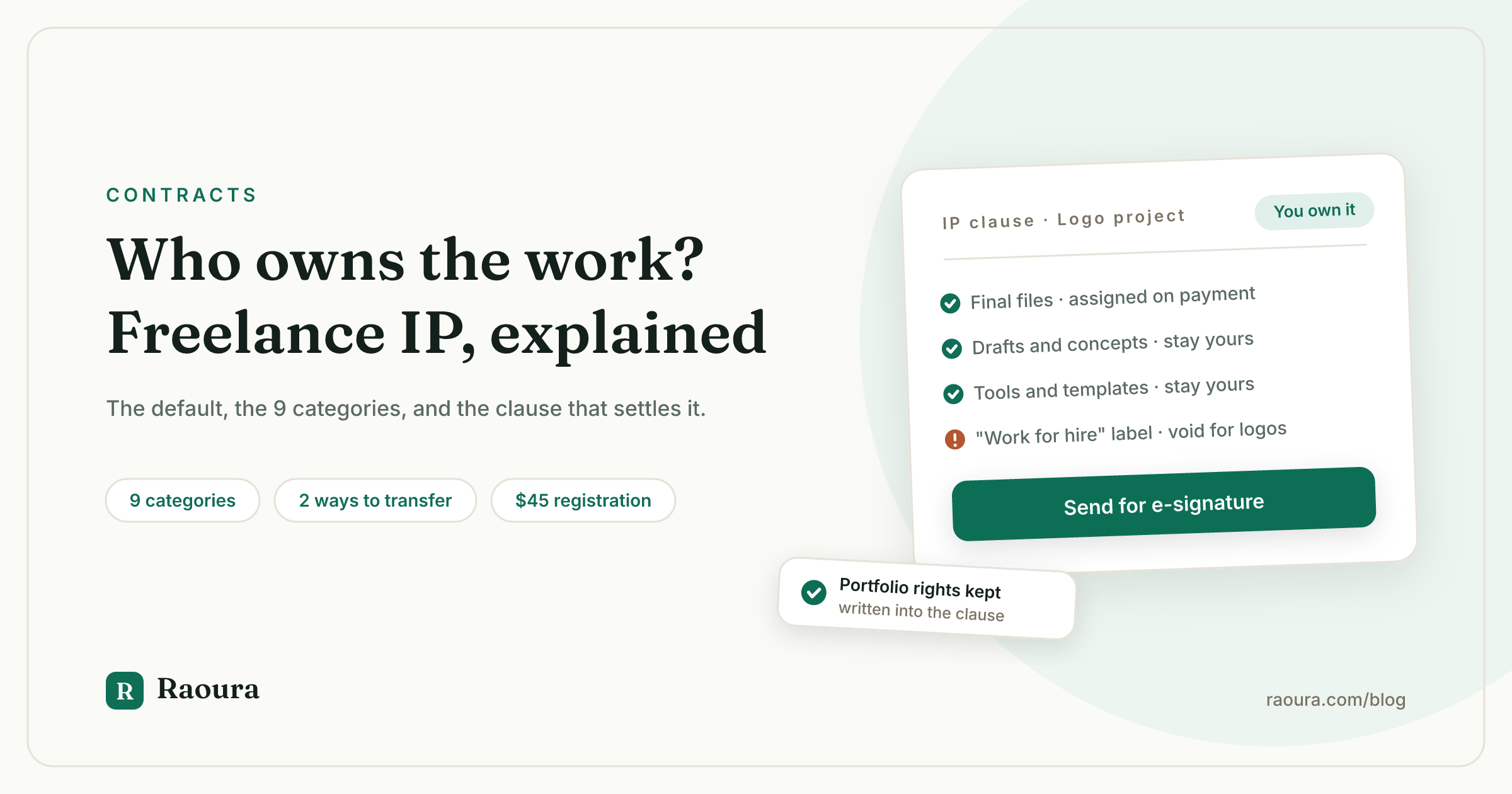
A client emails you three months after a project wraps: "Quick question, we are trademarking the logo, can you confirm we own all the design files?" Or a new contract lands in your inbox with the phrase "all work product shall be deemed a work made for hire" sitting in section 8 like it settles something. Either way, the question underneath is the same: when a freelancer makes a thing and a client pays for it, who actually owns it?
The answer surprises both sides. Under US copyright law, you own it, from the second you create it, and payment alone changes nothing. The client gets ownership in exactly two ways, both of which require paper: a qualifying work-for-hire agreement or a signed assignment. Everything else, including a paid invoice, a handshake, and the phrase "we bought it," gets them at most a license to use the work.
One observation of our own before the law: we pulled the top five pages ranking for "freelance intellectual property rights" in July 2026, and three of the five state the ownership default backwards or without its conditions. One tells freelancers their work "is usually defined as work for hire." Another says clients "automatically own all rights" under a work-for-hire arrangement, no conditions given. Only one page, a 2022 Freelancers Union post, names the actual statutory test.
That is the confusion this article exists to fix, with the primary sources linked so you can check everything yourself.
This is general information about US law, not legal advice. For the full picture of what belongs around the IP clause, start with our clause-by-clause freelance contract guide.
The default rule: you own what you make#
Under 17 USC 201(a), copyright vests initially in the author, which means an independent contractor owns the copyright in their work from the moment of creation, and only 2 things can move ownership to the client: a qualifying signed work-for-hire agreement or a signed written assignment.
Copyright exists automatically when you fix a work in tangible form: the moment the logo file is saved, the article is typed, the photo is captured. No registration, no notice, no payment required. And the statute is explicit about who holds it: the author. For an employee, the employer is treated as the author of work created within the job. For an independent contractor, the author is you.
Payment does not transfer copyright. This is the single most common misunderstanding on both sides of freelance work. A client who paid your invoice in full owns the deliverable file the way you own a paperback: they have a copy, and (as covered below) a license to use it for the purpose they hired you for. The right to reproduce it, modify it, resell it, or stop others from copying it stays with you unless a signed document says otherwise.
17 USC 204(a) is blunt about this: a transfer of copyright ownership "is not valid unless an instrument of conveyance, or a note or memorandum of the transfer, is in writing and signed by the owner of the rights conveyed."
Standalone fact worth keeping: a freelancer who never signed anything still owns the copyright in every piece of client work they have ever delivered.
Work made for hire: the two-part test almost nobody passes#
A contractor's work becomes a work made for hire only if it clears both prongs of 17 USC 101: the work fits 1 of 9 statutory categories, and both parties signed a written agreement calling it a work made for hire before the work is in dispute.
"Work made for hire" is the most misused phrase in freelance contracts, so here is the actual law. It covers two situations. First, work created by an employee within the scope of employment. Second, specially commissioned work from a contractor, but only when both of these are true:
- The work falls into one of nine categories listed in the statute: a contribution to a collective work, part of a motion picture or other audiovisual work, a translation, a supplementary work, a compilation, an instructional text, a test, answer material for a test, or an atlas.
- Both parties expressly agreed in a written instrument, signed by both, that the work is a work made for hire.
Miss either prong and the work is not a work made for hire, no matter what the contract says. The Copyright Office spells this out in Circular 30 (revised August 2024).
Notice what is not on that list: logos, brand identities, websites, app code, photographs as such, marketing copy, illustrations as such. Most of what solo freelancers sell fits none of the nine categories, which produces a fact that startles clients: most freelance work cannot legally be a work made for hire at all.
The "employee vs contractor" line matters too, and clients do not get to pick. In Community for Creative Non-Violence v. Reid (1989), the Supreme Court held that employee status is decided by common-law agency factors: who controls how the work is done, who supplies the tools and workspace, whether there are benefits and payroll taxes, whether the hirer can assign other projects. A nonprofit commissioned a sculptor, directed the concept, and paid for the piece, and the Court still found him an independent contractor, so the sculpture was not a work for hire.
If you work from your own studio, on your own equipment, invoice per project, and get a 1099, you are on the contractor side of that line.
Here is how the test lands across common freelance fields:
| Your work | Can it be work for hire? | Owner with no signed IP clause | What clients usually actually need |
|---|---|---|---|
| Logo and brand identity | No, fits none of the 9 categories | You | Assignment of the final marks; their trademark rights come from use |
| Website or application code | Almost never | You | Assignment or license of the deliverable code; you keep your reusable tools |
| Articles for a multi-author site | Sometimes, as a contribution to a collective work | You, until a signed agreement says otherwise | Exclusive license or assignment |
| Photography | Rarely (narrow collective-work or supplementary uses) | You | Usage license scoped by medium and duration |
| Video editing and motion work | Often, as part of an audiovisual work | You, unless signed work-for-hire paper exists | Signed work-for-hire agreement or assignment |
| Translation | Yes, a listed category | You, unless signed work-for-hire paper exists | Signed work-for-hire agreement |
| Marketing and email copy | Usually not | You | Assignment on final payment |
| Illustration | Sometimes, as a supplementary work | You | License with defined usage, or assignment |
The difference is not academic. A true work made for hire makes the client the author from the moment of creation, forever. An assignment transfers your rights but leaves you two things a work for hire never does: the 35-year termination right and, for narrow categories of visual art, moral rights. More on both below.
The clause that says "work made for hire" anyway#
When the work does not fit the 9 categories, a bare work-for-hire clause transfers nothing, which is why competently drafted contracts pair it with 1 backup assignment sentence.
So why does every agency template say "all deliverables shall be deemed works made for hire"? Habit, and hedging. Lawyers know the label may fail, so the standard move is belt and suspenders: "to the extent any deliverable is not a work made for hire, Contractor hereby assigns all right, title, and interest to Client." That second sentence is the one doing the work for a logo or a website. If you sign it, you have assigned your copyright, and the work-for-hire label is mostly decoration.
That means two things when you read a contract.
- Do not panic at the phrase "work made for hire." For most freelance work it is legally inert on its own.
- Do read for the assignment sentence next to it, because that one is real, and it is negotiable: what it covers (final deliverables only, or every sketch and draft), when it triggers (on creation, or on final payment), and what you carve out (your pre-existing tools, and portfolio rights).
We cover the predatory versions, like assignments of everything you create "during the term of the agreement," in our contract red flags guide.
One timing note, because a ranking law-firm page gets it wrong in a way that could burn you: courts disagree about whether the signed work-for-hire writing must exist before work begins or can memorialize an earlier oral deal afterward. Do not rely on the split in either direction. Get the paper signed before you start, which is also just good invoicing hygiene.
No contract, but they paid: the implied license#
When a freelancer creates work at a client's request and hands it over expecting them to use it, courts since 1990 have found the client holds an implied nonexclusive license to use the work, not ownership of it.
This is the sub-question none of the ranking pages answer, and it is the most common real-world situation: no contract, or a contract that never mentions IP, work delivered, invoice paid. Who owns it?
You do. But the client is not infringing by using it. In Effects Associates v. Cohen (9th Cir. 1990), a special-effects shop delivered footage for a horror film with no written transfer, then claimed the producer could not use it. The court held the producer had an implied nonexclusive license: the shop created the work at the producer's request and handed it over intending it be used in the film.
Nonexclusive licenses are the one exception to the writing requirement in 17 USC 204(a); they can be oral or implied from conduct.
Practically, the no-contract default shakes out like this: the client can keep using the work for the purpose they hired you for, and you keep everything else, including the right to reuse elements, license the work to others, and stop uses outside the original purpose. The fight, when it comes, is over the scope of the implied license, which is exactly the fight a one-page contract prevents.
Whether an unpaid invoice cancels the license is genuinely messy territory, which is one more reason to tie the license or assignment to payment in writing rather than litigating implications.
Assignment vs license: the decision that prices the project#
There are only 2 instruments that give a client rights in writing, an assignment or a license, and which one you sign should change the number on your proposal.
An assignment is a sale of the copyright itself. A license is permission, and it comes with dials: exclusive or nonexclusive, limited by time, territory, medium, or purpose.
A local restaurant's website copy probably justifies a full assignment; nobody is reselling it. Photography, illustration, and anything with reuse value is where licensing by scope earns its keep: web use is one price, national print advertising is another, a full buyout is a third.
Two things survive even a full assignment, and freelancers routinely forget both:
First, the termination right. Under 17 USC 203, the author of any work other than a work made for hire can terminate a grant, including a full assignment, during a five-year window opening 35 years after the grant. You cannot waive it by contract. It will not matter for a startup's landing page; it matters enormously for a character design or a song. It is also the cleanest illustration of why clients push for the work-for-hire label where it can stick: a true work made for hire has no termination right, ever.
Second, moral rights, barely. The US implementation, VARA (17 USC 106A), covers only narrow "works of visual art" like paintings, sculptures, and limited photographic editions, and it expressly excludes works made for hire. If you are a designer expecting European-style attribution rights, US law mostly does not have them, so attribution and portfolio use belong in the contract instead.
While we are on national differences: the US rule is not the world's rule. Under the UK Copyright, Designs and Patents Act 1988, section 11, the author is first owner even for commissioned work, with no US-style category list, so a UK commissioner gets rights only by assignment or implied license. If you work across borders, say which law governs the contract.
Two adjacent rights people mix into "IP" conversations. A logo's trademark is not yours to sell, because per the USPTO, trademark rights come from the client's use of the mark in commerce, not from the designer.
And on the rare project that produces a patentable invention, the default runs your way too: patent rights vest in the inventor, and 35 USC 261 requires assignments to be in writing.
Registration: the $45 step that turns rights into leverage#
US copyright registration currently costs $45 for a single work by a single author, and registering within 3 months of publication is what unlocks statutory damages of $750 to $30,000 per work (up to $150,000 if willful) plus attorney fees.
Your copyright exists without registration, but your enforcement options barely do. The Supreme Court held in Fourth Estate v. Wall-Street.com (2019) that you cannot file an infringement suit for a US work until the Copyright Office has registered it (or refused it).
And under 17 USC 412, statutory damages and attorney fees are available only if the work was registered before the infringement began or within three months of first publication. Miss that window and you are suing for actual damages you must prove, which for most freelance work means suing for lunch money.
The current fee is $45 for the single-application tier (one work, one author, not a work for hire) and $65 for the standard application. A March 2026 proposed rule would eliminate the $45 single application and raise the standard fee to $85, so check the fee page before relying on this paragraph.
No, you do not need to register everything. Register the work with reuse value: the illustration style clients keep "borrowing," the photo library, the template you sell.
For work that gets lifted anyway, there is now a small-claims lane. The Copyright Claims Board is a tribunal inside the Copyright Office: $100 total filing fee, no lawyer required, damages capped at $30,000 per proceeding (up to $15,000 per timely registered work; unregistered works cap at $7,500 each and $15,000 per proceeding), and you can file with a pending application.
The honest catch: respondents can opt out within 60 days, and then your only path is federal court.
AI-assisted work: the 2026 ownership question#
The Copyright Office's January 29, 2025 report and the D.C. Circuit's Thaler decision of March 18, 2025 agree on 1 rule: purely AI-generated material without human authorship cannot be copyrighted, and prompts alone are not authorship.
If you use AI tools in client work, the ownership conversation now has a third party in it: the public domain. The Copyright Office's Copyright and Artificial Intelligence, Part 2: Copyrightability report concluded that material generated entirely by AI is not copyrightable, that prompts alone do not make you the author, and that human selection, arrangement, and modification of AI output can be protected to the extent of the human contribution.
The D.C. Circuit reached the same bottom line in Thaler v. Perlmutter: human authorship is a requirement.
For your contracts, this cuts two ways. A client cannot own what nobody owns, so a deliverable that is raw AI output may be something you cannot assign in the first place. And clients have started asking.
The clean answer is a disclosure-plus-warranty structure: say what role AI tools play in your process, and warrant your human authorship of the deliverable as assigned. We are adding a dedicated guide to AI clauses to this hub because the question deserves more than a paragraph.
The clause to actually use#
The healthiest IP structure for most solo freelance work is boring and takes four sentences:
Upon Contractor's receipt of final payment, Contractor assigns to Client all right, title, and interest in the final deliverables listed in the Scope of Work. Contractor retains ownership of drafts, preliminary concepts, and Contractor's pre-existing materials, tools, and templates, and grants Client no rights in them except as embedded in the final deliverables. Until final payment is received, Client has a limited license to use the deliverables solely for internal review. Contractor may display the final deliverables in Contractor's portfolio and marketing materials.
Each sentence closes a specific dispute.
- Payment-triggered assignment is your collection leverage: a client who has not paid does not own the work, which pairs naturally with milestone billing so ownership and money move phase by phase.
- The drafts-and-tools carve-out keeps your reusable base yours.
- The review license kills the "we already launched it" problem.
- The portfolio sentence preserves the asset your next client hires you off of.
When mid-project additions arrive, the same logic extends through change orders: new deliverables enter the scope, and the assignment covers them on payment for that phase.
The operational failure mode is not bad wording, it is no wording: the project that started from a Slack message and never got paper. If contracts take you 20 minutes of copy-paste plus a separate e-signature subscription, small projects will keep launching without one. That is the gap Raoura is built for: proposal, contract with your IP clause, e-signature, and milestone invoices in one flow at $17/mo flat, so the paper exists before the work does. Disclosure: Raoura is our product.

The paper existing before the work does: every client gets their own agreement, and you can see at a glance which ones are signed and which are still drafts.
Verified July 2026. Primary sources: 17 USC 101, 201, 203, 204, 106A, 412, 504; US Copyright Office Circular 30 (rev. 08/2024); copyright.gov fee schedule and the March 20, 2026 fee NPRM; Community for Creative Non-Violence v. Reid, 490 U.S. 730 (1989); Effects Associates v. Cohen, 908 F.2d 555 (9th Cir. 1990); Fourth Estate v. Wall-Street.com, 586 U.S. 296 (2019); Thaler v. Perlmutter (D.C. Cir. Mar. 18, 2025); Copyright and Artificial Intelligence, Part 2: Copyrightability (US Copyright Office, Jan. 2025); ccb.gov handbook and fee table; UK CDPA 1988 s.11; USPTO trademark basics; 35 USC 261. This article is general information, not legal advice.
Frequently asked questions
Who owns freelance work if there is no contract?
The freelancer owns the copyright. Under 17 USC 201(a) copyright vests in the author at creation, and a transfer requires a signed writing under 17 USC 204(a). The paying client typically holds an implied nonexclusive license to use the work for the purpose it was commissioned, per Effects Associates v. Cohen (1990), but a license is permission, not ownership.
Does paying for the work transfer the copyright?
No. Payment transfers ownership of the copy delivered and supports an implied license to use it. Copyright ownership moves only by a signed work-for-hire agreement covering one of the nine statutory categories, or a signed written assignment.
Is my contract's "work made for hire" clause enforceable?
Only if the work fits one of the nine categories in 17 USC 101 (collective-work contributions, audiovisual works, translations, supplementary works, compilations, instructional texts, tests, test answer material, atlases). Logos, websites, and most standalone creative work do not qualify. Most contracts add a backup assignment sentence, and that sentence is the enforceable part.
Can I reuse code, templates, or design elements I built for one client?
Yes, if your contract carves out pre-existing materials and general tools, which it should. Without a carve-out, a broad assignment of "all work product" can sweep in reusable components, which is one of the walk-away flags in our red flags guide. Reusing another client's actual assigned deliverable is different: that work is theirs.
Can I show assigned work in my portfolio?
Not automatically. Once you assign the copyright, display rights belong to the client, so put a portfolio clause in the contract. Most clients accept it without comment, and confidentiality-heavy clients can be handled with a delay ("after public launch") rather than a ban.
Who owns work I made partly with AI?
You own what you authored; nobody owns the purely AI-generated portions, per the Copyright Office's 2025 copyrightability report and Thaler v. Perlmutter. Human selection, arrangement, and editing of AI output can be protected. Disclose your process and warrant human authorship of the final deliverable rather than hiding the tooling.
Do I need to register my copyright for it to exist?
No, it exists at creation. But you cannot sue without a registration (Fourth Estate, 2019), and statutory damages plus attorney fees require registering before the infringement or within 3 months of publication (17 USC 412). Registration is currently $45 for a single work by a single author.
---
Run your client work in one place
Send a proposal, get it signed, invoice, and get paid, with a branded portal your clients will actually use. One flat plan at $17/month, and we never take a cut of your payments.
Try Raoura free for 14 daysNo credit card required. Set up in minutes.
Keep reading
The Virtual Assistant Contract: 24 Clauses, Scored Against Every Template Ranking for This Search
We scored the four pages that publish actual virtual assistant contract text against 24 clauses a VA agreement needs. Twenty-four of 96 possible slots were filled. The best single template managed 7 out of 24. Twelve clauses appear in none of them, including every clause about the thing that makes VA work different from other freelance work: you are holding your client's passwords and running their inbox. One popular template also tells you a contract fixes your independent contractor status, then mandates client-set 9 to 5 weekday hours in the same document. Here is the clause-by-clause version, with the classification test the DOL is actually applying in 2026, the data protection terms nobody drafts, and the retainer mechanics that decide whether unused hours roll over.
Stripe vs PayPal for Freelancers: Every Fee Verified (2026)
Every page ranking for this comparison either prints in-person retail rates, contradicts itself, or skips the numbers freelancers actually pay. We read the current Stripe and PayPal pricing pages line by line, ran a $3,000 invoice through every rail, and found a $1,764 per year gap between the cheapest setup and the default one.
The Pause Clause: How to Stop Work When an Invoice Goes Overdue
Stopping work is the strongest move a freelancer has against a late-paying client, and the least understood. Here is the legal doctrine that lets you pause even without a clause, the exact clause to add so you never have to rely on doctrine again, the day-by-day timing, and the two emails that keep the pause professional. Verified against primary sources in July 2026.