The Illinois Freelance Worker Protection Act, Explained for the Freelancers It Covers
August 30, 2026
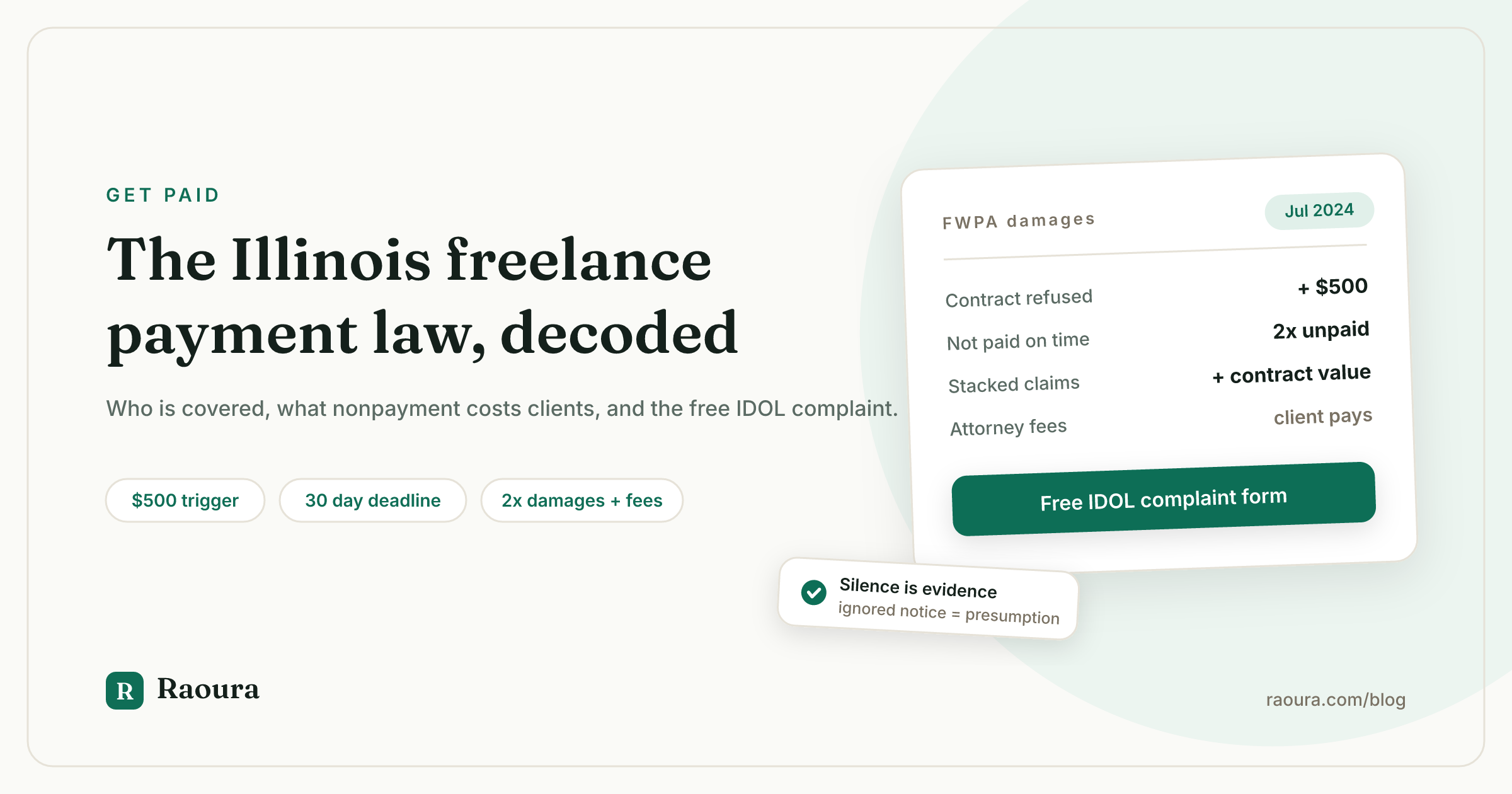
Here is what happens when you search for Illinois's freelance payment law: the top results after the state's own pages are law firm alerts written for the companies that hire you, one of which flatly misstates who is covered (it claims construction workers are included; the statute excludes them by name). The one plain-language page written for workers never mentions a single dollar figure of damages.
So the people this law protects mostly do not know what it is worth, and the numbers show it: in the law's entire first year, Illinois freelancers filed just 24 complaints, in a state with hundreds of thousands of independent workers.
This is the other version. Every quote and figure below comes from the text of 820 ILCS 193 and the Illinois Department of Labor's own pages and first enforcement report, checked this month. If you freelance outside Illinois, the national map of these laws is in our freelance payment laws by state guide, and California's very different version gets its own teardown.
What is the Illinois Freelance Worker Protection Act?#
The Freelance Worker Protection Act (820 ILCS 193) requires Illinois clients to give freelancers a written contract for work worth $500 or more and to pay within 30 days, with double damages plus attorney fees for nonpayment, enforced through a free state complaint process. It took effect July 1, 2024 (Public Act 103-0417) and applies to contracts taking effect after that date.
It is Illinois's entry in the "Freelance Isn't Free" family that started with New York City in 2017, and it is arguably the strongest of them for two reasons.
First, unlike California's SB 988, it covers freelancers in any industry, not a curated list of professions. Second, unlike California, it gives you a government complaint channel that costs nothing and quietly stacks the deck for you in court.
More on that mechanism below, because it is the best part of the law and almost nobody explains it.
Are you covered? The three tests#
You are covered if you pass three tests: you are an individual working as an independent contractor, your client is a private entity (with you or them in Illinois), and the work is worth $500 or more across any 120-day window. The fine print on each:
Test 1: you are a "natural person" working as an independent contractor. The statute defines a freelance worker as "a natural person who is hired or retained as an independent contractor by a contracting entity to provide products or services." Any industry qualifies; the IDOL FAQ says outright that "freelancers can work in any industry."
Three groups are excluded by name: people performing construction services, workers who are actually employees under the Employee Classification Act, and employees as defined by the Illinois Wage Payment and Collection Act. If you are an employee wearing a 1099 costume, your remedy is a wage claim, not this law, and as you will see below, that mixup is already the most common reason complaints get rejected.
Test 2: your client is a private company or person, not a government. The "contracting entity" definition excludes the US government, the State of Illinois, units of local government including school districts, and foreign governments. Everyone else hiring a freelancer is in scope.
Test 3: $500, aggregated. The threshold is met by a single contract "or when aggregated with all contracts for products or services between the same contracting entity and the freelance worker during the immediately preceding 120 days." Two $260 projects for the same client inside four months total $520, and the written contract requirement applies. Note it is "equal to or greater than" $500: a flat $500 gig counts, which one ranking law firm page also gets wrong.
And the jurisdiction rule is unusually generous for remote work. Per the IDOL FAQ: "If either the remote freelance worker or the contracting entity is located in Illinois, the law applies." A freelancer in Texas with a Chicago client has an Illinois claim; so does a Chicago freelancer with a Miami client. Which state's law wins when several could apply is its own question, one we cover in the national map.
What your client owes you under the law#
A covered client owes you four things: a written contract with five required items, payment no later than 30 days after the work is done, no pay-cut ultimatums at payment time, and no retaliation. Section by section:
- A written contract (Section 15): the client must reduce the deal to writing and furnish you a copy, physical or electronic. Minimum contents: both parties' names and contact information including the client's mailing address; an itemization of the products and services, their value, and the rate and method of compensation; the payment date; and, if their accounting needs it, the date by which you must submit your list of services rendered. The client, not you, must keep the contract for at least 2 years. IDOL publishes free model contracts in 11 languages if either side needs a starting point, and our clause-by-clause guide covers what a good contract needs beyond the statutory minimum.
- A payment date that cannot exceed 30 days. This is the sleeper clause: Section 15(b)(3) requires the contracted payment date to be "no later than 30 days after the products or services are provided." Illinois did not just set a default; it capped the contract itself. A client's standard net 60 terms are noncompliant on a covered Illinois freelance contract. And if the contract sets no date, Section 10 makes payment due "no later than 30 days after the completion of the freelance worker's services." Either way, your payment terms can beat 30 days; the client's paper cannot lawfully stretch past it.
- No hostage negotiations (Section 10(b)): once you have started the work, the client "shall not require as a condition of timely payment that the freelance worker accept less compensation than the amount of the contracted compensation." The pay-you-faster-if-you-take-a-haircut move is illegal in Illinois. (California's law also bans demanding extra work or IP as a payment condition; the Illinois text only names the pay cut.)
- No retaliation (Section 20): no threats, intimidation, discipline, harassment, or blacklisting that would deter you from exercising rights under the Act.
- No waivers (Section 35(b)): any contract clause purporting to waive these rights "is void as against public policy." If a client's template tries, that clause is dead on arrival, and it belongs on your contract red flags list.
What you can collect: the damages math#
Nonpayment costs an Illinois client double the unpaid amount plus your costs and attorney fees, and the statutory damages tiers can stack a $3,000 dispute to $9,000 plus fees. Section 30 sets the tiers, and the stacking rule is the thing every ranking page flattens:
| Violation | What you can recover (Section 30) | On a $3,000 project |
|---|---|---|
| You asked in writing for a contract before starting, client refused | $500 statutory damages | $500 |
| Client paid late, underpaid, or never paid | Double the underpayment, plus costs and reasonable attorney fees, plus injunctive relief | $6,000 plus fees |
| You win a contract claim plus any other claim | The value of the contract or $500, whichever is greater, in addition to the other remedies | $3,000 more |
| Client retaliated against you | The value of the contract for each act of retaliation, plus costs and fees | $3,000 per act |
Two honest notes on that table. First, the $500 tier has a precondition almost every summary skips: it applies when the contract was refused "despite the freelance worker's request for a written contract prior to commencing the contracted work." No documented request, no $500. So ask for the contract in writing, every time, before you start; the email takes thirty seconds and is literally worth $500.
Second, the contract-value award in row three is not a standalone prize; it triggers when you prevail on a Section 15 contract claim and at least one other claim, and then it comes "in addition to the other remedies provided."
That is where the stacking math comes from. A client who refused to put a $3,000 deal in writing and then never paid faces double the underpayment ($6,000) plus statutory damages of the contract value ($3,000) plus your costs and attorney fees: $9,000 and climbing, on a $3,000 invoice.
The deadline to act: complaints and civil claims must be filed "within 2 years after the date the final compensation was due." The clock runs from the missed payment date, not from when you finished the work.
The free complaint that flips the burden#
Filing the free IDOL complaint costs nothing, forces a certified-mail notice to your client within 20 days, and if they ignore it, their silence becomes a rebuttable presumption in court that they committed every violation you alleged. This mechanism is the law's best feature, and understanding what it does (and does not do) is the difference between using it well and being disappointed.
What it does not do: IDOL does not judge your case or collect your money. The department's own FAQ is blunt: "Will the Department of Labor help collect the money my contracting entity owes me? No." The unit that runs the process facilitates information exchange and may offer mediation if both sides agree. That is all, and the employer-side law firm posts claiming IDOL "must investigate" every complaint are overstating it.
What it does do is manufacture evidence for you, for free. The sequence:
- File the online complaint form with your supporting documents: the contract or your request for one, the invoice, the communications. Takes an evening. Before you get here, a reminder citing the statute often ends the dispute on its own; our payment reminder system shows where that line fits, and the demand letter template is the formal wrapper.
- IDOL mails the client a certified-letter notice within 20 days, including a copy of your complaint and a description of the civil remedies you can seek.
- The client has 20 days to respond. If they do not, Section 25(e)(2) says the failure "creates a rebuttable presumption in any civil action commenced in accordance with this Act that the contracting entity committed the violations alleged in the complaint."
- You go to court with the presumption in your pocket. Section 25(g) lets you sue in circuit court where the violation occurred or where you live, with no requirement to exhaust the administrative process first. For typical freelance amounts that means small claims, up to $10,000 in Illinois; the mechanics are in our small claims guide. And while the invoice sits unpaid, you can also simply stop work.
Why the presumption matters in practice: in the law's first year, of the 24 complaints filed, only 5 contracting entities responded to IDOL's notice at all. Silence is the normal client response. Illinois wrote a rule that converts that silence into your best exhibit.
What year one actually looked like#
IDOL's first statutory report, published July 1, 2025, shows 24 complaints in year one, of which 14 (58%) were rejected for jurisdiction, mostly because the contract predated July 1, 2024 or the complainant was legally an employee. The report is the only public data on how this law is being used, no other page covering the FWPA cites it, and it teaches three things:
- The law is dramatically underused. Illinois has hundreds of thousands of independent workers; 24 complaints is a rounding error, which means the certified-mail leverage above is sitting on the table almost entirely unclaimed.
- The jurisdiction rejections are avoidable. Contracts that took effect before July 1, 2024 and misclassified employees were the two most common dead ends, so check both boxes before you file.
- The stakes are real at every size. Complained-about contract values ranged from under $500 to the $481,500 band, and 17 of the 24 complaints came from Cook County, so if you are downstate, you are even more alone in knowing this law exists.
The paper trail is the whole game#
Every damages tier in Section 30 pays out based on documents: the written contract request, the contract, the invoice with its due date, and the reminders, so the freelancers who collect will be the ones who can produce that file in twenty minutes. The Act even helps you here: a client's failure to keep the required records "shall not operate as a bar to a freelance worker filing a complaint," and the client is the one legally required to retain the contract for 2 years. But the presumption play, the $500 tier, and the double damages number all get easier when your own records are complete and dated.
This is where your tooling either helps or does not. Raoura keeps the contract, its e-signature record, the invoice, its due date, and every dated reminder attached to the client they belong to, so the evidence file the FWPA rewards assembles itself as a side effect of normal work. Disclosure: Raoura is our product.

The furnished, signed copy Section 15 requires, stored with a signing record: exhibit one in any FWPA complaint or small claims filing.
!An invoice detail view in Raoura showing line items, the issue and due dates, and payment status

Section 30's double damages are computed from the amount unpaid on the due date, so an invoice that states its due date plainly is doing legal work, not just accounting.
Frequently asked questions
Does the law cover me if I freelance through an LLC?
Unresolved. The statute covers a "natural person" hired as an independent contractor and never addresses single-member LLCs; IDOL guidance is silent too. (California's law, by contrast, explicitly covers a one-person organization "whether or not incorporated.") If you invoice through an LLC, file the complaint anyway and let IDOL make the jurisdiction call; nothing in the Act penalizes asking.
I live outside Illinois but my client is in Illinois. Am I covered?
Yes, per IDOL's FAQ: "If either the remote freelance worker or the contracting entity is located in Illinois, the law applies." That is the most explicit remote-work answer of any state freelance law.
Will the state collect my money for me?
No. IDOL facilitates the notice process and may offer mediation if both parties agree, but it does not adjudicate or collect. Its real gift is the rebuttable presumption you carry into circuit court if the client ignores the certified-mail notice for 20 days.
What if we never signed anything at all?
You can still file and still sue. The Act says the client's failure to provide a written contract is no bar to your complaint, and the deal itself remains enforceable. But the $500 statutory damages tier requires proof that you requested a written contract before starting work, so make that request in writing every time.
Can a client make me waive my FWPA rights in the contract?
No. Section 35(b) voids any waiver as against public policy. The rights survive whatever their template says.
Are construction workers covered?
No. The definition excludes "an individual performing construction services," along with true employees and anyone working for a government client. Construction workers keep their separate remedies, starting with mechanics liens.
How long do I have to act?
Two years from the date the final compensation was due, for both the IDOL complaint and a civil claim. The clock starts at the missed payment date, not project completion.
How does Illinois compare with New York and California?
Illinois covers every industry and gives you a free complaint channel; California covers only a list of 15 professional-services categories and has no agency at all; New York (state and city) sits between, with agency channels and an $800 threshold in the city. Thresholds: $500 Illinois, $250 California, $800 NYC. The full eight-jurisdiction landscape is in the national map.
---
Every quote, threshold, date, and damages figure in this article was verified in July 2026 against the text of 820 ILCS 193 (Public Act 103-0417) on ilga.gov, the Illinois Department of Labor's FWPA page, FAQ, and complaint form, and IDOL's July 1, 2025 Freelance Worker Protection Act report. No amendments to the Act and no published court decisions interpreting it were identified as of July 2026. Statutes change; check the linked primary sources before relying on any figure.
Run your client work in one place
Send a proposal, get it signed, invoice, and get paid, with a branded portal your clients will actually use. One flat plan at $17/month, and we never take a cut of your payments.
Try Raoura free for 14 daysNo credit card required. Set up in minutes.
Keep reading
The Virtual Assistant Contract: 24 Clauses, Scored Against Every Template Ranking for This Search
We scored the four pages that publish actual virtual assistant contract text against 24 clauses a VA agreement needs. Twenty-four of 96 possible slots were filled. The best single template managed 7 out of 24. Twelve clauses appear in none of them, including every clause about the thing that makes VA work different from other freelance work: you are holding your client's passwords and running their inbox. One popular template also tells you a contract fixes your independent contractor status, then mandates client-set 9 to 5 weekday hours in the same document. Here is the clause-by-clause version, with the classification test the DOL is actually applying in 2026, the data protection terms nobody drafts, and the retainer mechanics that decide whether unused hours roll over.
Stripe vs PayPal for Freelancers: Every Fee Verified (2026)
Every page ranking for this comparison either prints in-person retail rates, contradicts itself, or skips the numbers freelancers actually pay. We read the current Stripe and PayPal pricing pages line by line, ran a $3,000 invoice through every rail, and found a $1,764 per year gap between the cheapest setup and the default one.
The Pause Clause: How to Stop Work When an Invoice Goes Overdue
Stopping work is the strongest move a freelancer has against a late-paying client, and the least understood. Here is the legal doctrine that lets you pause even without a clause, the exact clause to add so you never have to rely on doctrine again, the day-by-day timing, and the two emails that keep the pause professional. Verified against primary sources in July 2026.