California's Freelance Worker Protection Act (SB 988), Explained for the People It Protects
August 30, 2026
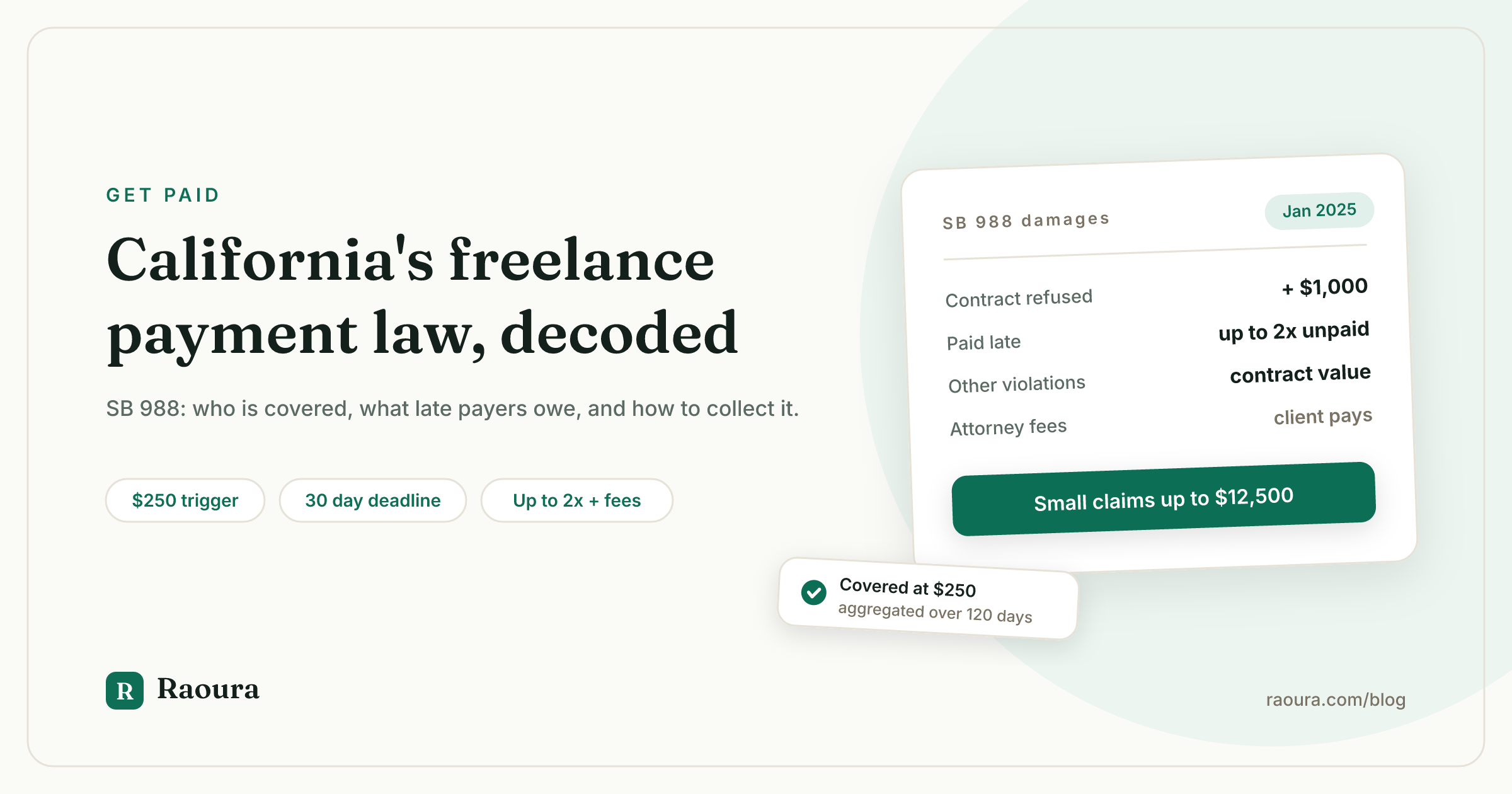
Here is a strange fact about California's freelance payment law: of the five pages that rank for it, three are law firm alerts written for the companies hiring you ("audit your vendor agreements," "train your hiring managers"), one is the raw statute, and none of them shows a freelancer what the damages are worth in dollars or how to actually collect them. The law has been in force since January 1, 2025, and the people it protects are still reading about it through their clients' lawyers.
This is the other version. Every quote and figure below comes from the chaptered text of SB 988, checked this month. If you freelance outside California, the national map of these laws is in our freelance payment laws by state guide.
What is the Freelance Worker Protection Act?#
The Freelance Worker Protection Act (SB 988) requires California clients to give freelancers a written contract for professional services worth $250 or more and to pay by the contract date or within 30 days of completion, with up to double damages for late payment. It was signed September 28, 2024, added sections 18100 to 18107 to the Business and Professions Code, and applies to contracts entered into or renewed on or after January 1, 2025.
It is California's entry in the "Freelance Isn't Free" family: New York City started it in 2017, New York State and Illinois followed in 2024, and California's version has the lowest dollar trigger of any state. It also has the biggest catch: unlike New York and Illinois, there is no government agency to complain to. You enforce this law yourself, in court. More on how below, because that turns out to be less scary than it sounds.
Are you actually covered? The three tests#
You are covered if you pass three tests: you work alone, your work is on a list of 15 "professional services" categories, and a California client owes you $250 or more across the last 120 days. Each test has fine print worth reading before you cite this law to anyone.
Test 1: you are a business of one. The statute defines a freelance worker as "a person or organization composed of no more than one person, whether or not incorporated or employing a trade name." Your single-member LLC counts. The moment you have an employee or partner, you are out.
Test 2: your client is a California hiring party, and not a government or a household. The law covers "a person or organization in the State of California that retains a freelance worker," but excludes the US government, the State of California and its subdivisions, foreign governments, and individuals hiring for personal or family purposes. So a Sacramento startup is covered; a Sacramento homeowner hiring you to design her kitchen is not.
Test 3: your work is "professional services" under Labor Code 2778(b)(2). This is the test that surprises people, because the list is specific and it is not the list you would guess. SB 988 borrows the occupation list California wrote for its AB 5 contractor-classification exemptions:
| Covered by SB 988 (Labor Code 2778(b)(2)) | Common freelance work NOT on the list |
|---|---|
| Marketing (original and creative work) | Software and web developers |
| Graphic design | Virtual assistants |
| Freelance writers, editors, copy editors, translators | Bookkeepers |
| Illustrators and newspaper cartoonists | General business consultants |
| Still photographers, photojournalists, videographers, photo editors | Web designers doing production work |
| Content contributors, advisers, producers, narrators, cartographers | Social media managers (unless the work qualifies as marketing) |
| Fine artists, grant writers, HR administrators | Coaches |
| Travel agents, IRS-enrolled agents, appraisers, foresters | Home inspectors (they are in 2778(c), not (b)(2)) |
| Estheticians, manicurists, barbers, cosmetologists (with conditions) | Tradespeople and construction |
| Specialized performers teaching a master class (one week max) |
We cross-checked that list against the work solo freelancers actually sell, and the gap is the most underreported thing about this law: developers, virtual assistants, bookkeepers, and generic consultants, four of the largest solo freelance categories, are not named anywhere in 2778(b)(2) and so get nothing from SB 988. If that is you, your protection is still contract law and the escalation ladder, plus the Los Angeles ordinance if you work in LA (below).
One more piece of good news from the statute: the old AB 5 caps of 35 submissions per client per year for writers and photographers were removed by AB 2257 back in 2020. The current list SB 988 borrows has no submission caps.
The $250 aggregates. The threshold is met by one contract or by "all contracts for services between the same hiring party and independent contractor during the immediately preceding 120 days." Three $90 blog posts for the same client inside four months total $270, and the written contract requirement applies.
What your client owes you under the law#
A covered client owes you four things: a signed written contract, payment by the contract date or within 30 days of completion, no renegotiation at payment time, and no retaliation. The specifics, section by section:
- A written contract with four required items (section 18103): the name and mailing address of each party; an itemized list of services with their value and the rate and method of compensation; the payment date "or the mechanism by which the date shall be determined"; and the date by which you must submit your list of services rendered so their internal processing can pay you on time. The client must give you a signed copy, physical or electronic, and keep the contract at least four years. Our clause-by-clause contract guide covers the rest of what a good contract needs beyond the statutory minimum.
- Payment on time (section 18102): on or before the contract's payment date, or within 30 days of completing the services if the contract sets no date. This is why you always set a date. "Due on receipt" or net 7 payment terms beat the statutory fallback by three weeks.
- No hostage negotiations (section 18102(b)): once work has begun, the client cannot make timely payment conditional on you accepting "less compensation than the amount of compensation specified by the contract" or providing "more goods or services or grant more intellectual property rights than agreed to in the contract." The pay-you-when-you-throw-in-the-source-files move is now illegal in California. That exact move also tops our contract red flags list.
- No retaliation (section 18105): no adverse action that penalizes you, or would reasonably deter you, from asserting rights under the Act.
- No waivers (section 18104): any contract clause waiving these rights "shall be deemed contrary to public policy and is void and unenforceable." If a client's template says you give up SB 988 protections, that sentence is dead on arrival, and it tells you something about the client.
What you can collect: the damages math#
Late payment can cost a California client up to double the unpaid amount plus your attorney fees, and refusing to put the deal in writing costs an extra $1,000. Section 18106 sets three damages tiers, and it is worth seeing them as dollar figures, because no ranking page shows this:
| Violation | What you can recover | On a $3,000 project |
|---|---|---|
| You asked for a written contract before starting, client refused | $1,000, on top of anything else | $1,000 |
| Client paid late or not at all | Up to twice the amount unpaid when payment was due | Up to $6,000 |
| Any other violation (retaliation, renegotiation demands) | The value of the contract or of the work performed, whichever is greater | $3,000 or more |
| You win on any of it | Reasonable attorney fees and costs, plus injunctive relief | Fees shift to the client |
Two honest notes on that table.
- The statute says "up to twice," not an automatic doubling; the court has discretion, which several freelancer-facing summaries get wrong.
- If the client refused a written contract and then underpaid you, the unpaid amount is measured by "the rate the freelance worker reasonably understood to apply," which means your quote email sets the number. Keep it.
The math worth memorizing: a $3,000 unpaid invoice exposes the client to $6,000 plus your attorney fees, and if they also refused a contract, $7,000 plus fees. Nonpayment in California is now a bet with terrible odds, and your job is simply to make sure the client knows the odds before they place it.
How to enforce it when there is no agency#
There is no state complaint form for SB 988; your enforcement path is a demand letter, then small claims court up to $12,500, then a fee-shifted civil case. New York and Illinois freelancers get a free government complaint channel. California handed you a private right of action instead ("an aggrieved freelance worker or a public prosecutor may bring a civil action"). In practice, the sequence looks like this:
- Cite the statute in your overdue reminder. One sentence: "This invoice is covered by California's Freelance Worker Protection Act (Business and Professions Code 18100 to 18107), which provides up to double damages plus attorney fees for late payment." Most disputes end here, because the client's own counsel will read that sentence correctly. Our payment reminder system shows where this line slots into the cadence.
- Send a demand letter. Same claim, formal wrapper, deadline attached. Template here.
- File in small claims. California's limit for individuals is $12,500, the highest in the country, no lawyers allowed on either side. Here is an alignment nobody seems to have noticed: doubling damages under SB 988 means any invoice up to $6,250 fits inside the small claims cap even at the maximum award. That covers the overwhelming majority of solo freelance invoices. Filing mechanics are in our small claims guide.
- Above that, the fee-shifting does the work. For a five-figure claim, section 18106's attorney fees provision changes the economics: a lawyer can take a strong FWPA case knowing the client pays the fees on a win. That is what makes lawyers answer the phone.
One thing the statute does not give you: a deadline it names. SB 988 is silent on its own limitation period (the four-year figure in the statute is the client's record-retention duty, not your filing window). The nearest guideposts are California's general contract periods, four years written and two years oral. Do not sit on a claim while those questions stay unmapped; file while the paper trail is fresh. And while an invoice is unpaid, remember you can also simply stop work.
The paper trail is the whole game#
Section 18103(c) makes your own email a weapon: an oral deal is still enforceable, and your written summary sent before starting work counts as evidence of the contract's terms. This is the most freelancer-practical clause in the statute and almost no coverage mentions it. If a client will not sign, the law explicitly lists what proves the deal anyway: their representations about your rate, "email, text message, or other electronic communication" you sent summarizing the terms before performing, and the fact that you did the work.
So the discipline is simple and it is the same discipline that wins every payment dispute anywhere: written contract, dated request if they refuse, itemized invoice, due date, dated reminders. The freelancers who collect double damages will be the ones who can produce that file in twenty minutes.
This is where your tooling either helps or does not. Raoura keeps the contract, the e-signature record, the invoice, its due date, and every reminder attached to the client they belong to, so the evidence file SB 988 rewards assembles itself as a side effect of normal work. Disclosure: Raoura is our product.

The signed copy SB 988 requires your client to furnish, stored with a signing record, which is exactly the exhibit a small claims judge wants to see.
!The invoices list in Raoura showing status, due dates, and overdue invoices flagged per client

Due dates and overdue flags in one list: the "amount that remained unpaid at the time payment was due" is the number double damages are computed from, so knowing it per invoice matters.
In Los Angeles, a second law fills the gaps#
If you work inside the City of Los Angeles, the city's Freelance Workers Protections Ordinance covers work SB 988 does not, at a $600 threshold with no professional-services restriction. In November 2025 the city revised its rules to clarify the split: for contracts from 2025 on, the state law governs where it applies, and the LA ordinance covers LA work that falls outside SB 988's professional services definition. Translation for the left column of the table above: an LA-based web developer or virtual assistant, invisible to SB 988, still gets a written contract requirement and damages under city law. The LA details, and every other city and state law, are in the national map.
Frequently asked questions
I am outside California but my client is in California. Am I covered?
Unresolved. The statute requires the hiring party to be "in the State of California" but puts no location requirement on the freelance worker, and no court has mapped the edge yet as far as we can find. The practical move: cite the statute in your demand letter anyway and let the client's lawyer decide whether jurisdiction is the hill to fight on over a four-figure invoice.
Is there a state agency I can complain to, like New York or Illinois?
No. SB 988 created no complaint channel and gave the Labor Commissioner no role. Enforcement is a civil action by you or a public prosecutor. For invoice-sized amounts that means small claims court, up to $12,500 for individuals.
Do web developers, virtual assistants, or bookkeepers get SB 988 protection?
No. Coverage is limited to the occupation list in Labor Code 2778(b)(2), and none of those roles appears on it. Inside the City of Los Angeles, the city ordinance covers them instead at $600. Everywhere else in California, they rely on ordinary contract law.
Does the law apply to my existing contracts?
It applies to contracts entered into or renewed on or after January 1, 2025. A contract signed in 2024 that renews in 2026 comes into scope at renewal.
Is the $250 threshold per invoice?
No, it aggregates: one contract alone, or all contracts with the same client over the preceding 120 days. Three $90 projects inside four months cross the line.
Can a client make me waive these rights in the contract?
No. Section 18104 voids any waiver as contrary to public policy. The rights survive whatever the template says.
My client says they will pay on time only if I hand over extra IP or accept less. Legal?
Not anymore. Section 18102(b) prohibits conditioning timely payment on accepting less compensation or granting more work or IP than the contract specifies. That demand is itself a violation with its own damages tier.
What if we never signed anything at all?
You can still enforce the deal. Section 18103(c) preserves oral contract and promissory estoppel claims, and your pre-work summary email counts as evidence of the terms. If you asked for a written contract in writing and were refused, add $1,000 to the claim.
---
Every quote, threshold, date, and damages figure in this article was verified in July 2026 against the chaptered text of SB 988 (California Business and Professions Code sections 18100 to 18107), Labor Code section 2778, the California courts' small claims self-help pages ($12,500 individual limit), and the City of Los Angeles November 2025 ordinance rules update. No SB 988 amendments or published court decisions were identified as of July 2026. Statutes change; check the linked primary sources before relying on any figure.
Run your client work in one place
Send a proposal, get it signed, invoice, and get paid, with a branded portal your clients will actually use. One flat plan at $17/month, and we never take a cut of your payments.
Try Raoura free for 14 daysNo credit card required. Set up in minutes.
Keep reading
Is Upwork Worth It in 2026? A Break-Even Test for Your Situation
Upwork is worth it when its fee costs less than finding the client yourself, and that is true far more often for a first project than for a repeat client. Here is the break-even math with 2026 numbers: the 0 to 15% fee, Connects, the shrinking client base, and when to wait out the 24-month rule instead of paying to leave.
The Virtual Assistant Contract: 24 Clauses, Scored Against Every Template Ranking for This Search
We scored the four pages that publish actual virtual assistant contract text against 24 clauses a VA agreement needs. Twenty-four of 96 possible slots were filled. The best single template managed 7 out of 24. Twelve clauses appear in none of them, including every clause about the thing that makes VA work different from other freelance work: you are holding your client's passwords and running their inbox. One popular template also tells you a contract fixes your independent contractor status, then mandates client-set 9 to 5 weekday hours in the same document. Here is the clause-by-clause version, with the classification test the DOL is actually applying in 2026, the data protection terms nobody drafts, and the retainer mechanics that decide whether unused hours roll over.
Stripe vs PayPal for Freelancers: Every Fee Verified (2026)
Every page ranking for this comparison either prints in-person retail rates, contradicts itself, or skips the numbers freelancers actually pay. We read the current Stripe and PayPal pricing pages line by line, ran a $3,000 invoice through every rail, and found a $1,764 per year gap between the cheapest setup and the default one.