Client Onboarding for a Team of One
July 6, 2026
The client said yes. That moment is the most dangerous point in a freelance project, because everything that will go wrong later, the scope that balloons, the invoice that goes quiet, the feedback that arrives from three people who were never mentioned, gets decided in the next 48 hours, while you are busy feeling relieved.
Before writing this guide we fetched every page ranking on the first page for this query in July 2026, and two things stood out:
- Every single one gates its actual checklist behind an email capture, a paid template bundle, or a product trial; the "checklist" articles do not contain checklists.
- None of them mention that a written contract, the step they all list as a nice best practice, has been a legal requirement for freelance work in California since January 2025 and in Illinois since July 2024.
This article publishes the whole system ungated and treats onboarding as what it actually is for a business of one: not a welcome-packet etiquette exercise, but the machinery that protects your revenue.
Onboarding is not admin. It is how you keep money you already earned.#
Freelancers with written contracts earn income that is 13.7% higher on average than those without, and 67% of freelance work arrives through word of mouth and referrals, which makes onboarding both your payment protection and your marketing.
Every step in an onboarding sequence maps to a measured failure mode further down the project:
- Skip the contract, and you join the freelancers earning the lower number in that ILR Review study of Freelancers Union survey data, which also found that even with a contract, 38.8% of freelancers still had payment trouble at some point. Without one, you have far less recourse: a Freelancers Union survey of more than 5,000 freelancers found 71% have struggled to collect payment at least once, losing an average of nearly $6,000 a year when it happens.
- Skip the written scope, and you are volunteering for the statistic that 52% of projects experience scope creep, per PMI's Pulse of the Profession, and that figure comes from projects run by professional project managers, not solo freelancers negotiating alone.
- Skip the deposit invoice, and your first payment experience with this client happens at the end, when your leverage is gone. Bonsai's analysis of three years of invoices across 100,000+ freelancers found 29% of invoices are paid at least a day late. The deposit is how you find out on day one, with 25 to 50 percent of the fee, whether this client pays promptly, instead of finding out on day sixty with all of it.
And the referral half is just as mechanical. If two thirds of freelance work comes through word of mouth, then the client's experience of working with you is your acquisition channel, and onboarding is the first thing that experience is made of. A client who got a clear proposal, a signable contract, a payment link that worked, and a kickoff agenda inside two days has a story to tell the next person who asks "do you know anyone good?"
The five documents (this is the whole system)#
A complete solo onboarding system is five reusable documents: an intake questionnaire, a proposal, a contract, a deposit invoice, and a kickoff agenda. You build each one once, then reuse it on every project forever. Nothing else on the ranking pages, the welcome eBooks, the brand videos, the team introductions, is load-bearing.
1. The intake questionnaire. Five to ten questions that collect what you always end up asking anyway: decision maker and final approver, goal of the project in the client's own words, deadline and what is driving it, budget range if not already agreed, access you will need (accounts, brand files, existing assets), and how they prefer to communicate. Its second job is quiet vetting: a client who cannot name a single decision maker is telling you something worth knowing now, and the same red flags that show up in contracts show up first in intake answers.
2. The proposal. A one-page restatement of what they are buying: deliverables, what is explicitly not included, timeline, price, and payment schedule. Even when the deal is already agreed verbally, send it. Speed matters more than polish here: Proposify's analysis of millions of proposals found half of all proposals are opened within 74 minutes of sending, and the median time-to-close for winning proposals is 51.4 hours, with 42.5% of eventual wins closing within 24 hours of being opened. Clients decide fast. The freelancer whose paperwork shows up while the enthusiasm is warm wins more of these than the better freelancer whose paperwork shows up next week.
3. The contract. The clause-by-clause anatomy is its own guide, what should be in a freelance contract, but for onboarding purposes the contract needs five things nailed down: scope and exclusions, payment schedule with late terms, a revision limit, ownership and licensing terms, and what happens if either side walks away. If the project is bigger than a week or two, define done properly with a statement of work. As the next section covers, in several states this document is no longer optional.
4. The deposit invoice. Sent the moment the contract is signed, due before work begins. How much deposit to charge has its own decision table, but 25 to 50 percent is the working range for most project types. The deposit is not just cash flow; it is the client's first repetition of the behavior you want for the rest of the project, which is paying you through a real payment link on a real invoice. For longer projects, the deposit is simply the first milestone in a milestone billing structure where you are never owed more than one phase.
5. The kickoff agenda. A 30-minute call, agenda sent in advance, held after the deposit clears. Confirm the intake answers out loud, walk through the timeline and what you need from them by when, name the feedback process and the revision limit, and agree on the communication channel. The kickoff is where you install the habits that prevent the "just one quick change" conversation later, because every boundary is easier to state before the work starts than after it slips.
The 48-hour sequence, hour by hour#
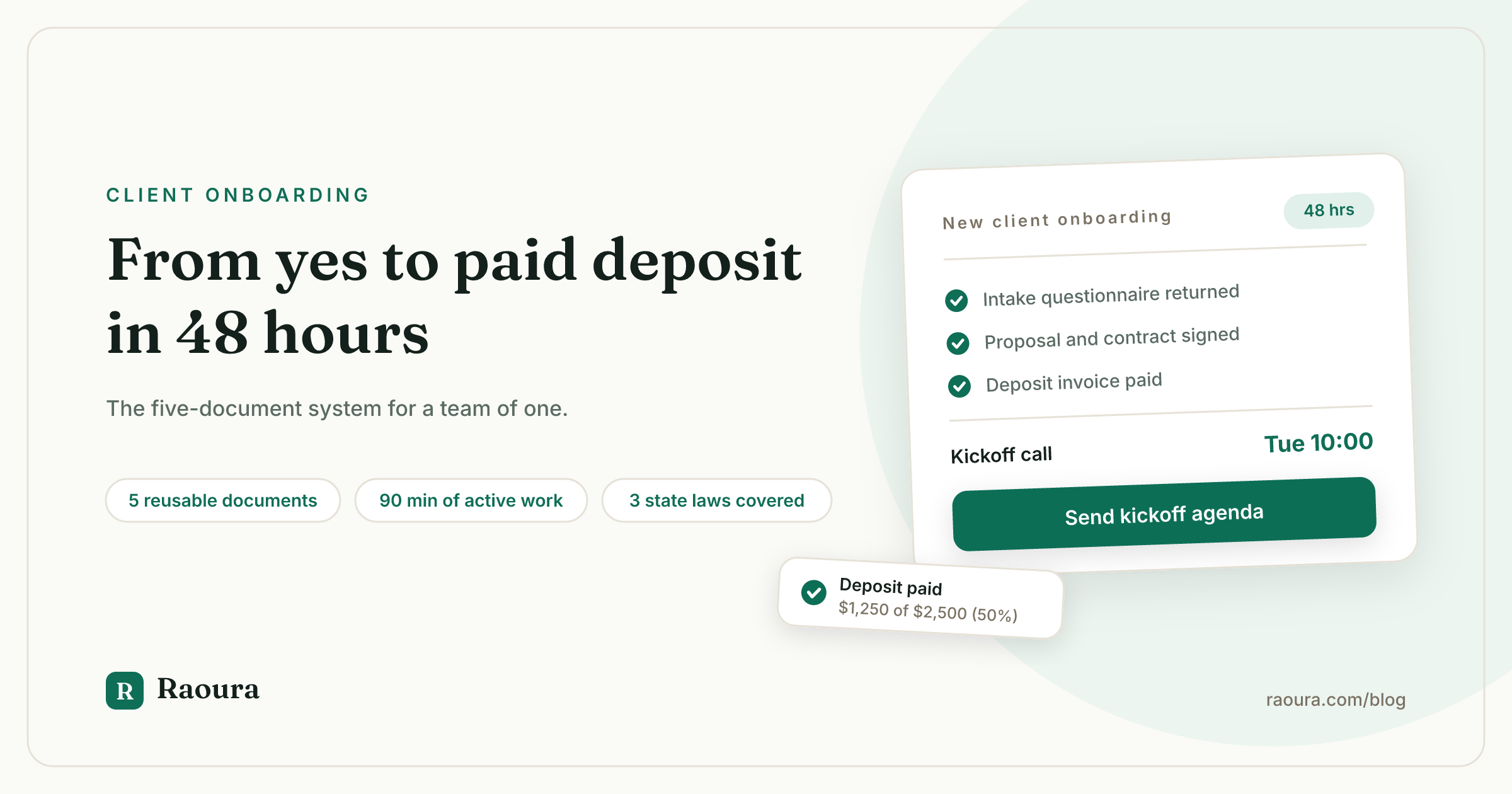
From "yes" to a paid deposit should take 48 hours or less and, once your five documents are templated, about 90 minutes of your active work. That 90-minute figure is our own recommendation from building this system, not an industry statistic; the table below is the complete checklist the ranking pages gate.
| When | What you send | Document | Active work |
|---|---|---|---|
| Within 2 hours of "yes" | Thank-you email with the intake questionnaire link | Intake questionnaire | 10 min |
| Within 24 hours | Proposal: scope, exclusions, timeline, price, payment schedule | Proposal | 30 min |
| With the proposal | Contract, ready for e-signature | Contract | 10 min |
| The moment it is signed | Deposit invoice with a payment link, due before work begins | Deposit invoice | 5 min |
| When the deposit clears | Welcome note: what happens next, where files live, kickoff booking link | (email) | 5 min |
| Within 48 hours | 30-minute kickoff call, agenda sent ahead | Kickoff agenda | 30 min |
Total: 90 minutes of active work spread across two days. The elapsed time mostly belongs to the client, which is fine, because each document creates a natural deadline for them rather than for you.
Two sequencing rules matter more than the exact hours:
- Work never starts before the deposit clears. The moment you break that rule once, the deposit becomes decorative.
- The kickoff call happens after the money, not before, because a kickoff before payment is a free consulting session with a prospect, while a kickoff after payment is the first working session with a client.
If the client goes quiet mid-sequence, opened the proposal, never signed, one nudge at 48 hours and one at a week is enough. A prospect who cannot complete paperwork while excited is showing you what they will be like paying invoices while bored.
The contract step is now the law in three states#
Since 2024, a written contract for freelance work is legally required at $250 or more in California, $500 or more in Illinois, and $800 or more in New York, in each case aggregated across all contracts with the same client over the preceding 120 days. This is the single largest fact missing from every page ranking for this keyword.
| State | Law | Written contract required at | Effective |
|---|---|---|---|
| California | [Freelance Worker Protection Act, SB 988](https://leginfo.legislature.ca.gov/faces/billNavClient.xhtml?bill_id=202320240SB988) | $250+ per client over 120 days | January 1, 2025 |
| Illinois | [Freelance Worker Protection Act](https://labor.illinois.gov/faqs/freelance-worker-protection-act.html) | $500+ per client over 120 days | July 1, 2024 |
| New York | [Freelance Isn't Free Act](https://dol.ny.gov/freelance-isnt-free-act) | $800+ per client over 120 days | August 28, 2024 |
Note the aggregation rule, because it catches exactly the client relationships freelancers run informally: three $100 tweaks for the same California client inside four months crosses the $250 line. All three laws also set payment deadlines (30 days after completion when the contract is silent) and attach real penalties, including double damages for nonpayment; the full mechanics, plus which state's law applies when you and the client are in different places, are in our freelance payment laws guide.
For onboarding, the practical effect is that the awkward contract conversation is gone in these states. You are not imposing paperwork; you are complying with the law, and both Illinois and New York publish free model contracts. "My contract keeps us both compliant with the Freelance Worker Protection Act" is a sentence that ends the discussion.
When the client resists the process#
Offer one accommodation on format and zero on substance: the written contract, the deposit, and the scope in writing are the three items you never waive. Most pushback is not malice; it is friction, and each flavor has a clean answer.
"Can we just get started? We're in a hurry." Speed is the system's strong suit, so agree enthusiastically: "Absolutely. Fastest path is the same as the careful path: sign here, pay the deposit link, and I start tomorrow morning." If the hurry survives a 10-minute signature and a card payment, it was real. A client whose urgency evaporates when it requires anything from them was not in a hurry; they were testing whether your process is negotiable.
"We don't do contracts for small stuff." In California, Illinois, and New York, the law now answers this for you. Elsewhere, keep the tone light and the position fixed: "It's one page and it protects your deposit as much as my fee." A client who refuses one page of terms is declining to say, in writing, what they owe you. Treat that as the answer it is.
"We'll pay the invoice, we just can't do deposits." Sometimes this is a real accounts-payable constraint, which is why the accommodation you offer is format, not substance: a smaller first milestone due on signing, or net-15 terms on the deposit invoice for a client with a procurement process. What never changes is that some money moves before the work starts. The refusals worth walking away from, and the scripts for the ones that are salvageable, are spelled out in our payment terms guide.
The quiet benefit of holding the line is selection. The clients who flow through the system without friction are, overwhelmingly, the ones who pay on time later; the escalation ladder for the ones who do not exists, but the cheapest unpaid invoice is the one you never let happen.
Repeat clients and retainers: what you skip#
A repeat client skips two of the five documents, the intake questionnaire and usually the kickoff call, but never skips the three that carry money: the scope, the contract, and the deposit invoice. The failure pattern with repeat clients is warmth-induced informality: the second project arrives by text message, gets confirmed by emoji, and eight weeks later nobody agrees on what "the same as last time, plus a few extras" meant.
The repeat sequence is three artifacts and one day: a short scope note (even five bullet points in the proposal template), a fresh contract or a signed amendment referencing the original terms, and the deposit invoice. In the aggregation states above, the second project is often precisely what pushes the relationship over the legal threshold, so "we did the last one on a handshake" is an argument for the contract, not against it.
Retainers front-load the onboarding instead of repeating it: one contract defining the monthly scope, the rollover rule, and the exit terms, then an invoice that recurs without you touching it. Onboarding a retainer client well is mostly about defining what a month includes before the first month starts, and it deserves its own guide, which is on our roadmap.
Running it with one tool instead of eight#
Everything above is five documents and one place to send them from; a folder of templates and a calendar does it for free, and Raoura does it for $17 a month flat. The most experienced practitioner guide ranking for this keyword, written by a design consultancy veteran, assembles its onboarding from a separate e-signature tool, a form tool, a file-sharing tool, an email scheduler, and several more, and that stack is exactly the part that has aged: every tool is another subscription, another login for the client, and another seam where a project can leak.
The honest failure mode of any onboarding system is not building it; it is running it the eleventh time, at 9pm, when the templates are in four places and the client is waiting. That gap is the reason Raoura exists: proposal, contract with e-signature, deposit invoice, and the client portal where intake answers, files, and milestones live are one flow, so "yes" to a paid deposit is a sequence of sends rather than a scavenger hunt. Payments go through your own Stripe account, and Raoura takes no cut of them, a design choice we explain in why your client tool should never touch your money. Disclosure: Raoura is our product, and every step in this article works identically if you run it from Google Docs, a free e-signature tool, and a spreadsheet; you will just be the automation.

The 48-hour sequence as software: the moment your client says yes, the contract and the deposit invoice are one click each instead of fresh documents.
Whichever way you run it, the system beats the tool. A freelancer with five solid templates and no software onboards better than a freelancer with an all-in-one CRM and no system.
The first message after the contract sets the tone; copy our project kickoff email template so it goes out the same day.
Frequently asked questions
How long should client onboarding take for a freelancer?
From "yes" to a paid deposit, 48 hours or less, with about 90 minutes of your active work once your documents are templated. The elapsed time is mostly the client's (reading, signing, paying), and each document gives them a concrete next action, which is why the two-day version usually outruns the "we'll get the paperwork sorted eventually" version by weeks.
What should a client onboarding checklist include?
Six sends across five documents: intake questionnaire within 2 hours of yes, proposal within 24 hours, contract with the proposal, deposit invoice on signature, welcome note when the deposit clears, kickoff call within 48 hours. The full table above is the checklist; there is nothing gated behind this article.
Do I really need all five documents for a small project?
Compress the documents, never the functions. For a $400 logo, the proposal and contract can be one page and the kickoff can be a phone call, but the scope in writing, the signature, and the deposit stay, and if your client is in California, a written contract at $250+ is required by law. The contract-for-small-projects question has a longer answer, but "small" is exactly where handshake deals go to die, because neither side thinks the stakes justify a difficult conversation later.
Should the kickoff call happen before or after the deposit is paid?
After. A kickoff before payment is a free strategy session with a prospect who has not committed. If the client wants a call before signing, keep it to 15 minutes and treat it as a sales call: answer questions about the proposal, then route back to the signature. The working session starts when the working relationship has, which is when money has moved.
What if the client insists on using their own contract?
Read it before signing; client paper is written to protect the client. Check the payment terms, ownership and licensing language, and anything that smells like unlimited revisions or indemnity, and run it against our contract red flags list. Signing their contract with two or three redlined changes is a normal, professional move, and how a client reacts to reasonable redlines is itself useful onboarding data.
How big should the deposit be?
25 to 50 percent for most project work, sized to the client type and project length; the decision table lives in our deposit guide. On projects longer than a month, think of the deposit as milestone one of a payment schedule where you are never owed more than one phase.
Does onboarding actually affect whether I get paid?
It is the strongest lever you control. Contract use is associated with 13.7% higher income, 29% of freelance invoices run late, and 71% of freelancers have had trouble collecting at least once. Every one of those numbers is decided, or at least heavily loaded, by what you send in the first 48 hours.
---
Every statistic and legal claim in this article was verified against primary sources in July 2026: the ILR Review study of Freelancers Union survey data, the Fiverr 2024 Freelance Economic Impact Report, PMI's Pulse of the Profession scope creep research, Bonsai's invoice dataset, the Freelancers Union nonpayment survey, Proposify's proposal timing data, the Illinois Department of Labor FWPA FAQ, the California Legislature's SB 988 text, and the New York DOL Freelance Isn't Free Act pages.
Run your client work in one place
Send a proposal, get it signed, invoice, and get paid, with a branded portal your clients will actually use. One flat plan at $17/month, and we never take a cut of your payments.
Try Raoura free for 14 daysNo credit card required. Set up in minutes.
Keep reading
Is Upwork Worth It in 2026? A Break-Even Test for Your Situation
Upwork is worth it when its fee costs less than finding the client yourself, and that is true far more often for a first project than for a repeat client. Here is the break-even math with 2026 numbers: the 0 to 15% fee, Connects, the shrinking client base, and when to wait out the 24-month rule instead of paying to leave.
The Virtual Assistant Contract: 24 Clauses, Scored Against Every Template Ranking for This Search
We scored the four pages that publish actual virtual assistant contract text against 24 clauses a VA agreement needs. Twenty-four of 96 possible slots were filled. The best single template managed 7 out of 24. Twelve clauses appear in none of them, including every clause about the thing that makes VA work different from other freelance work: you are holding your client's passwords and running their inbox. One popular template also tells you a contract fixes your independent contractor status, then mandates client-set 9 to 5 weekday hours in the same document. Here is the clause-by-clause version, with the classification test the DOL is actually applying in 2026, the data protection terms nobody drafts, and the retainer mechanics that decide whether unused hours roll over.
Stripe vs PayPal for Freelancers: Every Fee Verified (2026)
Every page ranking for this comparison either prints in-person retail rates, contradicts itself, or skips the numbers freelancers actually pay. We read the current Stripe and PayPal pricing pages line by line, ran a $3,000 invoice through every rail, and found a $1,764 per year gap between the cheapest setup and the default one.