The Project Kickoff Email: 7 Templates for Solo Freelancers
August 30, 2026
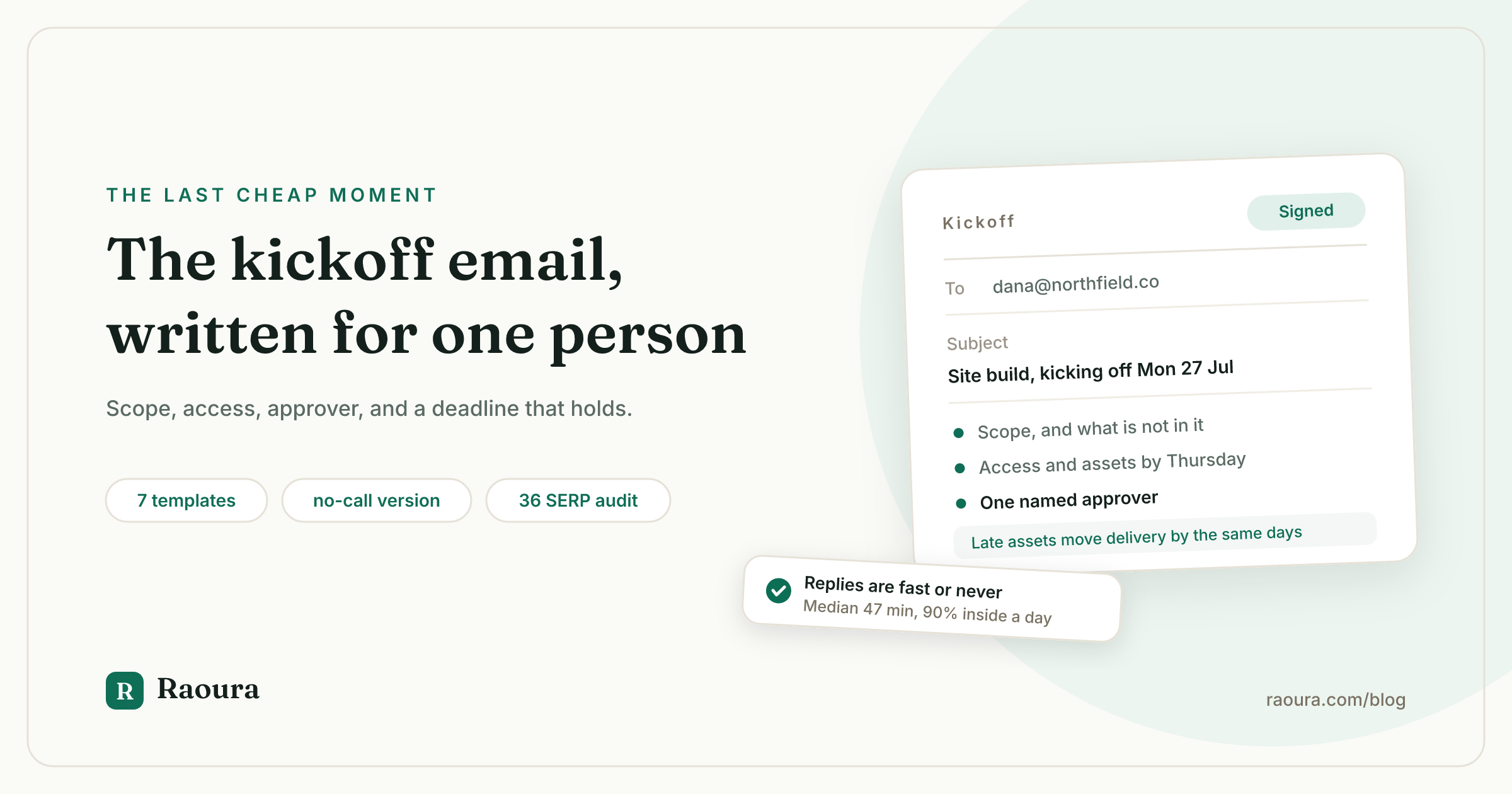
Before writing this we fetched the seven pages ranking for "project kickoff email" and its close variants in July 2026 and read every one of them end to end. Here is what we counted.
Between them, those seven pages contain 36 kickoff or kickoff-adjacent email templates. Thirty-five are written from a project manager to an internal team, a board, or a group of stakeholders. They assume a signed project charter, an executive sponsor, a slide deck, a QA team, and a resource plan. One page is written for freelancers at all, and it covers welcome emails rather than the kickoff itself.
That mismatch is not cosmetic. The standard kickoff agenda that every ranking page recommends has a "roles and responsibilities" section, and for a corporate PM that section allocates work across a team.
For you, that section has exactly one job: telling the client what you need from them, by when, and what happens if it does not arrive.
Same heading. Completely different document.
So this article writes the freelancer version. Seven templates, each with when to use it, the subject line, the full email, and the one line inside it that is doing the real work. No email capture, no download. The copy is on the page.
What a kickoff email actually is for a freelancer#
A freelance kickoff email is the message you send after the contract is signed and before the work starts, and its real job is to convert everything you agreed verbally into a written record the client has seen and not objected to.
The meeting logistics are the surface. The record is the point.
Six weeks from now, when the client says they always assumed two rounds of revisions were included per page rather than per project, the argument gets settled by whatever is in writing. Your contract is the first line of defence. The kickoff email is the second, and it is the one written in plain English that the client actually read.
Here is where it sits relative to the other documents people confuse it with:
| Document | When it goes out | Who it is for | Main job |
|---|---|---|---|
| [Intake form](https://www.raoura.com/blog/client-intake-form-freelance) | Before you quote | You | Collect facts so you can price the work |
| [Proposal](https://www.raoura.com/blog/freelance-proposal-template) | Before signature | Client | Sell the scope and the price |
| [Contract](https://www.raoura.com/blog/what-should-be-in-a-freelance-contract) | At signature | Both | Define obligations and remedies |
| [Welcome packet](https://www.raoura.com/blog/client-welcome-packet) | After signature, longer projects | Client | Explain the contract in plain language |
| **Kickoff email** | After signature, before work starts | Client | Confirm start, name what you need, set the first deadline |
| Recap email | Within 24 hours of the kickoff call | Client | Record what was decided and what changed |
If your project runs under about two weeks, skip the welcome packet and let the kickoff email carry the whole load. Template 2 below is built for exactly that.
When to send it, and the one timing number worth knowing#
Send the kickoff email within one business day of the contract being signed, and if it requests a meeting, send it at least three business days before the proposed slot.
The one business day rule is not about efficiency theatre. It is about catching the client while the decision is still fresh and the internal approval that got you signed is still recent enough to remember.
The timing that most freelancers get wrong is the reply deadline, not the send.
The largest published study of email reply behaviour, Kooti et al., "Evolution of Conversations in the Age of Email Overload" (WWW 2015), analysed 16 billion emails from more than 2 million users and found that the median reply arrives 47 minutes after the message, and more than 90% of all replies that will ever come arrive within a day. The single most likely reply time was two minutes.
That is consumer webmail rather than business email, and it is a decade old, so treat it as directional. But the shape of the finding is the useful part: replies are fast or they are never.
The practical consequence is that "at your earliest convenience" is not a soft deadline. It is no deadline, and a message with no deadline drops off the end of the 24 hour window and joins the pile.
Every template below carries a named date instead. Compare:
At your earliest convenience, could you send over the brand files?
I need the brand files and the staging login by Thursday 24 July. If they land later than that, the delivery date moves out by the same number of days.
The second one gets answered on Thursday. The first one gets answered in October.
The seven blocks a freelancer kickoff email needs#
Every ranking page lists five agenda items: project overview, scope, roles, timeline, and Q&A. Three of those five belong in a corporate kickoff and do nothing for you. Here is the replacement set.
| Block | What it says | Why a freelancer needs it |
|---|---|---|
| 1. Confirmation | The project is on, starting [date] | Ends the ambiguity between signature and start |
| 2. Scope in one paragraph | What you are delivering, in the client's words | The plain-English version they will remember |
| 3. Explicitly out of scope | Two or three things you are not doing | The cheapest [scope creep](https://www.raoura.com/blog/scope-creep-scripts-for-freelancers) prevention available |
| 4. What you need from them, with a date | Assets, access, decisions | The single biggest cause of freelance delays |
| 5. Who approves | One named person | Prevents the committee problem |
| 6. Money and dates | Deposit status, milestone dates, invoice timing | Nobody is surprised by an invoice |
| 7. Where the project lives | One link | Stops the project living in an email thread |
Blocks 3, 5 and 7 appear on none of the pages currently ranking for this term. They are also the three that will save you the most money.
Block 5 deserves a note. The most reliable way a scoped project comes apart is that the person who signed is not the person who reviews, and a third person appears in week four with opinions. Name your approver in the kickoff email in one sentence and it is on the record: "I will treat your sign-off as final approval at each stage."
Template 1: The standard project kickoff, with a call#
Use this for a fixed-scope project over about two weeks, with a new client, where you want a kickoff call.
Subject: Northfield site build, kicking off Monday 27 July
Hi Dana,
Contract is signed, deposit received, and we are on. I am starting the Northfield site build on Monday 27 July with delivery on Friday 5 September.
What I am building: a five page marketing site on your existing hosting, with the blog migrated from the current CMS, plus one round of responsive fixes after launch.
What is not included, so it is clear now rather than later: copywriting, photography, and any pages beyond the five listed in the contract. If you want any of those, I will send a change order with a price and a date before I start.
What I need from you by Thursday 24 July: logo files in SVG or AI, brand colour and font references, hosting and DNS access, and your Google Analytics login. If those land after Thursday, the delivery date moves by the same number of days.
Approvals: I will treat your sign-off as final at each stage. If someone else needs to review, tell me who now so I can build their round into the timeline rather than adding it later.
Money: the 40% deposit is paid. The next invoice is 30% on design approval (around 12 August) and the final 30% on delivery, both net 14.
Kickoff call: are you free Monday 27 July at 10:00 or 14:00 UK time? It takes 30 minutes and we will cover the sitemap, who your reviewers are, and anything in the brief that has changed since May. Link to follow once you pick a slot.
Everything for this project lives here: [project link]. Files, milestones, invoices, and approvals are all in one place, so nothing gets lost in this thread.
Looking forward to it.
Alex
That out-of-scope paragraph is the one most freelancers cut for length. Keep it, and pair it with a real change order process so the client learns early that extras are priced rather than absorbed.
The line doing the work: "If those land after Thursday, the delivery date moves by the same number of days." It is not a threat and it is not a fee. It is a stated consequence, which is far easier to enforce than a penalty and almost never gets pushed back on. Clients argue about late fees. They do not argue about arithmetic.
Template 2: The async kickoff, no call at all#
This is the version nothing on the first page of Google offers, and it covers a large share of real freelance projects. Use it for short work, repeat clients, small budgets, or any client who will not turn up to a call.
Subject: Starting your logo refresh Monday, three things I need first
Hi Sam,
Signed and paid, thank you. I am starting Monday 27 July and you will have first concepts on Friday 31 July.
No call needed for something this size, so here is everything in writing instead.
Scope: three logo concepts, one chosen concept refined through two revision rounds, final files in SVG, PNG and EPS. Not included: brand guidelines, social templates, or a fourth concept.
Three things I need by Thursday:
1. Any existing logo files you have, even old ones
2. Three to five brands whose look you like, with one line each on why
3. Confirmation that you are the only person approving this
If anything arrives after Thursday, Friday's delivery moves back by the same number of days. That is not a penalty, it is just how the week works.
Revisions: two rounds on the chosen concept. A round means one consolidated set of notes from you, not a series of separate emails. Anything past round two is billed at my hourly rate, quoted first.
Invoicing: balance due on delivery, net 14, and I will send it the same day I send the files.
Reply "yes" to this and I will treat it as confirmed.
Alex
The line doing the work: "A round means one consolidated set of notes from you, not a series of separate emails." That definition is the difference between two revision rounds and eleven. It costs one sentence here and it is nearly impossible to introduce later without looking like you are moving the goalposts. We go deeper on this in how many revision rounds to put in a contract.
Template 3: The retainer kickoff#
Retainers fail differently from projects. The failure is not scope creep on one deliverable, it is the slow expansion of what "available" means. Set the boundary in month one.
Subject: Retainer starts 1 August, here is how each month runs
Hi Priya,
Your retainer starts 1 August. Here is the rhythm so we both know what a normal month looks like.
Included each month: 20 hours of development work, priority response within one business day, and a monthly summary of what shipped.
Not included: emergency weekend work, new feature builds over 8 hours, and anything for the other two brands in the group. Those get quoted separately.
How the month runs: you send priorities by the 1st, I confirm what fits in 20 hours by the 3rd, work runs to the 25th, and you get the summary and the next invoice on the 28th.
Unused hours do not roll over. That is deliberate: rollover turns a retainer into a bank account and the last month always becomes a scramble.
Overage: if we go past 20 hours I will tell you before it happens, not after, and you decide whether to approve it or push the work to next month.
Invoicing: £2,400 on the 28th for the following month, net 7, and the first invoice is already with you.
Anything in there you want to change, tell me this week rather than in September.
Alex
The line doing the work: "I will tell you before it happens, not after." Every retainer dispute we have seen described in public comes from an overage invoice the client did not see coming. More on the billing mechanics in retainer invoicing and the retainer agreement template.
Template 4: The repeat client kickoff#
Repeat clients need four lines, not forty. Sending a returning client the full onboarding treatment reads as though you have forgotten who they are.
Subject: Round two, starting Monday
Hi Dana,
Signed, thank you. Same process as the site build: I start Monday 27 July, first draft with you Friday 7 August.
Two things changed from last time. Revisions are two rounds rather than three, and the deposit is now 50%, which is on the invoice I sent this morning.
I already have your brand files and hosting access. The only new thing I need is the product photography, by Thursday.
Same project link as before, new project inside it.
Alex
The line doing the work: "Two things changed from last time." Repeat clients assume last year's terms apply until you say otherwise, and the assumption is reasonable. Name the changes in the kickoff email and you never have to have the conversation in week six. This is also the natural moment to apply a rate increase.
Template 5: The access and assets request#
Sometimes the kickoff has already happened and you still cannot start, because the logins have not arrived. Send this as a standalone message so it does not get buried.
Subject: Blocked on three items, can you send by Thursday?
Hi Dana,
Quick one. I am ready to start Monday but three things are outstanding:
1. Hosting login (or add me as a user on the account: alex@example.com)
2. Logo in SVG or AI, not the PNG from the deck
3. Confirmation that Marcus is not reviewing this round
If you can get me all three by end of Thursday, Monday's start holds and the 5 September delivery date is safe. If they land Friday or later, both move by the same number of days and I will send you a revised schedule.
If it is easier, upload them straight here: [project files link].
Alex
The line doing the work: "or add me as a user on the account." Half the delay in getting credentials is the client hesitating to email you a password. Give them the alternative and the block clears the same day.
Never accept credentials over email if you can avoid it, and never store them in a mail thread you cannot revoke.
Template 6: The nudge when the client goes quiet#
Not one of the seven ranking pages covers this, and it is the most common thing that actually happens after you hit send.
Subject: Northfield build, holding your Monday start
Hi Dana,
Following up on Tuesday's email. I have not had the brand files or the hosting access yet, so I cannot start Monday as planned.
I am holding the slot until Wednesday 30 July. If the files arrive before then, delivery stays at 5 September. After Wednesday I will need to reschedule you into the next available window, which is currently the week of 18 August, and delivery moves to around 26 September.
No problem either way, I just need to know which one so I can plan the rest of the month.
Alex
The line doing the work: the specific replacement date. "Let me know when you are ready" gives the client nothing to react to. A named alternative that is genuinely worse for them produces a reply, because now silence has a cost that is visible.
If this is the second or third nudge and you are still getting nothing, the situation has changed from a scheduling problem to a client problem, and the escalation ladder applies.
Template 7: The post-kickoff recap#
Send this within 24 hours of the kickoff call, every time, with no exceptions, because it is the only written record of what changed on that call.
Verbal agreements on a kickoff call are the single most common source of the "but you said" argument, and they are entirely preventable.
Subject: Kickoff notes, Northfield site, 27 July
Hi Dana,
Good call. Writing down what we agreed so we are both working from the same version.
Confirmed: five pages as scoped, blog migration included, launch on 5 September.
Changed on the call: you asked to swap the "Team" page for a "Case studies" page. Same page count, so no change to price or timeline. I have updated the sitemap.
You are taking on: writing the case study copy, with a deadline of 15 August so it does not hold up design.
Still open: whether the blog needs categories. You are checking with Marcus and coming back to me by Friday. If I do not hear by Friday, I will build it without categories and adding them later becomes a change order.
Next from me: wireframes on 5 August.
If any of that does not match your notes, tell me today rather than later.
Alex
The line doing the work: "If I do not hear by Friday, I will build it without categories." Open questions with no default answer sit open for the whole project and then become your fault. Give every open question a default and a date, and it either gets resolved or it resolves itself in your favour.
The "changed on the call, no change to price" line matters too. Say it explicitly even when a change is free, because it establishes that changes are things which get priced, and the next one might not be free. That is the groundwork for the statement of work holding up.
Subject lines: what to write and what to avoid#
The subject line has one job, which is to be findable in the client's inbox in November when someone asks what was agreed.
| Write this | Not this | Why |
|---|---|---|
| Northfield site build, kicking off Monday 27 July | Kickoff | Project name plus date is searchable |
| Blocked on three items, can you send by Thursday? | Following up | States the ask and the deadline |
| Kickoff notes, Northfield site, 27 July | Great speaking today! | Recap emails get searched for later |
| Retainer starts 1 August, here is how each month runs | Welcome aboard! | Tells them there is something to read |
| Round two, starting Monday | Project Kickoff Meeting Invitation | Nobody opens a document title |
One rule underneath all of those: put the date in the subject line whenever the email contains a deadline. It survives forwarding, and it is the thing you will search for.
The three things that make a kickoff email hold#
A kickoff email fails in three predictable ways, and each has a one line fix.
1. It has no named approver#
The person who signs is often not the person who reviews. Ask in the kickoff email who has final sign-off, get a name, and put that name in the recap. When a new reviewer appears in week four, you have a document that says who the approver was, and their notes become a change order conversation rather than a free extra round.
2. Its deadlines have no consequence#
"Please send by Thursday" is a request. "If it arrives after Thursday, delivery moves by the same number of days" is a mechanism. Use a schedule shift rather than a fee wherever you can, because a schedule shift is arithmetic and a fee is a negotiation.
3. The project lives in the email thread#
If the kickoff email is the only place the milestones, the file list, and the invoice schedule exist, then in week five you are both scrolling. Every deadline you set is invisible unless someone remembers to search for it.
Give the project one link instead, and put it in the kickoff email.
That last one is what we built Raoura around. Disclosure: Raoura is our product, a client and project management tool for solo freelancers at one flat $17 a month. The milestone dates you name in the kickoff email become real dates the client can see, rather than a line in an email nobody reopens.

The dates you promise in the kickoff email become tracked milestones, so "delivery on 5 September" is visible to both of you rather than buried in a thread.
The client side is one link with no password to create and no account to set up, which is the practical test of whether they will actually use it. Files, approvals, and invoices sit in the same place as the timeline.

One link in the kickoff email replaces "where did you send that file" for the rest of the project.
You do not need software to send a good kickoff email, and every template above works from plain Gmail. The tool only matters for the part after the email, which is whether the dates you named survive contact with week five. More on that in what a client portal actually is.
A note on the contract, if you are in NY, IL or CA#
If you are sending a kickoff email before a contract is signed, stop and reverse the order.
Three US states now require a written contract for freelance work above a dollar threshold: New York's Freelance Isn't Free Act took effect 28 August 2024 at $800, the Illinois Freelance Worker Protection Act on 1 July 2024 at $500, and California's SB 988 on 1 January 2025 at $250, all measured across contracts in the preceding 120 days.
Here is the detail that matters for kickoff timing. None of the three statutes says in terms that the contract must be delivered before work begins, but all three condition the freelancer's statutory damages on having requested the written contract before starting. In New York that is General Business Law § 1414(2)(e); the equivalent in Illinois is § 30(b) and in California it is Business and Professions Code § 18106(b)(1).
So if you start work on a handshake and it goes wrong, you can lose the statutory penalty by never having asked. Ask in writing, before you start. Full state by state detail is in freelance payment laws by state.
Why any of this is worth ten minutes#
PMI's 2018 Pulse of the Profession found that organizations reported an average of 52% of their projects experiencing scope creep, up from 43% five years earlier.
That figure is a self-reported estimate from 5,402 project professionals rather than an observed project-level rate, so read it as the profession's own sense of the problem rather than a measurement. It is also a figure produced by people who have change control processes, project charters, and a governance layer.
You have an email.
The same report ranks inaccurate requirements gathering and inadequate vision or goal for the project as the third and fourth most common primary causes of project failure, behind changes in organizational priorities and objectives. Both of those are the first-week problems the kickoff email exists to fix.
Ten minutes now, or a negotiation with someone who owes you money later. The kickoff email is the last cheap moment in a project.
Verified July 2026. The SERP count (36 kickoff or kickoff-adjacent templates across the seven pages ranking for "project kickoff email" and close variants, 35 written for internal or enterprise audiences) is our own, from fetching and reading every first-page result in July 2026. Email reply timing from Kooti, Aiello, Grbovic, Lerman and Mantrach, "Evolution of Conversations in the Age of Email Overload", WWW 2015, based on 16 billion emails from over 2 million Yahoo Mail users (median reply 47 minutes, over 90% within a day); this is consumer webmail and a decade old, and is used here as directional only. PMI Pulse of the Profession 2018 figures are from a survey of 5,402 project professionals and are self-reported portfolio estimates, not observed rates. Statutory thresholds and effective dates checked against NY General Business Law Article 44-A, 820 ILCS 193, and California Business and Professions Code sections 18100 to 18107 this month. Commonly circulated figures for freelancer unbilled admin hours per week could not be traced to any primary study and are deliberately not used here.
Frequently asked questions
What is the difference between a kickoff email and a kickoff meeting?
The email confirms the project, sets the first deadline, and names what you need. The meeting resolves anything that needs discussion. Plenty of freelance projects need the email and not the meeting, which is what Template 2 is for.
How far in advance should I send a kickoff meeting invitation?
At least three business days before the proposed slot, and offer two specific times rather than asking for their availability. Asking for availability adds a round trip and usually a day.
Should I attach documents to a kickoff email?
Link rather than attach where you can. Attachments go stale the moment you update anything, and old versions keep circulating. The exception is anything the client may need to forward to their accounts team, which travels better as a PDF.
What should I do if the client never replies to the kickoff email?
Send Template 6 with a specific replacement start date. If that gets nothing, treat it as a client problem rather than a scheduling one and do not start work on an unconfirmed scope, even if the deposit is paid.
Do I still need a kickoff email if I sent a welcome packet?
Yes, but a short one. The welcome packet explains how you work in general. The kickoff email says what is happening on this project, starting on this date, with this deadline. Template 4 is the right length when a packet has already gone out.
Should I mention money in the kickoff email?
Yes, in one block: deposit status, the next invoice amount and approximate date, and the payment terms. Clients who are surprised by invoices pay late. Clients who saw the schedule in week one do not. See freelance payment terms for the terms themselves.
Can I automate kickoff emails?
The structure yes, the specifics no. Keep a template with the seven blocks and rewrite the scope paragraph, the out-of-scope list, and the deadline every time. A kickoff email that reads as automated defeats its own purpose, which is to prove you have read your own contract.
---
Run your client work in one place
Send a proposal, get it signed, invoice, and get paid, with a branded portal your clients will actually use. One flat plan at $17/month, and we never take a cut of your payments.
Try Raoura free for 14 daysNo credit card required. Set up in minutes.
Keep reading
Is Upwork Worth It in 2026? A Break-Even Test for Your Situation
Upwork is worth it when its fee costs less than finding the client yourself, and that is true far more often for a first project than for a repeat client. Here is the break-even math with 2026 numbers: the 0 to 15% fee, Connects, the shrinking client base, and when to wait out the 24-month rule instead of paying to leave.
The Virtual Assistant Contract: 24 Clauses, Scored Against Every Template Ranking for This Search
We scored the four pages that publish actual virtual assistant contract text against 24 clauses a VA agreement needs. Twenty-four of 96 possible slots were filled. The best single template managed 7 out of 24. Twelve clauses appear in none of them, including every clause about the thing that makes VA work different from other freelance work: you are holding your client's passwords and running their inbox. One popular template also tells you a contract fixes your independent contractor status, then mandates client-set 9 to 5 weekday hours in the same document. Here is the clause-by-clause version, with the classification test the DOL is actually applying in 2026, the data protection terms nobody drafts, and the retainer mechanics that decide whether unused hours roll over.
Stripe vs PayPal for Freelancers: Every Fee Verified (2026)
Every page ranking for this comparison either prints in-person retail rates, contradicts itself, or skips the numbers freelancers actually pay. We read the current Stripe and PayPal pricing pages line by line, ran a $3,000 invoice through every rail, and found a $1,764 per year gap between the cheapest setup and the default one.