How Many Revision Rounds Should Your Contract Include?
August 30, 2026
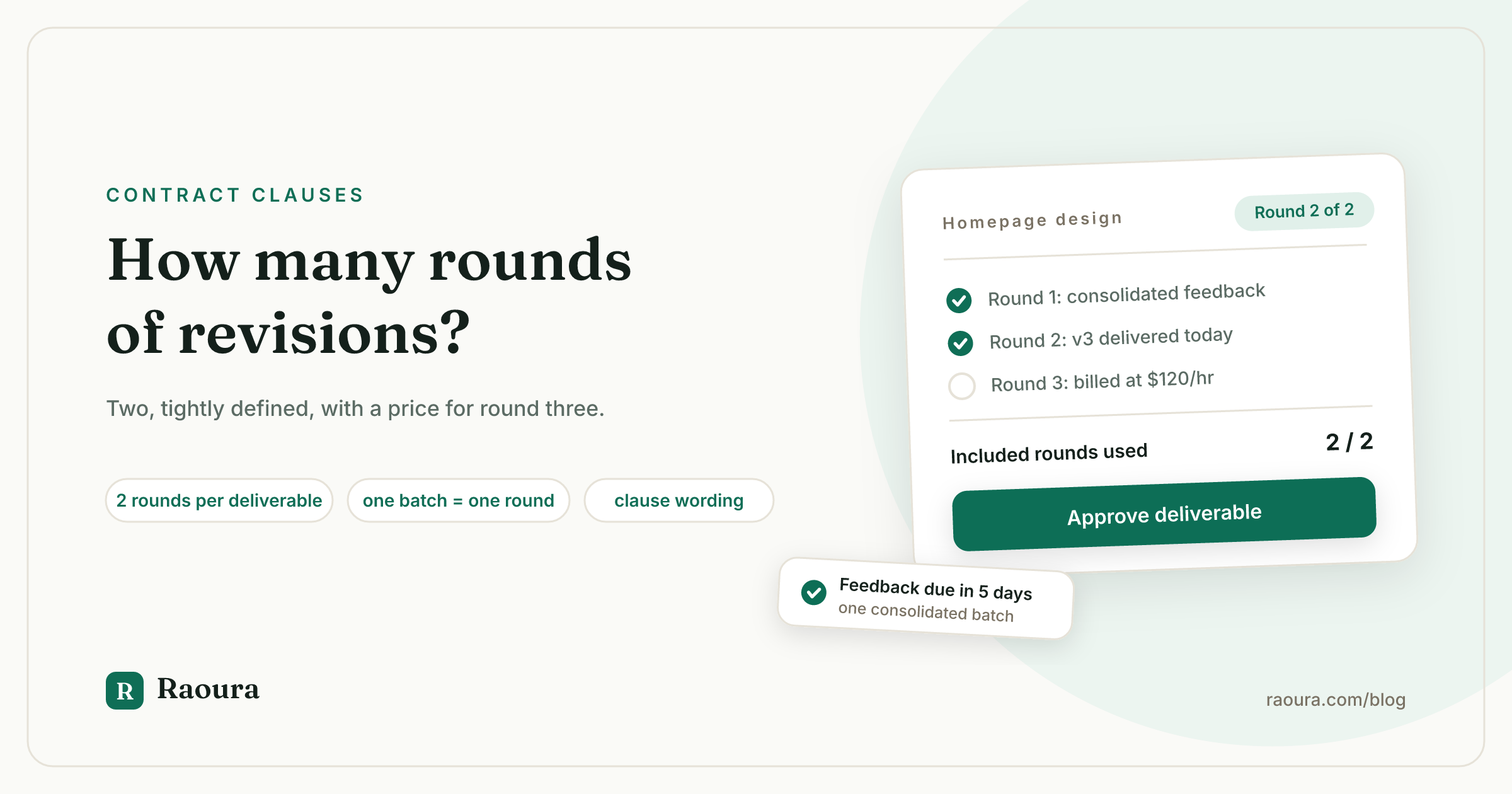
Round one went fine. Round two picked at fonts. Round three introduced the CEO's spouse, who "has an eye for this stuff."
By round six you are redesigning for a committee you have never met, at an effective hourly rate that would embarrass a teenager with a lawn mower. Nothing in your contract says when this ends, because your contract never said how it would end.
The revision clause is where freelance projects go to die quietly. Unlike a missed payment, there is no dramatic moment, just an accumulating pile of "one more small tweak" until the project is unprofitable and both sides resent each other.
The fix is not saying no more often. The fix is a number, a definition, and a price, written down before the work starts. Here is what to put in the contract, with wording you can copy.
The short answer: two rounds, defined tightly#
Include 2 rounds of revisions per deliverable, define one round as a single consolidated batch of feedback, and price additional rounds at your hourly rate or a flat fee stated in the contract.
Two is the number working professionals keep landing on independently.
- Trillion Creative, a New Jersey design agency, includes two rounds on most projects.
- Rachel Simms, a Registered Graphic Designer certified through Ontario's RGD professional body, includes two rounds and charges beyond them.
- When MonstersPost asked 14 named designers and developers how many revisions they allow, answers ranged from 1 to 10, and the cluster sat at 2 to 3.
Here is something worth knowing about that consensus: we fetched the five top-ranking pages for this exact question, and not one of them cites a primary source for its round count. The "industry standard" is really a working norm that thousands of freelancers arrived at independently, because two rounds maps to how feedback actually behaves.
Round one catches the substantive reactions. Round two catches the responses to your fixes. Round three onward is almost never new information, it is indecision, committee dynamics, or scope change wearing a revision costume.
The number is also not the part that protects you. A contract that says "2 rounds of revisions included" but never defines a round is barely better than silence, because a client can reasonably believe every email counts as part of one endless round. The definition does the real work.
What counts as one round (this is the whole game)#
One round is one consolidated batch of feedback, delivered within a stated window, followed by one set of changes from you.
The lifecycle of a round looks like this:
- You deliver the work with a request: "Please gather feedback from everyone who has an opinion and send it in one document or one portal comment thread."
- The client sends one consolidated batch by the feedback deadline.
- You make the changes and redeliver.
- That was one round. The counter goes up by one.
The consolidation requirement is what makes the count meaningful. Without it, Tuesday's email, Wednesday's "oh also," and Friday's forwarded note from the spouse are all arguably "still round one." With it, drip-fed feedback either waits for the batch or starts the next paid round. You are not being rigid; you are giving the client a strong incentive to get their stakeholders aligned, which produces better feedback and a better result.
Two things should never count against the client's rounds, and saying so in the contract builds trust:
- Your own fixes. Typos you caught, a spacing bug, an export error. Errors and omissions on your side are always free.
- Clarifications. Questions about the work, requests to explain a decision, or a quick call are conversation, not revision.
And one thing never counts as a revision at all: new scope. That gets its own section, because it is the most expensive confusion in freelancing.
How many rounds by discipline#
Two rounds per deliverable is a defensible default in every discipline; the unit you attach the rounds to is what changes.
| Discipline | Included rounds (working norm) | Attach rounds to | Watch out for |
|---|---|---|---|
| Logo and brand design | 2 on the chosen concept | Each concept direction | "Can we see it in blue" times 12; concept swaps disguised as revisions |
| Web design | 2 to 3 | Each page template, not the whole site | Per-page feedback trickling in for weeks |
| Writing and content | 2 | Each article or asset | "Revise" requests that are really a new brief |
| Web development | 2 per milestone | Each milestone or feature | Bug fixes (always free) blurred with change requests (never free) |
| Video editing | 2 to 3 | Each cut stage (rough, fine, final) | New footage or a new storyline arriving at fine cut |
Sources and honesty notes: the design norms reflect the named practitioners above. Writing and video figures are our recommendations based on the same batching logic, since no published standard exists for either. If you find a client pushing for more included rounds, agencies handling enterprise work do sometimes include up to 5 on complex projects, per the ranges practitioners report, but every added round should move the price up, because you are pricing in committee risk.
The "attach rounds to" column matters more than the count. "Two rounds for the project" is a trap on anything with multiple deliverables, because the client will spend both rounds on the homepage and then expect the interior pages, the invoice template, and the 404 page to be revisable forever. Per-deliverable rounds keep the accounting clean.
When a revision stops being a revision#
The professional dividing line: if the request changes what you are making rather than refining it, it is a change order, not a revision, and AIGA's standard agreement draws that line at a stated percentage of project time or value.
The design profession's most institutional document, the AIGA Standard Form of Agreement for Design Services, does not even use a round count. It splits client changes into two categories:
- General changes, the small stuff, get billed at the designer's hourly rate.
- Substantive changes, defined as changes exceeding a percentage you fill in (of the time, value, or scope of the services), entitle you to submit a new proposal before continuing.
The mechanism to notice: past a threshold, the conversation stops being about editing and becomes a new purchase.
A practical test you can apply in ten seconds: could you make this change using the materials and direction you already have? "Make the headline bigger" refines what exists. "Actually, let's target enterprise buyers instead of consumers" invalidates what exists. The first is a revision. The second is a change order, priced and signed before you touch it, no matter how many included rounds remain.
This distinction is also your protection against the statistic hanging over every project: 52% of projects experience scope creep, per PMI's survey of 4,455 project professionals, and that is in organizations with project managers whose whole job is preventing it. A solo freelancer's revision clause is doing the work of that entire department. When feedback arrives that smells like new scope, the answer is not round three, it is "great idea, let me price that," and our scope creep scripts give you the exact sentences.
What to charge for round three#
Price extra rounds at your hourly rate with an estimate before starting, or as a flat fee of roughly 10 to 15 percent of the deliverable's price per round, stated in the contract from day one.
The AIGA agreement's answer is hourly billing for general changes, and that is the cleanest model: round three costs whatever the changes take at your stated rate, with an estimate first so nobody is surprised. The flat per-round fee is the simpler alternative for fixed-price projects, and the 10 to 15 percent figure is our recommendation, not an industry statistic: enough to make a third round a real decision rather than a reflex, not so much that it reads as a penalty.
Whichever model you choose, the price must exist in the contract before the project starts. A number introduced at round three, mid-frustration, feels like retaliation. The same number agreed at signing feels like the menu.
This is the single most repeated piece of advice from practitioners who publish their revision policies, and it matches what the law firm Hudson Gavin Martin lists among its seven essential freelance contract clauses: state the number of revisions included, the process for requesting them, and the fees for going beyond them.
One more pricing note: freelancers with written contracts earn 13.7% more than those without, per an ILR Review study. The revision clause is a meaningful piece of why. Uncapped revisions do not show up as a line item you lost; they show up as an hourly rate that quietly halved.
The clause, four ways#
Every version needs the same four elements: a number, a definition of one round, a feedback window, and a price for exceeding the number.
Adapt one of these to your situation. Plain English works; you do not need legalese for a revision clause to function.
Standard (fits most projects):
Each deliverable includes two (2) rounds of revisions. One round means one consolidated batch of feedback, submitted within five (5) business days of delivery, followed by one set of changes. Additional rounds are billed at $[rate]/hour, estimated and approved in writing before work begins. Corrections of Contractor errors do not count as revisions. Requests that change the scope, audience, or strategy of a deliverable are handled as change orders under Section [X], not as revisions.
Flat-fee version (for fixed-price packages):
Additional revision rounds beyond the two included are available at $[amount] per round per deliverable, payable before the round begins.
AIGA-style percentage trigger (for larger or looser projects):
Client changes that together exceed 10% of the estimated project time or value entitle Contractor to submit a revised proposal for the remaining work before continuing.
Feedback-window backstop (add to any of the above):
If no feedback is received within ten (10) business days of a delivery, the deliverable is deemed accepted and any later changes begin a new paid round.
That last one deserves a sentence of explanation. Stalled feedback is the twin problem of endless feedback: without a window, a client can reappear four months later expecting their unused rounds to be waiting, after your context on the project has evaporated. A deemed-acceptance line keeps the project mortal. Pair it with the guidance in our clause-by-clause contract guide, and if you are starting from zero, our free annotated contract template has a revision clause built in.
Why "unlimited revisions" backfires on everyone#
Unlimited revisions is a pricing lie: the cost of infinite rounds is either hidden in a padded quote or extracted from the freelancer's hourly rate, and it reliably produces worse work.
Some freelancers offer unlimited revisions as a differentiator, and some clients push for it as security.
Both are buying a feeling, not an outcome.
A freelancer offering "unlimited" has either priced in the expected abuse (the client overpays for restraint they would have shown anyway) or has not (the freelancer subsidizes indecision until they resent the project and the quality shows it). And a client facing no revision boundary has no incentive to consolidate feedback, sharpen their brief, or get stakeholders aligned, which are the actual drivers of a good final product.
There is also a quieter failure mode: unlimited revisions makes the project unschedulable. You cannot commit round-two dates to your next client when your current one holds an infinite claim on your calendar. Practitioners who publish their policies converge on the same advice the legal writers give: cap it, define it, price the overflow. If a client insists on unlimited, that is useful information about how they plan to use it, and worth reading alongside our contract red flags guide.
Make the rounds visible while the project runs#
A revision clause only works if both sides can see the count. Buried in a PDF nobody rereads, "round 2 of 2" is a fact you have to assert mid-conflict. Surfaced in the tools where the work happens, it is just the weather.
The low-tech version: number your deliveries in the subject line ("Homepage v2, round 2 of 2 included") and restate the remaining count with every handoff. Nobody can be surprised by a counter they have watched increment.
The systematized version is why we built revision handling into Raoura the way we did. Disclosure: Raoura is our product, a $17/month client and project tool for solo freelancers. Raoura's free contract template library includes revision clauses in plain English, so the cap, the definition, and the overflow price are in the agreement your client e-signs before kickoff.

The clause work is done before the project starts: Raoura's contract templates spell out deliverables and revision terms in plain English, then collect the client's e-signature.
While the project runs, each milestone lists its deliverables in the client portal, so "wireframes v2" is a named, versioned object both sides are looking at rather than an attachment lost in a thread. And because files can be set to unlock when the milestone is paid, round-complete and payment-complete stay tied together.

Versioned deliverables per milestone: the client sees exactly what round they are on, and the final file unlocks when the milestone is paid.
Verified July 2026. Round-count norms are drawn from named practitioners (Trillion Creative, Broadbent Studio, and 14 designers and developers surveyed by MonstersPost); the percentage-trigger mechanism is from the AIGA Standard Form of Agreement for Design Services; the 52% scope creep figure is from PMI's Pulse of the Profession 2018 media release; the 13.7% contract income premium is from ILR Review. Extra-round pricing of 10 to 15 percent is our recommendation and is labeled as such; no primary-source benchmark for extra-round pricing exists that we could verify.
Frequently asked questions
How many rounds of revisions is standard?
Two rounds per deliverable is the working norm across design, writing, and development, with 3 common on complex work. No formal industry standard exists; the AIGA standard agreement uses a percentage-of-scope trigger instead of a round count.
What counts as one round of revisions?
One consolidated batch of feedback followed by one set of changes. Drip-fed feedback across multiple emails is the main thing a revision clause exists to prevent; require consolidation and the count stays meaningful.
Should revisions be per project or per deliverable?
Per deliverable. Project-wide rounds get spent entirely on the first deliverable, leaving every later one contractually ambiguous.
What should I charge for extra revision rounds?
Your hourly rate with a pre-approved estimate, or a flat fee of roughly 10 to 15 percent of the deliverable's price per round (our recommendation; no published benchmark exists). The price must be in the contract before the project starts.
Is an unlimited revisions clause enforceable?
It is generally binding on you if you signed it, which is exactly the problem: you have promised infinite labor for finite money. Legal practitioners who write about freelance contracts recommend a stated number, a request process, and overflow fees instead.
When does a revision become a change order?
When the request changes what you are making rather than refining it: new audience, new strategy, new scope, new deliverable. Refining uses materials you already have; changing invalidates them. Price changes separately as a change order regardless of rounds remaining.
What if the client uses both rounds and still is not happy?
The contract keeps working: further rounds exist at the stated price, so the conversation is "happy to keep going, here is what round three costs" rather than a standoff. If the dissatisfaction is really a new direction, that is a change order conversation instead.
---
Run your client work in one place
Send a proposal, get it signed, invoice, and get paid, with a branded portal your clients will actually use. One flat plan at $17/month, and we never take a cut of your payments.
Try Raoura free for 14 daysNo credit card required. Set up in minutes.
Keep reading
The Virtual Assistant Contract: 24 Clauses, Scored Against Every Template Ranking for This Search
We scored the four pages that publish actual virtual assistant contract text against 24 clauses a VA agreement needs. Twenty-four of 96 possible slots were filled. The best single template managed 7 out of 24. Twelve clauses appear in none of them, including every clause about the thing that makes VA work different from other freelance work: you are holding your client's passwords and running their inbox. One popular template also tells you a contract fixes your independent contractor status, then mandates client-set 9 to 5 weekday hours in the same document. Here is the clause-by-clause version, with the classification test the DOL is actually applying in 2026, the data protection terms nobody drafts, and the retainer mechanics that decide whether unused hours roll over.
Stripe vs PayPal for Freelancers: Every Fee Verified (2026)
Every page ranking for this comparison either prints in-person retail rates, contradicts itself, or skips the numbers freelancers actually pay. We read the current Stripe and PayPal pricing pages line by line, ran a $3,000 invoice through every rail, and found a $1,764 per year gap between the cheapest setup and the default one.
The Pause Clause: How to Stop Work When an Invoice Goes Overdue
Stopping work is the strongest move a freelancer has against a late-paying client, and the least understood. Here is the legal doctrine that lets you pause even without a clause, the exact clause to add so you never have to rely on doctrine again, the day-by-day timing, and the two emails that keep the pause professional. Verified against primary sources in July 2026.