The Overdue Invoice Phone Call: A Script That Stays Friendly
August 30, 2026
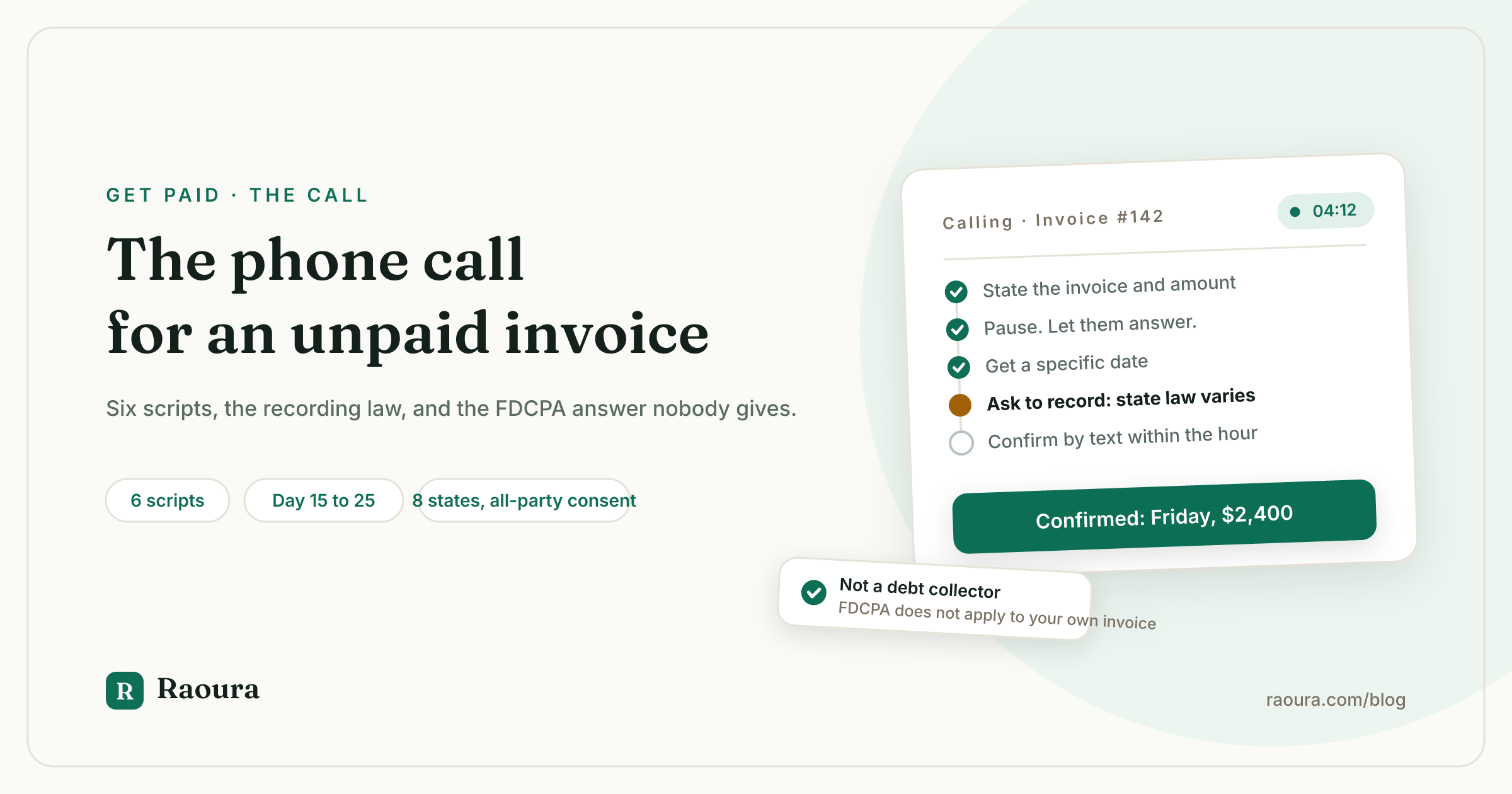
Every guide to unpaid invoices tells you to "pick up the phone" somewhere around the second or third reminder. Then it moves on, as if the hard part was deciding to call, not knowing what to say once someone answers.
We read the five pages ranking on page one for this query in July 2026. All of them are written for an accounts-receivable clerk or a customer-success caller phoning on behalf of a company. Not one names a single state's call-recording law. Only one mentions the Fair Debt Collection Practices Act at all, and it does not say whether the law applies to you when the invoice is your own.
That is the gap this article closes, plus the actual words to say when a client answers.
When to make the call#
Call around day 15 to 25 overdue, after two written reminders have gone unanswered and before you send a final demand letter.
That window sits inside rung 2 of the unpaid invoice escalation ladder. You have already stopped in-progress work and applied any agreed late fee. The phone call is the specific action inside that rung: the channel switch from an ignorable email thread to a human commitment.
Calling on day 2 reads as impatient. Waiting past day 30 means you are calling right before a demand letter anyway, so you may as well skip straight to the letter.
There is a real, if imprecise, signal on timing from the collections industry. insideARM's analysis of contact-center data found connect rates for outbound calls peak in the 9 to 10 a.m. window, while the rate at which you actually reach the person who owes money (not a gatekeeper or voicemail) peaks in the evening, and mid-week days outperform Mondays and Fridays.
Treat that as a tiebreaker, not a rule. For a client you already have a working relationship with, call whenever you would normally expect them to pick up.
Before you dial#
Have four things in front of you before the phone rings:
- The invoice number and exact amount.
- The original due date and how many days overdue it is.
- A copy of every reminder you already sent, with dates and channel.
- The payment link, ready to text or email the moment the call ends.
Calling without the invoice number in front of you is the single most common reason these calls go sideways. It reads as disorganized instead of firm.

Everything you need before you dial lives on one screen: what is owed, whether they have even opened the invoice, and the follow-up date you set last time.
The call structure#
Every effective collection call, whether it is a Fortune 500 receivables team or a solo freelancer, follows the same shape:
- Greet, and confirm you are speaking to the right person.
- State the fact plainly: invoice number, amount, days overdue.
- Stop talking. Let them respond.
- React to what they actually say, not to a script.
- End with a specific commitment, a date or an amount or both, and confirm it will follow in writing.
The part freelancers skip is step 3, the pause after stating the fact. Silence puts the burden of the next sentence on the client, not you.
Six scripts for the calls you will actually make#
Say these close to word for word. They are short on purpose. A long opening gives a disorganized client room to talk past the point.
1. Opening, first call, no prior contact issue#
"Hi [name], it's [you] calling about invoice 142, the $2,400 for the homepage redesign. It was due on the 3rd, so it's about three weeks out now. I wanted to check in and see what's going on."
2. "I forgot" or "it must have slipped through"#
"No problem, it happens. Can you tell me now, while we're on the phone, when you can get it paid? I can text you the payment link the second we hang up."
Get a specific day, not "soon."
3. Client disputes the invoice or the work#
"Okay, let's sort that out first, separately from the payment date. What specifically is the concern?"
Do not negotiate the amount on this call. Note the objection, say you will follow up in writing within 24 hours with the contract and delivery record, and end the call. Mixing a dispute conversation with a collection conversation is how freelancers accidentally agree to a discount they did not mean to offer.
4. Cash-flow problem, client is being honest about it#
"I appreciate you telling me straight. Can we set up two payments, half by [date] and half by [date two weeks later]? I'll send that in writing today so we're both clear."
A written payment plan with real dates is the single best outcome of this call short of full payment. Get the first date within two weeks, not "next month."
5. No answer, straight to voicemail#
"Hi [name], it's [you]. Just following up on invoice 142, it's currently a few weeks past due. No rush to call back, just send me a text or email with when you can take care of it, or call anytime. Thanks."
Keep the tone neutral. Do not state a dollar amount aloud, since voicemails are not always private, and leave a low-friction way to respond that does not require a callback.
6. Client is defensive, evasive, or hostile#
Lower your voice slightly rather than matching their volume: "I hear you. I'm not trying to cause a problem, I just need a plan for getting this paid. What works for you?"
If they hang up or the call turns hostile with no resolution, stop talking on the phone. Move to the final demand letter in writing, where you control the pace and keep a record.
Can you record the call?#
At least eight states require every party's consent before you record a phone call, so ask and get a "yes" out loud before you hit record, no matter what state you are calling from or into.
A call between two states follows the stricter of the two states' laws in practice. Treat every call as if the strictest rule applies.
| State | Consent required | Statute |
|---|---|---|
| California | All parties | Cal. Penal Code § 632 |
| Florida | All parties | Fla. Stat. § 934.03 |
| Illinois | All parties (narrow exceptions apply) | 720 ILCS 5/14-2 |
| Maryland | All parties | Md. Cts. & Jud. Proc. § 10-402 |
| Massachusetts | All parties | Mass. Gen. Laws ch. 272, § 99 |
| New Hampshire | All parties | N.H. Rev. Stat. § 570-A:2 |
| Pennsylvania | All parties | 18 Pa. Cons. Stat. § 5703 |
| Washington | All parties (narrow exceptions apply) | Rev. Code Wash. § 9.73.030 |
The other 42 states require only one party's consent, meaning you can legally record your own call without saying anything, since you are that one party.
But the simplest practice covers every state at once: say "I'd like to record this call for accuracy, is that okay?" at the start. A verbal yes satisfies all-party consent everywhere it applies, and it costs you nothing in a one-party state.
If you would rather not record at all, a note written immediately after the call, with the date, time, and what was agreed, holds up almost as well as a recording if this ever reaches small claims court.
Does the FDCPA apply to you?#
No: the Fair Debt Collection Practices Act generally does not cover a creditor collecting its own debt, which is what a freelancer calling about their own unpaid invoice is doing.
The Federal Trade Commission's own guidance walks through the statute's definition of "debt collector" under Section 803(6) of the Act. It covers third parties collecting debts owed to someone else, not a creditor collecting on its own account.
There is one trap worth knowing, straight from that same FTC guidance. The exemption disappears if a creditor "uses any name other than his own which would indicate that a third person is collecting or attempting to collect such debts."
In practice, that means do not invent a scarier-sounding entity, like calling as "Meridian Collections" instead of your own name or business name, to make the call feel more official. It does the opposite of what you want. It can turn a straightforward first-party call into something regulated as third-party debt collection, and clients recognize the tactic anyway.
Calling as yourself, plainly, is both the legally cleaner move and the one that actually works, because your client already knows who you are and why you are calling.
Even without FDCPA coverage, the FTC notes that deceptive or unfair collection practices are still reachable under Section 5 of the FTC Act, things like false threats of legal action you have no intention of taking. Say only what you will actually do. If you are not prepared to file in small claims court, do not say the words "I'll see you in court" on this call.
After the call: confirm it in writing#
Every phone call ends with a two-line email or text sent within the hour, restating exactly what was agreed, because a verbal promise with no written record is worth exactly as much as the last reminder email that got ignored.
"Great catching up, confirming you'll send the $2,400 for invoice 142 by Friday the 14th. Here's the payment link: [link]."
This single habit is what turns "we had a good call" into evidence. It is the difference the escalation ladder depends on if this invoice ever needs a demand letter or a small claims filing later.
This is the moment we should say plainly where our own product fits in, because it is the reason we built the client page the way we did. Disclosure: Raoura is our product. Every call you make and every commitment a client gives you is worth logging against the invoice the second you hang up, and it should not depend on you remembering to open a separate notes app.

The day 15 to 25 window that this whole article is about: overdue turns red automatically, so you know exactly which invoices have earned a phone call today.
Frequently asked questions
Should I text instead of calling if I hate making these calls?
A text is better than nothing, but it does not carry the same weight as a voice conversation, and it is easy to leave on read. If you genuinely will not make the call, send a text that asks for a specific commitment ("Can you let me know by tomorrow when invoice 142 will be paid?") rather than a generic nudge, and treat it as rung 2, not a substitute for the written demand letter at rung 3.
What if the client says they already paid?
Ask for the confirmation number or a screenshot on the spot, politely, and check your own records while still on the call if you can. This happens most often with a bounced ACH transfer or a payment sent to the wrong invoice. Resolve it as a factual question, not an accusation.
Is it okay to call from a blocked or private number?
No. A hidden caller ID reads as an attempt to catch someone off guard rather than a normal business call, and it makes you harder to call back. Call from the number you actually use for business.
How many times should I call before giving up and moving to a letter?
Two genuine attempts on two different days is enough. If neither connects and neither voicemail gets a response within 3 to 4 days, move to the final demand letter covered in our demand letter guide. Repeated same-day calling reads as harassment even where it is not against a specific law.
Can the client record the call without telling me?
The same state consent laws apply to them. If you are in a one-party state, they can legally record without telling you; if either of you is in an all-party state, they need your consent too, same as you need theirs.
Should I mention the state freelance payment laws (double damages) on this call?
Save that for the written demand letter, where the exact statute and dollar threshold need to be stated precisely. Our freelance payment laws by state guide covers the New York, Illinois, and California thresholds if you get there.
---
Every legal claim in this article was verified against primary sources in July 2026: the FTC's Business Blog guidance on FDCPA coverage of first-party creditors (citing Section 803(6) of the Act), Justia's 50-state survey of call recording consent laws with underlying state statutes, and insideARM's published contact-rate data. The observation that none of the five top-ranking pages for this query name a state consent law or resolve the FDCPA question is our own, from a first-page SERP review conducted this month.
Run your client work in one place
Send a proposal, get it signed, invoice, and get paid, with a branded portal your clients will actually use. One flat plan at $17/month, and we never take a cut of your payments.
Try Raoura free for 14 daysNo credit card required. Set up in minutes.
Keep reading
Is Upwork Worth It in 2026? A Break-Even Test for Your Situation
Upwork is worth it when its fee costs less than finding the client yourself, and that is true far more often for a first project than for a repeat client. Here is the break-even math with 2026 numbers: the 0 to 15% fee, Connects, the shrinking client base, and when to wait out the 24-month rule instead of paying to leave.
The Virtual Assistant Contract: 24 Clauses, Scored Against Every Template Ranking for This Search
We scored the four pages that publish actual virtual assistant contract text against 24 clauses a VA agreement needs. Twenty-four of 96 possible slots were filled. The best single template managed 7 out of 24. Twelve clauses appear in none of them, including every clause about the thing that makes VA work different from other freelance work: you are holding your client's passwords and running their inbox. One popular template also tells you a contract fixes your independent contractor status, then mandates client-set 9 to 5 weekday hours in the same document. Here is the clause-by-clause version, with the classification test the DOL is actually applying in 2026, the data protection terms nobody drafts, and the retainer mechanics that decide whether unused hours roll over.
Stripe vs PayPal for Freelancers: Every Fee Verified (2026)
Every page ranking for this comparison either prints in-person retail rates, contradicts itself, or skips the numbers freelancers actually pay. We read the current Stripe and PayPal pricing pages line by line, ran a $3,000 invoice through every rail, and found a $1,764 per year gap between the cheapest setup and the default one.