Cash Discount vs Surcharge: The Workaround That Is Legal in Almost All 50 States
August 30, 2026
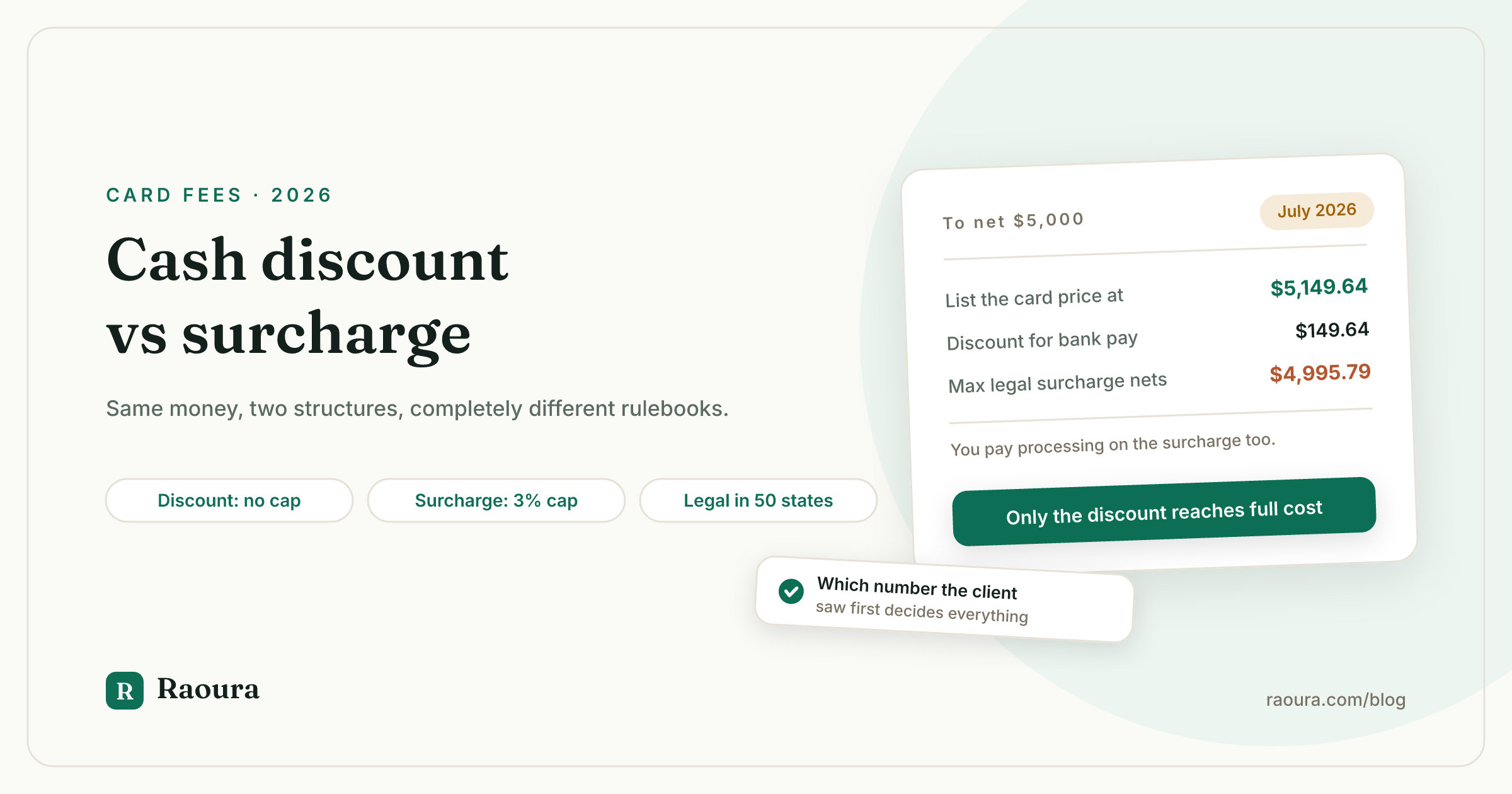
You want your client to stop paying by card, because every card payment on a $5,000 invoice costs you about $150 you did not price for.
There are two ways to make that happen, and they move exactly the same amount of money. You can list $5,000 and add $150 when they choose a card. Or you can list $5,150 and take $150 off when they pay by bank transfer.
Financially identical. Legally, they are not remotely the same thing.
The first is a surcharge. It is capped at 3% by Visa, banned outright in four US jurisdictions, requires 30 days written notice to your acquirer and to Mastercard, has to appear as its own line on the receipt, and is regulated by nine or more states with their own disclosure rules on top.
The second is a discount. It is not capped, requires no registration with anybody, is expressly protected by federal statute, and is legal in three of the four places where surcharging is banned.
That is the whole trick, and it is why processors sell "cash discount programs." It is also why most of those programs are structured in a way that regulators have started calling out by name.
If you are still deciding whether to pass card costs on at all, start with our guide to surcharging rules for freelancers, which covers the surcharge side in full. This article is about the other structure, and about the arithmetic that makes it the better one.
The short answer#
A surcharge adds a fee to your listed price when the client pays by card; a cash discount makes the card price the listed price and reduces it for bank transfer or check, and that structural difference is what makes the discount legal in 3 of the 4 US jurisdictions that ban surcharging, uncapped where surcharges are capped at 3%, and exempt from the 30-day network notice surcharging requires.
The test is not what you call it. It is which number you published first.
If the number your client saw before choosing a payment method is the card price, you are discounting. If the total goes up after they pick a card, you are surcharging, no matter what the line item says.
Visa states this in as many words in its merchant surcharging Q&A: the total price paid on a card must be reached from the prices you displayed "and not achieved by applying an additional fee for a card payment as it may appear to be, and may be treated as, a surcharge and subject to Visa's surcharge rules."
Why this question has no good answer online#
Every page currently ranking for "cash discount vs surcharge" is published by a payment processor, and four of the six sell a cash discount program.
They also assume you have a storefront. Every one of them talks about shelf tags, entry signage, registers, and receipt printers. Not one is written for someone whose "posted price" is a proposal, an engagement letter, or an invoice emailed to a client in another state.
That gap matters more than it sounds, because federal law treats the no-shelf-tag case differently, and in your favor. More on that in a moment.
The other problem is that the single most repeated sentence in this category is not quite true. "Cash discounting is legal in all 50 states" appears on nearly every processor page, usually with no source. It is close to right and it is wrong in two specific places, one of which was decided by a federal appeals court in 2025.
The federal law that makes discounts safe#
Federal law has protected cash discounts since 1974 and has not banned surcharges since February 27, 1984, when the federal surcharge ban expired and was never renewed.
The operative statute is 15 U.S.C. 1666f, part of the Truth in Lending Act. Subsection (a) bars card issuers from prohibiting a seller "from offering a discount to a cardholder to induce the cardholder to pay by cash, check, or similar means rather than use a credit card."
Subsection (b) sets the two conditions that make the discount clean. It has to be "offered to all prospective buyers" and its availability has to be "disclosed clearly and conspicuously."
That is the entire federal compliance burden. Offer it to everyone, say so plainly.
The federal surcharge ban lived in the same statute from 1976, and Congress let it sunset. The editorial notes on that section record it directly: the amendments "shall cease to be effective on February 27, 1984." Everything restricting surcharges today is state law or card network contract, which is precisely why surcharging is the fragile structure and discounting is the durable one.
The sentence that was written for freelancers by accident#
15 U.S.C. 1602(y) defines "regular price," the number a discount comes off of, and it contains a clause that almost no processor guide quotes:
"the tag or posted price charged for the property or service if a single price is tagged or posted, or the price charged for the property or service when payment is made by use of an open-end credit plan or a credit card if either (1) no price is tagged or posted, or (2) two prices are tagged or posted"
Read the second half again. If no price is posted, the regular price is by definition the card price.
A retail store always has a tag, so it always has to be careful that the tag shows the card price. You usually have no tag at all. Your price appears for the first time on a proposal or an invoice you write yourself, which means you get to set the regular price as the card price simply by writing it that way.
The same section defines a surcharge as "any means of increasing the regular price to a cardholder which is not imposed upon customers paying by cash, check, or similar means." Set the regular price high enough and there is nothing left to increase.
Where the "legal in all 50 states" claim breaks#
Cash discounts are permitted in all 50 states and the District of Columbia, so the claim is technically true; it is Puerto Rico that breaks it, where the consumer affairs regulator reads the 2013 removal of the discount carve-out as forbidding them, a position the First Circuit left standing in May 2025.
Here is what actually happens in the four jurisdictions that ban surcharging outright.
| Jurisdiction | Surcharge | Cash discount | The catch |
|---|---|---|---|
| Connecticut | Banned on any payment method | Allowed | You must affirmatively disclose the discount, including verbally on phone calls and on the payment page before the transaction completes ([CGS 42-133ff(c)(1)](https://law.justia.com/codes/connecticut/title-42/chapter-739/section-42-133ff/)) |
| Massachusetts | Banned | Allowed | Must be offered to all buyers and disclosed clearly and conspicuously ([M.G.L. c.140D 28A](https://malegislature.gov/Laws/GeneralLaws/PartI/TitleXX/Chapter140d/Section28a)) |
| Maine | Banned on credit and debit | Allowed by statute | Listed price must be at least as prominent as the cash price ([9-A M.R.S. 8-509](https://legislature.maine.gov/legis/statutes/9-A/title9-Asec8-509.html)) |
| Puerto Rico | Banned | Regulator says no | The 2008 law had a discount carve-out; the legislature deleted it in 2013 and DACO now reads discounts as prohibited |
Maine's statute is the cleanest sentence on this subject in American law. After banning surcharges it simply says: "A discount or reduction from the regular price is not a surcharge."
Puerto Rico is the real exception, and it is recent. Merchants challenged the ban on preemption and vagueness grounds, and in May 2025 the First Circuit rejected both arguments, holding that the federal Cash Discount Act regulates card issuers rather than territories, and that the Durbin Amendment regulates networks rather than merchants.
So if you invoice a client in Puerto Rico, neither structure is safely available to you. Build the cost into your rate instead.
New York is the second place it breaks, in a stranger way#
New York does not ban surcharging. Since February 11, 2024 it regulates how you present the two prices, and the regime it created is the strictest dual-pricing law in the country.
The Division of Consumer Protection's reference guide lists what is allowed: show both prices, or show the higher card price and advertise a discount for cash, or charge the same for both.
Then it lists what is illegal, and one of those items is the standard processor script: advertising "that all PRICES INCLUDE A CASH DISCOUNT that does not apply to credit card purchases."
That is the exact language sold under the name "cash discount program." New York banned the marketing formulation while leaving the underlying structure legal, which is why the same program can be compliant in Albany and a violation in the way it is described.
Violations run up to $500 each.
The arithmetic nobody runs#
Surcharging at the maximum rate the card networks allow still leaves you short of full recovery, because you pay processing on the surcharge itself; on a $5,000 invoice the maximum compliant surcharge nets you $4,995.79, a $4.21 gap that a discount does not create.
This is the part that decided it for us, and we have not seen it anywhere else, so here is the working.
Visa caps a surcharge at the lesser of your merchant discount rate or 3%. On Stripe's US card pricing of 2.9% plus $0.30, your effective rate on a $5,000 invoice is 2.906%, so 2.906% is your ceiling. That is $145.30.
But the client is now paying $5,145.30, and Stripe charges 2.9% plus $0.30 on the whole amount, not on the original $5,000. You pay $149.51 and keep $4,995.79.
The surcharge cap is calculated on the pre-surcharge amount. The fee is calculated on the post-surcharge amount. Those are different numbers, and the difference is yours to eat.
| You want to net | List the card price at | Discount for bank transfer | Discount as % of listed | Max compliant surcharge | Net if you surcharge instead | Shortfall |
|---|---|---|---|---|---|---|
| $500 | $515.24 | $15.24 | 2.958% | $14.80 | $499.57 | $0.43 |
| $1,000 | $1,030.18 | $30.18 | 2.929% | $29.30 | $999.15 | $0.85 |
| $2,500 | $2,574.97 | $74.97 | 2.912% | $72.80 | $2,497.89 | $2.11 |
| $5,000 | $5,149.64 | $149.64 | 2.906% | $145.30 | $4,995.79 | $4.21 |
| $10,000 | $10,298.97 | $298.97 | 2.903% | $290.30 | $9,991.58 | $8.42 |
Card price column is your target net plus $0.30, divided by 0.971. Surcharge column is the lesser of your effective Stripe rate or 3%, applied to the target net. Recompute against your own processor's rate before using any of these figures.
Two things fall out of that table.
The discount always reaches full recovery, because nothing caps it. You pick the listed price, and the listed price can be whatever covers your cost.
And the two percentages describing the identical dollar amount are different. On the $5,000 row, $149.64 is a 2.906% discount off the listed price and a 2.993% surcharge on the base price, because the surcharge percentage is measured against the smaller number. Converting a "3% surcharge" into a "3% discount" is not a like-for-like swap, and it costs you the difference every time.
There is a third, quieter consequence. Below roughly $2,308, a 3% surcharge does not fully recover Stripe's 2.9% plus $0.30 even before the compounding problem, because the fixed $0.30 is a larger share of a small invoice. Small invoices are where surcharging is structurally worst and where a discount is structurally easiest, since you can just list the number you need.
What your invoicing tool will actually let you do#
Of the four invoicing tools most solo freelancers use, two support surcharging (both with restrictions), two forbid it outright, and none of the four offers a native cash discount feature, because a cash discount does not need one.
| Tool | Card surcharge on invoices | Cash or ACH discount | Notes |
|---|---|---|---|
| Stripe Invoicing | Yes, [public preview only](https://docs.stripe.com/payments/cards/surcharge), 3% US cap, developer work required | Manual discount line | "You're fully responsible for any fines, penalties, or losses" |
| Square Invoices | Yes, [open beta](https://squareup.com/help/us/en/article/8596-set-up-and-manage-card-surcharges), web only, 3% cap | Manual discount line | No partial payments or payment schedules while surcharging; you must file the Mastercard notification yourself |
| PayPal | No, the User Agreement forbids it | Manual discount line | A handling fee is permitted only if it does not operate as a surcharge |
| Wave | No | Manual discount line | ["Wave does not have a feature to add processing fees to an invoice and does not permit surcharging"](https://support.waveapps.com/hc/en-us/articles/115000423946-Can-I-pass-credit-card-fees-onto-my-customer) |
Notice the pattern in the middle column. There is no "cash discount" feature to build, in any of them, because a discount is just a line item and a number you chose.
That is the practical argument for this structure over surcharging. It requires no beta program, no API preview, no acquirer notification, and no vendor to support it. It works in a tool that was written before anyone thought about this problem, and it works the same way in every tool.
How to actually run it on a freelance invoice#
Five steps, and the order matters, because the whole thing rests on which number the client saw first.
1. Set your listed price at the card price#
Do this in the proposal, not the invoice. The proposal is the document that establishes your regular price, and it needs to already contain the number a card payer will pay.
Take your target net, add $0.30, divide by 0.971. Round up to something that does not look like it came out of a calculator.

The listed total in a proposal is your regular price under 15 U.S.C. 1602(y), which is why the card price belongs here rather than as a fee added later. Disclosure: Raoura is our product.
2. Disclose the discount in the same document#
One sentence, in the pricing section, not the fine print:
"Prices shown are payable by credit card. A 2.9% discount applies to payment by bank transfer (ACH) or check, available to all clients."
That single sentence satisfies the federal "offered to all prospective buyers" and "clearly and conspicuously disclosed" conditions, and it satisfies Connecticut's requirement that the disclosure appear before the transaction completes. Say it out loud on the kickoff call too, and Connecticut's telephone clause is covered as well.
3. Offer a genuinely fee-free alternative#
This is the step most people skip, and it is the one that makes the whole structure defensible rather than merely legal.
If a card is the only way a client can actually pay you, the card cost is not avoidable, and both the FTC's stated position on payment fees and Minnesota's "reasonably avoidable" test treat an unavoidable fee as part of the total price. ACH through Stripe costs 0.8% capped at $5.00, so it is cheap to offer and it is the reason the discount is real. Our comparison of card, ACH, and wire has the full fee math on all three rails.
Your bank transfer option is what turns the card price from a hidden markup into a choice.
4. Invoice at the listed price, apply the discount when they choose#
Send the invoice at the card price. If the client pays by bank transfer, the discount comes off, either as a credit line before payment or as a partial credit after.

Both payment rails on one screen is what makes the discount available rather than theoretical, and payments land in the freelancer's own Stripe account. Disclosure: Raoura is our product.
5. Never call it a fee#
"Non-cash adjustment," "processing fee," "technology fee," and "convenience fee" are the terms that turn a discount back into a surcharge in the eyes of regulators. New York lists them by name as illegal when the total was not posted first. The FTC's fee guidance tells businesses to describe what a fee is for and avoid exactly those vague labels.
Clover removed every cash discount app from its marketplace over this, telling merchants that a true cash discount "does not add any fees or surcharges at the register."
If your invoice shows a number going up, you built the wrong one.
The honest case against doing any of this#
Most solo freelancers should skip both structures and put the 2.9% in their rate.
You are not running a convenience store with 400 transactions a day. On twenty invoices a year averaging $3,000, the entire annual cost of card acceptance is around $1,750. Raising your rates 3% recovers the same money, costs you nothing in compliance surface area, requires no disclosure sentence in any document, and removes a conversation about fees from the exact moment you are trying to get paid. Our pricing models guide covers how to fold overhead like this into a rate without itemizing it.
The discount structure earns its keep in two situations.
One is when you want to steer a specific client toward ACH on genuinely large invoices, where $150 per payment is worth a sentence in a proposal. The other is when a client has told you they intend to pay by card and you have not priced for it.
Outside those, the simplest compliant answer is a higher number with nothing after it.
Frequently asked questions
Is a cash discount legal in all 50 states?
Yes, in all 50 states and DC. Puerto Rico is the exception: the discount carve-out was removed from its surcharge statute in 2013, and its consumer affairs department reads the current law as prohibiting cash discounts, a reading the First Circuit left in place in May 2025.
Does a cash discount have a maximum percentage?
Federal law and the card network rules do not cap it. Wyoming caps cash discounts at 5% of the transaction by statute, and it is the only state we found that caps the discount rather than the surcharge. Practically, a discount above your actual processing cost starts looking like a two-tier price rather than a cost recovery, which is a different conversation with a client.
Does "cash" mean actual cash?
No. The statute says "cash, check, or similar means," and ACH and bank transfer sit comfortably inside that. For a freelancer, the discount is almost always an ACH discount, which is why the ACH rate matters more than the card rate.
Do I need to notify Visa or Mastercard?
Not for a discount. Surcharging requires at least 30 days advance notice to your acquirer, plus separate notification to Mastercard, plus a dedicated surcharge data field in the transaction message. A discount requires none of that, which is most of its practical advantage.
Can I offer both a discount and a surcharge?
Do not. Mastercard's rules require any point-of-interaction discount to be netted into the surcharge calculation, which means combining them changes your compliant cap in ways that are difficult to compute and easy to get wrong. Pick one structure.
What about my client in the UK or the EU?
Different rulebook entirely. Several EU member states prohibit surcharging on consumer cards outright, and the UK banned consumer card surcharges in 2018. Discounts for bank transfer are generally the safer international structure too, and the fee mechanics of cross-border work are covered in our guide to invoicing international clients.
Does the 2026 interchange settlement change this?
Possibly, but not yet. The amended Visa and Mastercard settlement received preliminary approval on June 9, 2026, and reporting on it says merchants would gain new rights to add surcharges and offer discounts to steer clients away from higher-cost cards. It is preliminarily approved only, a fairness hearing is still pending, and at least one trade group has said it will appeal. Nothing in it overrides a state surcharge ban.
---
Every rule, rate, and statute above was read from primary sources on July 19, 2026: 15 U.S.C. 1666f, 1602 and 1693o-2 via the Cornell Legal Information Institute, Maine 9-A M.R.S. 8-509 from the Maine Revisor of Statutes, M.G.L. c.140D 28A from the Massachusetts Legislature, Connecticut General Statutes 42-133ff, Puerto Rico's 10 L.P.R.A. 11, the New York Department of State Division of Consumer Protection reference guide, the California Attorney General's surcharge page, Visa's merchant surcharging Q&A (v.02152024), Mastercard's merchant surcharge rules, the FTC's Rule on Unfair or Deceptive Fees FAQ, and the current Stripe, Square, PayPal, and Wave product documentation. Card network rules and state law both change without notice; the linked sources outrank this article the moment they disagree. Nothing here is legal advice. Verified July 2026.
Run your client work in one place
Send a proposal, get it signed, invoice, and get paid, with a branded portal your clients will actually use. One flat plan at $17/month, and we never take a cut of your payments.
Try Raoura free for 14 daysNo credit card required. Set up in minutes.
Keep reading
Is Upwork Worth It in 2026? A Break-Even Test for Your Situation
Upwork is worth it when its fee costs less than finding the client yourself, and that is true far more often for a first project than for a repeat client. Here is the break-even math with 2026 numbers: the 0 to 15% fee, Connects, the shrinking client base, and when to wait out the 24-month rule instead of paying to leave.
The Virtual Assistant Contract: 24 Clauses, Scored Against Every Template Ranking for This Search
We scored the four pages that publish actual virtual assistant contract text against 24 clauses a VA agreement needs. Twenty-four of 96 possible slots were filled. The best single template managed 7 out of 24. Twelve clauses appear in none of them, including every clause about the thing that makes VA work different from other freelance work: you are holding your client's passwords and running their inbox. One popular template also tells you a contract fixes your independent contractor status, then mandates client-set 9 to 5 weekday hours in the same document. Here is the clause-by-clause version, with the classification test the DOL is actually applying in 2026, the data protection terms nobody drafts, and the retainer mechanics that decide whether unused hours roll over.
Stripe vs PayPal for Freelancers: Every Fee Verified (2026)
Every page ranking for this comparison either prints in-person retail rates, contradicts itself, or skips the numbers freelancers actually pay. We read the current Stripe and PayPal pricing pages line by line, ran a $3,000 invoice through every rail, and found a $1,764 per year gap between the cheapest setup and the default one.