Can You Pass Card Fees to Your Client? Surcharging Rules for Freelancers
August 30, 2026
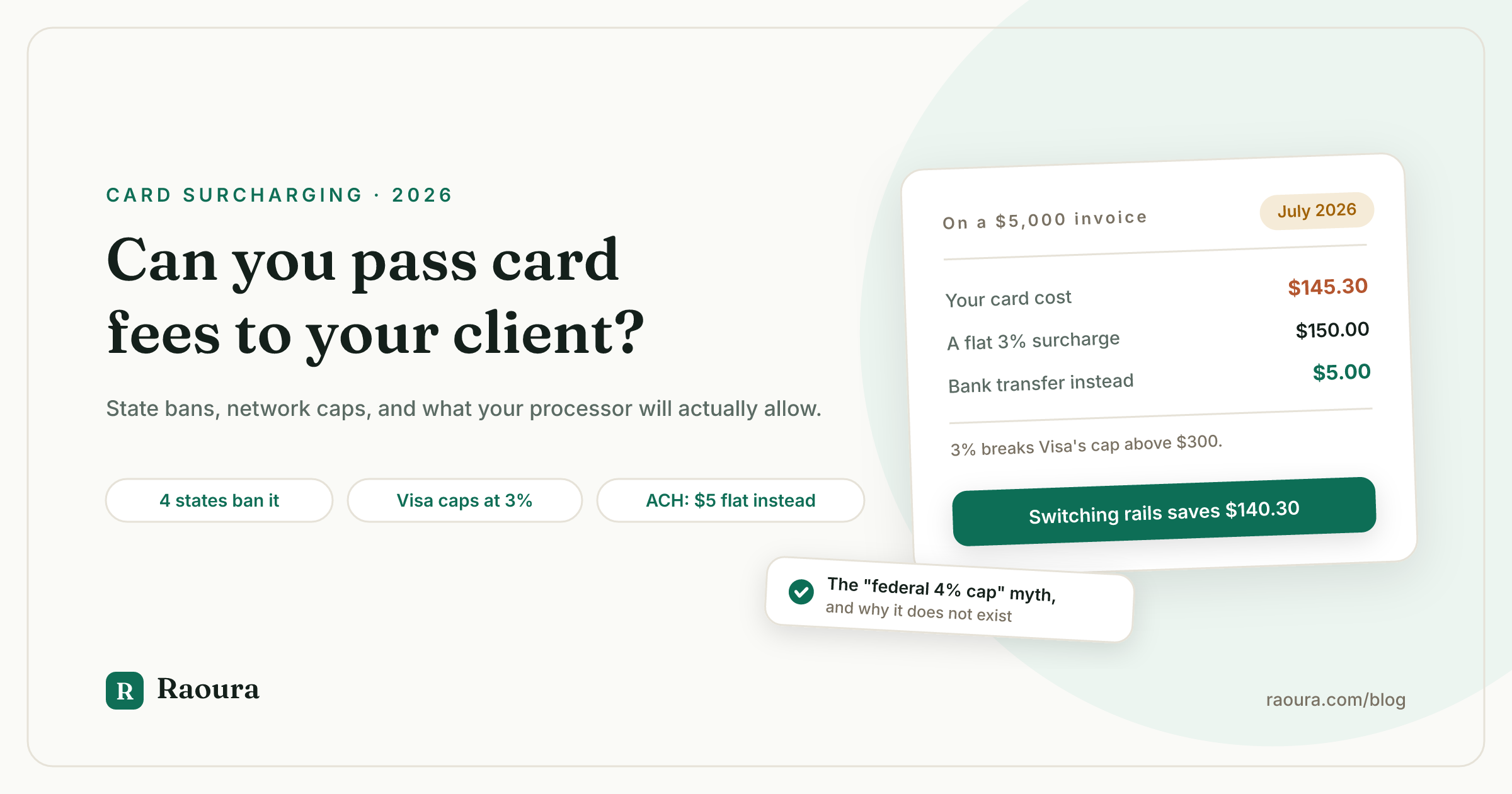
A client owes you $5,000 and wants to pay by card. That costs you $145.30 in processing fees, and somewhere between sending the invoice and watching the deposit land, the obvious thought arrives: why am I paying this? Just add it to the invoice.
You can, in most of the country. But almost every guide that tells you so gets the details wrong in ways that matter.
The pages ranking for this question mostly recycle each other. One claims a "federal 4% maximum" that does not exist. One lists ten states as prohibiting surcharges when seven of those are wrong as of today. Several tell you New York bans surcharging (it does not) and none of them mention the thing that will actually stop you: your invoicing tool almost certainly cannot add a compliant surcharge at all.
Every rule below was read this week from Visa's and Mastercard's own merchant documentation, state statutes, court opinions, and processor docs. Where a source contradicts a popular claim, the source wins.
The short answer#
Credit card surcharging is legal in most of the US, banned outright in four jurisdictions (Connecticut, Massachusetts, Maine, and Puerto Rico), and capped by Visa at the lesser of your actual processing cost or 3%, which means the flat 3% most guides recommend is illegal on any invoice above $300.
That last part is the piece nobody covers, and it is arithmetic rather than law. Your Stripe cost on a card payment is 2.9% plus $0.30. On a small invoice the fixed $0.30 pushes your effective rate above 3%, but the bigger the invoice, the more that $0.30 shrinks as a percentage. At exactly $300 your effective rate is 3.000%. Above that, it drops below 3%, and a flat 3% surcharge starts collecting more than the transaction actually cost you.
Visa's cap is the lesser of your cost or 3%. So on a $5,000 invoice, a 3% surcharge is a rules violation.
Surcharge, convenience fee, cash discount, service fee: they are not the same thing#
These four terms get used interchangeably by almost every guide on this topic, and they carry completely different rules; only one of them (the cash discount) is available in all 50 states.
Visa defines each one separately in its merchant surcharging Q&A, and the definitions are what determine which rulebook applies to you.
| Term | What it means | Where it is allowed | Key catch |
|---|---|---|---|
| Surcharge | A fee added specifically because the client paid by credit card | Most US states, not CT, MA, ME, or PR | Capped, requires disclosure and notice, credit only |
| Convenience fee | A fee for paying through an alternative channel outside your normal one | Narrow, channel-specific | Cannot be charged just for accepting a card. Not permitted at all in Canada |
| Service fee | A fee allowed only in specific merchant categories (US: government, education, utilities) | Not available to freelancers | You cannot charge both a service fee and a surcharge |
| Cash discount | Your card price is the listed price, and you discount for cash or bank transfer | All 50 states | If you reach the total by adding a fee at checkout, Visa treats it as a surcharge anyway |
The cash discount distinction is subtle and worth reading twice. Listing a $5,000 price and adding $145 at checkout is a surcharge. Listing $5,145 and offering $145 off for bank transfer is a discount.
Same money, different rulebook. And under Massachusetts law, which bans surcharges outright, the cash discount version is explicitly permitted while the surcharge version is not.
Where surcharging is banned, capped, or unenforceable#
Four US jurisdictions prohibit credit card surcharges today, three more have bans still printed in their statutes that federal courts have blocked on First Amendment grounds, and two states cap surcharges at 2% rather than 3%.
The "unenforceable but still on the books" category is what wrecks most of the guides on this topic. A state can have a surcharge ban in its statutes that a court has permanently enjoined, which means the text is still there when a writer looks it up but the state cannot enforce it.
| Jurisdiction | Status as of July 2026 | Cap | Source |
|---|---|---|---|
| Connecticut | Banned | n/a | [CGS 42-133ff](https://portal.ct.gov/dcp/knowledge-base/articles/surcharge-faqs/what-is-the-connecticut-surcharge-law), amended by PA 24-142 |
| Massachusetts | Banned (cash discounts allowed) | n/a | [M.G.L. c.140D 28A](https://malegislature.gov/Laws/GeneralLaws/PartI/TitleXX/Chapter140d/Section28a) |
| Maine | Banned, credit and debit both | n/a | [9-A M.R.S. 8-509](https://legislature.maine.gov/legis/statutes/9-A/title9-Asec8-509.html) |
| Puerto Rico | Banned, credit and debit both | n/a | [Ley 150-2008](https://bvirtualogp.pr.gov/ogp/Bvirtual/leyesreferencia/PDF/150-2008.pdf) |
| Colorado | Allowed | 2% or your actual processing cost | [C.R.S. 5-2-212](https://leg.colorado.gov/bills/sb21-091), effective July 1, 2022 |
| Oklahoma | Allowed since Nov 1, 2025 | 2% or processing cost, whichever is less | [SB 677](https://www.oklegislature.gov/cf_pdf/2025-26%20INT/SB/SB677%20INT.PDF) repealed the old ban |
| Kansas | Allowed since Jan 1, 2025 | Network rules only | [K.S.A. 16a-2-403](https://www.ksrevisor.gov/statutes/chapters/ch16a/016a_002_0403.html) |
| New York | Allowed, with a strict posting rule | What your processor charges you | [NY S.B. 1359](https://www.governor.ny.gov/news/governor-hochul-announces-new-law-clarify-disclosure-credit-card-surcharges-goes-effect-sunday), effective Feb 11, 2024 |
| California | Ban on the books, effectively unenforced | Network rules only | [CA AG guidance](https://oag.ca.gov/consumers/general/credit-card-surcharges) applying *Italian Colors v. Becerra* |
| Texas | Ban on the books, permanently enjoined in part | Network rules only | [Texas State Law Library](https://www.sll.texas.gov/faqs/credit-card-surcharge/) on *Rowell v. Paxton* |
| Florida | Ban on the books, struck down as unconstitutional | Network rules only | *Dana's Railroad Supply v. Att'y Gen.*, 11th Cir. 2015 |
| Everywhere else | Allowed | Network rules only |
Two of these deserve a closer look because they are misreported most often.
New York does not ban surcharging. What the February 2024 law requires is that you post the total credit card price, not a base price plus a percentage. A sign or invoice line reading "3.9% surcharge applies" is specifically non-compliant. So is calling it a "convenience fee," "service fee," "non-cash adjustment," or "technology fee." You show the full card price, or you show two prices side by side.
California is the opposite kind of confusion. Civil Code 1748.1 still prohibits surcharges, but after Italian Colors v. Becerra the Attorney General's office states it will "generally apply the Italian Colors decision to merchants that are similarly situated." Misleading pricing is still actionable. The surcharge itself, disclosed honestly, is not being enforced against.
The card network rules that apply everywhere#
Visa caps US surcharges at the lesser of your merchant discount rate or 3%, Mastercard's published cap is 4%, both prohibit surcharging debit and prepaid cards entirely, and both require 30 days of advance notice before you start.
State law tells you whether you may surcharge. The card networks tell you how, and their rules apply in every state including the ones with no surcharge law at all. Breaking them is a contract problem with your processor rather than a legal one, but Visa fines acquirers $1,000 per identified violation and runs annual mystery shopping to find them.
Here is what both networks require, from their own documentation:
- Cap the surcharge. Visa: the lesser of your merchant discount rate or 3%. Mastercard: the lesser of your average effective merchant discount rate or 4%. Your state cap, if it has one, overrides both.
- Never surcharge debit or prepaid cards. This holds even when a debit cardholder chooses "credit" at checkout. It is the rule most likely to catch out a freelancer using a manual line item, because you usually cannot tell what card a client is about to use when you send the invoice.
- Give 30 days' notice. Visa requires notice to your acquirer. Mastercard has historically required notice to both Mastercard and your acquirer.
- Disclose it three times. At point of entry, at point of sale, and as a separate line item on the receipt.
- Pick brand level or product level, not both. You can surcharge all Visa credit cards at one rate, or surcharge by card product, but you cannot mix the two approaches.
- Refund it proportionally. If you refund the invoice, the surcharge goes back too.
One live change worth knowing: Mastercard's registration form currently states that it is "presently no longer requiring that U.S. merchants register their intent to surcharge credit cards," pending revised rules it expects to announce in the second half of this year. Its main rules page still describes the 30-day registration requirement. The two pages contradict each other right now, so assume the requirement may return and check before relying on the suspension.
The part nobody mentions: your tool probably cannot do this#
Stripe has no generally available surcharging product, PayPal's user agreement prohibits surcharging PayPal payments outright, and Square's surcharge feature is in open beta and excluded from most of its payment surfaces.
This is the single biggest gap in the existing coverage. Six articles will walk you through state law and network caps, and not one tells you that the tool sitting in your browser tab cannot execute any of it.
| Processor | Surcharging support, July 2026 | Notes |
|---|---|---|
| Stripe | [Private preview only](https://docs.stripe.com/payments/advanced/surcharge) | US only, Payment Element only, requires a third-party app (Yeeld or InterPayments). Stripe does not calculate the surcharge and places legal liability on you |
| PayPal | [Prohibited](https://www.paypal.com/us/legalhub/paypal/useragreement-full) | "You agree that you will not impose a surcharge or any other fee for accepting PayPal as a payment method" |
| Square | [Open beta, 3% cap](https://squareup.com/help/us/en/article/8596-set-up-and-manage-card-surcharges) | In-person POS and web invoices only. Not on Virtual Terminal, Kiosk, Square Website, or Appointments. Never on ACH, debit, or tips |
The workaround most freelancers reach for is adding a manual line item: "Card processing fee, $145." That fails compliance in at least three ways at once. You cannot know in advance whether the client will pay with a debit card (where surcharging is banned), the fee is not passed in the transaction data field Visa requires, and if the client is in New York you have just published the exact base-price-plus-fee format the state prohibits.
It is not that the line item is risky in some abstract sense. It is that a compliant surcharge is a property of the transaction, and a line item is just text on a document.
What to do instead, and the math on why#
Offering bank transfer alongside card costs you $5.00 on a $5,000 invoice instead of $145.30, which is more than a compliant 3% surcharge could ever have recovered, with no state law, network rule, or disclosure requirement attached.
Stripe's published rates are 2.9% plus $0.30 for cards and 0.8% capped at $5.00 for ACH direct debit. The ACH cap kicks in at $625, so every invoice above that clears for a flat five dollars.
Compare the three options on the same invoice:
| Invoice | Your card cost (2.9% + $0.30) | Your effective rate | Max legal Visa surcharge | A flat 3% surcharge | ACH cost instead |
|---|---|---|---|---|---|
| $300 | $9.00 | 3.000% | $9.00 | $9.00 | $2.40 |
| $500 | $14.80 | 2.960% | $14.80 | $15.00 | $4.00 |
| $1,000 | $29.30 | 2.930% | $29.30 | $30.00 | $5.00 |
| $5,000 | $145.30 | 2.906% | $145.30 | $150.00 | $5.00 |
| $10,000 | $290.30 | 2.903% | $290.30 | $300.00 | $5.00 |
Read the last two columns together. On a $5,000 invoice, a flat 3% surcharge overcharges by $4.70 against your actual cost, putting you outside Visa's cap for the sake of $4.70. Meanwhile switching that same client to ACH saves you $140.30 outright, roughly thirty times the amount the non-compliant surcharge would have gained you.
Surcharging recovers your processing cost. Changing the rail eliminates most of it.
That is the whole argument, and it holds at every invoice size above a few hundred dollars. We ran the full three-rail version of this math, including wire transfers, in our card vs ACH vs wire comparison, and the same $5-flat ceiling shows up at $50,000 that shows up at $1,000.
If you want the fee-recovery benefit without the compliance exposure, price it in instead. Set your rate to absorb an average 2.9%, then offer a bank transfer discount. That is a cash discount, legal in all 50 states, and it needs no notice to anyone.
The clause to put in your contract#
Whatever approach you choose, it belongs in the agreement your client signs before the first invoice goes out, not as a surprise line item afterward.
For a bank transfer discount, which is the version we would actually recommend:
Payment methods. Invoices are payable by bank transfer (ACH) or credit card. The amounts stated in this agreement assume payment by bank transfer. Payment by credit card is available and the invoice total will reflect the card price at the time of invoicing.
For a surcharge, if you have confirmed it is legal in the applicable state and your processor genuinely supports it:
Card processing. Invoices paid by credit card are subject to a processing fee equal to the Contractor's actual cost of acceptance, not to exceed 3%. This fee does not apply to debit card or bank transfer payments and will be shown as a separate line item on the invoice.
Note the wording of the second one. Tying the fee to your actual cost of acceptance rather than naming a flat percentage keeps you inside Visa's cap automatically, and it is the same construction Colorado and Oklahoma use in their statutes. Our guide on what should be in a freelance contract covers where this sits alongside your payment terms and late fee language.
Neither clause is legal advice, and both are worth a lawyer's eye if you work at any real volume in a state with its own rules.
What changes if the interchange settlement is approved#
A settlement in the long-running Visa and Mastercard interchange case received preliminary approval on June 9, 2026, and would let merchants surcharge at the brand or product level up to 3% regardless of what competing card brands allow, but the fairness hearing is not until November 16, 2026.
This is worth knowing about precisely because nothing has changed yet. Judge Brodie denied preliminary approval to an earlier version of this settlement in June 2024, calling the surcharging reforms it offered insufficient. The current settlement cleared that bar on June 9, 2026, with an objection deadline of September 14, 2026 and a fairness hearing set for November 16, 2026.
The relevant change for a freelancer: under the amended terms, you would be able to surcharge Visa and Mastercard credit cards up to the lesser of your full cost of acceptance or 3%, without the current constraint that drops your allowance to 1% when a competing brand you accept limits surcharging.
Until final approval lands, the rules in the sections above are the ones that govern. Any article you read that describes the new surcharging freedoms as current is describing something that has not happened.
How Raoura handles this#
Disclosure: Raoura is our product. Raoura is client and project management for solo freelancers at $17 per month flat, and invoices run on your own Stripe account through Stripe Connect, so you pay Stripe's published rates directly with no markup layered on top. That also means Raoura inherits Stripe's surcharging position: there is no automatic surcharge feature, because Stripe does not offer one outside a private preview that requires a third-party app.
What you can do is add a line item to an invoice, which is what most freelancers mean when they ask about this, with the compliance caveats above firmly in mind.
!Raoura's new invoice screen with fields for client, line item, amount, and due date

A surcharge added here is a line item on a document, not a fee attached to the transaction, which is exactly why it does not satisfy Visa's disclosure and data-field requirements.
The better use of the same five minutes is making sure bank transfer is in front of the client at all, since that is the option that actually removes the fee rather than moving it.

Bank transfer sitting next to the card button is what turns a $145.30 fee into a $5.00 one on a $5,000 invoice.
Surcharge rules follow the client's location as much as yours, so check the surcharge law for remote clients before you add the line item.
Frequently asked questions
Can I legally charge my client a credit card fee?
In most US states, yes. Connecticut, Massachusetts, Maine, and Puerto Rico prohibit credit card surcharges outright. Colorado and Oklahoma cap them at 2% or your actual processing cost. New York permits them but requires you to post the total card-inclusive price rather than a base price plus a percentage. Everywhere else, state law allows it and only the card network rules apply.
What is the maximum credit card surcharge I can charge?
Visa caps it at the lesser of your merchant discount rate or 3%, and Mastercard's published cap is the lesser of your average effective rate or 4%. Because your effective Stripe rate falls below 3% on any invoice over $300, the practical cap for most freelancers is your actual cost, not the headline 3%. There is no federal cap, despite what several widely read guides claim.
Can I add a card fee as a line item on my invoice?
Mechanically yes, compliantly no. A compliant surcharge has to be excluded from debit cards, passed in a specific transaction data field, and disclosed in a particular format. A manual line item does none of those things, and in New York the base-price-plus-fee format is specifically prohibited.
Does Stripe support surcharging?
Not in any generally available form. Stripe's surcharging documentation describes a private preview, US only, restricted to the Payment Element in payment mode, and it requires installing a third-party app such as Yeeld or InterPayments. Stripe does not calculate the surcharge itself and assigns the legal responsibility to the merchant.
Can I surcharge a debit card?
No. Both Visa and Mastercard prohibit surcharging debit and prepaid cards, including when the cardholder selects "credit" at the terminal. Maine and Puerto Rico also ban debit surcharges as a matter of state law.
What is the difference between a surcharge and a convenience fee?
A surcharge is charged because the client used a credit card. A convenience fee is charged for using an alternative payment channel outside your customary one, and it cannot be applied simply for accepting a card. Freelancers who invoice by email are almost never in convenience fee territory, and calling a surcharge a convenience fee is explicitly non-compliant in New York.
Is a cash discount a better option?
For most solo freelancers, yes. A cash discount is legal in all 50 states including the four that ban surcharges, requires no network notice, and carries no cap. The requirement is structural: your card price has to be the listed price, with the discount applied for cash or bank transfer, rather than a fee added at checkout.
Can I charge a surcharge to an international client?
It depends on their country, not yours. In Canada, surcharging has been permitted since October 6, 2022 under a class action settlement, capped at 2.4% or your average effective rate if lower, and convenience fees are not permitted at all. Other countries vary widely, and several EU member states prohibit surcharging on consumer cards. See our guide to invoicing international clients for the fee side of cross-border work.
Should I just raise my rates instead?
That is what most freelancers land on. Building an average 2.9% into your pricing costs the client the same amount, costs you nothing in compliance risk, and removes a conversation about fees from the point where you are trying to get paid. Our pricing models guide covers how to fold overhead like this into a rate.
---
Every rule, cap, and rate in this article was verified from primary sources on July 18, 2026: Visa's merchant surcharging Q&A and requirements documents, Mastercard's merchant surcharge rules and registration pages, Connecticut DCP, the Massachusetts and Maine legislatures, Puerto Rico's OGP statute compilation, Colorado SB 21-091, Oklahoma SB 677, the Kansas Revisor of Statutes, the New York Governor's office, the California Attorney General, the Texas State Law Library, Stripe's pricing and surcharge documentation, PayPal's user agreement, Square's surcharge help article, and the court-authorized interchange settlement site. Card network rules and state law both change without much warning; the linked sources outrank this article the moment they disagree. Nothing here is legal advice. Verified July 2026.
Run your client work in one place
Send a proposal, get it signed, invoice, and get paid, with a branded portal your clients will actually use. One flat plan at $17/month, and we never take a cut of your payments.
Try Raoura free for 14 daysNo credit card required. Set up in minutes.
Keep reading
Is Upwork Worth It in 2026? A Break-Even Test for Your Situation
Upwork is worth it when its fee costs less than finding the client yourself, and that is true far more often for a first project than for a repeat client. Here is the break-even math with 2026 numbers: the 0 to 15% fee, Connects, the shrinking client base, and when to wait out the 24-month rule instead of paying to leave.
The Virtual Assistant Contract: 24 Clauses, Scored Against Every Template Ranking for This Search
We scored the four pages that publish actual virtual assistant contract text against 24 clauses a VA agreement needs. Twenty-four of 96 possible slots were filled. The best single template managed 7 out of 24. Twelve clauses appear in none of them, including every clause about the thing that makes VA work different from other freelance work: you are holding your client's passwords and running their inbox. One popular template also tells you a contract fixes your independent contractor status, then mandates client-set 9 to 5 weekday hours in the same document. Here is the clause-by-clause version, with the classification test the DOL is actually applying in 2026, the data protection terms nobody drafts, and the retainer mechanics that decide whether unused hours roll over.
Stripe vs PayPal for Freelancers: Every Fee Verified (2026)
Every page ranking for this comparison either prints in-person retail rates, contradicts itself, or skips the numbers freelancers actually pay. We read the current Stripe and PayPal pricing pages line by line, ran a $3,000 invoice through every rail, and found a $1,764 per year gap between the cheapest setup and the default one.