Whose Surcharge Law Applies When Your Client Is in Another State?
July 19, 2026
You are a designer in Austin. Your client is a marketing agency in Hartford. The invoice is $6,000, they always pay by card, and the processing fee is going to cost you about $174.
Texas allows surcharging. Connecticut bans it outright.
So can you add the fee, or not?
Search that question and you will get three different answers from the first three results, none of them sourced. One page says follow your own state. One says follow your customer's state. One says follow whichever is stricter. They cannot all be right, and the reason nobody resolves it is that the question is actually three questions wearing a trench coat.
This article separates them. If you have not yet decided whether to pass card costs on at all, start with our guide to surcharging rules for freelancers. This one is about the interstate problem specifically.
The short answer#
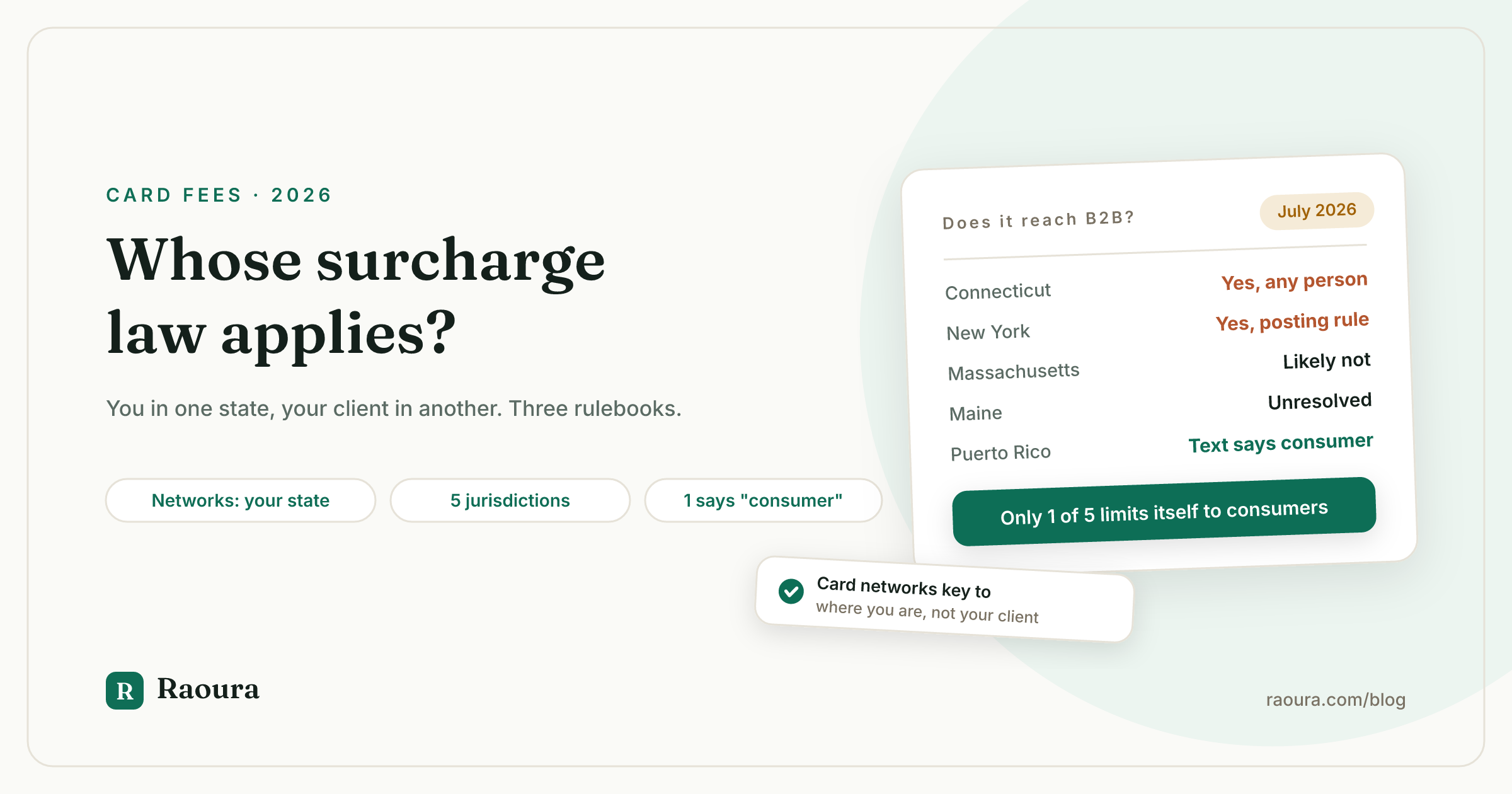
Three separate rulebooks govern a surcharge, and only one of them looks at your client's location at all: the card networks key entirely to your location as the merchant, state statutes reach you based on where the transaction happened rather than where your client lives, and of the five US jurisdictions that restrict surcharging, exactly one limits its operative sentence to consumers.
That last number is the one nobody publishes, so here is the working below.
The practical consequence is that your own state is the binding constraint most of the time, your client's state matters in a narrower set of cases than the internet believes, and the whole question disappears if you use the other pricing structure.
Why every page you find contradicts the next one#
The search results for this question are almost entirely payment processors selling merchant accounts, and every one of them stops the analysis at the point where it gets interesting.
Their answers split three ways.
Camp one says merchant location. This comes from Visa's own merchant surcharging Q&A, which states that "the merchant outlet location must follow the state laws which the merchant outlet is located." Solid source. The problem is that the sentence is written about a chain with physical stores in several states, and you do not have an outlet.
Camp two says customer location. Several processor blogs assert flatly that a surcharge must comply "with the laws of the state where the customer is located, not just your business's home state." Not one of them cites a statute, a case, or an enforcement action for that claim.
Camp three says give up. Versapay, an accounts-receivable vendor, buries the most honest sentence in the entire category twelve FAQs deep on a 5,000 word page: "There is not a clear answer to this question... State laws do not explicitly state whether they apply to merchants or customers or both in their jurisdiction."
That is closer to correct than either of the confident answers. But "no clear answer" is not the same as "no analysis available," and the analysis is not hard. You just have to read the statutes instead of the blogs about the statutes.
One more thing to clear out of the way first, because it appears on nearly every page in this category and it is false.
There is no federal cap on credit card surcharges. The "4% maximum allowable surcharge under federal law" that processor pages keep repeating is a Mastercard network rule, not a statute. The federal surcharge ban expired on February 27, 1984 and was never renewed. Everything restricting you today is either state law or a private contract with a card network.
Rulebook one: the card networks, which only look at you#
Neither Visa's nor Mastercard's published surcharge rules contain a single reference to cardholder location; both key permissibility and every disclosure obligation to where the merchant is located.
Visa's rule, quoted above, is about merchant outlets. Mastercard's merchant surcharge rules open by describing what a "Merchant located in the U.S. Region or a U.S. Territory" may do.
Read both documents end to end and the customer's address never comes up.
This matters more than it sounds, because the network rules are the layer with actual teeth for a solo freelancer. A state attorney general is unlikely to open a file on your $6,000 invoice. Your acquirer absolutely will shut off your ability to surcharge, and Visa can assess a $1,000 fine against your acquirer for improper surcharging, which your acquirer will pass to you.
Here is what the network layer requires regardless of where anyone is sitting.
| Network requirement | Visa | Mastercard |
|---|---|---|
| Maximum surcharge | Lesser of your merchant discount rate or 3% | Lesser of your merchant discount rate or 4% |
| Advance written notice | 30 days to your acquirer | 30 days to Mastercard and your acquirer |
| Debit and prepaid cards | Surcharging prohibited, including when the cardholder selects "credit" at the terminal | Prohibited on Debit Mastercard and prepaid |
| Receipt treatment | Separate line item | Separate line item, refunded pro rata on any refund |
| State law | "Nothing in the rules affects your obligation to comply with applicable state or federal law" | Same disclaimer |
If you accept both brands, and you do, your working cap is 3%. Visa's is the binding one.
And notice the last row. Both networks explicitly hand the state-law question back to you. Their silence on cardholder location is not permission. It just means they are not the ones asking.
Rulebook two: whether a state statute reaches you at all#
State consumer statutes reach an out-of-state seller based on where the transaction occurred, not where the buyer resides, which is the rule New York's highest court set in Goshen v. Mutual Life in 2002 and the framework most states apply.
This is the part the processor blogs skip entirely, and it is the actual legal question.
The New York Court of Appeals in Goshen v. Mutual Life Insurance Co. held that "the transaction in which the consumer is deceived must occur in New York." Then it said the thing that decides your case:
"our General Business Law analysis does not turn on the residency of the parties"
The test cuts both ways. A New York resident buying from a seller in another state, in a transaction that happened elsewhere, does not automatically drag New York law along with them. A non-resident deceived inside New York can invoke it.
The general principle across states is similar. The National Association of Attorneys General describes it plainly: if conduct occurs in the state, the seller may be regulated there even if some conduct happened elsewhere, but "if all the relevant conduct occurred exclusively out of state, a state's statute cannot have extraterritorial application." The Supreme Court's decision in Healy v. Beer Institute, 491 U.S. 324 (1989), is the constitutional backstop on how far a state can push.
So where does a remote freelance transaction occur?
Honestly, nobody has litigated that for surcharging. But the facts you can point to are mostly on your side of the line. Your price is posted in a document you wrote and sent from your state. Your merchant account is registered in your state. The payment is processed to your account. Your client's only contribution to the location analysis is opening an email.
The one exception worth taking seriously is a state that is unusually broad about who can sue, and there is exactly one of those.
Rulebook three: whether the statute even covers a business client#
Here is the original work in this article. We pulled the operative sentence of all five US surcharge statutes and read what each one restricts. They are not written the same way, and the differences decide whether a B2B invoice is in scope.
Of the five US jurisdictions restricting surcharges, only Puerto Rico's operative sentence limits itself to a consumer; Connecticut and New York use terms broad enough to cover a business buyer, Massachusetts is likely carved out by a business-purpose exclusion elsewhere in its chapter, and Maine is genuinely unresolved.
| Jurisdiction | Operative sentence restricts | Who it names | Reaches a business client? |
|---|---|---|---|
| Connecticut, [42-133ff(b)](https://law.justia.com/codes/connecticut/title-42/chapter-739/section-42-133ff/) | Any surcharge on any transaction | "No person may impose" | Yes. No consumer limiter anywhere in the section |
| Massachusetts, [140D 28A(2)](https://malegislature.gov/Laws/GeneralLaws/PartI/TitleXX/Chapter140d/Section28a) | Credit card surcharges | "No seller in any sales transaction" | Probably not, but by inference only |
| Maine, [9-A 8-509](https://legislature.maine.gov/legis/statutes/9-A/title9-Asec8-509.html) | Credit and debit surcharges | "A seller in a sales transaction may not impose" | Unresolved. No case law either way |
| New York, [GBL 518](https://www.nysenate.gov/legislation/laws/GBS/518) | Not a ban since 2024. A posting requirement | "Any seller in any sales transaction" | Yes. "Customer" is undefined and unqualified |
| Puerto Rico, [10 L.P.R.A. 11](https://law.justia.com/cases/federal/appellate-courts/ca1/24-1188/24-1188-2025-05-29.html) | Surcharges and, per the regulator, cash discounts | "a surcharge on a **consumer**" | On its text, no |
One of five. That is the whole finding, and it is the opposite of what the processor pages assume when they tell you B2B changes nothing.
Now the detail behind each, because two of these have traps.
Connecticut is the one that genuinely reaches you#
Connecticut rewrote its surcharge statute in 2022 and deleted the words "seller" and "buyer." The current text is four words wider than anything else in the country: "No person may impose a surcharge on any transaction."
A violation is deemed an unfair trade practice under CUTPA, and CUTPA is the unusual one. Its private right of action runs to "any person who suffers any ascertainable loss," where "person" expressly includes corporations, LLCs, and partnerships. The Connecticut Supreme Court held in Larsen Chelsey Realty Co. v. Larsen, 232 Conn. 480 (1995), that CUTPA "imposes no requirement of a consumer relationship" and that a competitor or other business person can sue without showing consumer injury.
So if any state's surcharge rule is going to follow a business client home, it is this one. Treat a Connecticut client as a hard no.
New York is not a ban, and half the internet still says it is#
The 2024 amendment retitled GBL 518 as a "credit card surcharge notice requirement." The operative verb changed from "no seller may impose" to "any seller imposing."
Surcharging is legal in New York now. What is required is that you post the total card-inclusive price up front, and that the surcharge not exceed what the card company actually charges you. The final price cannot exceed the posted price.
The Department of State's guidance lists three compliant structures: show both prices, show the higher card price and advertise a cash discount, or charge the same for both. What it makes illegal is announcing a percentage fee without having posted the total first.
Penalties run to $500 per violation, down from a misdemeanor before the amendment.
Massachusetts and Maine are quieter than they look#
Massachusetts chapter 140D contains a scope exclusion in section 2: the chapter does not apply to "credit transactions involving extensions of credit primarily for business, commercial, or agricultural purposes, or... to organizations."
Read literally, an invoice to a business client sits outside the chapter that contains the surcharge ban. That is a textual inference, not a holding. No Massachusetts appellate decision has used section 2 to defeat a 28A claim, and we would not build a pricing policy on it.
Maine is worse. Section 8-509 has its own self-contained language about sellers and cardholders, sitting inside a Consumer Credit Code whose general scope provision limits it to consumer credit transactions. There is no Maine case law, no Bureau ruling, and no AG opinion reconciling the two.
Maine also bans surcharges on debit cards, which Massachusetts does not.
Puerto Rico is the strictest jurisdiction in the country#
Puerto Rico bans surcharges, and after the legislature deleted the cash discount carve-out in 2013, the consumer affairs regulator reads discounts as prohibited too. Merchants challenged the ban on federal preemption grounds and lost. The First Circuit in Asociación de Detallistas de Gasolina de Puerto Rico v. Commonwealth of Puerto Rico, No. 24-1188, decided May 29, 2025, held that the federal Cash Discount Act regulates card issuers rather than territories and does not preempt the ban.
Its statute is the only one of the five whose operative sentence says "consumer," which on its face leaves a B2B invoice outside it. But the penalty there retains criminal exposure, up to a $500 fine or six months, so this is not a place to test a textual argument.
Build the cost into your rate for Puerto Rico clients and move on.
What the exposure actually looks like#
At $500 per violation and a surcharge on two card invoices a month, a Connecticut or New York violation compounds to $12,000 a year in maximum civil exposure, which is 8.6 times the $1,392 in processing fees you would have recovered on those same 24 invoices at $2,000 each.
The point of running this is to see how badly the risk-reward is shaped.
| Card invoices surcharged | Invoice size | 2.9% recovered per year | Max civil exposure at $500 per violation | Ratio |
|---|---|---|---|---|
| 12 | $2,000 | $696 | $6,000 | 8.6x |
| 24 | $2,000 | $1,392 | $12,000 | 8.6x |
| 24 | $5,000 | $3,480 | $12,000 | 3.4x |
| 48 | $5,000 | $6,960 | $24,000 | 3.4x |
Recovery column is 2.9% of invoice size times the number of invoices. Exposure column is $500 times the number of invoices, which is the statutory maximum in both Connecticut and New York, not a prediction of what any regulator would seek. Ratio is exposure divided by recovery.
Nobody is suggesting a state AG is coming for your invoices. The reason to look at this table is that the upside is small and bounded at about 3% while the downside is unbounded in the number of invoices, and that shape is what should drive the decision rather than any confident reading of a statute.
What to actually do, in order#
Six steps. The first two settle most cases before your client's state ever comes up.
1. Check your own state first, because it is dispositive#
If you are located in Connecticut, Massachusetts, Maine, or Puerto Rico, stop. The network rules bind you to your own state's law, so no client location makes surcharging available to you.
If you are anywhere else, the network layer is satisfied and you move on to step two.
2. Give the strict four and Puerto Rico their own rule#
There are five jurisdictions to flag in your client records, not fifty. Connecticut for the CUTPA reach, New York for the posting requirements, Massachusetts and Maine as conservative no-go, Puerto Rico as no-go for both structures.
Everything else in the country, surcharge normally at 3% or below with proper disclosure.
3. Do not use the "customer location" rule the processors sell you#
It has no authority behind it and it is a bad approximation of Goshen, which turns on transaction location rather than residency. If you want to be conservative, be conservative about the specific states above for specific reasons, not by adopting a rule nobody can source.
4. Know the contract clause exists, and know it is untested#
Lowenstein Sandler documented the technique that sophisticated merchants use: designate a surcharge-friendly state as the situs of credit card payments in your terms, and provide that its law governs disputes about payment. Their October 2023 piece calls it a common practice and then adds the caveat everyone skips: "to date, that practice has not been tested in court in a reported decision."
Useful to know. Not something to rely on as a solo operator.
5. Post the total price in the proposal, not the invoice#
Whatever structure you choose, the document that establishes your price is the proposal, and it needs to contain the number a card payer will actually pay. New York's posting requirement is written this way explicitly, and it happens to be good practice in every other state too.

The total your client accepts is the posted price, which is what New York's GBL 518 requires you to establish before a card is chosen. Disclosure: Raoura is our product.
6. Consider the structure that deletes the question#
A cash discount is not a surcharge under any of these statutes, and Maine's version says so in one sentence: "A discount or reduction from the regular price is not a surcharge."
If you list the card price as your price and reduce it for bank transfer, four of the five jurisdictions above stop applying to you. Only Puerto Rico still says no. There is no 3% cap, no 30 day acquirer notice, no separate line item requirement, and no interstate analysis to run at all.
Our full breakdown of that structure, including the arithmetic showing why a maximum legal surcharge still leaves you short, is in cash discount vs surcharge.
Where your tooling fits#
None of this is a software problem, which is worth saying because most pages in this category end by selling you a merchant account.
Stripe does support surcharging, but as of July 2026 it is public preview only, requires a preview API version, caps US surcharges at 3% on credit cards only, publishes no state-by-state list, and tells you in writing that "you're fully responsible for any fines, penalties, or losses" arising from non-compliance.
The discount structure needs none of that. It is a line item and a number you chose, which every invoicing tool ever written already supports.
What does help is a tool that does not add its own layer of fees on top of the processing cost you are already trying to recover, and that lets your client pay by bank transfer so the discount is a real choice rather than a theoretical one. ACH through Stripe runs 0.8% capped at $5.00 against 2.9% plus $0.30 for cards, which is the entire reason a discount works.

Raoura charges a flat $17 a month and takes no percentage of your invoices, so payments land in your own Stripe account at Stripe's rate and nothing is added to the number your client sees. Disclosure: Raoura is our product.
For the full fee comparison across payment rails, see our card vs ACH vs wire breakdown.
Frequently asked questions
If my client is in Connecticut and I am not, can I surcharge them?
The card networks will not stop you, because they key to your location. Connecticut's statute is the broadest in the country ("no person... any transaction") and CUTPA lets business plaintiffs sue without any consumer relationship, so it is the single client state where we would not do it. Use a cash discount instead.
Does it matter that my client is a business rather than an individual?
It matters in Massachusetts, where chapter 140D excludes credit for business or commercial purposes, and on the face of Puerto Rico's statute, which says "consumer." It does not help you in Connecticut or New York, whose operative sentences contain no consumer limiter at all. Maine is unresolved.
Is there a federal limit on how much I can surcharge?
No. The federal surcharge ban expired on February 27, 1984 and was never renewed. The caps you have read about are card network contract terms: 3% for Visa, 4% for Mastercard, and in both cases no more than your own effective processing rate. If you take both brands, your real cap is 3%.
What about a client outside the US?
Different analysis. Surcharge caps vary by country (Canada caps at 2.4%, for example) and some jurisdictions ban the practice outright. Our guide to invoicing international clients covers the payment side of cross-border work.
Can I just add a "convenience fee" or "processing fee" instead?
No. Those labels are what turn a compliant structure into a surcharge in a regulator's eyes, and New York names them specifically. If the number your client sees goes up after they choose a card, it is a surcharge no matter what the line item says.
Should a solo freelancer be doing any of this?
Probably not. The recoverable amount caps out around 3%, the compliance surface spans five jurisdictions and two network rulebooks, and the simplest version of this decision is to price 3% higher and never think about it again. Surcharging pays off mainly if a large share of your revenue arrives by card on invoices big enough for 3% to be real money.
---
This is general information about how these rules are written, not legal advice, and the law here moves. Confirm your own state's current position and talk to a lawyer before building a surcharge program.
Statutes, network rules, and pricing in this article were verified July 2026 against the primary sources linked above.
Run your client work in one place
Send a proposal, get it signed, invoice, and get paid, with a branded portal your clients will actually use. One flat plan at $17/month, and we never take a cut of your payments.
Try Raoura free for 14 daysNo credit card required. Set up in minutes.
Keep reading
Is Upwork Worth It in 2026? A Break-Even Test for Your Situation
Upwork is worth it when its fee costs less than finding the client yourself, and that is true far more often for a first project than for a repeat client. Here is the break-even math with 2026 numbers: the 0 to 15% fee, Connects, the shrinking client base, and when to wait out the 24-month rule instead of paying to leave.
The Virtual Assistant Contract: 24 Clauses, Scored Against Every Template Ranking for This Search
We scored the four pages that publish actual virtual assistant contract text against 24 clauses a VA agreement needs. Twenty-four of 96 possible slots were filled. The best single template managed 7 out of 24. Twelve clauses appear in none of them, including every clause about the thing that makes VA work different from other freelance work: you are holding your client's passwords and running their inbox. One popular template also tells you a contract fixes your independent contractor status, then mandates client-set 9 to 5 weekday hours in the same document. Here is the clause-by-clause version, with the classification test the DOL is actually applying in 2026, the data protection terms nobody drafts, and the retainer mechanics that decide whether unused hours roll over.
Stripe vs PayPal for Freelancers: Every Fee Verified (2026)
Every page ranking for this comparison either prints in-person retail rates, contradicts itself, or skips the numbers freelancers actually pay. We read the current Stripe and PayPal pricing pages line by line, ran a $3,000 invoice through every rail, and found a $1,764 per year gap between the cheapest setup and the default one.