What to Say When a Client Refuses to Pay a Deposit
August 30, 2026
You send the proposal, the client is excited, and then the deposit line lands and everything goes quiet. Or worse, they reply immediately, just not with a yes.
Every guide on this topic gives you one script for one version of this conversation, usually the polite "we don't do that" version. Real deposit pushback comes in at least five different flavors, and they do not call for the same answer. Some are a client protecting their own cash flow. Some are the clearest signal you will get, for free, before you have done any work.
The short answer: sort the objection into legitimate or red flag before you respond, because the two get opposite replies, then use a script that trades the word "deposit" for structure the client can say yes to. This article gives you the triage table, five scripts for the objections you will actually hear, the scenario every other guide skips (a client who signs the contract, then stalls when the actual invoice arrives), and a plain rule for when the right move is to walk. Everything below was checked in July 2026.
If you have not settled on a percentage yet, start with our guide to how much deposit to charge, which covers the decision table and the clause. This one picks up exactly where that one leaves off: the client has seen the number, and they are pushing back.
Sort the objection first: legitimate caution and a red flag sound almost identical#
The same sentence, "I don't pay deposits," can mean a careful business owner or a client who never intended to pay you at all, and the fastest way to tell them apart is asking what specifically they are proposing instead. A legitimate objection comes with an alternative. A bad-faith one comes with pressure to just start.
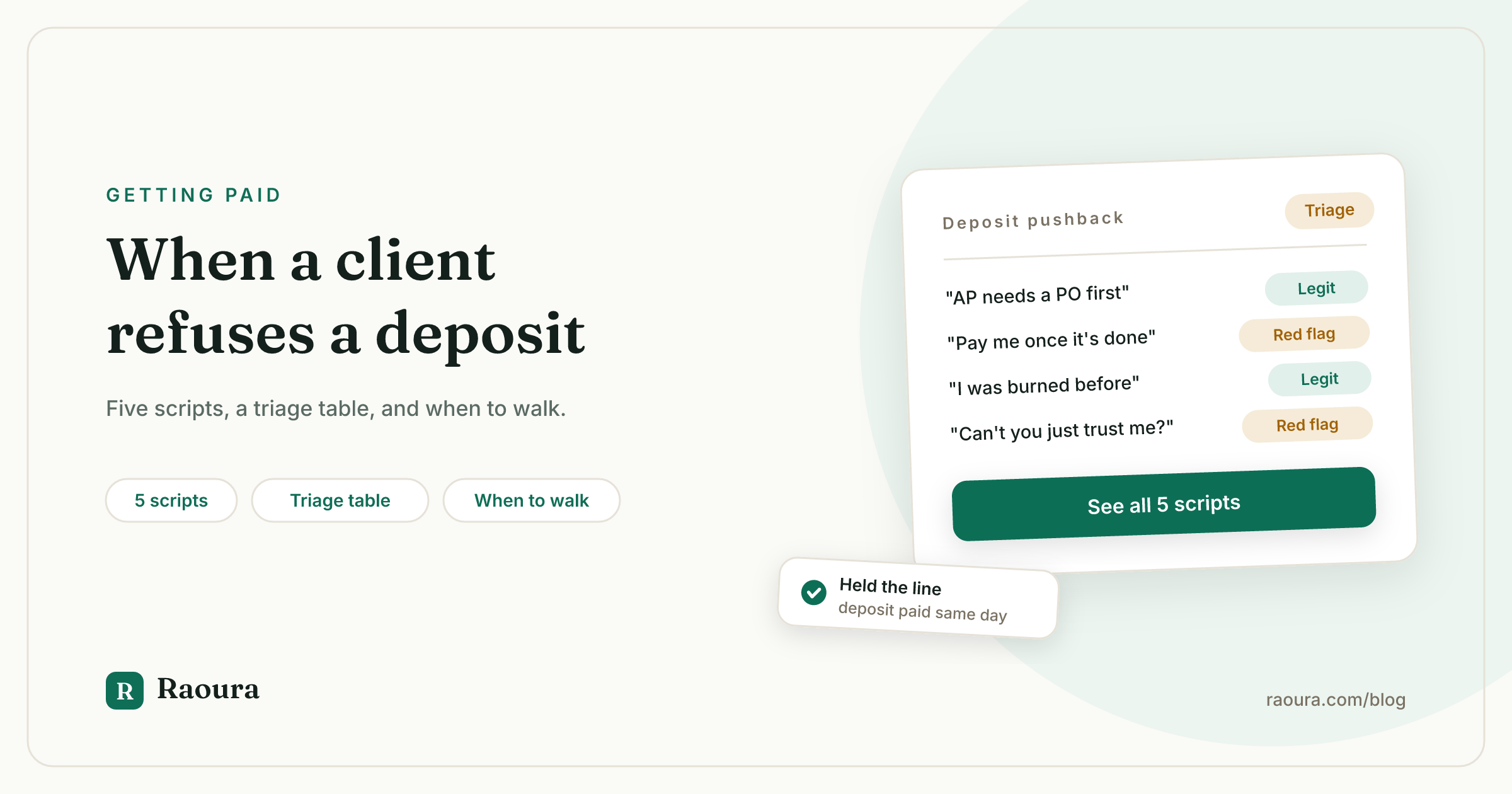
Run every deposit pushback through this table before you decide how to respond.
| What they say | What it usually means | Legitimate or red flag | What to do |
|---|---|---|---|
| "Our accounts payable can't cut a check before delivery" | A real procurement process with a PO system | Legitimate | Reshape the ask: invoice phase one as its own line item |
| "I've been burned by a freelancer before" | Genuine caution from a bad past experience | Legitimate, usually | Offer milestones instead of a lump deposit |
| "Let's start and you'll get paid when it's done" | No plan to change how they pay, just when | Ambiguous, lean red flag | Hold the line, offer a smaller first milestone, watch the reaction |
| "I don't have that kind of money right now" | Cash flow problem on a project that has not even started | Red flag | Small first milestone or decline; the final invoice will face the same problem |
| "No one else asks me for that" / "Can't you just trust me?" | Pressure, not an actual constraint | Red flag | Restate your policy once, do not argue it, watch what they do next |
The single question that clarifies most of these fastest: "What would work better for you?" A client with a real constraint answers with a structure (a PO, a payment schedule, a smaller first phase). A client testing you answers with more pressure to skip payment protection entirely, not a workable alternative.
Five scripts for the objections you will actually hear#
Five scenarios cover almost every deposit conversation. Each script keeps the protection (money changes hands before the next phase of work) while dropping whatever word is making the client dig in.
1. "We've never paid a deposit to anyone, and we're not starting now"#
This is company policy stated as if it were law. Sometimes it is real. Sometimes it is the first test of whether you will fold.
"Totally understand, and it's a reasonable policy to have. Here's how I handle it on my end: I don't start a project without some payment reserving the time, because I turn away other work to make room for it. If a straight deposit doesn't fit your process, I can invoice the first phase as its own line item once we agree on scope, that way you're only ever paying for defined work, not a percentage."
You have not asked them to break their policy. You have offered a structure their policy can say yes to.
2. "Our accounts payable can't cut a check before work is delivered"#
With a genuine mid-size or enterprise client, this is frequently true. Their system pays invoices against a purchase order on a fixed cycle, and there is no field in it for "deposit." Fighting the AP department wastes the goodwill you will need later.
"No problem, that's common with larger companies. Can we treat phase one as its own deliverable with its own invoice and PO number? I'll send that invoice the day we kick off so it can start moving through your cycle while I get to work."
Confirm their actual payment terms (net 30, net 45) before you sign anything, and price the wait into your schedule. A PO-based first milestone gets you most of what a deposit gets you: money committed before you have sunk real hours into an undefined scope.
3. "I was burned by a freelancer who took a deposit and vanished"#
This objection deserves a different tone than the others, because the client is describing something that actually happened to them, probably more than once. Arguing that you are different is exactly what the freelancer who vanished also said.
"That's a fair thing to be cautious about, and honestly a smart lesson to have learned. Instead of one deposit up front, let's split this into three milestones: you approve and pay for each phase only after you've seen it. The first one is small, it covers [discovery and a first draft], so you're never funding work you haven't seen yet."
Milestones solve their actual fear (paying for nothing) without you giving up the thing that protects you (never carrying more than one unpaid phase at a time). Our milestone billing guide has the full structure if this is the option you end up using most.
4. "I don't have that kind of money right now"#
Said about a deposit before the project has even started, this is the clearest version of the red flag, not because people cannot have a rough month, but because the final invoice, for the full amount, will land on that same client at a moment you do not control.
"I get it, cash flow is real. Let's shrink the first step instead of skipping it: a smaller kickoff milestone of [$400] covers [the discovery phase], and we can time the next payment to when it works better for you. If the timing genuinely doesn't work at all right now, I'd rather push the start date than begin without it."
Notice what this script does not do: it does not waive payment protection and hope things improve by the time the final invoice is due. If a client cannot fund a modest first milestone, the full balance later is not more likely to arrive, it is less.
5. "No one else asks me for that" / "Can't you just trust me?"#
This is pressure dressed as a reasonable question, and the tell is that it offers no alternative structure at all, just an appeal to your discomfort with saying no twice.
"I hear you, and I get that it can feel like an extra step. It's just how I run every project, not something specific to you, so I keep it consistent. Happy to talk through the payment schedule if that would help, but the deposit itself isn't something I skip."
State it once, warmly, and stop. Repeating the justification signals that the policy is negotiable if pushed hard enough. If the client escalates rather than proposing an actual alternative, you have your answer, and it did not cost you anything to get it.
The scenario every other guide skips: the client signs, then stalls at invoice time#
Every deposit-refusal guide online assumes the pushback happens before signature, while you are still negotiating. In practice, a lot of it happens after: the contract is signed with a deposit clause in black and white, and then the actual invoice arrives and the client goes quiet, or suddenly discovers an objection they never raised while reviewing the contract.
This gap exists because most freelancers run signature and invoicing as two separate steps, days apart, in two different tools. A signed contract with no invoice attached is an easy thing to quietly deprioritize.
The fix is structural, not conversational: collapse acceptance and payment into the same action, so there is no gap for a second thought to live in. If the client's "yes" and the deposit charge happen on the same page, in the same click, the stall-at-invoice-time problem mostly stops existing, because there was never a moment where the deal was agreed but unpaid.
(Disclosure: this is our product, but it is exactly what Raoura is built to do. The deposit line lives inside the proposal itself, so accepting the proposal and paying the deposit are the same click, by card or Apple Pay, straight into your own Stripe account. Raoura is $17 a month flat, with no cut of your payments.)

The deposit is a line in the document the client is already accepting, not a second ask that arrives after the fact.
If a client already stalled on a signed contract before you read this, do not send a bigger ask, send a smaller one: re-send the same invoice with a short, specific note ("just following up, want to make sure this didn't get buried") and a real due date. Our guide on asking a client for payment politely has the exact wording for that first nudge and every excuse that tends to follow it, and our payment reminder email templates cover the full sequence if the first nudge does not land.
The sunk-cost trap: the more free work you do, the harder this gets#
Nobody frames this part clearly, and it matters. The harder a deposit conversation feels, the more likely it is that free work already happened before the money was discussed, mockups, a discovery call that turned into a working session, a "quick draft" to show good faith.
Every hour you spend before the deposit is agreed is an hour that makes walking away later feel more expensive than it should, which is exactly backwards: the work you already gave away for free is already gone whether you continue or not.
| Free work already done | How hard walking away feels | What actually changes if you hold the line now |
|---|---|---|
| None, still at proposal stage | Easy | Nothing lost by holding firm |
| One intro call | Still easy | An hour of your time, already spent either way |
| A draft, mockup, or working session | Feels hard | The draft is sunk either way; it is not collateral for future free work |
| Multiple rounds of "just show me a bit more" | Feels very hard | This is the pattern itself, not a one-off; it is more evidence, not less |
The practical fix is upstream of any script: stop doing unpaid creative or strategic work before the deposit conversation happens, even a "quick" one. If a client wants to see your thinking before committing, that is what your portfolio and past work are for.
This is also where knowing a client's actual history pays off. A returning client with a clean record of on-time payments earns a lighter deposit; a new client with no track record does not, whatever their opening tone.

Outstanding balance and payment history sit on the client record itself, so the deposit decision is based on their actual pattern, not a gut read from one conversation.
When to walk away#
Walk away when a client meets two or more of these at once: no workable alternative to a straight deposit, escalating pressure instead of a proposed structure, and no verifiable business information you can find. Any one of these alone is common and often fine. Two or more together, on a client you have never worked with, is a pattern, not a coincidence.
Concretely, that looks like:
- You offered a smaller milestone or PO-based structure, and they rejected that too, not just the original percentage.
- Every reply adds new pressure ("I thought you wanted this job") rather than a new option.
- A basic search turns up no verifiable business name, no reviews, and no digital footprint that matches what they told you (worth a proper 20-minute check before any high-value contract, not just a gut feel).
- They want to start "today" or "this week" with no room to even finish the conversation.
- This is the second or third objection in the same conversation, not the first.
If that is where you land, the exit script is short and does not require an argument:
"I understand this isn't going to work for both of us. I'll hold off on the project for now, best of luck with it."
You are not owed an explanation for declining unpaid work. The freelancers in the source threads for this piece who said "I just dropped him" were, without exception, glad they did. If you want the fuller picture of what else should make you walk before signing anything, our client red flags database covers 50 more of them, ranked by severity.
Is refusing to start work without a deposit even legal?#
Yes. As an independent business, you can set your own payment terms, including declining to begin work until a deposit is received, and no US law requires you to extend credit to a client who has not paid you anything yet. This falls under ordinary freedom of contract, the same principle that lets any vendor set its own terms; it is not a special freelancer carve-out, and no source we found points to a specific statute granting it because none is needed.
One distinction worth knowing: what you are calling a "deposit" as a freelancer is a contract term you set, not the kind of regulated security deposit that shows up in landlord-tenant law or, in a few states, licensed home-improvement contracting. California, for example, caps the down payment a licensed contractor can collect on a residential home-improvement job at $1,000 or 10% of the contract price, whichever is less, under Business and Professions Code section 7159.5, enforced by the Contractors State License Board. That cap applies to licensed contractors doing residential remodeling work. It does not apply to freelance creative, marketing, or technical services, where deposit terms are simply whatever you and the client agree to in the contract.
This is general information, not legal advice for your specific situation. If you are structuring deposits on consistently large contracts, an hour with a contract lawyer is cheap insurance against a badly worded clause, not against the basic right to require payment before you start. And if a client cites a specific state law at you during this conversation, our freelance payment laws by state guide will tell you fast whether they are right.
What the numbers actually tell you#
There is no reliable, sourced statistic anywhere on what share of deposit refusals turn out to be bad faith versus genuinely cautious clients. Several sites publish specific-sounding percentages here ("40% default rate," "70% of disputes prevented"), and none of them link to an actual study. Treat any number like that as decoration, not data, and do not repeat it in your own client conversations.
What is real and sourced: 56% of US small businesses currently have unpaid invoices outstanding, averaging $17,500 each, per Intuit QuickBooks' 2025 Small Business Late Payments Report, which surveyed more than 2,000 US small businesses. The same report found 47% have invoices overdue by more than 30 days. Separately, a 2025 report from collections firm CashInUSA put the number even higher industry-wide: 55% of all US B2B invoiced sales are currently past due, with the average business waiting 43 days for payment.
Neither of those studies is about deposit refusal specifically. But here is the arithmetic worth sitting with, and it is ours: if roughly half of small-business invoices in the US run late regardless of who the client is, a 50% deposit does not just reduce your risk, it converts half of every project's payment risk into money that is already resolved before you have written a line of the final invoice. The remaining balance still faces the odds above. The deposit portion does not, because it was never exposed to them.
Frequently asked questions
Is it rude to insist on a deposit when a client pushes back?
No. Requiring payment before starting work is standard business practice, not a judgment of the client's character. The scripts above frame it as your consistent policy rather than a reaction to them specifically, because it is.
What if the client agrees verbally but keeps "forgetting" to pay?
Treat repeated forgetting the same as refusal. A client who intends to pay pays when reminded once. Send one clear reminder with a specific due date, and if it happens again, hold the project start until the deposit clears, not just until they say they will send it.
Should I ever waive the deposit "just this once"?
Be very cautious. The exception that gets made once becomes the expectation for every project after it, for that client and for anyone they refer. If the situation is genuinely unusual, offer a smaller milestone instead of zero, so the principle (payment before the next phase of work) survives even when the percentage flexes.
Can I keep a deposit if the client refuses to continue after paying it?
Generally yes, if you reserved time or started work, because the deposit is compensating you for something real. Keeping a deposit when the client cancelled before you did anything at all is legally shaky in most places, whatever the contract says. Our deposit guide covers the enforceability question and the clause wording in full.
Does a bigger project justify a harder line on the deposit?
Usually the opposite. Larger projects tend to use a smaller deposit percentage paired with milestones, since a third of $30,000 is still real money and the milestone structure protects both sides better than one large lump sum up front.
What if a long-time client suddenly refuses a deposit for the first time?
Pay attention to that shift specifically. A pattern change in a trusted relationship, someone who always paid promptly suddenly resisting a routine ask, is worth a direct, friendly check-in ("everything okay on your end?") before you assume it is nothing.
---
Every stat, law, and quote in this article was verified in July 2026. Sources: Intuit QuickBooks' 2025 Small Business Late Payments Report, CashInUSA's 2025 B2B Late Payments Report, the California Contractors State License Board on Business and Professions Code section 7159.5, and freelancer-reported scenarios from public discussion threads. Any percentage describing deposit-refusal outcomes specifically that could not be traced to a named, linkable study was left out.
Run your client work in one place
Send a proposal, get it signed, invoice, and get paid, with a branded portal your clients will actually use. One flat plan at $17/month, and we never take a cut of your payments.
Try Raoura free for 14 daysNo credit card required. Set up in minutes.
Keep reading
Is Upwork Worth It in 2026? A Break-Even Test for Your Situation
Upwork is worth it when its fee costs less than finding the client yourself, and that is true far more often for a first project than for a repeat client. Here is the break-even math with 2026 numbers: the 0 to 15% fee, Connects, the shrinking client base, and when to wait out the 24-month rule instead of paying to leave.
The Virtual Assistant Contract: 24 Clauses, Scored Against Every Template Ranking for This Search
We scored the four pages that publish actual virtual assistant contract text against 24 clauses a VA agreement needs. Twenty-four of 96 possible slots were filled. The best single template managed 7 out of 24. Twelve clauses appear in none of them, including every clause about the thing that makes VA work different from other freelance work: you are holding your client's passwords and running their inbox. One popular template also tells you a contract fixes your independent contractor status, then mandates client-set 9 to 5 weekday hours in the same document. Here is the clause-by-clause version, with the classification test the DOL is actually applying in 2026, the data protection terms nobody drafts, and the retainer mechanics that decide whether unused hours roll over.
Stripe vs PayPal for Freelancers: Every Fee Verified (2026)
Every page ranking for this comparison either prints in-person retail rates, contradicts itself, or skips the numbers freelancers actually pay. We read the current Stripe and PayPal pricing pages line by line, ran a $3,000 invoice through every rail, and found a $1,764 per year gap between the cheapest setup and the default one.