How to Ask a Client for Payment Politely (Without Losing the Client)
July 19, 2026
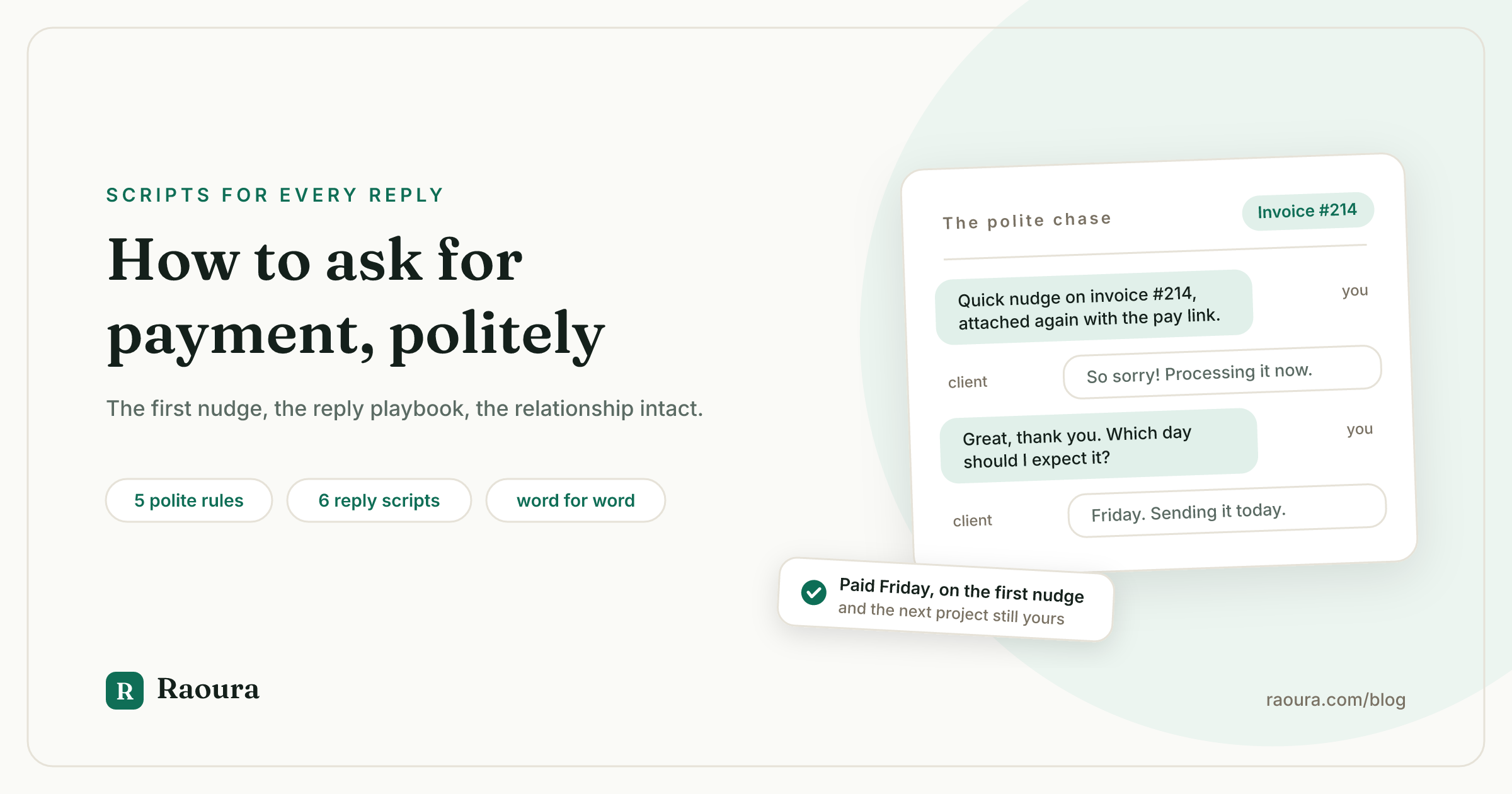
You finished the work. The invoice went out. The due date passed four days ago, and now you are drafting an email you have rewritten three times because every version sounds either desperate or aggressive, and this client mentioned another project next quarter.
That fear, that asking for your own money will cost you the relationship, is the actual problem this article solves. The mechanics are easy.
The pages that rank for this search skip the fear entirely because they were written for accounts receivable departments. We fetched the top-ranking pages for "how to ask a client for payment politely" in July 2026, and:
- Not one of them is written in the first person.
- One routes you to a debt collection agency within a few paragraphs.
- One suggests a $90-per-day late fee, which is a fast way to turn a forgetful client into a former one.
None of them acknowledges that the person sending the reminder is the same person whose name is on the work.
So here is the freelancer version: the evidence that chasing does not cost you clients, five rules that keep any payment ask polite, scripts for the first nudge, and, the part nobody else covers, what to say to every reply you get back, from "processing it now" to total silence.
Chasing payment will not cost you the client. Silence will.#
According to Chaser's 2026 accounts receivable research, 92% of businesses are now typically paid after the invoice due date, so a late payment is the default state of an invoice, not a judgment on your relationship. That figure is up from 87% in 2022, and it should permanently retire the idea that a late invoice means something has gone wrong between you and this client. Statistically, nothing has gone wrong. An invoice is buried in an inbox.
The freelance-specific data is gentler still. Bonsai analyzed three years of invoicing data from its base of 100,000+ freelancers and found that 29% of freelance invoices are paid at least a day late, but over 75% of those late invoices are paid within 14 days of the due date, and 90% within a month.
Three out of four late payers are not refusing. They forgot, or an approval is stuck, or your invoice is waiting behind someone's vacation.
A polite nudge is not an accusation. It is the thing that un-sticks a payment that was always going to happen.
And the cost of not asking is measurable. The same Chaser research found that businesses that follow up on 100% of their overdue invoices are 76% more likely to be paid within a week, while 31% of businesses leave some invoices unchased every month.
On the freelance side, a Freelancers Union study of more than 5,000 freelancers found that 71% struggled to collect payment at least once in their career, losing an average of almost $6,000 a year to nonpayment and late payment. The study is from 2015, and nothing in the newer platform data suggests the problem shrank.
Silence does not protect the relationship. It just transfers the whole cost of the client's disorganization onto you, and quietly builds the resentment that actually does end relationships.
One reframe carries this entire article: you are not asking for a favor, you are administering an agreement both of you already made. Clients do not respect freelancers less for having a billing process. They respect them more, the same way you trust your dentist more, not less, for sending an appointment reminder.
The five rules of a polite payment ask#
Polite wording is not decoration, it is measurably profitable: FreshBooks analyzed over one million invoices and found those with "thank you" in the payment terms were paid 89.61% of the time versus a 78.62% baseline. The same FreshBooks study found "please" lifted payment rates to 88.07%, and that plain-language deadlines beat jargon: terms written as "7 days" were paid within a week 58.05% of the time versus 40.22% for terms written as "30 days". Courtesy and clarity get you paid. Here are the five rules that produce both.
1. Blame the invoice, never the person. "Invoice 214 is overdue" lands completely differently than "you haven't paid me". The invoice is a neutral third object the two of you can look at together and fix. Every script below is built on this grammar: the invoice is late, the payment has not arrived, the link is attached. The client is never the subject of an accusing sentence.
2. Every message carries the amount, the number, and one click to pay. A polite ask that makes the client search their inbox for the original invoice is a rude ask wearing nice words. Reattach the invoice every time, restate the amount, and put the payment link one click away. Friction reads as unprofessionalism, and unprofessionalism is what actually damages relationships.
3. End with a question that needs an answer. "Just following up on the invoice" can be ignored without guilt. "Could you let me know when payment will go out?" cannot. A specific, easy question converts your reminder from a noise into a task, and whatever answer comes back tells you your next move.
4. Sound like yourself. You are one person, so "our records indicate an outstanding balance" reads as either pompous or evasive, and your client, who knows exactly how many people you are, hears it instantly. Write the reminder in the same voice you used to deliver the work. First person, warm, direct.
5. Never apologize for asking, and never send anything you wrote angry. "Sorry to bother you about this" teaches the client that paying you is optional. And the message you draft at 11pm on day 12 is always worse than the one you scheduled on day zero. The politest chasers are the ones who decided what every message would say before any invoice was late.
The first nudge, word for word#
A first payment nudge should arrive about 3 days after the due date, run under 100 words, and assume good faith completely, because the data says three quarters of late invoices resolve within two weeks anyway. Here is the version that follows all five rules:
Hi Dana,
A quick nudge on invoice #214 ($2,500), which was due on Friday. I know invoices sink in busy inboxes, so I have attached it again, and you can pay here: [payment link].
If there is a snag on your end, a new approval step, a missing PO, anything, just tell me and I will fix my side of it today.
Thanks!
Sam
That is the whole email. The "snag on your end" line is doing quiet work: it hands a client with a real blocker an easy way to tell you now instead of on day 21. If you want the complete sequence around this email, from the pre-due heads-up (the single highest-return email you can send) through the day 30 final notice, the payment reminder email templates library has all ten, and the reminder cadence guide explains the timing. This article is about the conversation those templates start.
Two situations change the wording but not the rules.
If the client is also a friend, name the awkwardness instead of letting it fill the room: "This is the part of working with friends that is slightly awkward, so I will just say it plainly: invoice #214 is a week overdue. Link is here. Now back to our regularly scheduled friendship."
And if you are on a call about new work while an old invoice sits unpaid, sequence it rather than ambush it: "Before we scope the next project, can we close out invoice #214? I like starting new work with a clean slate."
Both versions work because they are honest about the situation without making the other person wrong.
What to say when they reply (this is where relationships are actually won)#
There are 6 replies you will hear over and over, and having a calm, pre-written response to each one is what separates a professional from a person improvising under resentment. Every ranking page stops at the outbound reminder. But the reminder is the easy part. The relationship is decided by what you say next.
| The reply | What it usually means | Your move |
|---|---|---|
| "Processing it now" or "I'll pay next week" | Sincere, but vague | Convert it to a date, thank them, calendar the date |
| "Cash flow is tight right now" | True more often than not | Offer a short payment plan with fixed dates, in writing |
| "Can we split it / pay half now?" | They want to pay and cannot, all at once | Accept, confirm the schedule for the balance |
| "I never got the invoice" | Sometimes true, always solvable | Resend, confirm the right recipient, ask them to confirm receipt |
| "Accounting handles that" | Your contact is not the payer | Get the AP contact introduced, keep your contact cc'd |
| Silence | The message is buried, or something is wrong | Change channel: text or call, once, then continue the sequence |
Scripts for the three that trip people up most:
The vague promise. "That is great to hear, thank you. Which day should I expect it, so I can keep my books straight?" Then, if the date passes: "Hi Dana, following up on the payment planned for the 20th. It has not arrived yet. Could you check on it from your side?" No accusation, no reference to the broken promise as a betrayal. But the second missed date changes the rules: stop accepting dates and propose a call, because two broken promises is a pattern, not scheduling.
The cash flow confession. "Thanks for being straight with me. How about we split it: $1,250 by Friday and $1,250 on the 30th? I will send updated invoices for each so it is easy on your end." You have just turned a stalled $2,500 into a scheduled $2,500, kept the client's dignity intact, and put the plan in writing. Never accept "when things free up" as a plan; a plan has dates.
The silence. Do not send the same email louder. Chaser's research found businesses using SMS alongside email got paid within two weeks 73% of the time versus 49% for email alone, and the principle generalizes: a channel switch surfaces buried messages.
One line is plenty: "Hi Dana, sent a couple of notes about invoice #214, want to make sure they are reaching you. Link here: [payment link]." If texting is not a channel you already share, a short phone call does the same job.
If the silence continues past day 30, you are no longer in a politeness problem, and the ghosted after delivery playbook takes over.
When polite needs a spine#
Politeness has a schedule, and it ends around day 30: after a month of calm reminders, more niceness stops being kind and starts being expensive. The escalation tools are covered in depth elsewhere on this blog, so here is just the map.
- Late fees work when they are already in your contract and invoked matter-of-factly, never invented mid-chase. Amounts and state legality are in the late fee guide.
- Pausing work on an active project is the single most effective lever a working freelancer has, and there is a right way to word it: see the pause clause.
- When reminders have run their course, the unpaid invoice escalation ladder walks from demand letter to small claims in order.
The important thing for the relationship is that escalation is not a personality change. You are the same calm person at day 40 that you were at day 3; only the tools changed. Clients respect that. What reads as hostile is the freelancer who was silent for five weeks and then arrives with a final notice, because the client experienced no sequence, just an explosion.
The even better play is making next time not happen: deposits collect part of the money before the work starts (the deposit guide has percentages by project type), and shorter, plainer payment terms get invoices paid days faster on the same work.
Make the polite ask automatic, so you never have to be brave#
The average US small business now waits 28.8 days to be paid, with late invoices settled 9.0 days past due, per Xero's Small Business Insights data from 32,000+ US businesses, and closing that gap by hand means sending reminders on schedule for every single invoice, forever. That figure is from Xero's April 2026 release, and it is why the real fix is structural. The freelancers who chase payment best are not braver than you. They removed courage from the equation: reminders go out on a schedule that was decided on a calm day, and every reminder carries a one-click way to pay.
This is where we should disclose an interest, because it is the problem our own product exists to solve. Disclosure: Raoura is our product. Raoura is client and project management for solo freelancers at $17 per month on one flat plan, and its invoicing does the mechanical half of this article for you: reminders send automatically on your schedule, in your voice, before and after the due date, so the early polite nudges never depend on you feeling up to it.

The polite sequence on autopilot: reminders and nudges are decided once in settings, then sent on schedule, so no single email requires courage.
Just as important, every invoice and reminder links to a payment page where the client pays by card or bank transfer in one click, through your own Stripe account, with no markup from us. Rule two of the polite ask, the one click to pay, is built in.

The one-click payment page every reminder points to: the client pays through your own Stripe account, and Raoura takes no cut.
The escalation half stays human, which is how it should be. Software should send the day 3 nudge; you should decide what happens on day 30.
Verified July 2026. Chaser figures (92% of businesses typically paid after the due date, up from 87% in 2022; the 76% follow-up effect; the 73% vs 49% SMS-plus-email effect; 31% of businesses leaving invoices unchased) are from Chaser's 2026 accounts receivable research summary, checked this month. Freelance late payment rates (29% of invoices paid at least a day late, over 75% of late invoices paid within 14 days, 90% within a month) are from Bonsai's analysis of three years of invoicing data across its 100,000+ freelancer base, checked this month. Payment timing (28.8 days average to be paid, 9.0 days late on average, March 2026 quarter) is from Xero Small Business Insights, US series, April 30 2026 media release. Invoice wording effects (thank you 89.61% vs 78.62% baseline, please 88.07%, interest 92.15%, "7 days" terms 58.05% vs "30 days" 40.22%) are from FreshBooks' analysis of over one million invoices, checked against the live study page. The 71% collection-struggle and $6,000 average annual loss figures are from a 2015 Freelancers Union survey of 5,000+ freelancers, the most recent large freelancer-specific nonpayment survey we could verify at a primary source. The ranking-page audit (none of the top pages written in the first person; one recommending a $90-per-day late fee; one gating its templates as image downloads) is our own review of the pages ranking for this keyword, July 2026.
Frequently asked questions
How do I ask a client for payment without sounding rude?
Blame the invoice, not the person ("invoice #214 is overdue", never "you haven't paid"), keep it under 100 words, restate the amount, attach the invoice again, include one click to pay, and end with a question that needs an answer. Politeness with no ask is noise; an ask with no courtesy is a collections letter. You want both.
How long should I wait before asking a client for payment?
Do not wait past three days overdue for the first nudge, and ideally send a friendly heads-up three days before the due date. Bonsai's data shows over 75% of late freelance invoices are paid within 14 days of the due date, and early, light reminders are what keep yours in that group.
Will asking for payment damage the client relationship?
The evidence points the other way. With 92% of businesses typically paid after the due date per Chaser's 2026 research, late payment is normal business friction, and businesses that consistently follow up are 76% more likely to be paid within a week. What damages relationships is silent resentment followed by a sudden final notice, or work quality quietly declining because you feel unpaid and unvalued.
What is a polite way to ask for payment over text?
One line, one link: "Hi Dana, quick check that my notes about invoice #214 are reaching you. You can pay here: [link]." Only text if you already text about work; opening a new channel just to chase money reads as an ambush. Chaser's research found SMS alongside email got businesses paid within two weeks 73% of the time versus 49% for email alone.
What should I say when a client keeps saying they will pay soon?
Convert every promise into a date and calendar it. The first missed date gets a calm follow-up the next morning. The second missed date means dates have stopped working: propose a call, put a payment plan with fixed installments in writing, and if the project is still active, pause work until the plan starts performing.
Should I mention late fees when I ask politely?
Only if your contract already provides for them, and not in the first two weeks. A fee that appears mid-chase reads as a penalty invented in anger. When it is contractual, mention it as calendar fact, not threat: "Per our agreement, a 1.5% monthly late fee applies from day 30, which I would honestly rather not add." FreshBooks found invoice terms that mention interest were paid 92.15% of the time, the strongest wording effect in their study.
What if the client never responds at all?
Run the full reminder sequence for the paper trail, switch channels once around day 14 to 21, and after day 30 move to the escalation ladder: demand letter, then small claims or a state nonpayment complaint. The ghosted-after-delivery playbook covers verifying whether the company is even still operating before you spend energy on leverage.
---
Run your client work in one place
Send a proposal, get it signed, invoice, and get paid, with a branded portal your clients will actually use. One flat plan at $17/month, and we never take a cut of your payments.
Try Raoura free for 14 daysNo credit card required. Set up in minutes.
Keep reading
The Virtual Assistant Contract: 24 Clauses, Scored Against Every Template Ranking for This Search
We scored the four pages that publish actual virtual assistant contract text against 24 clauses a VA agreement needs. Twenty-four of 96 possible slots were filled. The best single template managed 7 out of 24. Twelve clauses appear in none of them, including every clause about the thing that makes VA work different from other freelance work: you are holding your client's passwords and running their inbox. One popular template also tells you a contract fixes your independent contractor status, then mandates client-set 9 to 5 weekday hours in the same document. Here is the clause-by-clause version, with the classification test the DOL is actually applying in 2026, the data protection terms nobody drafts, and the retainer mechanics that decide whether unused hours roll over.
Stripe vs PayPal for Freelancers: Every Fee Verified (2026)
Every page ranking for this comparison either prints in-person retail rates, contradicts itself, or skips the numbers freelancers actually pay. We read the current Stripe and PayPal pricing pages line by line, ran a $3,000 invoice through every rail, and found a $1,764 per year gap between the cheapest setup and the default one.
The Pause Clause: How to Stop Work When an Invoice Goes Overdue
Stopping work is the strongest move a freelancer has against a late-paying client, and the least understood. Here is the legal doctrine that lets you pause even without a clause, the exact clause to add so you never have to rely on doctrine again, the day-by-day timing, and the two emails that keep the pause professional. Verified against primary sources in July 2026.