Health Insurance for Freelancers in 2026: What the Subsidy Cliff Actually Costs You
August 30, 2026
For four years, health insurance was the rare freelance expense that got cheaper. The enhanced premium tax credits passed in 2021 capped your marketplace premium at 8.5 percent of income no matter how much you earned, and roughly 48 percent of adults buying individual-market coverage are small business owners, their employees, or self-employed people, so freelancers were exactly who those credits carried.
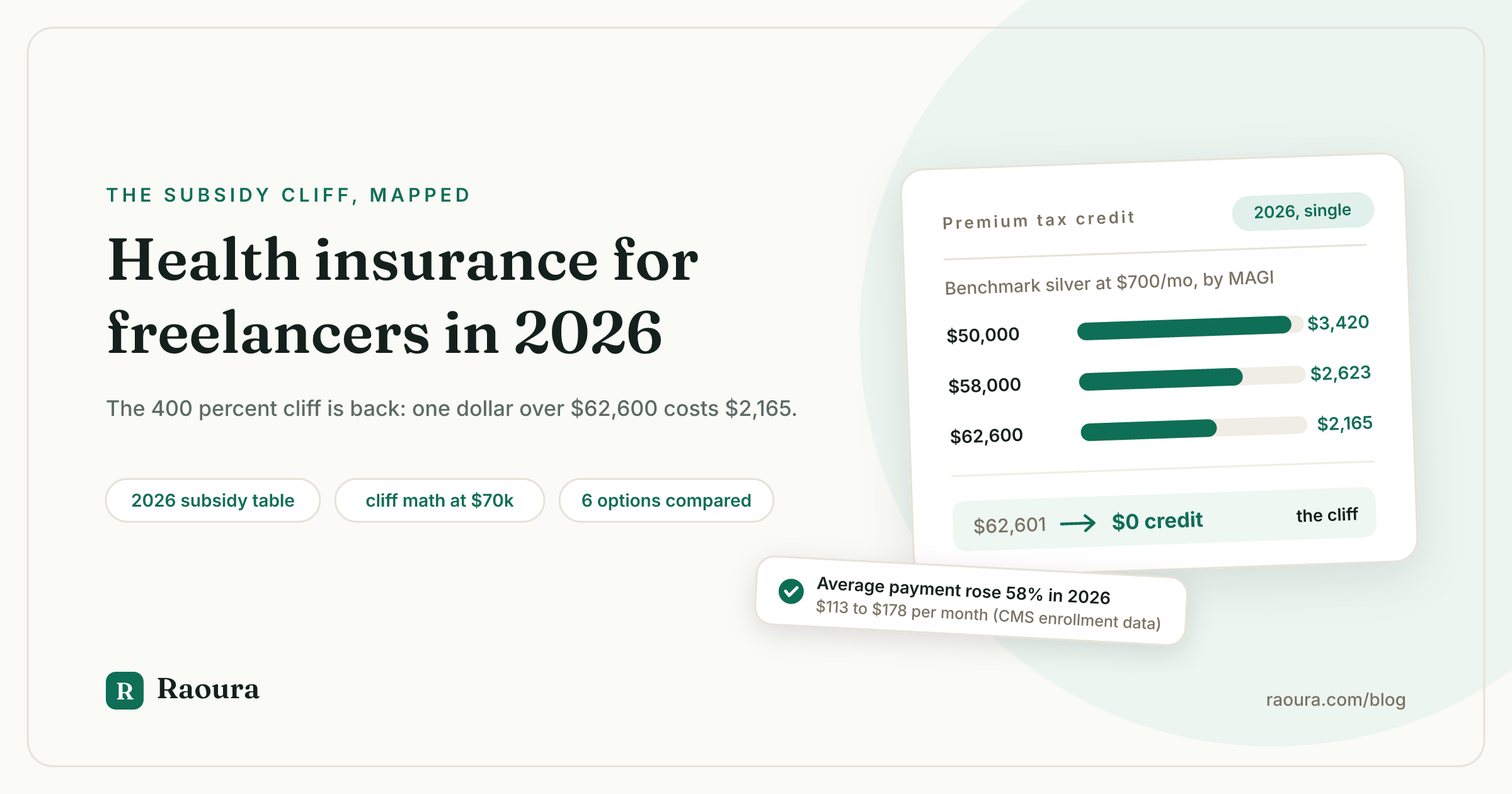
That era ended on December 31, 2025. The enhancements expired, the old rules snapped back, and the average marketplace enrollee's monthly payment rose 58 percent in one renewal cycle.
Here is the strange part: we fetched the top-ranking "health insurance for freelancers" guides in July 2026, and most still describe the world before January. One quotes an average post-subsidy payment with no mention that the rules changed. Another says most self-employed people qualify for subsidies, full stop. A third still references open enrollment for 2023 coverage in its FAQ. If you earn anywhere near $62,600, following any of them can cost you four figures.
So this is the freelancer-specific version: what changed, what the 2026 subsidy math actually looks like, every realistic coverage option with real costs, and the part no ranking page connects, which is that the same deductions that cut your taxes also decide whether you get a subsidy at all. One caveat up front: this is general information, not tax or insurance advice, and the numbers here are federal marketplace figures that vary by state, age, and household.
What actually changed in January 2026#
When the enhanced premium tax credits expired at the end of 2025, the average marketplace enrollee's premium payment rose 58 percent, from $113 to $178 per month, and enrollment fell by over a million people.
Two rules disappeared at once.
- The 8.5 percent income cap. Under the enhanced credits, nobody paid more than 8.5 percent of income for the benchmark silver plan, regardless of earnings.
- Subsidies above 400 percent of the federal poverty level. The enhancements had removed the eligibility ceiling entirely, and its return means one extra dollar of income can now erase your whole credit.
The damage is measured, not projected. Per KFF's analysis of CMS enrollment data: 2026 sign-ups came in at 23.1 million, down more than a million from 2025 and the sharpest single-year drop since the marketplaces launched. The average deductible jumped 37 percent, up $1,027, to a record $3,786, as people traded down to bronze plans.
And the people leaving were disproportionately the moderately successful: households between 400 and 500 percent of the poverty level were only 3 percent of 2025 sign-ups but 27 percent of the decline, with their enrollment falling 44 percent. That band, roughly $62,600 to $78,250 for a single person, is where an enormous number of established solo freelancers live.
The full, unsubsidized price you are negotiating against: the average 2026 marketplace premium before any credit is $741 per month, which is $8,892 per year.
The 400 percent cliff: the 2026 subsidy math#
For 2026 coverage, subsidy eligibility ends at a MAGI of $62,600 for a single freelancer and $84,600 for a household of two, and crossing that line by one dollar sets your credit to zero.
Subsidies for 2026 coverage are computed against the 2025 poverty guidelines: $15,650 for one person, plus $5,500 per additional household member. Below 400 percent of that line, you pay a fixed percentage of income for the benchmark silver plan and the credit covers the rest. The percentages come from IRS Rev. Proc. 2025-25, and this is the table that replaced the 8.5 percent cap:
| Income (% of poverty level) | Single-person MAGI, 2026 coverage | You pay this % of income for benchmark silver |
|---|---|---|
| Under 133% | Under $20,815 | 2.10% (usually Medicaid in expansion states) |
| 133 to 150% | $20,815 to $23,475 | 3.14 to 4.19% |
| 150 to 200% | $23,475 to $31,300 | 4.19 to 6.60% |
| 200 to 250% | $31,300 to $39,125 | 6.60 to 8.44% |
| 250 to 300% | $39,125 to $46,950 | 8.44 to 9.96% |
| 300 to 400% | $46,950 to $62,600 | 9.96% flat |
| Over 400% | Over $62,600 | No credit. Full price. |
Now the worked example nobody on page one runs. Take a single freelancer with $70,000 of Schedule C profit and a benchmark silver plan at $700 per month ($8,400 per year). Self-employment tax is $9,891, and half of it ($4,945) comes off as an adjustment, so MAGI before anything else is $65,055. That is over $62,600, so the credit is zero and the full $8,400 is theirs to pay.
Under the 2025 rules, that same person's contribution was capped at 8.5 percent of income, about $5,530, leaving a credit of roughly $2,870. Identical income, identical plan, a $2,870 swing from a rule change.
The cliff itself is worth stating as one quotable sentence: at a MAGI of exactly $62,600, this freelancer's expected contribution is 9.96 percent, or $6,235, so the credit is $2,165 per year, and at $62,601 the credit is $0, meaning one dollar of extra income costs $2,165. Older freelancers face bigger cliffs because their benchmark premiums are higher; for a 60-year-old the same one-dollar mistake can cost several times that.
Notice what MAGI is made of, though. It is profit minus half your SE tax, minus retirement contributions, minus HSA contributions, minus the self-employed health insurance deduction. Every one of those is a lever you control, which is where this stops being bad news and starts being a planning problem, covered two sections down.
Your realistic options in 2026, compared#
Most freelancers still land on a marketplace plan, where 87 percent of enrollees get some credit and the average payment is $178 per month, but the right answer now depends heavily on which side of $62,600 you sit.
| Option | Real 2026 cost | Best for | Watch out for |
|---|---|---|---|
| Marketplace (ACA) plan | $741/mo average full price; $178/mo average after credits | Most solos, especially under 400% FPL | The cliff; a bad income estimate gets reconciled on your tax return |
| Spouse's employer plan | Payroll share, often employer-subsidized | Married freelancers | Mere eligibility kills your SE health insurance deduction for those months |
| COBRA from a former job | 102% of the full group premium | The first months after leaving employment, mid-treatment continuity | No subsidy; 60-day election window; up to 18 months only |
| Bronze or catastrophic + HSA | Lower premium, up to $8,500 self-only out-of-pocket exposure | Healthy freelancers with a cash buffer | You are self-insuring the deductible; fund the HSA or it is just a thin plan |
| Short-term plan | Cheap by design | True gaps of a few weeks | Not ACA-compliant; excludes preexisting conditions; a [2024 federal rule](https://www.healthinsurance.org/self-employed-health-insurance/) limits new policies to 3-month terms (4 with renewal) and state rules vary from 36-month allowances to outright bans |
| Health care sharing ministry | Monthly "shares" | Almost nobody | Not insurance; payment of any claim is voluntary and not guaranteed |
Three notes the table cannot hold.
- If your income drops below about 138 percent of the poverty level (roughly $22,000 for a single person) in a Medicaid expansion state, Medicaid is free or near-free and you should take it without embarrassment. Feast-or-famine years do this to good freelancers all the time.
- COBRA's 102 percent price shocks people because you finally see what your employer was quietly paying, but it can still beat the marketplace if you are mid-treatment with a network you cannot afford to lose.
- One genuinely helpful 2026 change buried in the wreckage: under new federal law, all bronze and catastrophic marketplace plans are now HSA-eligible, which used to require hunting for specially flagged plans.
The three deductions that cut the real cost (and can win the subsidy back)#
A freelancer at $65,055 MAGI who contributes $4,400 to an HSA drops to $60,655, back under the cliff, and turns a $0 credit into roughly $2,359 per year in this article's worked example.
This is the section that should exist on every ranking page and does not: for a freelancer near the cliff, tax planning and insurance shopping are the same activity.
1. The self-employed health insurance deduction#
If you are not eligible for an employer-subsidized plan (yours or a spouse's), you deduct 100 percent of your health, dental, and vision premiums as an above-the-line adjustment, no itemizing required, limited to the net profit of the business the plan is tied to.
Two traps: eligibility for a spouse's plan disqualifies you for those months even if you never join it, and if you also get a premium tax credit, the deduction and the credit feed each other in a circular calculation the IRS resolves with an iterative worksheet in Pub 974. Software handles it; just know the answer is not "deduct the sticker price."
2. The HSA#
For 2026 the limits are $4,400 self-only and $8,750 family, paired with an HDHP carrying at least a $1,700 self-only deductible. HSA contributions reduce MAGI dollar for dollar, the money is yours forever, and with bronze and catastrophic plans now HSA-eligible, the cheap-premium-plus-HSA combination is the default play for a healthy solo near the cliff.
Run our example: $70,000 profit, MAGI $65,055, credit $0. Move $4,400 into an HSA and MAGI is $60,655, which is 387 percent of the poverty level, so your expected contribution is 9.96 percent ($6,041) and the credit on a $700 benchmark plan is $2,359. You banked $4,400 of your own money and got paid roughly $2,359 to do it.
3. Retirement contributions#
A SEP-IRA or solo 401k contribution also comes straight out of MAGI. Stack $12,000 of SEP contributions on top of that HSA and MAGI falls to $48,655, cutting the expected contribution to $4,846 and raising the credit to about $3,554.
The pattern generalizes: below the cliff, every $1,000 of deductible savings buys back roughly $100 of subsidy on top of its tax savings, and crossing the cliff from above is worth a four-figure jump all at once. If you are already doing the set-aside math on your profit, this is the same muscle applied to premiums, and the deductions that shrink your Schedule C shrink the number the subsidy runs on too.
Missed open enrollment? What gets you covered mid-year#
Open enrollment for 2026 plans closed January 15 in most states, and a mid-year drop in freelance income alone does not open a special enrollment period, but losing other coverage within 60 days does.
The 2026 window ran November 1, 2025 to January 15, 2026 on healthcare.gov, with some state exchanges running longer (California, New Jersey, New York, Rhode Island, and DC to January 31).
If you missed it, a special enrollment period requires a qualifying event: losing job-based or COBRA-exhausted coverage (within 60 days, before or after), moving, marriage, a birth, or in most states a drop in income to subsidy-relevant thresholds only in specific low-income cases. The event freelancers wrongly count on, "my income fell and now I want a subsidized plan," does not qualify by itself on the federal exchange.
If you left a job this year, the 60-day clock after your employer coverage ends is the door. Do not let it close while you compare COBRA quotes.
Open enrollment for 2027 coverage is expected to run November 1, 2026 to January 15, 2027 in most states, though pending litigation over marketplace rules could shift dates, so check your exchange in the fall rather than trusting a saved calendar entry.
Will Congress bring the subsidies back?#
The House passed a three-year extension of the enhanced credits on January 8, 2026 by 230 to 196, with 17 Republicans in favor, but no extension has become law as of July 2026.
The politics moved fast after the January renewal shock: the House vote drew 17 Republicans, and a bipartisan Senate group has floated a two-year compromise (the CARE Act, pairing extended credits with income caps and HSA deposits), but the Senate effort has stalled short of 60 votes. Plan on the current rules for 2026, treat any restoration as a mid-year bonus that would arrive via reconciliation on your tax return, and do not delay coverage decisions waiting on Congress. This article gets updated if the law changes.
Your income estimate is now a four-figure decision#
The subsidy runs on your projected annual MAGI, reconciled against the real number on your tax return, so a freelancer near $62,600 needs to know year-to-date profit at all times, not discover it in April.
Employees can set and forget their marketplace income estimate. Freelancers cannot: lumpy income means your January guess is fiction by August, and near the cliff the reconciliation is brutal in both directions. Underestimate and you repay credit at filing; drift one invoice over $62,600 and the entire year's credit claws back.
The operational fixes are the ones you already use for taxes.
- Update your marketplace estimate whenever a big project lands or dies, the same rhythm as re-running your quarterly estimated payments.
- Smooth the lumps with a buffer account and a fixed salary so a fat month does not read as a fat year.
- Watch December: whether an invoice is paid December 28 or January 5 can move thousands of MAGI from one year to the next, which is a legitimate reason to think about when your milestones bill, not just how much.
This is also the rare place where your admin tooling touches your health insurance. Raoura's dashboard shows paid revenue year to date in one number, which is the number your MAGI estimate starts from, and because invoices run through your own Stripe account, what you see is what actually landed, not what a platform will remit later. At $17 per month flat, it costs about two percent of the average freelancer's monthly unsubsidized premium. Disclosure: Raoura is our product.

One number for year-to-date paid revenue is what you check before updating your marketplace income estimate near the $62,600 cliff.
Frequently asked questions
How much does health insurance cost a freelancer in 2026?
The average marketplace plan costs $741 per month at full price in 2026. The 87 percent of enrollees who qualify for premium tax credits pay an average of $178 per month. Whether you are in the first group or the second depends almost entirely on whether your MAGI is under $62,600 (single) or $84,600 (two-person household).
What happens if my income goes over 400 percent of the poverty level?
For 2026 coverage, your premium tax credit becomes zero, with no phase-out. If you took advance credits during the year based on a lower estimate, you repay the full amount at tax filing. This is why freelancers near $62,600 should track year-to-date profit monthly and consider HSA and retirement contributions late in the year to stay under the line.
Can I get a marketplace plan mid-year if my freelance income drops?
An income drop by itself is not a qualifying event on the federal exchange. You need a trigger such as losing other coverage, moving, marriage, or a birth, and you get 60 days from the event. If your income falls below roughly 138 percent of the poverty level in a Medicaid expansion state, you can enroll in Medicaid at any time of year.
Are health care sharing ministries good insurance for freelancers?
They are not insurance at all. Monthly shares are lower than premiums because there is no legal obligation to pay any claim: no ACA protections, no preexisting condition coverage, no out-of-pocket maximum, no state guarantee fund. Treat them as a donation circle with medical branding, not a coverage plan.
Is COBRA worth it after quitting a job to freelance?
Sometimes, briefly. You pay 102 percent of the full group premium, which routinely lands between $600 and $800 per month for single coverage, and no subsidy applies. It wins when you are mid-treatment with providers you must keep, or when your MAGI is over the cliff anyway and the group plan is richer than an unsubsidized silver plan. Compare both inside your 60-day election window, because that window is also your special enrollment period for the marketplace.
---
Every figure above was verified in July 2026 against irs.gov, cms.gov, kff.org, aspe.hhs.gov, dol.gov, or healthcare.gov, including the 58 percent average payment increase, the $62,600 single-person cliff, the Rev. Proc. 2025-25 percentage table, and the 2026 HSA limits. Marketplace figures are national averages; your state, age, and household change them. This is general information, not tax, legal, or insurance advice.
Run your client work in one place
Send a proposal, get it signed, invoice, and get paid, with a branded portal your clients will actually use. One flat plan at $17/month, and we never take a cut of your payments.
Try Raoura free for 14 daysNo credit card required. Set up in minutes.
Keep reading
Is Upwork Worth It in 2026? A Break-Even Test for Your Situation
Upwork is worth it when its fee costs less than finding the client yourself, and that is true far more often for a first project than for a repeat client. Here is the break-even math with 2026 numbers: the 0 to 15% fee, Connects, the shrinking client base, and when to wait out the 24-month rule instead of paying to leave.
The Virtual Assistant Contract: 24 Clauses, Scored Against Every Template Ranking for This Search
We scored the four pages that publish actual virtual assistant contract text against 24 clauses a VA agreement needs. Twenty-four of 96 possible slots were filled. The best single template managed 7 out of 24. Twelve clauses appear in none of them, including every clause about the thing that makes VA work different from other freelance work: you are holding your client's passwords and running their inbox. One popular template also tells you a contract fixes your independent contractor status, then mandates client-set 9 to 5 weekday hours in the same document. Here is the clause-by-clause version, with the classification test the DOL is actually applying in 2026, the data protection terms nobody drafts, and the retainer mechanics that decide whether unused hours roll over.
Stripe vs PayPal for Freelancers: Every Fee Verified (2026)
Every page ranking for this comparison either prints in-person retail rates, contradicts itself, or skips the numbers freelancers actually pay. We read the current Stripe and PayPal pricing pages line by line, ran a $3,000 invoice through every rail, and found a $1,764 per year gap between the cheapest setup and the default one.