Budgeting on Lumpy Income: Pay Yourself a Salary
August 30, 2026
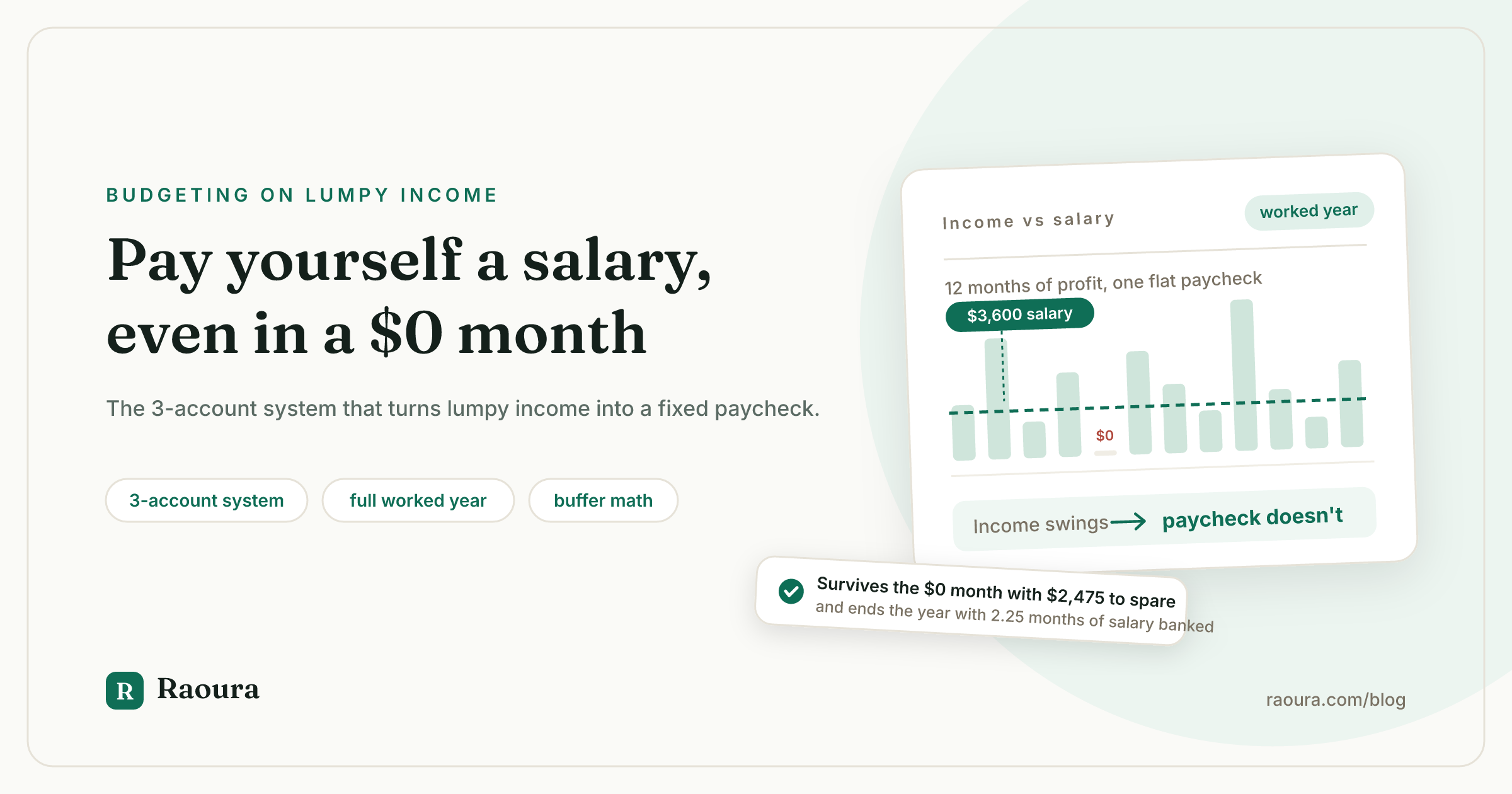
Freelance income is lumpy. A $11,400 month lands next to a $0 month, and both of them are normal. In freelancermap's 2025 freelancer study, 39 percent of freelancers named fluctuating income one of their biggest challenges, second only to finding work. And the wider backdrop is thin margins everywhere: in the Federal Reserve's 2025 household survey, 37 percent of US adults could not cover a $400 emergency expense with cash or its equivalent.
We fetched the pages that rank for irregular income budgeting in July 2026. They are consumer budgeting content: budget your lowest month, budget your average, adjust as you go. Only one of them mentions self-employment taxes at all, and not one explains the mechanic that actually solves the problem for a freelancer, which is separating your business cash from your personal cash and paying yourself a fixed salary from the gap between them. This article is that mechanic, with the formula, the account setup, and a complete worked year you can check with a calculator.
Why lowest-month and average-month budgeting both fail#
In our worked year below, budgeting on the lowest real month plans life around $2,400 while the year actually delivers $5,300 a month on average, leaving 55 percent of income with no plan; budgeting on the average overspends in the six months that come in under it.
The two standard prescriptions each break in a different direction.
Budget your lowest month, says one camp. The problem: a freelance year usually contains a month near zero, and you cannot run a household on zero. So you pick the lowest "real" month instead, and now most of your income has no job.
In the worked year below, the lowest nonzero month is $2,400 against a $5,300 average, so lowest-month budgeting leaves about 55 percent of the year's income unassigned. Unassigned money gets spent by default, which is exactly the behavior a budget exists to prevent.
Budget your average, says the other camp. The problem is sequencing. Your average is only spendable if the money arrives evenly, and it never does. Spend $5,300 in a $2,400 month and the difference comes off a credit card.
The JPMorganChase Institute's 2025 earnings instability research found that even hourly employees see take-home pay change month to month by a typical 9 percent, with one month in four swinging at least 21 percent, and freelance revenue swings far harder than an hourly paycheck.
An average is a fact about your year. It is not an amount you can safely spend in any given month.
Both methods share the real flaw: they try to make your personal budget absorb your business volatility. The fix is to stop the volatility at the business account and let only a flat, boring number through to your personal life.
The three-account system that makes a salary possible#
You need three accounts: a business checking account where every client payment lands, a tax savings account that takes 25 to 30 percent of each payment, and a personal checking account that receives one fixed transfer a month.
Here is the whole system, step by step:
- Every client payment lands in business checking.
- The day it lands, you move your tax percentage into tax savings and forget it exists.
- Whatever remains stays in business checking, which doubles as your buffer.
- Once a month, on the same date, you transfer a fixed salary from business checking to personal checking.
You budget your personal life on the salary, which never changes, no matter what the business did that month.
Each account has one job:
| Account | What goes in | What comes out | Never used for |
|---|---|---|---|
| Business checking (buffer) | Every client payment | Tax transfer, business expenses, your monthly salary | Personal spending |
| Tax savings | 25 to 30 percent of each payment | Quarterly estimated tax payments | Anything else |
| Personal checking | One fixed salary transfer a month | Rent, groceries, life | Business costs |
The tax slice comes first because it was never yours. The IRS expects quarterly payments once you will owe $1,000 or more, and the right percentage for most solos is 25 to 30 percent of profit; the real 2026 math by income level runs 19 to 24 percent federal plus your state's points, and the quarterly deadlines and mechanics have their own guide. For a sole proprietor, the salary transfer is legally just an owner's draw, not a payroll event: no withholding, no paperwork, taxes owed on profit either way. It only becomes an actual payroll salary if you elect S corp status, which is a separate decision entirely.
One sentence worth keeping: the buffer account exists so that your income's bad months and your rent's due date never have to meet.
How to set your salary number#
Set your monthly salary at 85 to 90 percent of your trailing 12-month after-tax average, and drop to 75 or 80 percent if you have less than a year of history or your trend is falling.
The formula, step by step:
- Add up the last 12 months of profit (collected revenue minus business expenses). Use what actually got paid, not what you invoiced.
- Multiply by 0.75 to remove the tax slice (use your own percentage if you know it).
- Divide by 12. This is your after-tax monthly average.
- Take 85 to 90 percent of it. That is your salary.
The 10 to 15 percent you shave off is what grows the buffer. It is the margin that turns one bad month from a crisis into a line in a spreadsheet.
If your history is short, your niche is seasonal, or the last three months trend below the twelve-month line, shave more: 75 or 80 percent. You can always raise a salary that proved too low. Cutting one that proved too high means unwinding personal commitments, which is the painful direction.
Worked example of the formula: $63,600 of profit over the trailing year, times 0.75 is $47,700, divided by 12 is $3,975, times roughly 0.9 rounds to a salary of $3,600. That freelancer is now underpaying themselves by $375 a month on average, and that $375 is precisely what funds the buffer's growth in the table below.
A full worked year, including a $0 month#
A freelancer averaging $5,300 a month in profit who pays themselves a fixed $3,600 survives a $0 month in May with $2,475 still in the buffer and ends the year with $8,100 banked, which is 2.25 months of salary.
Assumptions: profit figures are after business expenses, 25 percent of each payment goes to tax savings on arrival, salary is $3,600 transferred on the first of each month, and the buffer starts with exactly one month of salary ($3,600) already in it. "Stays in buffer" is 75 percent of that month's profit.
| Month | Profit collected | Stays in buffer (75%) | Salary out | Buffer at month end |
|---|---|---|---|---|
| Start | $3,600 | |||
| Jan | $4,200 | $3,150 | $3,600 | $3,150 |
| Feb | $9,100 | $6,825 | $3,600 | $6,375 |
| Mar | $2,800 | $2,100 | $3,600 | $4,875 |
| Apr | $6,400 | $4,800 | $3,600 | $6,075 |
| May | $0 | $0 | $3,600 | $2,475 |
| Jun | $7,800 | $5,850 | $3,600 | $4,725 |
| Jul | $5,200 | $3,900 | $3,600 | $5,025 |
| Aug | $3,100 | $2,325 | $3,600 | $3,750 |
| Sep | $11,400 | $8,550 | $3,600 | $8,700 |
| Oct | $4,600 | $3,450 | $3,600 | $8,550 |
| Nov | $2,400 | $1,800 | $3,600 | $6,750 |
| Dec | $6,600 | $4,950 | $3,600 | $8,100 |
Total profit: $63,600. Total to tax savings: $15,900. Total salary drawn: $43,200. Buffer growth: $4,500, from $3,600 to $8,100.
Look at what this year contained: a month of literally nothing in May, a $2,400 November, and an $11,400 September that was 4.75 times the size of the smallest paid month. The business account absorbed all of it. The personal account saw twelve identical $3,600 deposits and never noticed. That is the entire point of the system: rent does not care that May was a desert, and under this setup it never finds out.
Notice also the failure boundary. The May dry month pulled the buffer down to $2,475, which means a second consecutive $0 month would have overdrawn it. One month of starting buffer survives exactly one dry month. That is why the starting buffer is the minimum to launch, not the destination.
Buffer sizing: when to start and where to stop#
Start paying yourself a salary once you have one month of salary sitting in the business account, and treat three months of salary as the working target; in the worked year above, one starting month covered one $0 month with $2,475 to spare and nothing left for a second.
You do not need the buffer fully built before starting. You need one month of salary in business checking, because the first transfer happens before you know what the month will bring. From there the 10 to 15 percent underpayment builds the rest on autopilot: the worked year added $4,500 of buffer, about 1.25 extra months, without any deliberate saving effort.
Three months of salary is the level where the system gets boring, and boring is the goal. At three months you can absorb a client paying 60 days late, a project cancellation, and a slow season stacked on top of each other without touching your personal budget. Freelancers with heavy seasonality (wedding-adjacent work, retail-driven marketing, education) should push toward four to six.
Park the buffer and the tax money where they earn something. As of July 2026, top online high-yield savings accounts pay roughly 3.8 to 4.5 percent APY against a national savings average of 0.38 percent. On an $8,100 buffer plus a running tax balance, that is a few hundred dollars a year for switching banks once. Keep business checking itself lean and sweep the excess; the only rule is that buffer money must be reachable within a day or two, so no CDs, no brokerage.
Raises, pay cuts, and the quarterly review#
Review the salary once a quarter and change it by rule, not by feeling: raise it only after the buffer has held above three months of salary for a full quarter, and cut it the moment the buffer closes a month below one month of salary.
The whole system runs on the salary staying fixed, so change it rarely and by trigger:
- Raise trigger: the buffer has stayed above three months of salary for a full quarter and your trailing 12-month average supports the new number through the same formula. Recompute, take 85 to 90 percent, adjust.
- Cut trigger: the buffer closes any month below one month of salary. Cut immediately and hard, to 75 to 80 percent of the new trailing average, and treat the cut as the smoke alarm it is: the business is telling you something the salary was hiding.
- Windfall rule: a giant month changes nothing. September's $11,400 in the worked year produced the same $3,600 transfer as every other month. Windfalls build the buffer first; the raise, if the average genuinely moved, arrives at the next quarterly review.
The quarterly rhythm conveniently matches the estimated tax calendar, so one sitting handles both: send the IRS payment, check the buffer against the triggers, done in twenty minutes four times a year.
Smooth the inflow too: the business side of lumpy income#
A 50 percent deposit on every project means half your project revenue arrives on a date you control rather than a date the client controls, which directly shrinks the swings the buffer has to absorb.
Everything above treats your income pattern as weather. It is not; some of the lumpiness is billing design, and you control your billing. Three changes flatten the inflow before it ever reaches the buffer:
- Charge a deposit on every project. A 50 percent deposit converts "paid when the client gets around to it" into "paid at signature" for half the project value.
- Bill by milestone instead of invoicing 100 percent at the end: four mid-project payments produce four medium bumps instead of one spike and three deserts.
- Tighten payment terms and run a real reminder cadence, because an invoice paid 45 days late is a self-inflicted dry month. See our guides to payment terms and the reminder cadence that backs them up.
This is the part of the problem where your tooling matters. Raoura is built around exactly this billing pattern for solo freelancers: proposals that take a deposit at acceptance, milestone invoices that go out on schedule, automatic payment reminders, and payments that land in your own Stripe account the moment the client pays, so the money hits your business checking without a platform holding it. It is one flat plan at $17 per month, which is deliberately cheap enough to survive your leanest month. Disclosure: Raoura is our product.
!Raoura forecast report showing expected income from scheduled invoices in the months ahead

Seeing scheduled payments before they land turns the quarterly salary review into a twenty minute check instead of a guess.
Frequently asked questions
How do you budget with irregular income?
Separate business and personal money, then make your personal income regular by construction: every client payment lands in a business account, 25 to 30 percent moves to a tax account the day it arrives, and once a month you transfer a fixed salary (85 to 90 percent of your trailing after-tax monthly average) to personal checking. Your personal budget runs on the fixed salary; the business account absorbs the swings.
How much should I pay myself as a freelancer?
Take your last 12 months of collected profit, multiply by 0.75 to strip taxes, divide by 12, then pay yourself 85 to 90 percent of that number monthly. A freelancer with $63,600 of trailing-year profit lands at about $3,600 a month. Shave to 75 or 80 percent if your history is short or trending down.
What if I have less than a year of income history?
Use whatever full months you have, weight recent months more than early ones, and take the conservative end of the formula: 75 to 80 percent of the after-tax average. Set your first quarterly review for three months out instead of letting a guess run all year. Early on, the priority is building the one-month starting buffer, not maximizing the salary.
Is paying yourself a salary the same as an S corp salary?
No. For a sole proprietor or single-member LLC, the monthly transfer is an owner's draw: no payroll, no withholding, and it does not change your taxes, which are owed on profit regardless of what you draw. An S corp "reasonable salary" is a formal payroll obligation that exists only after you elect S corp status, which is a separate decision with its own break-even math.
What happens in months when I earn more than my salary?
Nothing, and that is the feature. The excess stays in business checking and builds the buffer. In the worked year above, an $11,400 month produced the same $3,600 personal transfer as every other month, and the buffer jumped from $3,750 to $8,700. If big months become the new normal, the trailing average rises and the raise arrives at the next quarterly review.
Where should the buffer and tax money sit?
Tax savings and any buffer beyond your next month or two of salary belong in a high-yield savings account, paying roughly 3.8 to 4.5 percent APY as of July 2026 versus a 0.38 percent national savings average. Keep it same-bank or one transfer day away. Do not put buffer money in CDs or investments; its job is availability, not return.
---
Figures verified July 2026: survey data against federalreserve.gov (SHED 2025, published May 2026), freelancermap.com, and jpmorganchase.com/institute; tax mechanics against irs.gov; savings rates against bankrate.com. The worked-year table is our own model and every row recomputes from the stated assumptions. This is general information, not financial or tax advice.
Run your client work in one place
Send a proposal, get it signed, invoice, and get paid, with a branded portal your clients will actually use. One flat plan at $17/month, and we never take a cut of your payments.
Try Raoura free for 14 daysNo credit card required. Set up in minutes.
Keep reading
Is Upwork Worth It in 2026? A Break-Even Test for Your Situation
Upwork is worth it when its fee costs less than finding the client yourself, and that is true far more often for a first project than for a repeat client. Here is the break-even math with 2026 numbers: the 0 to 15% fee, Connects, the shrinking client base, and when to wait out the 24-month rule instead of paying to leave.
The Virtual Assistant Contract: 24 Clauses, Scored Against Every Template Ranking for This Search
We scored the four pages that publish actual virtual assistant contract text against 24 clauses a VA agreement needs. Twenty-four of 96 possible slots were filled. The best single template managed 7 out of 24. Twelve clauses appear in none of them, including every clause about the thing that makes VA work different from other freelance work: you are holding your client's passwords and running their inbox. One popular template also tells you a contract fixes your independent contractor status, then mandates client-set 9 to 5 weekday hours in the same document. Here is the clause-by-clause version, with the classification test the DOL is actually applying in 2026, the data protection terms nobody drafts, and the retainer mechanics that decide whether unused hours roll over.
Stripe vs PayPal for Freelancers: Every Fee Verified (2026)
Every page ranking for this comparison either prints in-person retail rates, contradicts itself, or skips the numbers freelancers actually pay. We read the current Stripe and PayPal pricing pages line by line, ran a $3,000 invoice through every rail, and found a $1,764 per year gap between the cheapest setup and the default one.