Freelance Tax Deductions: The 26-Item Checklist (Verified Against the IRS, 2025 and 2026)
August 30, 2026
Tax deduction checklists are the most copied, least checked content in freelance publishing. We fetched the top-ranking pages for this keyword in July 2026 and found:
- A major bookkeeping app still citing the 2024 mileage rate as current.
- A checklist with "meals and entertainment" as a deduction heading eight years after entertainment became nondeductible.
- A guide that says you can deduct "up to 50%" of your self-employment tax (it is exactly half, not up to half).
- Several 2026-dated pages claiming the QBI deduction "rises to 23% in 2026" (that was a House draft provision; it never became law).
Not one of them covers the July 2025 tax law that changed seven of the numbers on this page.
So this is the checked version. Every figure below is traced to irs.gov, the 2025 Schedule C instructions, or the Social Security Administration, all verified this month. Both tax years are covered: 2025 (the return you will file by April 2026, or October with an extension) and 2026 (the year you are planning right now). The usual caveat applies and it is not a formality: this is general information, not tax advice, and a CPA who can see your whole return beats any checklist.
One rule frames everything else. An expense is deductible when it is ordinary and necessary for your trade, per IRS Publication 334. Ordinary means common in your field. Necessary means helpful and appropriate, not indispensable. Keep that test in mind for every row that follows.
The 26-item checklist, with where each deduction actually goes#
A solo freelancer can claim 26 distinct deductions across Schedule C, Schedule 1, and Form 8995, and the four largest never show up on a receipt.
The table below is the whole map. The first 22 rows live on Schedule C and reduce both your income tax and your 15.3% self-employment tax. The last four live elsewhere on your return and reduce income tax only. That distinction matters: a dollar of Schedule C deduction is worth roughly 15 cents more than a dollar deducted anywhere else.
| # | Deduction | What counts | Limit or rate | Where it goes |
|---|---|---|---|---|
| 1 | Advertising and marketing | Ads, your website, business cards, directory listings | Actual cost | Schedule C, line 8 |
| 2 | Car and truck | Business miles driven, or actual costs by business percentage | 70 cents/mile (2025), 72.5 cents/mile (2026) | Line 9 |
| 3 | Commissions and fees | Referral fees, marketplace commissions | Actual cost | Line 10 |
| 4 | Contract labor | Subcontractors you hire | Actual cost; 1099-NEC required at $600+ (2025), $2,000+ (2026) | Line 11 |
| 5 | Depreciation and Section 179 | Equipment above the $2,500 expensing threshold | Section 179 cap $2,500,000 (2025), $2,560,000 (2026) | Line 13, via Form 4562 |
| 6 | Business insurance | Liability, E&O, business property | Actual cost (not health) | Line 15 |
| 7 | Business interest | Interest on business loans and business card balances | Actual cost | Line 16b |
| 8 | Legal and professional | Lawyer, accountant, business portion of tax prep | Actual cost | Line 17 |
| 9 | Office expense | Postage, small office costs | Actual cost | Line 18 |
| 10 | Rent and coworking | Coworking desk, studio, equipment rental | Actual cost | Lines 20a and 20b |
| 11 | Repairs and maintenance | Fixing business equipment | Actual cost | Line 21 |
| 12 | Supplies | Materials consumed, small tools, reference books | Actual cost | Line 22 |
| 13 | Taxes and licenses | Business licenses, local business taxes | Not federal income or SE tax | Line 23 |
| 14 | Travel | Lodging and transportation away from your tax home | Actual cost, no meals here | Line 24a |
| 15 | Business meals | Meals with clients or while traveling for work | 50% deductible | Line 24b |
| 16 | Utilities | Business utilities | First home landline base rate excluded | Line 25 |
| 17 | Software and subscriptions | Design tools, hosting, your client management app | Actual cost | Line 27a (Part V) |
| 18 | Phone and internet | Business-use percentage of your bill | Business share only | Line 27a (Part V) |
| 19 | Education | Courses that maintain or improve current skills | Not training for a new career | Line 27a (Part V) |
| 20 | Business gifts | Client gifts | $25 per person per year | Line 27a (Part V) |
| 21 | Bank and processing fees | Business account fees, payment processing fees | Actual cost | Line 27a (Part V) |
| 22 | Startup costs | Costs before your first sale | $5,000 in year one, rest over 180 months | Line 27a plus Form 4562 |
| 23 | Home office | Space used regularly and exclusively for business | Simplified: $5/sq ft, max 300 sq ft ($1,500) | Line 30, or Form 8829 |
| 24 | Half of SE tax | Automatic, computed on Schedule SE | Exactly one half | Schedule 1, line 15 |
| 25 | Retirement contributions | SEP IRA or solo 401(k), your own contributions | Up to $70,000 (2025), $72,000 (2026) | Schedule 1, line 16 |
| 26 | Health insurance | Medical, dental, LTC, Medicare premiums | Capped at business profit | Schedule 1, line 17 |
Then, after all of that, the QBI deduction takes 20% off what remains (row 27 in spirit, Form 8995 in practice). It gets its own section below because it is the one deduction most checklists explain wrong.
Two placement details worth flagging because even the good ranking pages miss them. Your own health insurance never goes on Schedule C line 14 (that line is for employee benefit programs), and your own retirement contributions never go on line 19 (that one is for employee plans). Both belong on Schedule 1, per the 2025 Schedule C instructions.
The big four that never show up as receipts#
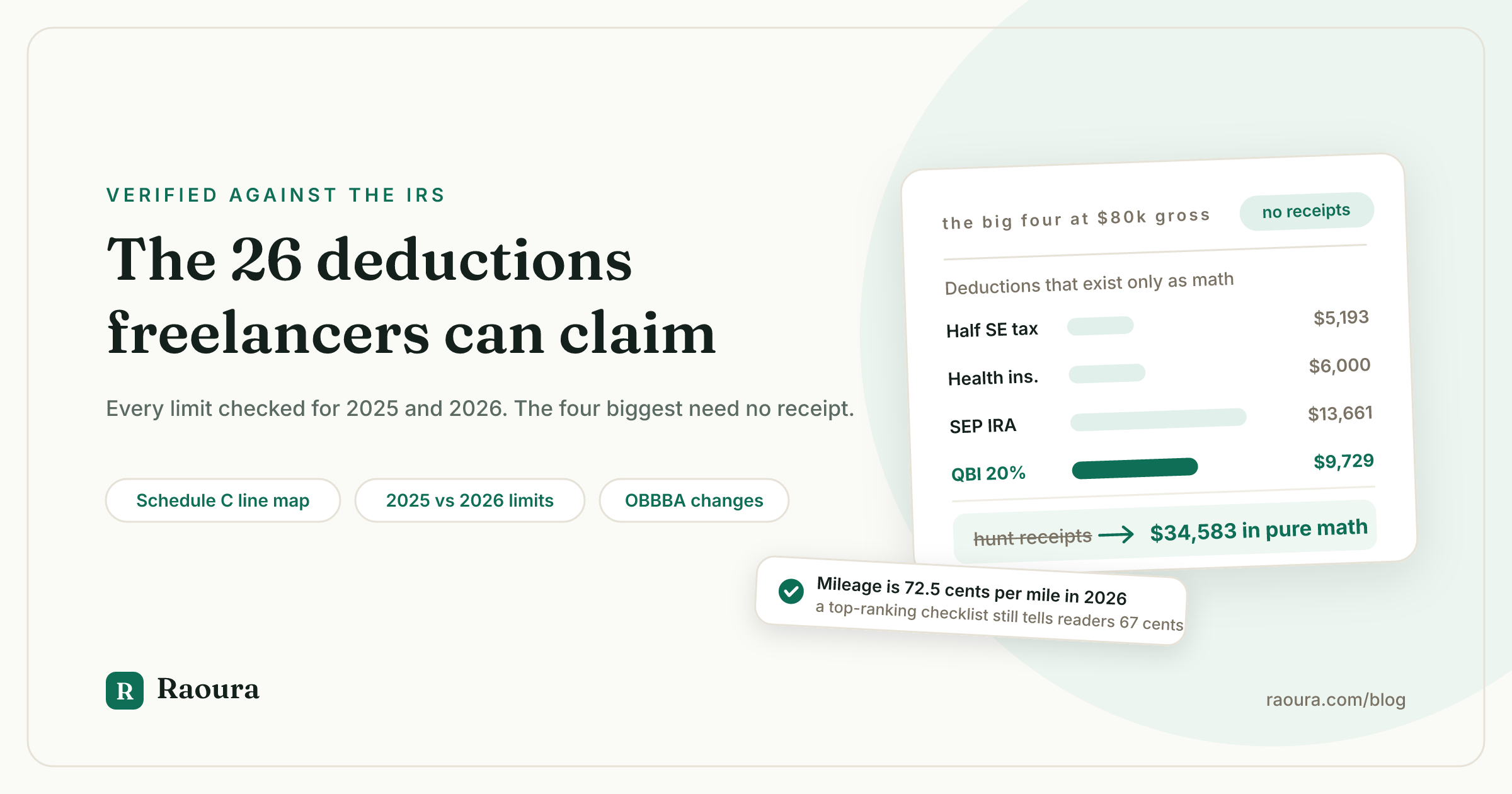
For a single freelancer netting $73,500, the four deductions that exist only as math (half of SE tax, health insurance, retirement, and QBI) remove $34,583 from taxable income.
Most freelancers hunt receipts and ignore the deductions that are pure arithmetic. Here is what that costs, worked through a concrete case: a single freelancer, $80,000 in gross client revenue, $6,500 in everyday business expenses (software, home office, mileage, phone share, insurance, accounting, marketing, supplies), paying $500 a month for her own health insurance.
| Step | Amount |
|---|---|
| Gross revenue | $80,000 |
| Schedule C expenses | $6,500 |
| Net profit (Schedule C, line 31) | $73,500 |
| Self-employment tax (15.3% of 92.35% of profit) | $10,385 |
| Deduction 1: half of SE tax | $5,193 |
| Deduction 2: self-employed health insurance | $6,000 |
| Deduction 3: SEP IRA contribution (20% of profit minus half SE tax) | $13,661 |
| Deduction 4: QBI, 20% of what remains | $9,729 |
| Total removed from taxable income by the big four | $34,583 |
In the 22% bracket, those four lines are worth about $7,608 of income tax on their own, before a single receipt enters the picture. Three notes on the math, because this is where competitor checklists get sloppy:
Half of SE tax is exact, not "up to." You compute SE tax on Schedule SE (15.3% of 92.35% of net profit, up to the Social Security wage base of $176,100 for 2025 and $184,500 for 2026), then deduct precisely one half of it on Schedule 1, line 15. No election, no judgment call. It happens automatically if you file correctly.
The SEP IRA "25%" is really 20% for you. A SEP allows 25% of compensation, but for a self-employed person your own contribution reduces the compensation it is measured against, so the effective rate is 20% of net profit minus half your SE tax. The overall cap is $70,000 for 2025 and $72,000 for 2026. A solo 401(k) reaches the same total faster at lower incomes because it adds an employee deferral of $23,500 (2025) or $24,500 (2026) on top of the percentage piece.
Health insurance is above the line but has a ceiling. The self-employed health insurance deduction covers medical, dental, qualified long-term care, and Medicare premiums for you, your spouse, and dependents, but it cannot exceed the profit of the business the plan is tied to, and it disappears entirely for any month you were eligible for an employer-subsidized plan, including through a spouse. It also never reduces SE tax.
If you have not yet worked out what all this means for the money you should be setting aside each month, our 25 to 30 percent rule breakdown runs the full math, and the quarterly estimated taxes guide covers when it has to go out the door.
Car and mileage: the rate everyone gets wrong#
The standard mileage rate is 70 cents per mile for 2025 and 72.5 cents per mile for 2026, and one of the top-ranking checklists still tells readers 67 cents.
The IRS set the 2025 business rate at 70 cents in Notice 2025-5 and the 2026 rate at 72.5 cents. Multiply your logged business miles by the rate, add business parking and tolls, and put the total on Schedule C, line 9.
Commuting between home and a regular work location does not count, and if you claim a home office as your principal place of business, drives from home to client sites generally do count, which is one of the quiet reasons the home office deduction is worth claiming.
The alternative is the actual expense method: the business-use percentage of gas, repairs, insurance, and depreciation. Two traps from the Schedule C instructions: you can only use standard mileage if you chose it in the first year the car was placed in service, and on a leased car you cannot switch off standard mileage for the life of the lease.
Estimating your business percentage is also not a shrug: it comes from a mileage log, and "guesstimate it," which one ranking page recommends, is exactly what an auditor is trained to pull apart.
One brand-new interaction no competitor page covers. The July 2025 law created a personal deduction for car loan interest of up to $10,000 a year (2025 through 2028, new US-assembled vehicles, income phaseouts apply). The 2025 Schedule C instructions carry a repeated new caution about it: the same interest cannot be deducted both there and on Schedule C. If you use the car partly for business, you allocate: the business share of loan interest goes on Schedule C, and only the personal share can go on the new Schedule 1-A.
Equipment: three ways to write it off, and the order to try them#
Anything costing $2,500 or less per item can be expensed immediately with no depreciation forms, and above that, 100% bonus depreciation now covers property acquired after January 19, 2025.
Work through purchases in this order:
- De minimis safe harbor first. Items at $2,500 or less per invoice or item can simply be expensed as supplies with an election statement attached to your return. A laptop, a monitor, a microphone: no Form 4562, no depreciation schedule.
- 100% bonus depreciation for the rest. The July 2025 law made 100% first-year bonus depreciation permanent for qualified property acquired after January 19, 2025. Business use has to exceed 50%, and you deduct the business-use share of the full cost in year one. Equipment acquired on or before that date falls under the old 40% phase-down, a wrinkle that matters if you bought gear in early January 2025.
- Section 179 as the fallback and fine-tuner. The expensing cap is $2,500,000 for 2025 and $2,560,000 for 2026, numbers a solo freelancer will never approach. Its practical relevance for you: unlike bonus depreciation, 179 lets you pick and choose amounts per asset, but it is limited to your business taxable income for the year.
For almost every freelancer, rules one and two mean equipment is now fully deductible in the year you buy it. The days of spreading a laptop over five years are effectively over unless you choose otherwise for planning reasons.
The QBI deduction: permanent, still 20%, and a new $400 floor#
The qualified business income deduction is 20% of your net business income, it was made permanent in July 2025, and starting with tax year 2026 there is a $400 minimum deduction if you have at least $1,000 of QBI.
The Section 199A deduction is the closest thing freelancing has to a free lunch: roughly 20% of your qualified business income comes off your taxable income with no spending, no receipts, and no separate account. You claim it on Form 8995 (or 8995-A above the thresholds), and it works even though you take the standard deduction.
Three things the ranking checklists get wrong or skip:
It is 20% of income, not 20% of your taxes. One top page describes it as writing off "up to 20% of their taxes." It reduces taxable income, and it never touches SE tax.
It is not going to 23%. Several 2026-dated articles claim the rate rises to 23% in 2026. That figure was in the House version of the 2025 bill and was dropped before passage. The enacted law keeps 20% and makes it permanent.
The phaseout only bites high earners, and it got gentler. If your work counts as a specified service business (consulting, health, law, financial services, and similar advice-based fields), the deduction phases out above a taxable income threshold: $197,300 single and $394,600 married filing jointly for 2025, rising to $201,750 and $403,500 for 2026 under Rev. Proc. 2025-32. The 2026 phase-in ranges also widen to $75,000 single and $150,000 joint, so the deduction fades out more gradually than before. Below those thresholds, which is where most solo freelancers live, none of the service-business complexity applies to you.
And from tax year 2026, Rev. Proc. 2025-32 confirms a new floor: a minimum $400 deduction for anyone with at least $1,000 of qualified business income from a business they materially participate in. Small, but automatic.
What changed under the July 2025 law: 2025 vs 2026 at a glance#
Seven numbers on this checklist changed between tax years 2025 and 2026, and the 1099 paperwork thresholds moved in opposite directions from what most freelancers expect.
The One Big Beautiful Bill Act (OBBBA), signed July 4, 2025, is why so many older checklists are now wrong. Here is the side-by-side, each row verified against the IRS source linked earlier in this article:
| Item | Tax year 2025 | Tax year 2026 |
|---|---|---|
| Standard mileage rate | 70 cents/mile | 72.5 cents/mile |
| Social Security wage base (SE tax) | $176,100 | $184,500 |
| 1099-NEC threshold (clients paying you) | $600 | $2,000 |
| 1099-K threshold (payment apps) | over $20,000 and 200+ transactions | same (restored by OBBBA) |
| QBI SSTB threshold (single / joint) | $197,300 / $394,600 | $201,750 / $403,500 |
| QBI minimum deduction | none | $400 (with $1,000+ of QBI) |
| Section 179 cap | $2,500,000 | $2,560,000 |
| Solo 401(k) employee deferral / total cap | $23,500 / $70,000 | $24,500 / $72,000 |
The 1099 rows deserve one plain sentence each, because they are about paperwork, not tax owed.
The 1099-K threshold reverted to more than $20,000 and more than 200 transactions, retroactively killing the $600 rule that never fully took effect. And starting with payments made in 2026, clients only owe you a 1099-NEC once they pay you $2,000 or more in a year, up from $600.
Neither change alters what you owe: all freelance income is taxable whether or not a form arrives. It also cuts the other way: if you pay subcontractors, you still issue 1099-NECs at $600 for 2025 payments and $2,000 from 2026.
One more OBBBA item that applies to a slice of freelancers: the new tips deduction of up to $25,000 a year (2025 through 2028) is available to self-employed workers in qualifying tipped occupations, capped at the net income of the business the tips came from. If you are a freelance bartender, tour guide, or mobile stylist, that is worth a conversation with your CPA.
What you cannot deduct, no matter how many blogs say otherwise#
Entertainment has been 0% deductible since 2018, and it still appears as a deduction heading on a top-five ranking page in 2026.
The short blacklist, each item per the IRS sources already linked:
- Entertainment. Concert tickets, golf, sporting events with clients: nondeductible since the 2018 tax law. Meals at those events survive at 50% only if the food is billed separately.
- Commuting. Home to a regular workplace is personal, every time.
- Your first home landline. The base rate of the first landline into your home is excluded by the Schedule C instructions, even if you use it for work. Additional lines and services are fair game for the business share.
- Regular clothes. Unless it is a uniform or protective gear unsuitable for everyday wear, clothing is personal, even if you only wear the blazer for client calls.
- Federal income tax and SE tax themselves. Line 23 covers business taxes and licenses, never your own income tax.
- The personal share of anything mixed-use. Phone, internet, car, home: the business percentage is deductible and the rest is not, and the percentage needs a basis you can show.
- Education that qualifies you for a new field. A copywriter taking a UX bootcamp to become a designer is not deductible; a copywriter taking an advanced conversion course is.
The audit triangle: hobby losses, exclusive use, and substantiation#
Turning a profit in 3 of the last 5 years gives you a legal presumption that your freelancing is a business, not a hobby.
Three rules do most of the work of keeping deductions safe.
The hobby loss rule. If your activity shows a profit in 3 of the last 5 years, the IRS presumes profit motive. Fall short and deductions are not automatically dead, but you will be judged on businesslike behavior: separate records, a real rate, marketing, adjustments when something loses money. Hobby income is taxable while hobby expenses are not deductible, which is the worst of both worlds.
Exclusive use. The home office deduction requires a space used regularly and exclusively for business. A desk in the corner qualifies; the kitchen table does not. The simplified method ($5 per square foot up to 300) removes the depreciation recordkeeping but not the exclusive-use requirement.
Substantiation. Deductions survive audits on records: a mileage log with dates and purposes, receipts, a documented method behind your phone and internet percentages, and a separate business bank account so business expenses are not archaeology.
This is also where the yearly cost hides: freelancers already lose around 6 hours a week to unbilled admin, and January tax prep is the worst of it when income records are scattered across payment apps and email threads.
Keeping every invoice and payment in one system all year means your Schedule C gross receipts number is one export, not a reconstruction. That is part of why we built Raoura with invoicing and payment records in one place (disclosure: Raoura is our product). For the expense side, any dedicated account plus a spreadsheet or bookkeeping app clears the bar.

When every invoice and payment lives in one system all year, the gross receipts line is an export, not a January reconstruction.
There is no reliable government statistic on how much freelancers overpay by missing deductions. The most-cited numbers ("self-employed claim 40% fewer deductions," "$3,000 to $5,000 left on the table") trace back to content farms with no locatable primary source, so we will not repeat them. The one real study we found is small and vendor-run: Keeper's analysis of 205 gig workers' 2018 returns found an average 21% tax overpayment. Treat it as a signal, not a statistic.
Frequently asked questions
Do I need an LLC to claim these deductions?
No. Every deduction on this page is available to a sole proprietor filing Schedule C with no entity at all. An LLC changes liability protection and paperwork, not your deduction menu; our LLC vs sole proprietor guide covers when the switch is actually worth it.
Is the QBI deduction really increasing to 23% in 2026?
No. The 23% rate appeared in the House draft of the 2025 bill and was removed before passage. The enacted law keeps the deduction at 20% and makes it permanent, with a $400 minimum deduction starting in tax year 2026.
I never got a 1099 from a client. Do I still report that income?
Yes. The 1099 thresholds ($600 for 2025 payments, $2,000 from 2026, and over $20,000/200 transactions for 1099-K) control when a form must be sent, not what is taxable. All self-employment income is reportable from the first dollar, and once you net $400 in a year you owe SE tax on it.
Do I need a receipt for every single expense?
You need records that prove the expense and its business purpose, per Publication 334. Bank and card statements carry most of the load, but mileage needs a log kept near the time of the trips, meals need who and why, and mixed-use percentages need a documented method. When in doubt, keep it: storage is free and reconstruction is not.
Can I deduct my health insurance if my spouse's employer offers a plan?
Not for any month you were eligible for that employer-subsidized plan, even if you declined it. Eligibility, not enrollment, is the test. For months with no such eligibility, premiums are deductible up to your business profit.
---
Three facts worth keeping from this page: the standard mileage rate is 72.5 cents per mile for 2026. From tax year 2026, clients only owe you a 1099-NEC once they pay you $2,000 or more. And a dollar deducted on Schedule C is worth about 15 cents more than a dollar deducted anywhere else on your return, because only Schedule C deductions reduce self-employment tax.
Every figure above was verified in July 2026 against irs.gov (the 2025 Schedule C instructions, Notices 2025-5, 2025-67, and 2026-10, Rev. Proc. 2025-32, Publications 334 and 946, the Form 4562, 7206, 8995-A, and 1099-NEC instructions, and the IRS OBBBA pages) and ssa.gov. Tax year 2026 figures are as announced at verification time; this article gets refreshed if the IRS revises them. This is general information, not tax advice.
Run your client work in one place
Send a proposal, get it signed, invoice, and get paid, with a branded portal your clients will actually use. One flat plan at $17/month, and we never take a cut of your payments.
Try Raoura free for 14 daysNo credit card required. Set up in minutes.
Keep reading
Is Upwork Worth It in 2026? A Break-Even Test for Your Situation
Upwork is worth it when its fee costs less than finding the client yourself, and that is true far more often for a first project than for a repeat client. Here is the break-even math with 2026 numbers: the 0 to 15% fee, Connects, the shrinking client base, and when to wait out the 24-month rule instead of paying to leave.
The Virtual Assistant Contract: 24 Clauses, Scored Against Every Template Ranking for This Search
We scored the four pages that publish actual virtual assistant contract text against 24 clauses a VA agreement needs. Twenty-four of 96 possible slots were filled. The best single template managed 7 out of 24. Twelve clauses appear in none of them, including every clause about the thing that makes VA work different from other freelance work: you are holding your client's passwords and running their inbox. One popular template also tells you a contract fixes your independent contractor status, then mandates client-set 9 to 5 weekday hours in the same document. Here is the clause-by-clause version, with the classification test the DOL is actually applying in 2026, the data protection terms nobody drafts, and the retainer mechanics that decide whether unused hours roll over.
Stripe vs PayPal for Freelancers: Every Fee Verified (2026)
Every page ranking for this comparison either prints in-person retail rates, contradicts itself, or skips the numbers freelancers actually pay. We read the current Stripe and PayPal pricing pages line by line, ran a $3,000 invoice through every rail, and found a $1,764 per year gap between the cheapest setup and the default one.