Should You Hand Over Source Files? What Clients Own, What You Keep, and What to Charge
July 19, 2026
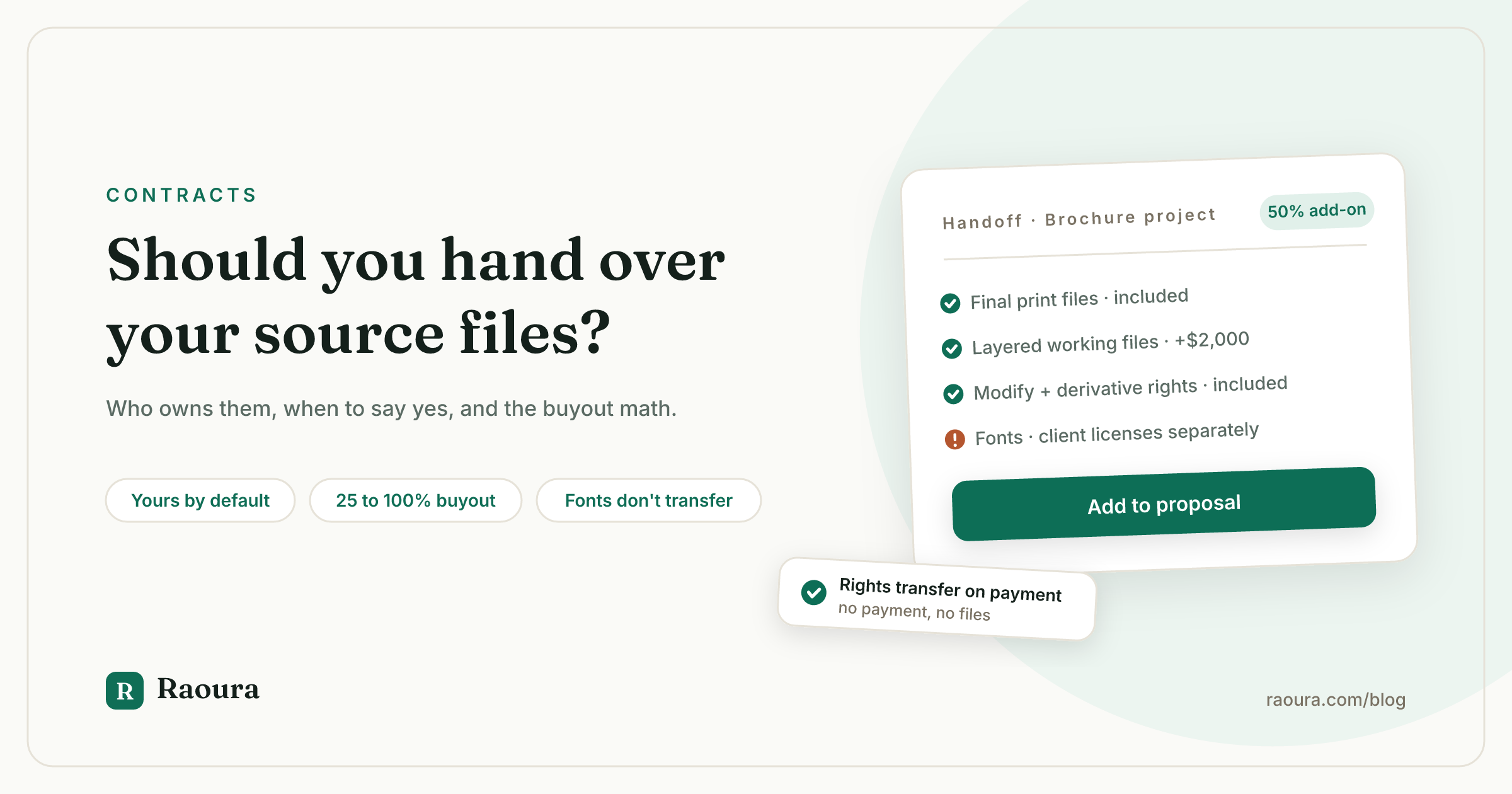
The project wrapped weeks ago. The invoice is paid, the deliverables are delivered, everyone is happy. Then the email arrives: "Could you send over the source files? Our new marketing hire wants to make some tweaks in-house."
And you freeze, because you have heard two completely contradictory rules about this moment. One camp says the files are your intellectual property, your recipe, and handing them over free is giving away the business.
The other camp says withholding them is petty, burns the relationship, and no client will ever refer you again.
Here is something we noticed researching this piece: both camps rank on page one for this query, side by side, giving opposite advice. One widely shared guide says to charge 25 to 100 percent of the project fee for native files. Another, equally popular, says to include them in the project fee as a matter of basic decency.
And neither of them, nor any other page we fetched from the top results, quotes the statute that actually decides who owns the files when the contract is silent.
So let us do this properly: the legal default, the honest norms by discipline, the buyout math, and the contract wording that makes the whole question boring. Verified July 2026.
Source files vs deliverables: the split that decides everything#
Every freelance project produces two distinct assets: the deliverable the client bought (the PDF, the exported logo pack, the finished photos, the live website) and the working files you used to produce it, and by default those are not the same thing legally or commercially.
Source files, sometimes called native files or working files, are the editable originals: the layered Photoshop and Illustrator documents, the InDesign package, the Figma file, the Premiere or After Effects project, the RAW photos, the un-minified code and build tooling. They contain not just the finished work but your method: how the layers are structured, which effects were built by hand, the grid logic, your component library, the color grading recipe.
That method is why the question is contentious. A client with your deliverables can use the work. A client with your source files can modify the work, produce derivatives of it, hand your technique to a cheaper freelancer, or bring everything in-house.
All of those might be perfectly legitimate things for them to want. They are also things they may not have paid for yet, and that distinction, what the client actually paid for, is exactly how the law analyzes it.
What the law says: the client does not own your files by default#
Under US copyright law a freelancer owns the copyright in commissioned work unless it falls into one of nine narrow statutory categories AND both parties signed an agreement expressly calling it work made for hire, or the freelancer signed a written copyright assignment.
This surprises clients constantly, so here is the chain, each link checkable at the source:
- As an independent contractor, you are the author and copyright owner of the work you create, even though the client paid you to create it. The client cannot acquire your copyright without a signed written assignment. No written agreement means no assignment, full stop. This is the plain-English summary given by IP attorney Linda Joy Kattwinkel in AIGA San Francisco's Legalities column on exactly this question.
- The "work made for hire" exception is far narrower than clients think. Per the US Copyright Office's Circular 30, a commissioned work from a non-employee is work for hire only if it meets four criteria: it falls within one of nine statutory categories (contribution to a collective work, part of an audiovisual work, translation, supplementary work, compilation, instructional text, test, test answer material, or atlas), there is a written agreement, that agreement expressly uses the words "work made for hire", and both parties signed it. Fail any one and it is not work for hire. Notice what is not on the nine-item list: logos, brand identities, brochures, websites, marketing photography.
- With no signed assignment and no valid work-for-hire agreement, a court will find at most an implied nonexclusive license: the client can use the work for the purposes both of you understood when you agreed to the project. Kattwinkel's analysis goes one step further, and it is the step that matters here: a court decides whether the client is entitled to your working files by asking whether the usage rights they paid for require those files. A client who bought a one-time brochure does not need your InDesign package to use the brochure. A client who bought the right to create derivative works does.
One sentence worth keeping: paying for a design does not buy the copyright, and buying the copyright is the thing that makes source files hard to refuse.
Two cautions before you print this out and wave it at anyone.
- The same law cuts the other way when you did sign something. A lot of client contracts contain assignment or work-for-hire-plus-assignment language, and if you signed one, the files question is likely already decided against you. Our contract red flags guide covers the clauses to watch.
- This is general information, not legal advice. A source file dispute with serious money attached deserves an hour with an IP attorney. The full ownership picture, including how rights differ by profession, is in our freelance IP rights guide.
Should you hand them over? The honest norms by discipline#
Across the six common freelance disciplines the norms genuinely differ: native logo files belong to the client in essentially every credible reading, RAW photos stay with the photographer in essentially every credible reading, and everything between those poles is a negotiation you should price, not improvise.
| Discipline | The working files | The norm as of 2026 |
|---|---|---|
| Logo and brand identity | Vector AI/EPS/SVG masters | Include with the project. Even the strongest charge-for-files advocates call logos the exception: a logo the client cannot reproduce everywhere is not a finished logo |
| Print and marketing design | Layered PSD, InDesign, Illustrator | Split practice. Deliver print-ready files always; native files either as a priced add-on (25 to 100 percent of fee) or included by designers who compete on generosity |
| Photography | RAW captures | Deliver edited finals; RAW files are treated like film negatives and rarely released, because unedited frames bypass the photographer's actual craft |
| Video and motion | Premiere/AE project files | Deliver final renders; project files negotiable, complicated by licensed music, stock, and plugins that do not transfer |
| Web development | Source code, repo, build tooling | Client generally needs the code for the site to be maintainable at all; the negotiation is about your reusable private tooling and boilerplate, not the project code |
| Writing | The manuscript is the source | No file split. The negotiation is purely about rights: what the client may publish, where, and for how long |
The middle rows are where freelancers get hurt, so here is the practical decision test, which is the same test a court would apply: does the use the client paid for require the working files? A restaurant that commissioned a menu does not need your InDesign file to print the menu. The same restaurant planning to update prices quarterly with an in-house person does. The first client is asking for something extra. The second described a need you should have scoped and priced on day one, which is why the fix in the last section of this guide happens in the proposal, not at handoff.
Whatever you decide, decide it before the work starts. The worst version of this conversation is the one that happens after the relationship sours, with the files as hostages. More on that below.
What to charge for a source file buyout#
The most concrete published anchor is 25 to 100 percent of the total project fee, with the percentage falling as the project fee rises.
That number comes from designer Colleen Gratzer, who has priced native file handoffs for over two decades and publishes her range: on a $5,000 project she would charge 25 percent ($1,250) to 50 percent ($2,500) for the native files, while on a $1,000 project she might charge 100 percent ($1,000). Her reasoning for charging at all: the files are additional value beyond the service, they expose your proprietary technique, and they frequently replace your future revenue with someone else cheaper.
Worked math on a $4,000 brochure project:
| Buyout level | Fee for native files | Client's total | When it fits |
|---|---|---|---|
| Included in fee | $0 | $4,000 | Client stated the derivative need upfront and the project was priced knowing it |
| 25% | $1,000 | $5,000 | Large project, limited reuse, good relationship |
| 50% | $2,000 | $6,000 | Client's team will produce derivative work from your design system |
| 100% | $4,000 | $8,000 | Small project, or full buyout including rights to rework everything |
Three things that are not optional in that conversation, whatever percentage you land on:
- The files fee is a rights fee, so say what rights come with it. Handing over an InDesign package while insisting the client may not modify anything is an incoherent deal. A buyout should name the new usage rights (typically: the right to modify and create derivative works) alongside the files.
- Fonts do not transfer. Your font license almost never permits sending font files to a client; they need their own license, which is a real cost you should flag before they buy the files. Gratzer's guide covers this trap, and it is the single most common way a "complete" file handoff turns out to be unusable.
- Stock licenses may not transfer either. Images licensed under your account may be licensed to you, not to the project. Check whether your stock provider allows license reassignment before promising the files are ready to use.
There is a real counterargument to charging anything, and it deserves a fair hearing. Agency owner Michael Janda argues for delivering source files as part of the project fee, on the logic that it is how you would want to be treated as a client.
His cautionary tale: a business owner asked his former agency for source files and was quoted $40,000, paid it, and then spent years telling every business owner he knew to avoid that agency. The extra fee was real; so was the reputation damage.
Janda's own contract makes client ownership conditional on full payment, which is the part of his approach everyone should copy even if you reject the rest.
The synthesis that holds up: generosity works when it is a decision you made in the pricing, not a concession extracted at handoff. If you include source files, say so in the proposal and price the project knowing it. If you charge, quote the add-on before work starts, when it is a menu option rather than a ransom note.
The clause: wording that settles it before it starts#
Three short provisions in your contract remove essentially all of the ambiguity: a deliverables definition, a working files reservation, and a priced buyout option.
Adapt this to your field and have a lawyer sanity-check your final version:
Deliverables and working files. The deliverables for this project are listed in the Scope of Work and consist of final files in the formats specified there. Contractor's working files (including layered, editable, or preliminary files, and Contractor's pre-existing tools, templates, and techniques) are not deliverables, and remain the sole property of Contractor.
Usage rights. Upon full and final payment, Client receives the rights described in the Scope of Work. No rights transfer, and no files are due, until payment in full is received.
Working file buyout (optional). Client may purchase Contractor's editable working files for this project, together with the right to modify them and create derivative works, for [X] percent of the total project fee. Fonts, stock assets, and third-party tools are licensed separately by their vendors and are excluded; Contractor will identify the licenses Client needs to obtain.
The structure does three jobs at once. The first paragraph makes "source files" a defined term instead of a vibe, which is what prevents the argument. The second ties every right and every file to full payment, so a client who terminates mid-project gets what they paid for and nothing more. The third converts the future ask from a confrontation into a price you already quoted. This mirrors the approach in the AIGA Standard Form of Agreement for Design Services, which separately defines preliminary art and "designer tools" and retains both for the designer; where these clauses sit among the rest of your contract is mapped in our clause-by-clause guide, and the annotated contract template includes a version of them.
One more wording note from the Circular 30 rules above: if a client's contract calls everything "work made for hire" and the work is a logo or website, that label alone probably fails the statutory test, because those works are not on the nine-category list. Sophisticated contracts know this and add fallback assignment language ("to the extent the work is not a work made for hire, Contractor hereby assigns...").
If you see that combination, you are signing away the copyright, and the source files question is settled in the client's favor the moment you sign. Price the whole engagement accordingly.
When the ask comes at the end of the relationship#
If the request arrives with no contract language to point to, you have three moves, and hostage-taking is not one of them: check what they actually need, quote the buyout calmly, or hand them over and bank the goodwill.
The triage:
- Ask what they are trying to do. Most clients asking for "the source files" want an outcome, not the files: reprint the brochure, update a date, resize for a new format. Quoting a small fee for the actual task is often cheaper for them and better for you than any file transfer. Some just want backup peace of mind, and a copy of the final deliverables in every format answers it.
- If they genuinely need the working files, quote the buyout. Anchor to the norms: name the percentage, name the new rights that come with it, flag the font and stock licenses they will need. Put a validity window on the quote. This is a normal, professional offer, and the calmer the email, the more normal it reads.
- If the relationship has been excellent and the project was priced well, consider Janda's route. Send the files with grace and a one-line note reserving your pre-existing tools and confirming their new usage rights in writing. What you lose in buyout revenue you often recover in referrals, and you keep the option because it was your call, not their demand.
What you should not do is discover, mid-divorce, that nobody knows what was agreed. An unpaid final invoice changes everything above: no rights and no files until payment clears is both the standard professional position and, per the ownership analysis earlier, the legally coherent one. If the project died partway through, your kill fee clause and this files clause are designed to work together: payment for the stage reached, rights to that stage's work, nothing more.
Make it a line item, not an argument#
The entire source files problem compresses into two artifacts you create before the work starts: a proposal line the client can see and choose, and a signed contract that defines what a deliverable is.
That is a workflow problem more than a legal one, and it is the part you can systematize. This is the shape of work Raoura is built around. (Disclosure: Raoura is our product.) Raoura lets you put the working file buyout on the proposal itself as an optional priced add-on the client checks or leaves unchecked, so the question is asked and answered while everyone is still excited about the project.
The proposal flows into a contract the client signs in their portal, and the final deliverables go out through the same portal, so "what was delivered, what was paid, and what was agreed" has one visible answer when the source files email arrives two years later. One flat plan at $17 a month, payments through your own Stripe account, and your money never touches us.

The buyout as a menu option: an optional add-on line the client selects at proposal stage reads as a choice, not a ransom.

The deliverables definition only settles arguments if it gets signed. One typed name, one click, and the working files clause is on the record.
Frequently asked questions
Does my client own the source files if they paid for the project?
Not by default under US law. As an independent contractor you own the copyright in your work unless you signed a written assignment, or the work fits the narrow work-made-for-hire rules (one of nine statutory categories plus an express signed agreement). Without that, the client has a license to use the work as intended, which usually does not require your working files.
Should I charge for source files?
For logos, no: include the vector masters, since the client cannot use the logo without them. For most other design work, either price the files into the project knowingly or offer them as an add-on; the published practitioner anchor is 25 to 100 percent of the project fee, with smaller percentages on bigger projects.
Can I send my fonts along with the files?
Almost never. Font licenses are personal to the buyer, and most EULAs prohibit redistributing font files. The client needs to buy their own license, and a professional handoff names the fonts and where to license them.
Do photographers have to give clients RAW files?
No, and most do not. The norm treats RAW captures like film negatives: the client buys finished, edited photographs, and the unedited frames stay with the photographer. Photographers who do release RAW files typically charge separately for them.
Can a client demand source files after firing me mid-project?
The general rule from the legal analysis is that a terminated client gets what they paid for as of termination. If interim payments covered interim deliverables, they get those deliverables, not your working files, and unpaid work transfers no rights at all. A clause tying all rights to full payment makes this explicit.
What if I already handed over files with no contract?
Handing over files does not by itself transfer copyright; a written signed assignment is still required for ownership to move. The client likely has an implied license to use the work for the original purpose. For anything beyond that, you can still negotiate usage rights now, though with less leverage than a contract would have given you.
---
Facts and figures verified July 2026. Primary sources: US Copyright Office Circular 30 (revised August 2024), AIGA SF Legalities 33 by Linda Joy Kattwinkel, Colleen Gratzer, Design Domination, Michael Janda.
Run your client work in one place
Send a proposal, get it signed, invoice, and get paid, with a branded portal your clients will actually use. One flat plan at $17/month, and we never take a cut of your payments.
Try Raoura free for 14 daysNo credit card required. Set up in minutes.
Keep reading
Is Upwork Worth It in 2026? A Break-Even Test for Your Situation
Upwork is worth it when its fee costs less than finding the client yourself, and that is true far more often for a first project than for a repeat client. Here is the break-even math with 2026 numbers: the 0 to 15% fee, Connects, the shrinking client base, and when to wait out the 24-month rule instead of paying to leave.
The Virtual Assistant Contract: 24 Clauses, Scored Against Every Template Ranking for This Search
We scored the four pages that publish actual virtual assistant contract text against 24 clauses a VA agreement needs. Twenty-four of 96 possible slots were filled. The best single template managed 7 out of 24. Twelve clauses appear in none of them, including every clause about the thing that makes VA work different from other freelance work: you are holding your client's passwords and running their inbox. One popular template also tells you a contract fixes your independent contractor status, then mandates client-set 9 to 5 weekday hours in the same document. Here is the clause-by-clause version, with the classification test the DOL is actually applying in 2026, the data protection terms nobody drafts, and the retainer mechanics that decide whether unused hours roll over.
Stripe vs PayPal for Freelancers: Every Fee Verified (2026)
Every page ranking for this comparison either prints in-person retail rates, contradicts itself, or skips the numbers freelancers actually pay. We read the current Stripe and PayPal pricing pages line by line, ran a $3,000 invoice through every rail, and found a $1,764 per year gap between the cheapest setup and the default one.