Project Cancelled Mid-Stream: What You Are Owed
July 19, 2026
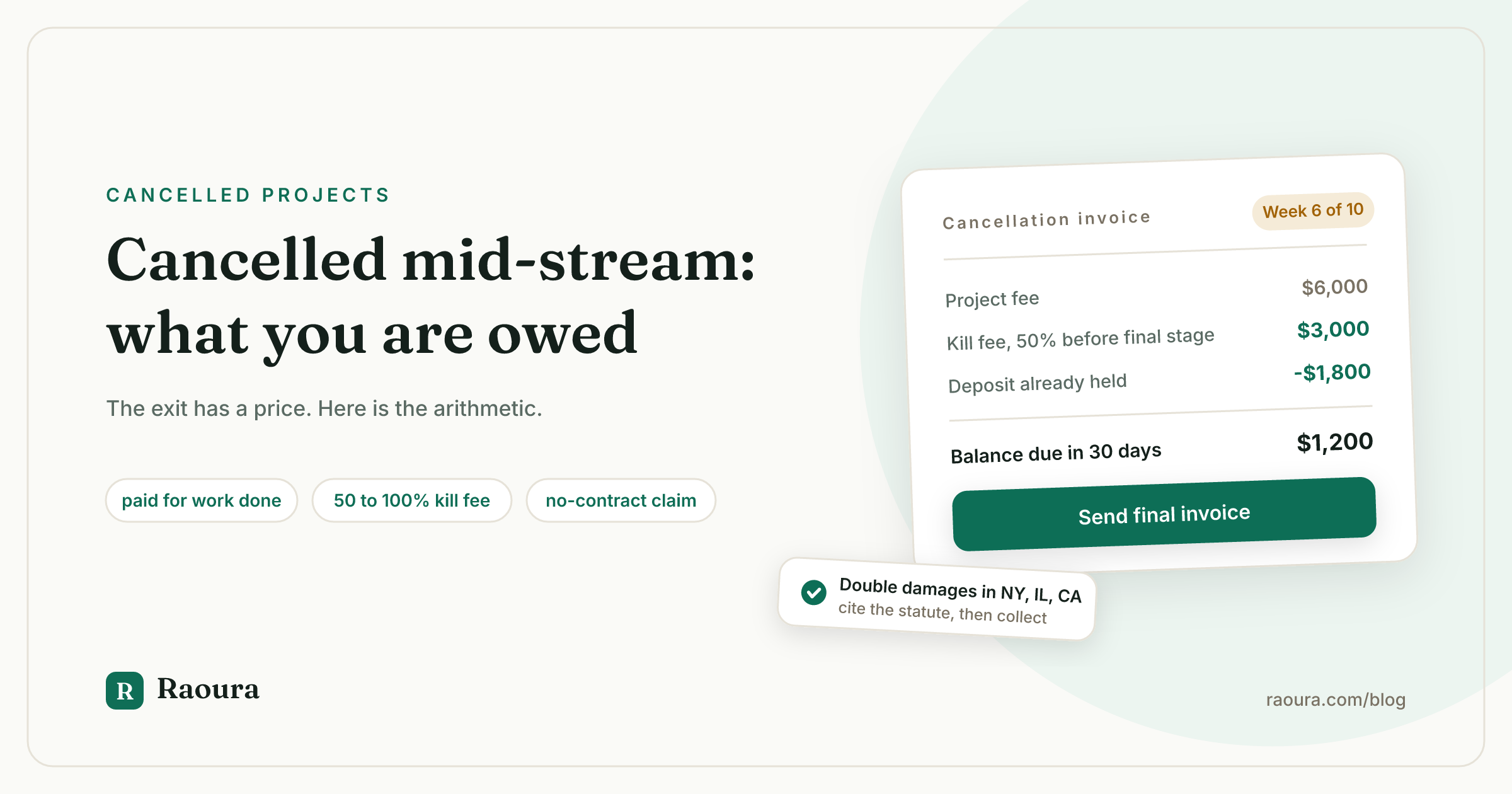
The email usually arrives on a Tuesday. "We've had a change in direction and won't be moving forward with the project. Thanks so much for the work so far!" You are six weeks into a ten week build. The deposit cleared long ago, the last two milestones have not, and the friendly exclamation point is doing a lot of work.
Most advice for this moment tells you how to feel about it. Breathe, refill the pipeline, treat it as a learning experience. That is fine, but it skips the only question that matters in week one: what are you actually owed, and how do you collect it?
This guide answers that question with numbers. What the four relevant contract clauses entitle you to, what the law gives you when there is no contract at all, the three state statutes that award double damages for nonpayment, a worked example you can map onto your own project, and the step-by-step collection ladder. Verified July 2026.
The short answer#
If a client cancels mid-project, you are typically owed payment for all work performed up to the cancellation date, plus any kill fee your contract sets, and the most cited professional standard (the Graphic Artists Guild model agreement) puts that kill fee at 50 percent of the total fee before the final stage and 100 percent once the work is complete.
Cancellation is not a refund event.
The client is not entitled to walk away from work you already did just because they no longer want the finished product. In contract terms, they are exercising an exit, and exits have prices. Your job is to figure out which price applies:
| Your situation | What you can claim | Legal basis |
|---|---|---|
| Contract with a kill fee or cancellation clause | The stated percentage or amount, often 50 to 100 percent of the fee depending on stage | The contract itself |
| Contract with a termination for convenience clause | All work performed to the termination date, plus any wind-down costs the clause names | The contract itself |
| Contract with milestones, no cancellation clause | Every completed milestone, plus a negotiated amount for work in progress | The contract plus quantum meruit for the WIP |
| Deposit only, no written contract | Keep the deposit (usually), plus the reasonable value of work beyond it | Liquidated damages, quantum meruit |
| Nothing in writing at all | The reasonable value of the work you performed | Quantum meruit, unjust enrichment |
The rest of this article walks each row, then shows you how to turn the answer into money.
Start with the contract: four clauses decide the outcome#
Four contract clauses determine what a cancellation costs the client: the kill fee, the termination clause, the deposit, and the payment schedule. Read your contract for all four before you reply to the cancellation email, because your first response should quote the contract, not react to the news.
The kill fee clause is the cleanest outcome. It names a percentage of the project fee that becomes due on cancellation, usually tiered by stage.
The Graphic Artists Guild's model Letter of Agreement is the most widely referenced standard: 50 percent of the final fee due within 30 days if the job is cancelled before the final stage, 100 percent if the work is complete, and all rights to the work revert to you. If you have this clause, your path is short: invoice the tier, credit the deposit, collect. We cover the norms, the exact wording, and why tiered fees survive legal challenges better than flat ones in our full guide to kill fees.
The termination for convenience clause lets either party end the contract without cause, usually with notice. The standard consequence, as construction payment specialists at Levelset explain, is that the client "will still have to pay for all work performed prior to the termination," sometimes plus wind-down costs.
What you generally do not get under these clauses is lost profit on the cancelled remainder. If your contract has one, your claim is: everything done through the termination date, at the contract rate.
The deposit is money you already hold, which makes it the strongest position in this list. Whether you can keep a deposit labeled non-refundable depends on reasonableness, not on the label.
Courts treat non-refundable deposits as liquidated damages clauses, enforceable when the amount is a good faith estimate of the harm a cancellation causes, not a punishment. A 30 percent deposit kept after three weeks of real work is easy to defend. A 100 percent prepayment kept after zero work is not.
One trap to know: in some cases, keeping the deposit as liquidated damages caps your recovery, meaning you cannot also chase the client for more. If the work you performed is worth substantially more than the deposit, invoice for the work and treat the deposit as a credit against that invoice instead of calling it a cancellation fee. Our deposit guide covers the percentages.
The payment schedule matters because completed milestones are simply due, cancellation or not. A milestone the client approved is an invoice waiting to be sent, and no cancellation email un-approves it.
The gray zone is the milestone you are halfway through, which is where the next section comes in.
No contract? You still have a claim#
No written contract does not mean no claim: the doctrine of quantum meruit entitles you to the reasonable value of the services you performed, and you prove it with five kinds of evidence you probably already have.
Quantum meruit is Latin for "as much as one has deserved." Cornell Law School's legal encyclopedia defines it as an equitable remedy that awards the reasonable value of services rendered by one party to another when someone accepted the benefit of your work without a contract covering the situation.
In plain terms: the client asked for work, you did work, they cannot keep the benefit for free just because the paperwork was thin.
The catch is the word "prove." Rocket Lawyer's attorney-reviewed guidance notes these claims are real but harder to prove than a contract claim, which means your evidence file decides the outcome. Five things establish reasonable value:
- The instruction trail. Emails, texts, or messages where the client asked for the work, gave feedback, or approved direction. This kills the "we never asked for this" defense.
- Time records. Logged hours, even reconstructed from calendars and file timestamps, dated and specific.
- A market rate. Your published rate, past invoices at that rate, or rate surveys for your field. Reasonable value is hours times a defensible rate.
- The work product itself. Drafts, staging links, files with timestamps, versions delivered.
- Evidence they used it. If the client launched, published, or built on your unpaid work, your claim strengthens dramatically, and you may have separate leverage entirely if the work was used without payment.
One number worth writing down before you negotiate: hours logged times market rate. That figure is your quantum meruit anchor, and it is often higher than the milestone math.
Three states put double damages behind you#
Freelancers in New York, Illinois, and California can now recover double the unpaid amount plus attorney fees when a client covered by their state's freelance law fails to pay, with contract thresholds of just $800, $500, and $250 respectively.
This is the part of the answer that none of the pages currently ranking for this search mention, and it changes the leverage math completely. A cancelled project with $2,000 unpaid is, in these states, potentially a $4,000 liability for the client plus your attorney's bill. Cite the statute in your demand letter and the client's own lawyer will tell them to pay.
New York's Freelance Isn't Free Act went statewide in August 2024 as Article 44-A of the General Business Law. It covers contracts worth $800 or more (alone or aggregated over 120 days), requires payment by the contract date or within 30 days of completing the services, and gives a prevailing freelancer double damages, injunctive relief, and reasonable attorney fees. Complaints go to the New York Attorney General.
Illinois passed the first statewide law of this kind. The Freelance Worker Protection Act covers work worth $500 or more in a 120-day period and requires full payment within 30 days of completing services if the contract sets no date. The statute awards double the underpayment, costs, and reasonable attorney fees, with a two year window to sue and an administrative complaint route through the Illinois Department of Labor.
California's SB 988 applies to contracts of $250 or more entered into or renewed since January 1, 2025, with the same 30-day default payment deadline. We break down coverage, exclusions, and the complaint process in our California FWPA guide and compare all the state laws in freelance payment laws by state.
The key interaction with cancellation: these laws enforce payment for services performed. They do not force a client to continue a project, but the moment your work is done (including "done because you cancelled it"), the payment clock is running, and nonpayment carries statutory teeth.
The math on a real project#
Here is the full calculation on a $6,000 website project cancelled in week six of ten, under each of the three most common paperwork situations.
Assume a $6,000 fixed fee, a 30 percent deposit of $1,800 paid at kickoff, and cancellation arriving when wireframes are approved and visual design is roughly half done. You logged 38 hours so far and your market rate is $90 per hour.
| Scenario | Calculation | Final invoice | Total collected |
|---|---|---|---|
| GAG-style kill fee (50 percent before final stage) | 50% x $6,000 = $3,000 due, minus $1,800 deposit already held | $1,200 | $3,000 |
| Milestones ($1,800 kickoff + $1,500 wireframes + $1,500 design + $1,200 launch), no kill fee | Kickoff paid; wireframes milestone completed and due; half-done design milestone negotiated via quantum meruit at ~$750 | $2,250 | $4,050 |
| No written contract, deposit only | 38 hours x $90 = $3,420 reasonable value, minus $1,800 deposit credited | $1,620 | $3,420 |
Three things jump out of that table.
- None of the scenarios round to zero. Even the no-contract row collects more than half the project fee.
- Milestone billing quietly outperformed the kill fee here. Completed milestones are owed at 100 percent while a mid-project kill fee pays 50, which is why the strongest contracts use both.
- The deposit is doing heavy lifting in every row. It is the only money that never needed collecting.
One honest note on the data: we searched for a credible 2024 to 2026 statistic on how often freelance projects get cancelled mid-stream and found none. The only large study is a pandemic-era survey that no longer describes normal conditions. Nobody currently ranking for this topic has that number either, so treat any confident "X percent of projects get cancelled" claim you see elsewhere with suspicion.
How to collect: the cancellation ladder#
Send your final invoice within 48 hours of the cancellation notice, while the goodwill and the guilt are both still warm, and escalate on a written schedule if it goes unpaid.
- Reply in writing, confirm the cancellation date, and quote the clause. "Confirming the project is cancelled effective July 14. Per section 6 of our agreement, 50 percent of the project fee is due on cancellation before the final stage. Final invoice to follow, with the deposit credited." No anger, no negotiation, just arithmetic.
- Invoice immediately. Itemize: work performed or kill fee tier, minus deposit, net due, with your normal payment terms. A cancellation invoice that arrives two days after the call gets treated as real. One that arrives five weeks later gets treated as optional.
- Run your normal reminder sequence. Same cadence as any other invoice. Our payment reminder templates work unchanged here.
- Send a demand letter at 30 days past due. Cite quantum meruit if you had no contract, and the state statute if you are in New York, Illinois, or California. Our demand letter guide has the template.
- File. State complaint (free, in the statute states) or small claims court, where limits range from $2,500 in Kentucky to $25,000 in Delaware and Tennessee depending on state, and most fall between $5,000 and $15,000. The small claims walkthrough covers filing, and the full escalation ladder covers everything in between.
While the invoice is unpaid, deliver nothing further. Source files, exports, admin access, and handoff documents are your remaining leverage, and the publishing norm baked into the GAG agreement points the same way: until the cancellation fee is paid, the rights stay with you.
Make the next cancellation a non-event#
The combination that defuses cancellations before they happen is a 30 to 50 percent deposit plus milestone billing, because together they mean a cancellation can never cost you more than one milestone of unpaid work.
Everything above is triage.
The structural fix is to price the exit into every project before it starts: a real deposit, a kill fee clause with stage tiers, and a payment schedule that keeps the client's balance small at every point in the project. Add those three and the worst case shrinks from "half the project fee at a lawyer's mercy" to "one milestone, already covered by the clause."
The reason most freelancers do not run projects this way is not ignorance, it is friction. Tracking which milestone is approved, which is invoiced, and what a mid-stage cancellation is worth across a dozen active projects is exactly the kind of bookkeeping that slides when you are busy. This is the problem client management tools exist to solve, and it is the core of how Raoura structures projects. Disclosure: Raoura is our product.

When every phase carries its own price and payment status, "what am I owed if this dies today" is already answered on screen.
When a cancellation does land, the final invoice takes about a minute because the numbers already exist: completed milestones at full price, the kill fee tier from the signed contract, the deposit sitting as a credit.

The cancellation invoice is a normal invoice: work performed and the kill fee as line items, the deposit as a credit, your standard payment terms on the bottom.
Raoura is $17 per month flat, payments go straight to your own Stripe account with no added fees, and proposals, contracts, milestones, and invoices live on one timeline per client, which is exactly the evidence trail a quantum meruit claim needs.
If the client is actively using what you delivered, the playbook in client used my work without paying covers the stronger position that gives you.
Verified July 2026. Kill fee tiers and rights reversion are from the Graphic Artists Guild model Letter of Agreement at graphicartistsguild.org. Quantum meruit definition from Cornell Law School's Legal Information Institute. Termination for convenience mechanics from Levelset's attorney-written guide. State laws: NY General Business Law Article 44-A (nysenate.gov, effective August 2024, $800 threshold), Illinois FWPA 820 ILCS 193 (labor.illinois.gov and ilga.gov, $500 threshold, double damages), California SB 988 (leginfo.legislature.ca.gov, $250 threshold, effective January 2025). Non-refundable deposit enforceability from attorney analysis at weddingindustrylaw.com. Small claims limits from Nolo's 50-state chart (last updated October 2023; check your state's current limit before filing). We found no credible 2024 to 2026 statistic on mid-project cancellation frequency and say so above rather than inventing one.
Frequently asked questions
What am I owed if a client cancels a project halfway through?
At minimum, payment for all work performed up to the cancellation date. If your contract has a kill fee, you are owed that instead when it is higher; the most cited standard is 50 percent of the total fee before the final stage and 100 percent after. Completed milestones are due in full regardless.
Can a client cancel a project and demand the deposit back?
Usually not once real work has begun. Courts enforce non-refundable deposits as liquidated damages when the amount reasonably estimates your loss. If little or no work happened, expect to refund some or all of it; a kept deposit that dwarfs the actual work looks like a penalty, and penalties get struck down.
What if there was no written contract?
You can still recover the reasonable value of your work under quantum meruit. Gather the instruction trail, time records, your market rate, the work product, and any evidence the client used the work. Hours times market rate is your anchor number.
Does the client have to pay for unfinished work?
For work performed, yes: partial completion is still performed work, valued by contract rate or reasonable value. What clients generally do not owe (absent a kill fee clause) is your lost profit on the never-started remainder of the project.
How long does the client have to pay after a cancellation?
Whatever your invoice terms say, but in New York, Illinois, and California, covered clients must pay within 30 days of completed services by law, and nonpayment exposes them to double damages plus attorney fees under each state's freelance protection act.
Should I keep working after a client says they want to cancel?
Stop billable work immediately at the written cancellation notice and do not release further deliverables, source files, or access until the final invoice is paid. Work done after the notice is hard to collect, and undelivered work is your leverage.
Is a cancelled project fee taxable income?
Yes. Kill fees and payments for work performed on cancelled projects are ordinary business income, reported like any other project revenue.
---
Run your client work in one place
Send a proposal, get it signed, invoice, and get paid, with a branded portal your clients will actually use. One flat plan at $17/month, and we never take a cut of your payments.
Try Raoura free for 14 daysNo credit card required. Set up in minutes.
Keep reading
Is Upwork Worth It in 2026? A Break-Even Test for Your Situation
Upwork is worth it when its fee costs less than finding the client yourself, and that is true far more often for a first project than for a repeat client. Here is the break-even math with 2026 numbers: the 0 to 15% fee, Connects, the shrinking client base, and when to wait out the 24-month rule instead of paying to leave.
The Virtual Assistant Contract: 24 Clauses, Scored Against Every Template Ranking for This Search
We scored the four pages that publish actual virtual assistant contract text against 24 clauses a VA agreement needs. Twenty-four of 96 possible slots were filled. The best single template managed 7 out of 24. Twelve clauses appear in none of them, including every clause about the thing that makes VA work different from other freelance work: you are holding your client's passwords and running their inbox. One popular template also tells you a contract fixes your independent contractor status, then mandates client-set 9 to 5 weekday hours in the same document. Here is the clause-by-clause version, with the classification test the DOL is actually applying in 2026, the data protection terms nobody drafts, and the retainer mechanics that decide whether unused hours roll over.
Stripe vs PayPal for Freelancers: Every Fee Verified (2026)
Every page ranking for this comparison either prints in-person retail rates, contradicts itself, or skips the numbers freelancers actually pay. We read the current Stripe and PayPal pricing pages line by line, ran a $3,000 invoice through every rail, and found a $1,764 per year gap between the cheapest setup and the default one.