Client Used Your Work Without Paying? Here Are Your Options
July 19, 2026
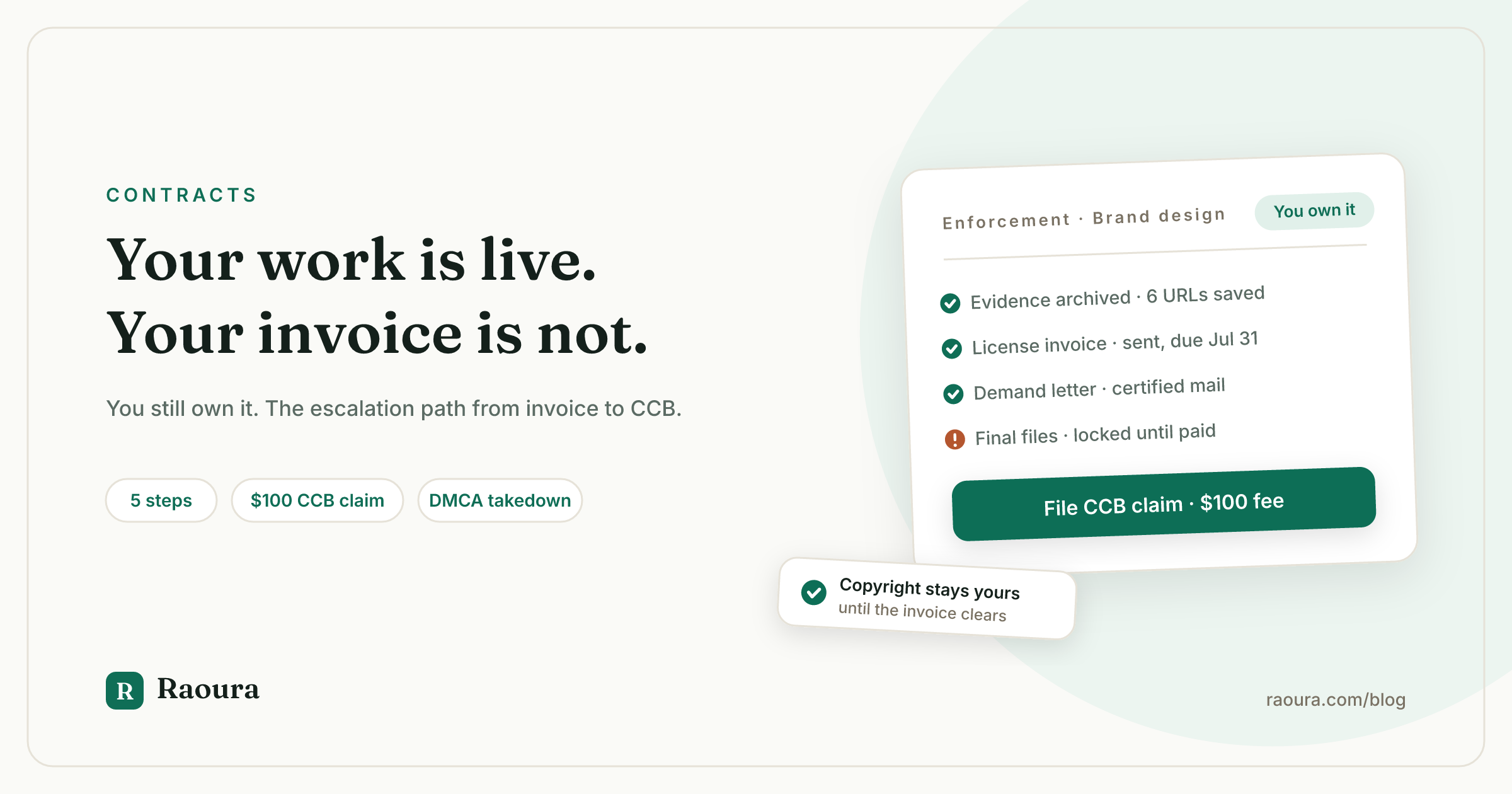
There is a specific kind of anger that arrives when you open a client's website and see your work live, published, earning them money, while your invoice for that exact work sits unpaid in their inbox. It feels like theft because, in most cases, it legally is something very close to it.
Here is what we found when we checked what ranks for this query in July 2026.
- The #1 result is a guide published in June 2026 by an India-based advocate with no US legal citations.
- The #3 result is a 400-word law firm post from 2022 whose only actionable advice is "call us."
- Not one page in the top five mentions the Copyright Claims Board, the $100 federal small claims tribunal that exists precisely for disputes like yours.
So this article is the US playbook those pages are not: what you actually own, the escalation ladder from politest to most forceful, real dollar figures for every step, and the honest catches nobody puts next to the DMCA advice.
One scope note before we start. If the client simply vanished without publishing anything, that is a different problem with a different sequence, covered in the client ghosted after delivery playbook. This article is for the sharper case: the invoice is unpaid and the work is in use.
First: you almost certainly still own the work#
Unless you signed a written agreement transferring copyright, the work you created belongs to you, not the client, under 17 USC 201, and a client using it without paying is using property they do not own.
This surprises clients constantly, and it is the foundation of every option below. US copyright vests in the creator at the moment of creation. For an independent contractor, the client only owns the work in two situations: you signed a written assignment transferring the copyright, or the work qualifies as a "work made for hire", which requires a signed agreement saying so and the work falling into one of just nine statutory categories (most solo freelance work, including logos, websites, and photography, does not qualify). The Copyright Office spells this out in Circular 30.
Even where your contract does assign the rights, read the clause again: well-drafted freelance contracts condition the transfer on payment in full. If yours says something like "rights transfer upon receipt of final payment", an unpaid client holds nothing.
If you have no written contract at all, courts sometimes find the client bought an "implied license" to use the work, but an implied license generally depends on the deal actually being honored, and nonpayment undercuts it. The full ownership rules, including the work made for hire test and the clause wording to use next time, are in our freelance IP rights guide.
A standalone fact worth keeping: a freelancer who was never paid, and never signed rights away, can pursue both the unpaid invoice and copyright infringement at the same time. They are separate claims.
Two legal doors: contract or copyright#
You have two distinct legal routes, a breach of contract claim for the invoice amount and a copyright infringement claim for the unauthorized use, and which one leads changes your venue, your damages, and your paperwork.
| Contract route | Copyright route | |
|---|---|---|
| What you claim | The unpaid invoice, plus late fees and interest | Unauthorized use of work you own |
| Where | State small claims or civil court | Copyright Claims Board or federal court |
| Typical recovery | The invoice amount (doubled in NY, IL, and CA under freelance payment laws) | Actual damages, or statutory damages of $750 to $30,000 per work if registered in time |
| Registration needed | No | Yes, to sue in federal court; an application is enough for the CCB |
| Best when | Clear contract or email agreement, client still reachable | No payment, work in active use, client stonewalling |
Practical rule of thumb: the contract route is simpler and cheaper for most invoice-sized disputes, and if your client is in New York, Illinois, or California, state freelance payment laws can double the amount owed.
The copyright route is your leverage multiplier: it is what turns "please pay my $2,000 invoice" into "you are commercially exploiting property you do not own". Most freelancers in this situation never need to choose in court, because the credible threat of the copyright route is what gets the contract route paid.
Step 1: Freeze the evidence before you say anything#
Capture proof of the use before contacting the client, because the first thing a caught client does is quietly take the work down: screenshot every placement with visible URLs and dates, save the pages to the Wayback Machine, and export your delivery and invoice records.
Do this first and do it thoroughly:
- Full-page screenshots of every place the work appears (site pages, social posts, ads, packaging), with the URL and date visible.
- Archive each URL at web.archive.org so a third party holds a timestamped copy.
- Your delivery trail: the email or portal link where you sent the files, with dates.
- The money trail: the invoice, its due date, and every reminder you sent.
- The agreement trail: contract, or the email and message thread where scope and price were agreed.
If your invoices, files, and client messages already live in one system, this takes ten minutes. If they live across two inboxes, a messaging app, and a downloads folder, budget an unpleasant afternoon, and see the FAQ below about fixing that permanently.
Step 2: The retroactive license invoice#
Your calmest first move is a short message with a new invoice attached: the original amount, now framed as a license fee for the use that already happened, with a 10 business day deadline.
This reframing matters. You are no longer a vendor chasing a late payment; you are a rights holder invoicing for use of your property. It gives the client a face-saving exit and gives you a dated demand on the record. Something like:
Subject: License required for [work] currently in use on [URL]
Hi [name],
I noticed the [deliverables] I created for you are live at [URL]. As invoice #[number] for this work remains unpaid, the copyright has not transferred and no license to use the work is in place. I own the rights under US copyright law.
I would much rather resolve this simply than formally. Attached is the invoice covering the work and its current use. If it is paid by [date, 10 business days out], the rights transfer as originally agreed and this is closed.
If I do not hear from you by then, I will need to treat the ongoing use as unauthorized and act accordingly, including takedown notices to the platforms hosting the work.
Payment link: [link]
[Your name]
Two notes. Some guides recommend invoicing 2x or 3x the original fee as a "retroactive license premium". You can ask for anything, but there is no statute entitling you to a multiplier, and an inflated number gives the client a reason to call the whole thing a shakedown. Invoice the agreed amount plus any late fees your contract actually specifies, and keep the moral high ground. And send this even if you already sent normal payment reminders; it is a different message legally, not another nudge.
Step 3: The demand letter, with the infringement paragraph#
If the license invoice deadline passes, send a formal demand letter by email and certified mail, and add one paragraph the standard template does not have: the copyright paragraph.
We have a full demand letter template with usage instructions, including the statutory language that doubles damages in New York, Illinois, and California. For the work-in-use situation, add this after the payment demand:
Please further note that the copyright in the delivered work remains my property. No assignment or license has taken effect, as the conditions of transfer were never met. Your continued commercial use of the work at [URLs] without payment constitutes copyright infringement under 17 USC 501. If this matter is not resolved by [date], I will pursue the remedies available to rights holders, including takedown notices under the DMCA and a claim before the Copyright Claims Board, in addition to collection of the debt itself.
Every escalation from here fits into the wider unpaid invoice escalation ladder; the steps below are the copyright-specific rungs.
Step 4: The DMCA takedown, including the catches#
A DMCA takedown notice under 17 USC 512 asks the platform hosting your work (the client's web host, Instagram, YouTube, a marketplace) to remove it, usually works within days, and costs nothing, but it carries two catches the popular guides skip.
The notice itself is simple. It must include your signature, identification of the copyrighted work, the exact URLs of the infringing use, your contact information, a good faith statement that the use is unauthorized, and a statement under penalty of perjury that the notice is accurate, per 17 USC 512(c)(3). You send it to the platform's registered agent, findable in the Copyright Office's DMCA Designated Agent Directory; big platforms also have their own IP report forms that route to the same place.
Now the catches.
- Section 512(f) creates liability for knowingly misrepresenting infringement. If your situation is genuinely murky (a signed contract with an unconditional assignment, or a dispute about whether payment was excused), a takedown is the wrong tool and could boomerang.
- The client can file a counter-notice. If they do, the platform restores the content in 10 to 14 business days unless you file an actual lawsuit.
A takedown is leverage, not a verdict. In practice, against a client who knows they never paid, it is strong leverage: their website going dark over an invoice they owe anyway is a bad trade, and they know it.
Step 5: The $100 copyright court, or small claims#
For disputes under $30,000 you have a federal venue most freelancers have never heard of: the Copyright Claims Board, with a $100 filing fee, no lawyer required, and no need to wait for your registration certificate.
Here is the enforcement math for a typical unpaid project:
| Route | Upfront cost | Cap | Lawyer needed | Registration |
|---|---|---|---|---|
| [Copyright Claims Board](https://ccb.gov/) | $145 ($45 registration + $100 filing) | $30,000 per proceeding; $15,000 per timely registered work; $7,500 per unregistered work | No | Pending application is enough to file |
| State small claims (contract claim) | Roughly $30 to $75 filing, [varies](https://www.nolo.com/legal-encyclopedia/small-claims-suits-how-much-30031.html) | $2,500 to $25,000 depending on state | No (some states bar lawyers) | Not needed |
| Federal court | $405 filing plus attorney fees | No cap; statutory damages $750 to $30,000 per work, up to $150,000 if willful | Realistically yes | Completed registration required ([Fourth Estate](https://supreme.justia.com/cases/federal/us/586/17-571/), 2019) |
The CCB's honest weakness: the respondent can opt out within 60 days, which ends the proceeding and leaves you with the other two rows. But opting out is itself a signal, and many small business clients, served with official federal tribunal paperwork over an invoice they cannot dispute owing, pay instead.
On timing and damages: statutory damages and attorney fees in federal court require that you registered the work before the infringement began or within 3 months of first publication, per 17 USC 412. Most freelancers reading this after the fact missed that window, which is exactly why the CCB (which still allows up to $7,500 per unregistered work) and the contract route matter more in practice than the $150,000 headline number.
Registration currently costs $45 for a single work by a single author ($65 standard), and a March 2026 proposed rule would raise the standard fee to $85, so register the valuable work now, not after the next client goes quiet.
For the contract route mechanics (filing, serving, collecting), see the small claims guide for freelance invoices.
Prevention: make payment the unlock#
Every option above exists because the final files left your hands before the money arrived; the durable fix is a delivery flow where previews are free and finals unlock on payment.
Three contract and workflow changes prevent a repeat:
- A rights clause that conditions transfer on full payment, in writing, on every project, even the small ones. The exact wording is in the IP rights guide.
- Deposits and milestone billing, so no single unpaid invoice ever represents the whole project.
- Watermarked or preview-quality delivery until the closing invoice clears, with source files held back by default.
This is the part Raoura is built around. Contracts carry your payment-conditioned rights clause and get e-signed before work starts, invoices track their own due dates and reminders, and delivered files sit in a client portal where finals can be set to unlock only when the linked invoice is paid. The client always has something to review, and never the thing they have not paid for. Disclosure: Raoura is our product, and every step in this article works the same if you run it from email and a spreadsheet.

When finals unlock on payment, the "client publishes your work and stops answering" scenario cannot start, because the publishable version never ships unpaid.

The signed contract with a payment-conditioned rights clause is the document every step in this article leans on, from the license invoice to the CCB claim.
Frequently asked questions
Is it copyright infringement if my client never paid?
Usually, if you never signed away the rights or your contract conditions transfer on payment. Ownership stayed with you, so their commercial use is unauthorized. If you signed an unconditional assignment or a valid work made for hire agreement, the use may be legal even though the debt is real, and your claim is breach of contract instead. This distinction is the first thing to check, before sending anything.
Can I really send a DMCA takedown against my own client?
Yes, if you own the copyright and never licensed the use. Nothing in section 512 exempts former clients. But be certain of your ownership position first, because 512(f) penalizes knowing misrepresentation, and a plainly contractual dispute dressed up as infringement is the classic way to get there.
We never signed anything. Do I still own the work?
Yes. Copyright requires a signed writing to transfer, so with no contract the rights are yours by default. The complication is the implied license: a court may find the client's payment (if any) bought a right to use the work for the agreed purpose. With zero payment, an implied license argument is weak. No contract also makes the debt itself harder to prove, so gather the email trail; here is what the contract should say next time.
Should I just take the work down myself? I still have site access. No. Logging into a client's website to remove work, however justified it feels, can expose you to claims under computer misuse laws and instantly makes you the aggressor in the story. Revoke through process (takedown notices, demands), not through their admin panel. The same logic applies to kill switches and back doors: courts and clients treat self-help sabotage far more harshly than a DMCA notice.
The client says they will pay "eventually". Does that change anything?
A written promise to pay is evidence the debt is owed, which helps you, and a reason to pause escalation briefly, which helps them. Reply asking for a specific date in writing, and say plainly that the work remains unlicensed until payment. If the date passes, resume the ladder where you left off. Vague reassurance without a date is a stall; our invoice dispute guide covers the variants where the client contests the amount rather than just delaying.
What if the client is in another country?
Your ownership travels well: most countries, via the Berne Convention, protect your work without registration. Your enforcement travels badly: the CCB and US small claims only help against parties you can pursue in the US. The practical tools become the DMCA takedown (effective against any content on US-based platforms and hosts) and pressure through the client's local payment norms. Our international clients guide covers contracts and payment terms across borders.
How much of this needs a lawyer?
Steps 1 through 4 are designed to be done yourself, and the CCB was built for unrepresented parties. Bring in a lawyer when the amount is large, when the client lawyers up, when your ownership position is genuinely unclear, or before filing in federal court. And the standing caveat: this article is legal information, not legal advice for your specific facts.
---
Every figure in this article was verified against primary sources in July 2026: 17 USC 101, 201, 412, 501, 504, and 512 via Cornell LII, Copyright Office Circular 30, the copyright.gov fee schedule ($45 single application, $65 standard, checked directly this month) and the March 2026 Federal Register fee proposal, Fourth Estate v. Wall-Street.com (586 U.S. 296), ccb.gov filing fees and damage caps, the Copyright Office DMCA resources and Designated Agent Directory, and Nolo's state small claims limits chart. We also read the five top-ranking pages for this query and confirmed that none of them mentions the Copyright Claims Board, and only one correctly states that registration must precede a federal infringement suit.
Run your client work in one place
Send a proposal, get it signed, invoice, and get paid, with a branded portal your clients will actually use. One flat plan at $17/month, and we never take a cut of your payments.
Try Raoura free for 14 daysNo credit card required. Set up in minutes.
Keep reading
Is Upwork Worth It in 2026? A Break-Even Test for Your Situation
Upwork is worth it when its fee costs less than finding the client yourself, and that is true far more often for a first project than for a repeat client. Here is the break-even math with 2026 numbers: the 0 to 15% fee, Connects, the shrinking client base, and when to wait out the 24-month rule instead of paying to leave.
The Virtual Assistant Contract: 24 Clauses, Scored Against Every Template Ranking for This Search
We scored the four pages that publish actual virtual assistant contract text against 24 clauses a VA agreement needs. Twenty-four of 96 possible slots were filled. The best single template managed 7 out of 24. Twelve clauses appear in none of them, including every clause about the thing that makes VA work different from other freelance work: you are holding your client's passwords and running their inbox. One popular template also tells you a contract fixes your independent contractor status, then mandates client-set 9 to 5 weekday hours in the same document. Here is the clause-by-clause version, with the classification test the DOL is actually applying in 2026, the data protection terms nobody drafts, and the retainer mechanics that decide whether unused hours roll over.
Stripe vs PayPal for Freelancers: Every Fee Verified (2026)
Every page ranking for this comparison either prints in-person retail rates, contradicts itself, or skips the numbers freelancers actually pay. We read the current Stripe and PayPal pricing pages line by line, ran a $3,000 invoice through every rail, and found a $1,764 per year gap between the cheapest setup and the default one.