Client Disputes Your Invoice: The Step by Step Response
August 30, 2026
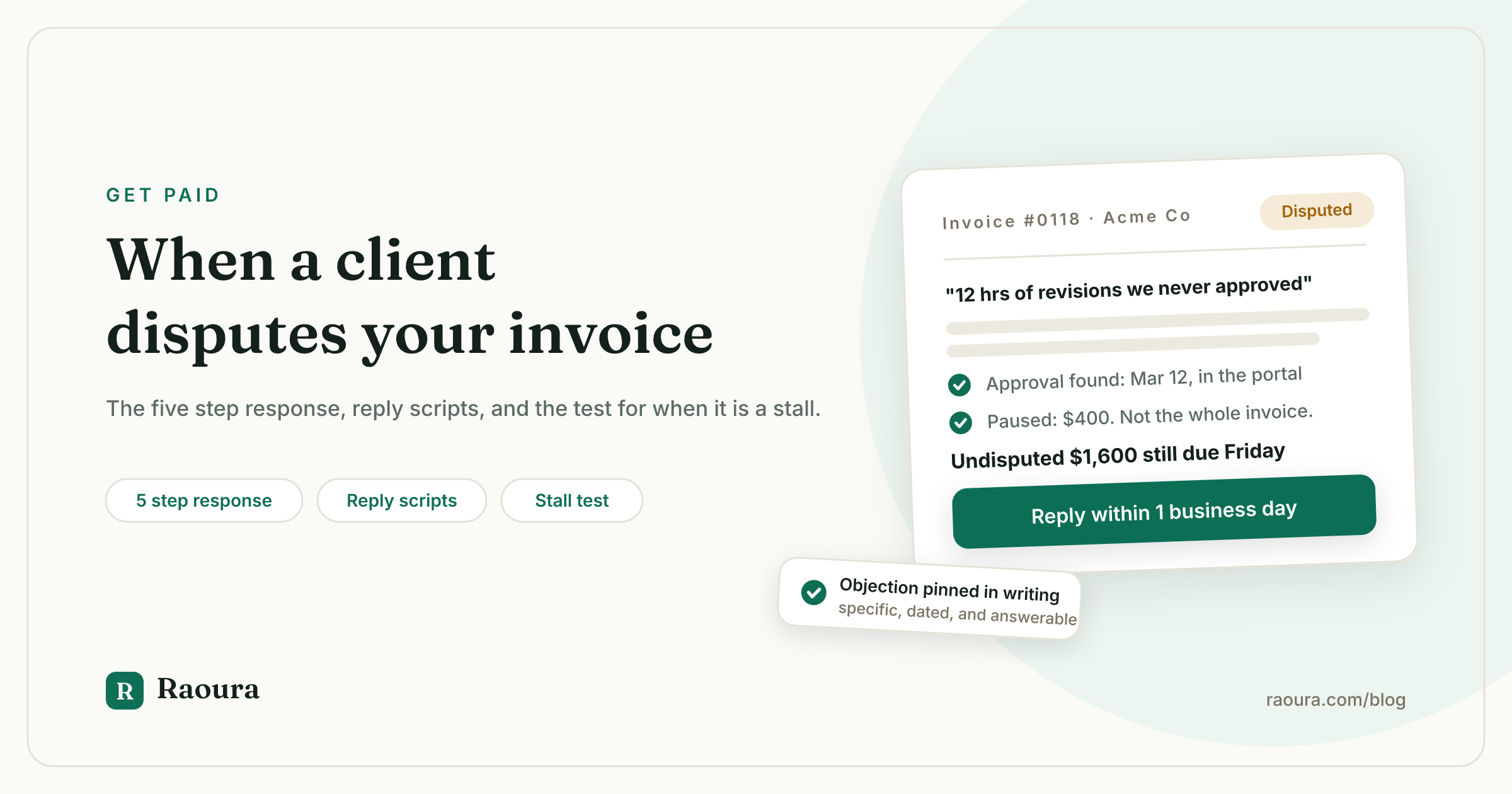
"Can we talk about this invoice?" lands differently than silence. A client who disputes an invoice is not refusing to pay, at least not yet. They are objecting to something on it: an amount, a line item, hours they say they never approved, work they say was included in the price. That distinction matters, because the playbook for a disputed invoice is different from the one for a client who simply went quiet (that one is our unpaid invoice escalation ladder).
Here is what we noticed reading every page on the first search page for this query in July 2026: four of the five are written for accounts receivable teams and generic small businesses, and the only one written for freelancers tells you that without written evidence "you will have to agree with what the client says." That is bad advice, and we will show you why.
Also, across all five ranking pages there is exactly one copy-paste reply script between them. This article has several.
The stakes are real. Intuit QuickBooks' January 2025 survey of 2,487 small businesses found 56% are owed money on unpaid invoices, averaging $17,500 each, and 47% have invoices more than 30 days overdue. Some of that money is stuck behind exactly this kind of dispute, aging while both sides wait for the other to move first.
The five step response at a glance#
A disputed invoice is a five step process: acknowledge within 1 business day, get the objection specific and in writing, check your paper trail, decide whether to concede, compromise, or hold, and close it out with a corrected invoice, while the undisputed portion of the invoice stays payable on its original due date.
| Step | Do it within | The move |
|---|---|---|
| 1. Acknowledge | 1 business day | Thank them for flagging it, confirm what exactly is disputed, pause collection on the disputed portion only |
| 2. Pin it down | 2 to 3 days | Get the specific objection in writing and classify which of the 5 dispute types you are in |
| 3. Check the paper | Same week | Contract, scope of work, approvals, time logs, change orders |
| 4. Decide | Within a week | Concede an error same day, compromise where the paper is ambiguous, hold with evidence where it is not |
| 5. Close it out | Immediately after | Credit note or corrected invoice under a new number, outcome confirmed in writing |
Speed is the through line. A dispute that gets a same-day acknowledgment usually stays a conversation. A dispute that sits for a week hardens into a standoff, and the invoice ages the whole time.
Step 1: Acknowledge within one business day, and pause only what is disputed#
Reply within 1 business day, and pause collection only on the disputed portion of the invoice, never on the whole thing. This is the single rule the accounts receivable world gets right and freelancers most often miss. If a client disputes one $400 line item on a $2,000 invoice, $1,600 of that invoice is not in dispute and remains due on the original date. QuickBooks' own guidance on disputed invoices states this plainly: if 95% of an invoice is undisputed, only 5% should go unpaid.
There is respectable precedent for handling it this way. Under the federal Prompt Payment Act, when a US government agency finds a defect in an invoice it must say so within 7 days and identify every defect at once, and the payment clock restarts only for the corrected invoice. Even the slowest payer in America is not allowed to let one objection freeze everything indefinitely. Neither is your client.
Your first reply sets the temperature. Do not defend anything yet, because you do not know what you are defending against:
Thanks for flagging this. I want to get it right, so before I look into it, can you confirm exactly which items you are questioning and what looks off about each one? The rest of the invoice is unaffected, so I will leave it due on the original date, and I will come back to you on the disputed part by [day].
That message does four jobs in four sentences: it stays warm, it forces specificity, it establishes the undisputed portion rule without arguing, and it commits you to a date.
Step 2: Get the objection in writing and name the dispute type#
Nearly every invoice dispute is one of 5 types, and each has a different correct response, which is why "just talk to the client" is useless advice. Vague unease ("this seems high") is not something you can resolve. A named objection is.
| Dispute type | What the client says | Your correct move |
|---|---|---|
| Billing error | "You charged for X twice" or "the math is off" | Verify, fix the same day, thank them, done |
| Unapproved work | "I never approved this many hours" | Show the time log and the approval trail |
| Scope | "This should have been included in the price" | Show the scope of work and the change order record |
| Quality | "The work is not what we expected" | Split the quality conversation from the payment one |
| Price shock | "This is more than we can pay right now" | Not a dispute at all, it is a cash flow negotiation |
Two of these deserve a note.
A quality objection raised for the first time when the invoice arrives, rather than when the work was delivered, is a yellow flag: address the work on its merits, but keep the deliverable conversation and the payment conversation in separate threads, because merging them is how "one small revision" becomes a 20% discount.
Price shock is not a dispute about what you are owed, it is a request for terms. Treat it as one: a dated payment plan in writing beats a discount every time, and in New York and Illinois a client may not legally demand you accept less than the contract amount as the condition of getting paid on time (more on those laws below).
If the client will not put the objection in writing, write it down yourself and confirm it back: "So I am looking at the right thing: your concern is the 12 hours billed for revisions in week 3, is that right?" You now have a defined dispute either way.
Step 3: Check the paper before you argue#
Four documents settle most invoice disputes before anyone raises their voice: the contract, the scope of work, the approval trail, and your time log. Pull all four before you reply on the merits, even if you are sure you are right. You are looking for two things: what was agreed, and what you can prove was agreed.
This is where the ranking freelancer advice goes wrong. The claim that without written evidence "you will have to agree with what the client says" ignores three real options.
- Partial records count. An email thread, a Slack message approving "the extra revisions," a text saying "yes go ahead" are all evidence.
- The undisputed portion rule still applies. Even a shaky dispute over one item does not forfeit the rest of the invoice.
- State laws can back you up. In New York, Illinois, and California, freelance payment laws now put weight behind your version of events when the client never gave you the written contract those laws require. Our state by state guide to freelance payment laws covers who qualifies.
If the paper shows the client is right, congratulations: you have the cheapest possible outcome. Fix it the same day, thank them for catching it, and move to step 5. A same-day correction with no defensiveness buys more client trust than a perfect invoice ever did.
If the paper is ambiguous, that ambiguity is information about your contract, not just this dispute. The fix for next time is a scope of work with exclusions listed and a change order habit for everything added mid-project. We cover both in how to write a statement of work and change orders for freelancers.
Step 4: Concede, compromise, or hold#
Decide within a week: concede documented errors immediately, compromise only where your own paper is ambiguous, and hold with evidence where it is not. The decision is about the paper, not the personality. Freelancers cave on well-documented invoices because the client sounded annoyed, and hold the line on badly documented ones because they felt right. Run it the other way.
When you hold, hold gently but with the receipts attached:
I went back through the project record. The revision hours in week 3 were requested in your March 12 email (attached) and confirmed in the portal on March 13, and they fall under the hourly revisions clause in section 4 of our agreement. So I am going to keep the invoice as issued. The undisputed balance is due Friday as scheduled, and I am happy to walk through the log together on a call if that is useful.
When you compromise, trade rather than discount. Waiving a genuinely gray-area line item in exchange for same-week payment of everything else is a trade.
Knocking 15% off because the client pushed is a precedent, and clients remember precedents. If a discount ask is the real substance of the dispute, our scope creep scripts cover the adjacent conversation.
And put the resolution in writing whichever way it goes, in one sentence both sides can see: "Confirming today's call: invoice 118 is revised to $1,850, the revision hours stay as billed, and payment lands by June 6."
Step 5: Close it out with a credit note or a corrected invoice#
Never edit and resend a disputed invoice under the same number: issue a credit note for the removed amount, or cancel and reissue under a new number, so the paper trail shows what changed and why. This is standard accounting practice everywhere, and in tax systems that regulate invoicing it is formalized: UK tax authority guidance, for instance, treats a credit note as documentary evidence of a change to a supply or a decrease in what is owed. A silently edited invoice, by contrast, is a record that contradicts the emails around it, which is exactly what you do not want if the dispute ever resurfaces.
The mechanics take two minutes: issue a credit note referencing the original invoice number for the conceded amount, or void the original and issue a new invoice with a new number for the corrected total, with a one-line note ("replaces invoice 118"). Then confirm the new amount and date in the same thread where the dispute lived. If invoicing mechanics are new territory, start with how to write an invoice.
When the dispute is really a stall#
A dispute that produces no specific objection within 2 weeks is a stall, and you should treat it as nonpayment: that means the escalation ladder, and in New York and Illinois, double damages laws. The tell is simple. A real dispute gets more specific over time, because the client wants it resolved. A stall gets vaguer: the objection shifts, the decision maker is perpetually unavailable, every answer produces a new question. Disputing an invoice is a well-known delay tactic precisely because polite freelancers will wait out weeks of "reviewing it on our end."
When you conclude you are being stalled, stop treating it as a conversation and start climbing the escalation ladder: a dated final demand letter, then small claims court, where filing runs $15 to $20 in New York City for claims up to $10,000.
If your client is in New York or Illinois, the Freelance Isn't Free Act and the Freelance Worker Protection Act provide double damages plus attorney fees for nonpayment, and both offer a free state complaint route. A manufactured dispute does not pause those laws: the payment deadline is set by the contract or by completion of the work, not by the client's satisfaction with the invoice.
One more distinction worth money: a client who disputes the card payment with their bank instead of talking to you has started a chargeback, which is a different process with its own referee. On Stripe, a chargeback costs you a $15 dispute fee whether or not you win, and it is fought with evidence submitted to the card network, not with reply emails. Your project record (the same contract, approvals, and delivery trail from step 3) is your evidence pack there too.
Prevention: make the invoice explain itself#
The invoices that get disputed least share three traits: itemized line items a client can recognize, an approval recorded before the money conversation, and no surprises between proposal and invoice. Both New York's and Illinois' freelance laws require contracts to itemize the services and their value, and the same logic protects the invoice itself: a client cannot dispute "12 hours, revisions, week 3, per your March 12 request" the way they can dispute "Design services, $2,000."
This is a workflow problem more than a willpower problem, and it is the reason we built invoicing into Raoura the way we did (disclosure: Raoura is our product). Invoices in Raoura are built from line items with quantities and rates, tied to the project they came from, so the client sees the same numbers they saw in the proposal.

Every line carries its own quantity and rate, so the client recognizes each item instead of confronting one unexplained total.
The approval trail is the other half. When a project runs on milestones that the client approves in a shared portal, the "I never approved this" dispute type stops existing, because the approval is a timestamped record both sides can see, not a memory. That approach, never being owed for more than one phase at a time, is the core of milestone billing.

A milestone the client approved on a date, in writing, in a place they can see: the dispute that never happens.
Raoura is one flat plan at $17 per month, with proposals, contracts, invoices, and the client portal included, and payments run through your own Stripe account with no markup from us. But the prevention advice stands with any stack, including a spreadsheet: itemize, get approvals in writing before the invoice, and keep proposal, scope, and invoice telling the same story.
When email stops working, use the overdue invoice phone call script before you escalate any further.
Frequently asked questions
Can a client legally refuse to pay a disputed invoice?
Only the disputed portion, as a practical and legal matter. The undisputed remainder of the invoice is still owed on its original terms, and in New York and Illinois a client cannot require you to accept less than the contracted amount as a condition of paying on time. A client who withholds an entire invoice over one line item is using the dispute as leverage, which is a stall signal.
How long does a client have to dispute an invoice?
There is no general legal time limit; your contract sets one if anything does. Claims circulating online of a standard "21 day" or "30 day" dispute window have no statutory source in the US (Xero's CPA-reviewed guide confirms no such general law exists). If you want a defined window, put a deemed acceptance clause in your contract: deliverables and invoices are accepted if no objection is raised within, say, 10 business days.
Should I keep working while an invoice is disputed?
Finish the conversation fast either way, but if the dispute drags past your payment terms, treat the unpaid balance like any other overdue invoice, including pausing work if your contract provides for it. Do not keep delivering new phases against a growing disputed balance.
Can I charge late fees on a disputed invoice?
On the undisputed portion, yes, if your contract includes a late fee clause, since that portion was never in question. On the disputed portion, wait until the dispute is resolved, then apply terms from the revised due date. Charging late fees on an amount you later concede was wrong hands the client the moral high ground. The clause mechanics are in our late fees guide.
What if the client disputes the work quality, not the amount?
Separate the threads. Agree on what a fix looks like against the acceptance criteria in your scope of work, deliver it, and keep the invoice on its own timeline. If there are no acceptance criteria, that is the root cause, and the quality conversation will be about opinions instead of tests. Write criteria into the next scope of work.
---
Every fee, filing cost, and legal threshold in this article was verified against the linked primary sources in July 2026.
Run your client work in one place
Send a proposal, get it signed, invoice, and get paid, with a branded portal your clients will actually use. One flat plan at $17/month, and we never take a cut of your payments.
Try Raoura free for 14 daysNo credit card required. Set up in minutes.
Keep reading
Is Upwork Worth It in 2026? A Break-Even Test for Your Situation
Upwork is worth it when its fee costs less than finding the client yourself, and that is true far more often for a first project than for a repeat client. Here is the break-even math with 2026 numbers: the 0 to 15% fee, Connects, the shrinking client base, and when to wait out the 24-month rule instead of paying to leave.
The Virtual Assistant Contract: 24 Clauses, Scored Against Every Template Ranking for This Search
We scored the four pages that publish actual virtual assistant contract text against 24 clauses a VA agreement needs. Twenty-four of 96 possible slots were filled. The best single template managed 7 out of 24. Twelve clauses appear in none of them, including every clause about the thing that makes VA work different from other freelance work: you are holding your client's passwords and running their inbox. One popular template also tells you a contract fixes your independent contractor status, then mandates client-set 9 to 5 weekday hours in the same document. Here is the clause-by-clause version, with the classification test the DOL is actually applying in 2026, the data protection terms nobody drafts, and the retainer mechanics that decide whether unused hours roll over.
Stripe vs PayPal for Freelancers: Every Fee Verified (2026)
Every page ranking for this comparison either prints in-person retail rates, contradicts itself, or skips the numbers freelancers actually pay. We read the current Stripe and PayPal pricing pages line by line, ran a $3,000 invoice through every rail, and found a $1,764 per year gap between the cheapest setup and the default one.